
Vybar is a polymer wax additive used mainly in paraffin-heavy candles to improve opacity and hardness and help fragrance oil stay distributed more evenly. On this page, the right starting dose means the lowest supplier-aligned test dose that improves those traits without flattening throw or making the wax brittle or plasticky; it does not mean a universal best formula or a broad safe-maximum claim. This page focuses on what Vybar does in paraffin-heavy candles and only summarizes deeper grade-choice, safety, and troubleshooting questions instead of owning them.
If a paraffin or paraffin-forward candle looks translucent, sweats fragrance, or sets with an uneven finish, Vybar is one of the more targeted common candle additives to test. It works by tightening the wax structure, which changes how light scatters, how oils sit in the wax, and how the surface sets as it cools. Used lightly, it can give a smoother, more opaque finish and steadier performance, but too much can create a plastic sheen, muted top notes, and brittle edges. A simple dose-by-wax approach plus consistent temperature and burn testing is what separates a useful adjustment from an over-structured batch.
What does Vybar do in candles?
Vybar is a structurant in the broader group of candle additives and enhancers that makes many paraffin-heavy candles look more opaque and feel harder, and it can reduce surface oiling so fragrance stays distributed more evenly through the wax.
What you’ll typically notice (when it’s a good fit for the wax system):
- A drier, smoother top with less “smear” or oily shine
- More opacity (less see-through wax), especially at the edges
- A more uniform surface set (fewer random finish changes between jars)
- More consistent fragrance release during the burn, especially in paraffin blends
Use it when:
- Your paraffin or paraffin-forward blend looks translucent, mottles in an unwanted way, or shows surface oiling
- You want a cleaner, more porcelain-like finish without changing the base wax
Skip it (or keep it optional) when:
- You’re trying to “solve” soy frosting or wet spots as the main problem
- Your scent throw drops or the wax starts to look plasticky/brittle as you increase dose
How to test Vybar in your wax (3-batch ladder)
A simple three-batch ladder is the fastest way to see whether Vybar helps your exact wax, fragrance, vessel, and wick without fooling yourself with multiple changes at once.
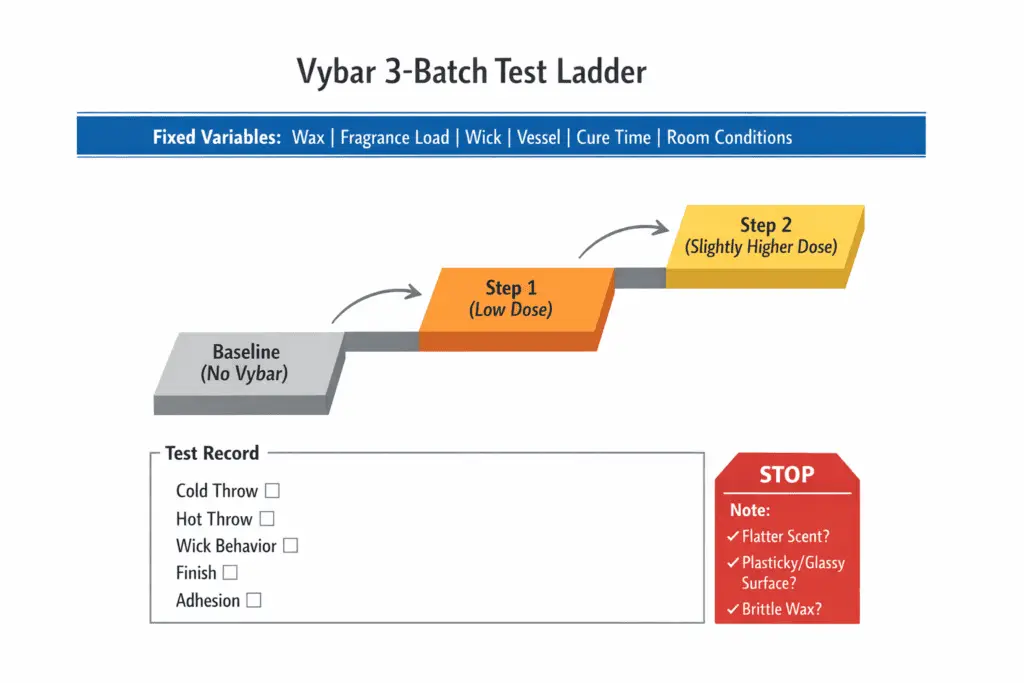
Method: keep the wax, fragrance load, wick, vessel, cure time, and room conditions the same, and change only the Vybar level from batch to batch.
- Baseline: pour your standard formula (no Vybar) and record cure time, room conditions, and burn notes.
- Step 1: repeat the same candle with a low test dose that matches the lower end of the supplier guidance for your exact Vybar grade and wax system.
- Step 2: repeat again with a slightly higher dose in the same system, keeping everything else identical.
What to record each time:
- Cold throw after your normal cure
- Hot throw during the first 2–3 burns
- Wick behavior (mushrooming, relight smoke), soot, and jar haze
- Finish (opacity, mottling, gloss), plus any oiling on the top or glass line
- Adhesion changes after 24 hours and after 7 days
Stop increasing the dose if scent becomes flatter, the surface looks plasticky/glassy, or the wax turns brittle—those are common “over-structured” signals.
What does Vybar do to hot and cold scent throw?
Vybar can steady hot throw (smell while burning) and cold throw (smell unlit) by reducing surface oiling and evening fragrance evaporation. In paraffin-heavy blends, a tighter crystal network can keep fragrance from pooling at the surface, so the melt pool releases it in a more consistent wave. For fair testing, keep wick, vessel, and fragrance load the same and follow your fragrance supplier’s usage guidance and normal safe burn-testing habits. If you want to compare other scent-focused options, see best candle additives for scent throw. If throw is still soft, troubleshoot one variable at a time before you change another ingredient.
These quick signals help you separate “helpful structuring” from “too much Vybar” during test burns:
- Helpful: the top looks drier and smoother, and the scent rises in a steady way as the candle warms.
- Too much: the wax can look plasticky or overly glossy, and the scent can feel flatter even though the candle is burning normally.
Cold throw is easiest to judge after your usual full cure, because a freshly set candle can smell “off” in either direction. Vybar tends to feel most noticeable with heavier fragrance styles that like to weep or smear on top (many gourmands and spices), while airy florals can seem muted if the blend ends up over-structured. Vybar can reduce sweating, but it doesn’t replace supplier usage guidance for fragrance oils, so treat supplier documentation as the ceiling. Once throw is under control, the next thing to watch is how Vybar changes the candle’s look—especially opacity and color saturation.
How Vybar changes opacity and color saturation
Vybar can raise opacity (less see-through wax) and deepen color saturation (richer dye look) by changing how wax crystals scatter light. In many paraffin blends, that shows up as cleaner whites, less translucent edges, and a more even “body color” from top to sidewall.
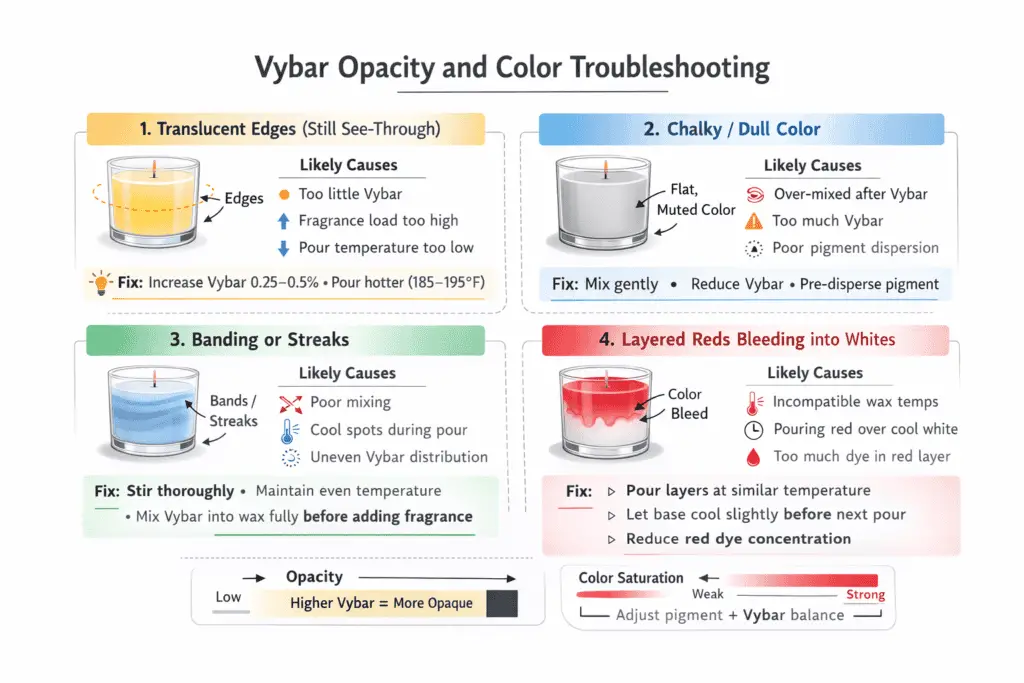
Without enough structure, you get the antonym effect: a glassier, more translucent look that makes color seem thinner. Results improve fastest when the dye system already fits the wax. If the real problem is yellowing or sun fade, Vybar won’t solve it alone, so handle that separately with preventing candle discoloration with UV additives.
Use this short checklist to diagnose why a candle still looks see-through even after adding Vybar:
- If the edges are translucent: the wax system may be too soft for the goal, or the cooling conditions may be too warm/uneven.
- If the color looks chalky: the dye may be overdone for the new opacity level, or the formula may be over-structured.
- If you see banding or streaks: the dye didn’t disperse evenly (often timing, mixing, or temperature), not an “opacity” issue.
- If layered reds bleed into whites: it’s usually dye family plus fragrance polarity and pour timing, even if the base wax looks more opaque.
After you like the visual finish, the next question is whether Vybar is actually helping the wax hold fragrance oil uniformly without sweating.
What Vybar does for oil binding and fragrance load tolerance
Vybar can reduce surface oiling in paraffin-heavy candles by helping fragrance oil stay distributed in the wax, but it does not replace supplier fragrance limits. In paraffin-dominant systems, the wax network tightens so liquid oil has fewer easy paths to migrate to the top or glass line. In soy-heavy blends, the benefit can be inconsistent, so temperature control, mixing, and wick choice may matter more than the additive. Pick your fragrance within supplier guidance so you’re not using Vybar to prop up an over-limit formula. If your candle suddenly smells flatter after adding it, stop changing variables and re-test because overdosing can over-structure the wax and mute lighter notes.
Here’s a simple test-batch log format you can use to spot oil seep and keep decisions grounded:
| wax_system | FO_pct | vybar_pct | oil_seep_incidence_pct | cure_days |
|---|---|---|---|---|
| paraffin blend | 8 | record actual % | record % | 7 |
| paraffin blend | 10 | record actual % | record % | 7 |
| paraffin blend | 10 | record actual % | record % | 7 |
Method: make 3–4 small jars per row, cure the same number of days, then check for visible oiling on the top and at the glass line at the same room temperature. If you change one thing (FO% or Vybar%), keep everything else fixed: wax, wick series, vessel, pour temp, and cooling location.
A common r/candlemaking question is whether “10% FO is realistic with Vybar in paraffin jars.” The honest answer is that it depends on the specific oil, wax, and process—and the only reliable way to know is to log oiling and burn performance together, because a dry-looking top isn’t helpful if the burn gets smoky or the throw drops.
How Vybar affects wax texture and surface finish (gloss, mottling)
In paraffin pillars and paraffin-leaning blends, Vybar can reduce mottling and create a glossier, more porcelain-like finish, but pour temperature and cooling rate still control most surface outcomes. Mottling is the patchy crystal pattern on pillar sides, pits are small surface voids, and ring lines are visible bands that often show up when cooling is uneven. Vybar shifts crystal growth and shrink behavior, which can smooth the surface when the candle cools steadily.
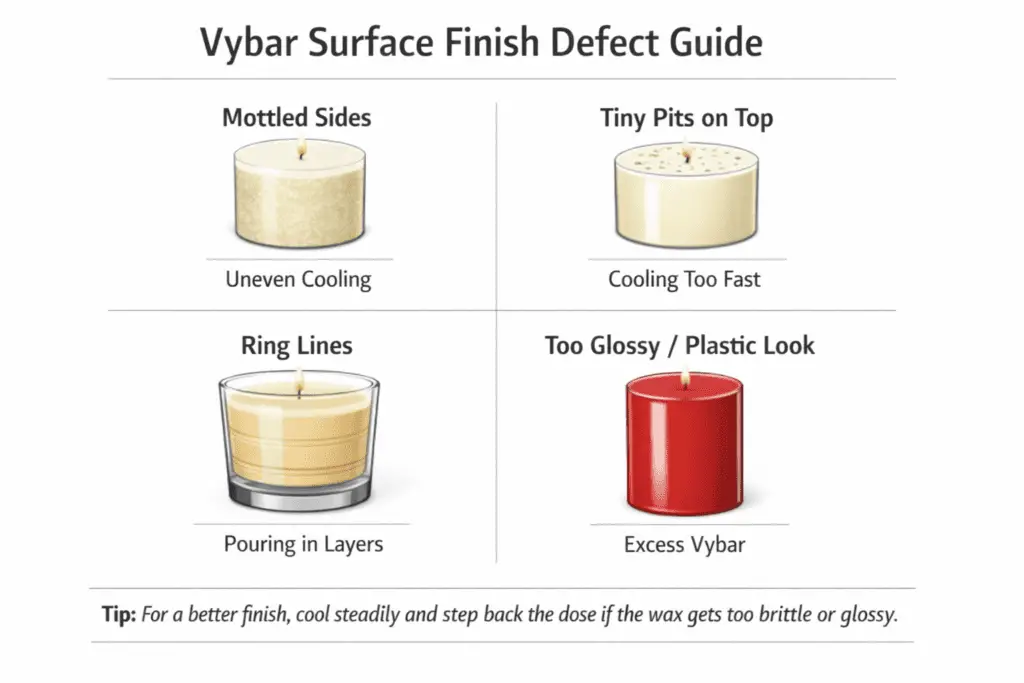
Quick defect gallery (symptom → most likely cause):
- Mottled sides → cooling too fast, high fragrance load, or wax that mottles easily
- Tiny pits on top → poured too cool, surface disturbed while setting, or trapped air from over-stirring
- Ring lines → temperature swings during set-up or moving the mold/jar mid-cool
- Overly glassy/plastic look → too much additive for the wax system
Practical tuning tends to work better than chasing a single “perfect” pour temperature: pre-warm the work area if it’s cold, avoid drafts, and keep cooling conditions repeatable from batch to batch. If you see the finish getting brittle or too glossy, step back the dose slightly and retest—your goal is a stable crystal structure, not a hard plastic shell.
How Vybar influences wick mushrooming and soot
Vybar can shift melt-pool viscosity enough to change wick mushrooming or soot in some candles, but wick size, fragrance load, and airflow still control most of the result. Treat wick changes after adding Vybar as a re-test signal, not as proof that the additive is the main cause.
Keep the check narrow: compare the same candle with and without Vybar, and if wick behavior is still unstable, troubleshoot the wick family and size first or run a fuller A/B burn check before you change another ingredient.
Steps to dose Vybar by wax type (paraffin, soy, blends)
Start with the low end of the supplier guidance for the exact Vybar grade and wax system you are using, then adjust with burn tests; paraffin-heavy systems are where Vybar is most at home, while soy-heavy blends often show smaller or inconsistent benefits.
Method: treat Vybar as a percent-by-weight ingredient, weigh it on a scale that reads 0.01 g, and use the technical sheet for the exact grade you bought as the controlling reference. A simple conversion keeps you honest: vybar_grams = batch_mass_g × target_pct/100 (for 2,000 g at 0.2%, that is 4 g).
Before you dose anything, confirm whether your base wax already includes Vybar or another additive package, because stacking additives on a pre-blended system can distort the test. Add Vybar at the supplier’s add window before fragrance, then keep the rest of the process unchanged.
| Wax system | How to start | What to watch |
|---|---|---|
| Paraffin containers | Start at the low end of the supplier’s range for your grade | Opacity, oiling, wick behavior, and relight smoke |
| Paraffin pillars/votives | Start low and increase only in small test steps | Hardness, brittleness, finish, and shape retention |
| Paraffin-forward blends | Test cautiously because response varies with the blend ratio | Finish, fragrance retention, and burn cleanliness |
| Soy-heavy blends | Treat as optional and test only if you have a specific reason | Whether the additive actually improves anything at all |
A clean setup process:
- Pick a target percent for the wax system and batch size, and write it down before you weigh anything.
- Weigh Vybar in grams from your percent target, then confirm the number once before adding to the pot.
- Heat wax to the supplier’s add window, add Vybar before fragrance, and stir until the wax looks uniformly clear.
- If you are combining additives, keep the order consistent and follow how to mix candle additives for optimal results instead of changing multiple variables at once.
- Pour, cure as you normally do, then re-test wick behavior and throw with the new formula.
Signs you overshot usually show up as muted throw, a plasticky-looking surface, or a candle that feels brittle; the fastest fix is dilution with more base wax, then a re-test with the same wick.
Vybar 103 vs Vybar 260: which one should you use?
Vybar 103 is usually associated with lower-melt, container-style paraffin systems, while Vybar 260 is more often associated with higher-melt paraffin systems such as pillars and votives; use the supplier grade sheet as the controlling reference for the exact product you bought.
As a shorthand, start with 103 when your main goal is container finish and fragrance distribution in paraffin-heavy jars, and start with 260 when your main goal is hardness and shape retention in higher-melt paraffin forms. Do not raise the dose to force the wrong grade to behave like the right one. If you need a broader additive comparison while a dedicated 103-vs-260 note is not live, see stearic acid vs Vybar and keep the supplier grade sheet as the deciding document for grade selection.
What to know about Vybar compatibility by wax system (paraffin, soy, beeswax blends)
Vybar is primarily built for paraffin systems; in soy-heavy or beeswax blends it can be inconsistent—sometimes doing little, sometimes making issues like brittleness or adhesion worse—so small A/B tests are the safest path.
- Paraffin containers and pillars: usually the most responsive place to test Vybar.
- Paraffin-forward blends: often worth testing, but results vary with the blend ratio.
- Soy-forward blends: benefits can be minor, cosmetic only, or negative.
- Beeswax blends: test cautiously, because the response can be unpredictable.
If you mainly need a side-by-side hardening comparison, see stearic acid vs Vybar. If you are testing any additive, keep the wax, vessel, wick, cure time, and room conditions the same so you can tell whether the additive helped or whether the result was just a process change.
Fixing issues from too much Vybar (weak throw, mottling, sinkholes)
If you added too much Vybar, the most reliable fix is dilution with plain wax, then re-testing wick and scent because overdosing can mute throw and push the finish toward brittle or plasticky. Start by reviewing the symptoms in your own batch notes so you know what changed before you correct the batch.
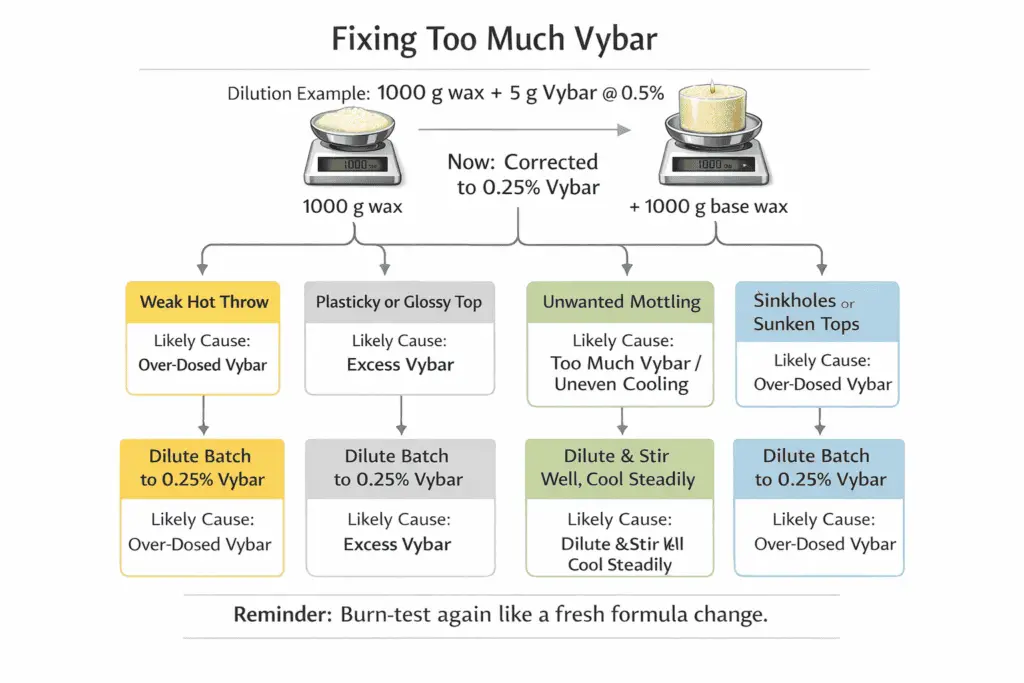
After dilution, re-test the candle like a fresh formula change because structure changes can shift fuel feed, surface set, and fragrance release. If the same symptom returns, review fixing additive problems in candle appearance and change one variable at a time.
A fast dilution calculation (so you don’t “double-fix” the batch):
- If you have 1,000 g wax that contains 5 g Vybar (0.5%) and you want 0.25%, you need a total of 2,000 g wax to make 5 g equal 0.25%.
- That means adding 1,000 g of the same base wax (no additional Vybar), then fully melting and mixing.
After you correct the batch, burn-test under controlled room conditions and keep the wick, vessel, cure time, and burn interval the same.
Is Vybar safe? Ingredient basics & handling
This section is about handling and SDS-based workshop practice, not a broad toxicology or legal conclusion: follow the supplier SDS, avoid breathing dust, keep storage clean and labeled, and document what you used in each batch.
For finished candles, route warning language and documentation to your warning language, labels, and documentation, and keep a version-controlled SDS copy with batch records.
Vybar FAQ (maker questions)
Can Vybar increase max fragrance load?
It can reduce surface oiling in some paraffin blends, but it does not change supplier limits; keep the ceiling with your supplier and use the fragrance load calculator if you need to check the percentage before another test batch.
Why did my throw drop after adding Vybar?
Over-structuring can flatten lighter notes; reduce the dose (or dilute a batch) and re-test with the same wick before you change FO%.
Do I need to re-wick after adding Vybar?
Often yes—any change in structure can shift melt-pool behavior, so re-check flame stability, mushrooming, and soot. If the flame is still unstable, see choose candle wick or run a fuller A/B burn check.
Will Vybar fix soy frosting?
No as a primary fix; wax choice and controlled cooling usually do more than additives, so review how to blend waxes before you add another structurant.
Vybar 103 vs 260—what’s the difference?
They are commonly used for different paraffin-heavy applications, so the choice depends on candle type and the supplier’s grade sheet. For a broader additive comparison while a dedicated 103-vs-260 note is not live, see stearic acid vs Vybar.
Can I use Vybar in soy-only candles?
You can test it, but results are often minor or inconsistent; treat it as optional and review how to blend waxes before you change additives.
How do I know I used too much Vybar?
Watch for muted throw, plasticky/glassy surfaces, or brittleness; the fastest correction is dilution and a controlled re-test.
Conclusion
Vybar is mainly a paraffin-focused additive for opacity, structure, and more even fragrance distribution. The useful zone is the lowest supplier-aligned test dose that improves those traits without flattening throw or making the wax brittle or plasticky.
Keep the wax, wick, vessel, cure time, and room conditions fixed, then test one change at a time.