

Neither mold type is universally better: one-piece molds usually fit simple, seamless, low-setup candles, while two-part molds fit detailed or undercut shapes that need split release. In this comparison, one-piece and two-part candle molds mean construction types: a single cavity mold versus a mold made from two separable halves. “Better” means better fit for shape complexity, release path, seam tolerance, leak risk, setup burden, cleanup, and maker skill level. This page does not compare mold materials, rank brands, list live prices, or give full troubleshooting steps for every mold problem.
What Are One-Piece and Two-Part Candle Molds?
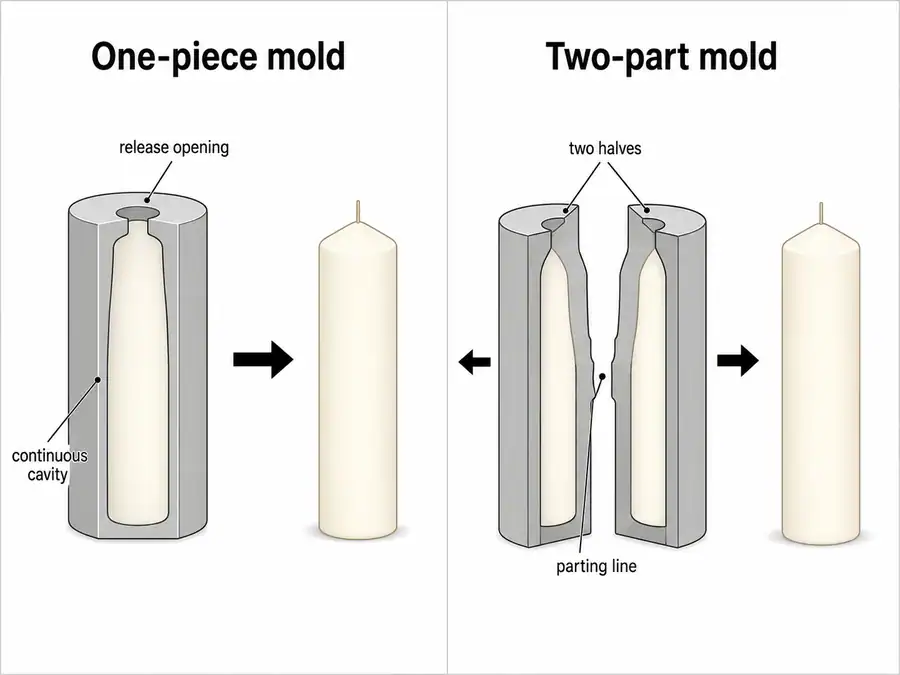
In this comparison, one-piece and two-part candle molds refer to construction: a single cavity mold versus a mold made from two separable halves.
A one-piece candle mold uses one continuous cavity, so the candle releases through one opening or by flexing the mold away from the candle. A two-part candle mold uses two matching halves that meet at a parting line, which is the join where the halves touch.
For the wider mold taxonomy, use the Candle Molds & Shapes guide. Here, the difference is narrower: one-piece construction usually has fewer assembly variables, while two-part construction usually gives more access around shapes that cannot pull straight out.
| Feature | One-piece candle mold | Two-part candle mold | Why it matters |
| Construction | One continuous cavity | Two separable halves | Construction controls release path, seam risk, and setup burden. |
| Release method | Pull, flex, or peel from one opening | Open the halves around the candle | Split release can protect shapes that would catch in one cavity. |
| Seam risk | Usually no parting line | May leave a visible parting line | Seam tolerance matters for gift, sale, and display candles. |
| Setup burden | Usually fewer parts to align | Requires matching, sealing, or clamping the halves | Extra assembly can add leak or misalignment risk. |
| Best-fit project type | Simple pillars, smooth shapes, low-setup batches | Detailed figures, sculptural forms, undercuts, fragile protrusions | The better mold is the one that matches the project’s shape and release path. |
Mold material can still affect flexibility, detail capture, and durability, but that is a separate decision. Use a candle mold material comparison when the real question is silicone versus metal, plastic, or another material rather than one-piece versus two-part construction.
One-piece molds are usually the cleaner starting point for simple, seamless projects. Two-part molds become more useful when the candle shape needs the mold to open around it instead of forcing the candle through one exit.
Which Mold Type Is Better for Detailed or Complex Candle Shapes?
Two-part candle molds are usually better for detailed or complex candle shapes when the finished candle cannot release cleanly from one cavity.
One-piece molds are usually better when the shape is simple enough to pull or flex out without damaging detail. A complex candle shape means the release path is difficult, not just that the design looks decorative.
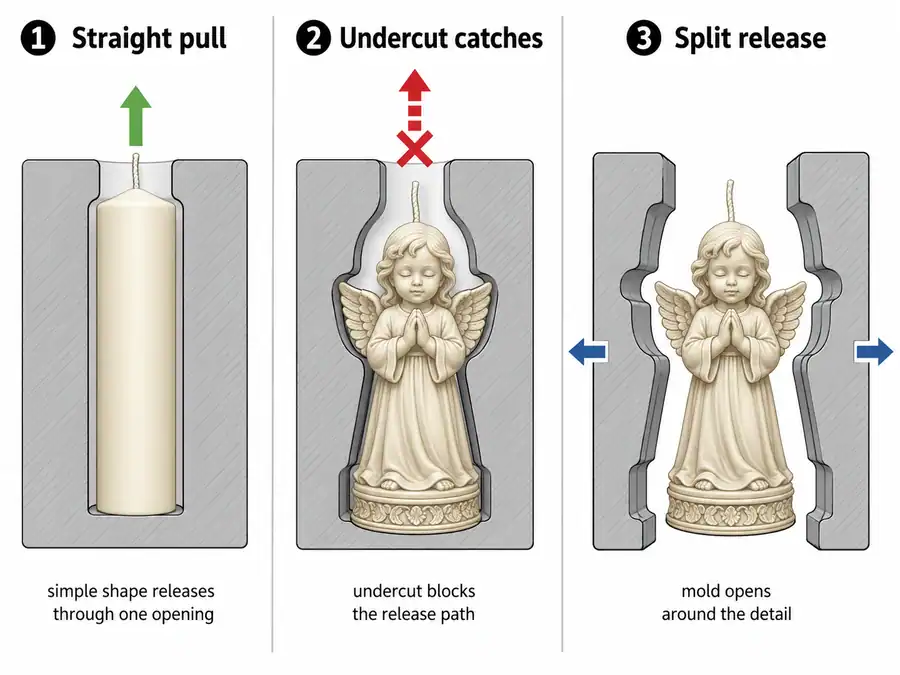
A shape becomes harder to release when it has undercuts, deep details, delicate protrusions, narrow release paths, or sculptural forms. In those cases, two-part construction can let the mold open around the candle instead of dragging the candle past fragile details.
| Candle shape or feature | Complexity level | Release concern | Better construction | Reason |
| Simple pillar | Low | Straight pull from one opening | One-piece mold | The candle shape does not need split access. |
| Smooth geometric shape | Low to moderate | Minor edge drag | One-piece mold | Smooth sides usually release without a parting line. |
| Flat-backed decorative candle | Moderate | Detail on one face, flat release side | One-piece mold | The flat back can reduce release resistance. |
| Detailed figurine | High | Small raised details may catch | Two-part mold | Split access can reduce damage during release. |
| Deep undercut shape | High | Candle may lock inside one cavity | Two-part mold | The mold halves can separate around the blocked area. |
| Delicate protrusions | High | Thin parts may bend, chip, or break | Two-part mold | Opening the mold can lower stress on fragile sections. |
Methods note: This matrix sorts shapes by release-path difficulty, not by artistic style, brand, or price. It treats mold construction as the decision variable and routes material flexibility to a separate material decision when material becomes the stronger cause.
There are exceptions. A flexible one-piece mold can handle moderate detail when the candle has a clear exit path, and not every detailed candle needs a two-part mold. When breakage during demolding becomes the main problem, use a stuck candle troubleshooting guide instead of turning this comparison into a full removal guide.
For broad mold categories, return to the Candle Molds & Shapes guide. For the next decision point, release path matters more than surface detail alone.
Which Mold Type Is Easier to Demold?
One-piece molds are easier to demold for simple candles, while two-part molds are easier when the candle shape would catch inside a single cavity.
Demolding depends on the release path, which is the route the finished candle must follow to leave the mold. A straight release path favors one-piece construction; a blocked or fragile release path favors two-part construction.
For simple pillars, tapers, cylinders, and smooth shapes, one-piece molds usually remove the candle with fewer steps. There are fewer joins to open, fewer parts to realign, and less assembly to manage before the next pour.
For detailed figures, undercuts, raised features, or shapes with narrow exits, two-part molds can be easier because the mold opens around the candle. That does not make every two-part mold easy, but it reduces the need to pull fragile details through one tight opening.
| Demolding problem | Likely construction factor | One-piece risk | Two-part risk | Where detailed fixes belong |
| Candle will not release from the mold | Release path is too narrow or blocked | Higher when the candle shape must pull through one opening | Lower if the halves open cleanly around the candle | Stuck candle troubleshooting |
| Raised detail breaks during removal | Detail catches against the cavity wall | Higher for fragile details and protrusions | Lower when split release supports the shape | Stuck candle troubleshooting |
| Candle edges drag or scrape | Shape rubs along the exit path | Moderate for tight one-piece cavities | Lower if halves separate evenly | Surface defect troubleshooting |
| Candle distorts during pull-out | Removal force is concentrated in one direction | Higher for soft, thin, or detailed shapes | Lower if the mold opens around weak areas | Demolding troubleshooting |
| Mold leaves marks after removal | Mold contact or release pressure affects the surface | Possible if the candle is dragged through the cavity | Possible if the parting line presses unevenly | Surface defect troubleshooting |
| Candle releases cleanly in one direction | Release path is open and simple | Low | Extra split construction may be unnecessary | No troubleshooting needed |
This table sorts demolding difficulty by release-path problems caused by mold construction. It does not diagnose wax formula, cooling time, mold material, or release-agent use. When the main task is fixing a stuck candle, that belongs in a troubleshooting guide rather than this construction comparison.
For a broad starter path, the Candle Molds & Shapes guide belongs above this comparison. For this page, the practical rule is simple: choose one-piece when the candle can come out cleanly in one direction, and choose two-part when the candle needs the mold to open around it.
Which Mold Type Gives a Cleaner Finish?
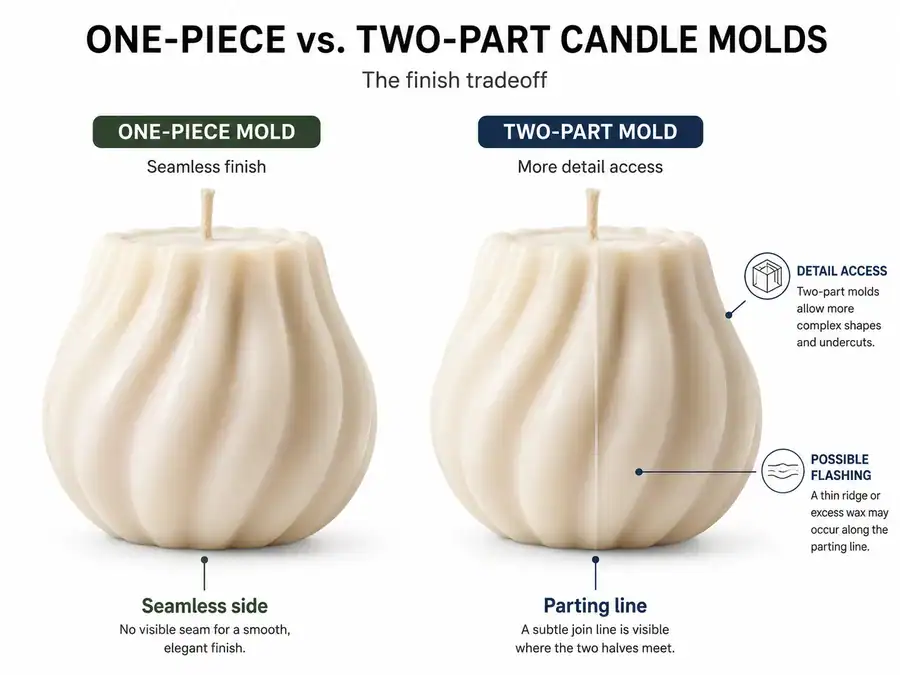
One-piece molds usually give a cleaner seamless finish, while two-part molds may trade a visible join for better access to detailed shapes.
A seam line is a visible mark where mold parts meet. One-piece construction usually avoids that parting line, so it often suits smooth gift candles, sale candles, and display pieces where surface appearance matters.
Two-part molds can still produce clean candles, but the finish depends more on alignment, clamping, sealing, and mold quality. If the halves shift or do not meet evenly, the candle may show a ridge, offset, or thin flashing along the join.
| Finish factor | One-piece mold | Two-part mold | Better fit |
| Seamless sides | Usually stronger | May show a parting line | One-piece mold |
| Fine sculptural detail | Limited by release path | Usually stronger | Two-part mold |
| Smooth display candle | Usually stronger | Possible, but join control matters | One-piece mold |
| Figure or novelty shape | May damage detail during release | Often better detail access | Two-part mold |
| Post-demold finishing work | Usually less | May need seam trimming or smoothing | One-piece mold |
| Shape realism | Good for simple forms | Better for shapes with depth on several sides | Two-part mold |
A cleaner finish means fewer visible joins after demolding. It does not mean better scent throw, safer burning, better wax quality, or a better mold material. If surface marks, frosting, bubbles, or dents become the main issue, that belongs in a candle surface-defect guide.
For material-specific finish questions, use a candle mold material comparison. Within this construction choice, one-piece molds usually win on seamlessness, while two-part molds win when shape detail is more important than avoiding every join.
What About Leaks, Alignment, and Assembly Risk?
One-piece molds usually have lower leak and alignment risk because there are fewer meeting points to seal before pouring.
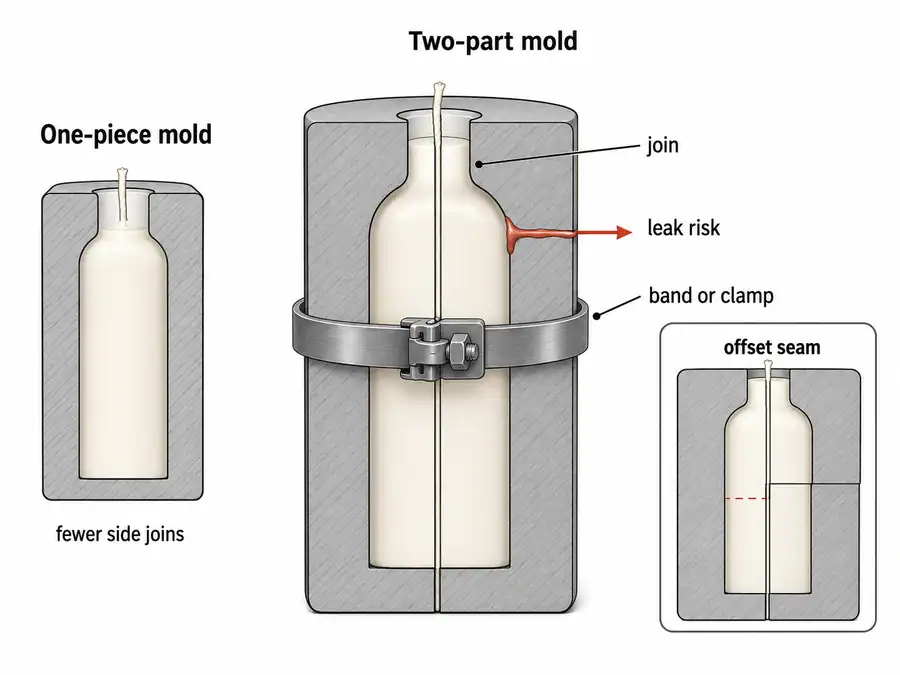
Two-part molds add assembly steps. The halves must meet correctly, stay aligned, and remain sealed while wax is poured and cools. If the join shifts, the candle can show a seam offset; if the seal fails, wax can leak from the parting line.
| Risk | More common with | Why it happens | Practical meaning |
| Wax leaking from the join | Two-part mold | The halves are not sealed tightly enough | More setup care is needed before pouring. |
| Offset seam | Two-part mold | The halves shift before or during the pour | The candle may need trimming or may look uneven. |
| Flashing along the seam | Two-part mold | Wax enters a tiny gap at the join | Extra finishing may be needed after demolding. |
| Shape distortion from pulling | One-piece mold | The candle must pass through one opening | Fragile shapes may bend or chip. |
| Setup mistake | Two-part mold | Clamps, bands, or seals add more variables | Beginners may need more patience. |
Methods note: This table compares construction-related failure points only: seams, alignment, clamping, sealing, and parting-line control. It does not give leak-repair steps or diagnose container leaks, wax temperature, or vessel failures.
Reliability here means fewer assembly failure points, not defect-free candles in every pour. A well-made two-part mold can work reliably when it is aligned and sealed correctly. A one-piece mold can still fail if the shape is too hard to release or the candle is removed too early.
Use a leaking mold troubleshooting guide when the main task is fixing a failed seal. In this comparison, leak risk matters only because construction changes how many joints, clamps, and alignment points the maker must control.
Which Mold Type Is Easier to Set Up, Clean, and Store?
One-piece molds are usually easier to set up, clean, and store because they have fewer parts and no matching halves to align.
Two-part molds often take more handling. They may need bands, clamps, keys, seams, or careful pairing of halves before pouring. After use, both halves and the join area may need cleaning so the mold closes correctly next time.
| Workflow task | Easier mold type | Reason |
| Fast setup | One-piece mold | Fewer parts need positioning before the pour. |
| Batch pouring simple shapes | One-piece mold | Repeating the same pour usually takes less handling. |
| Cleaning after use | Usually one-piece mold | There are fewer joins and edges to check. |
| Storing parts together | One-piece mold | There are no matched halves to keep paired. |
| Handling detailed shapes | Two-part mold | Extra setup may be worth it for better release access. |
| Repeating sculptural candles | Two-part mold | More handling can be acceptable when detail is the goal. |
Workflow burden is scored by construction-specific handling steps: assembly, alignment, pouring readiness, cleanup points, and part pairing. This does not replace a full candle mold cleaning or storage routine, and it does not compare silicone, metal, or plastic care.
Easier does not always mean faster total production. A two-part mold can take longer to prepare but save time if it prevents broken details, stuck candles, or rejected sculptural pieces. A one-piece mold can be faster for simple candles but frustrating if the design does not have a clean release path.
For full cleaning or storage routines, use a candle mold cleaning and storage guide. Here, setup and cleanup matter only as part of the construction tradeoff: one-piece molds reduce handling, while two-part molds add handling to make harder shapes possible.
Which Mold Type Is Better for Beginners?
One-piece candle molds are usually better for beginners because they have fewer assembly steps, fewer leak points, and a simpler release process for basic shapes.
Beginner-friendly means lower handling difficulty, not automatically cheaper, safer, or better for every candle design. For a new maker, the easiest mold is one that matches a simple shape and does not require careful clamping or seam control.
One-piece molds suit beginners when the project is a pillar, cube, round, taper, votive-style shape, or simple decorative form. The maker can focus on pouring, cooling, and demolding without managing matched halves.
Two-part molds suit beginners only when the candle design needs split release badly enough to justify the extra setup. A beginner can use one, but the mold should have clear alignment points, stable sealing, and a shape that is worth the added handling.
| Maker situation | Better starting choice | Why |
| First shaped candle project | One-piece mold | Fewer parts reduce setup mistakes. |
| Simple pillar or smooth shape | One-piece mold | The candle can release through one path. |
| Gift candles with smooth sides | One-piece mold | There is less risk of visible parting lines. |
| Detailed figure or novelty shape | Two-part mold | Split release can protect raised details. |
| Maker comfortable with clamps or bands | Two-part mold | Extra handling becomes manageable. |
| Batch practice with repeated pours | One-piece mold | Setup and cleanup stay simpler. |
Beginner fit is based on construction difficulty, release variables, seam tolerance, leak risk, and setup burden. It does not rank starter kits, prices, brands, waxes, wicks, or fragrance choices.
For a full starter mold list, use a beginner candle mold guide or the broader Candle Molds & Shapes page. This comparison stays on construction: one-piece molds reduce beginner friction, while two-part molds reward makers who need more shape access and can manage alignment.
One-Piece vs Two-Part Candle Molds: Which Should You Choose?
Choose a one-piece candle mold for simple, seamless, low-setup candles; choose a two-part candle mold for detailed, undercut, or fragile shapes that need split release.
The better mold is the one that fits the project’s release path, finish standard, assembly tolerance, and maker skill. A smooth candle that can pull out cleanly does not need extra mold halves. A sculptural candle that would catch or break may need them.
| Project or priority | Choose one-piece mold | Choose two-part mold | Better fit |
| Simple pillar candle | Yes | Rarely needed | One-piece mold |
| Smooth geometric candle | Yes | Only if shape traps inside mold | One-piece mold |
| Seamless gift or sale candle | Yes | Possible, but seam control matters | One-piece mold |
| Detailed figurine candle | Sometimes, if detail is shallow | Yes | Two-part mold |
| Deep undercuts | No, unless the mold flexes enough | Yes | Two-part mold |
| Fragile protrusions | Riskier during pull-out release | Better split access | Two-part mold |
| Fast setup and cleanup | Yes | More parts to manage | One-piece mold |
| Complex shape realism | Limited by release path | Stronger construction fit | Two-part mold |
| First-time maker practice | Yes | Only with clear assembly | One-piece mold |
| Repeating sculptural designs | Sometimes | Yes, if alignment is reliable | Two-part mold |
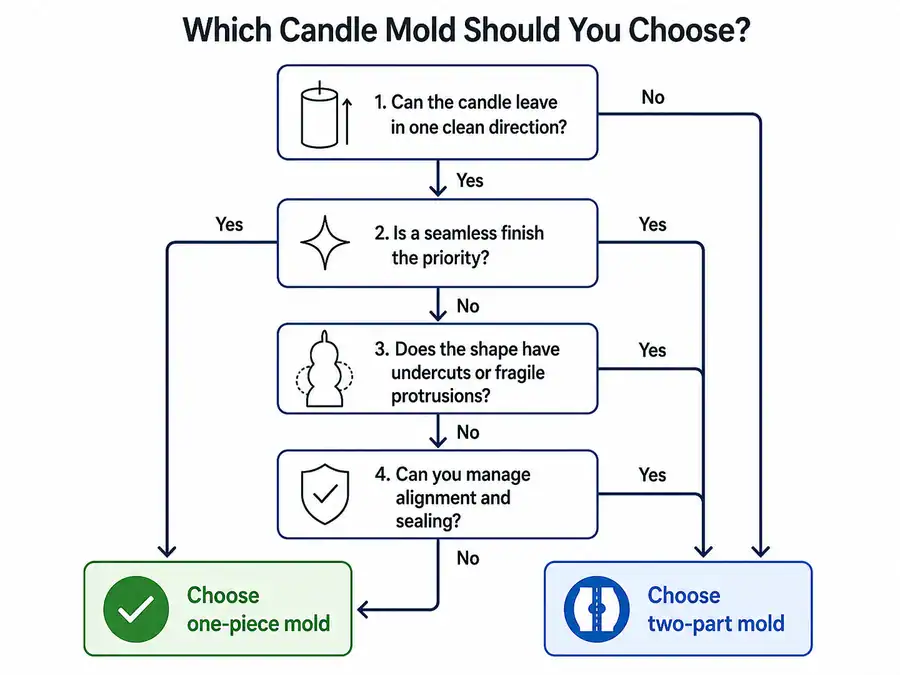
Methods note: This matrix prioritizes release path, shape complexity, seam tolerance, leak and alignment risk, handling burden, and maker skill level. It does not rank brands, compare live prices, or recommend specific retailers.
Use this rule of thumb: if the candle can leave the mold in one clean direction, start with one-piece construction. If the shape needs the mold to open around the candle, move to two-part construction.
Do not use this decision to answer every mold question. Material, wax type, fragrance load, mold cleaning, stuck candles, and leaking repairs belong to separate guides. In this article, the decision is only about whether one-piece or two-part construction gives the better project fit.
FAQs About One-Piece and Two-Part Candle Molds
These FAQ answers clarify the most common one-piece versus two-part candle mold decisions without turning the comparison into a material or troubleshooting guide.
Are one-piece candle molds better than two-part candle molds?
One-piece candle molds are better for simple, seamless candles that can release in one direction.
Two-part candle molds are better for detailed, undercut, or sculptural candles that need the mold to open around the shape. The better choice depends on the project, not on one mold type being best for every candle.
Do two-part candle molds always leave seam lines?
Two-part candle molds do not always leave obvious seam lines, but they have a higher seam risk because the halves meet at a parting line.
Good alignment, tight sealing, and clean mold edges can reduce visible joins. One-piece molds usually have the advantage when a seamless surface is the main goal.
Are one-piece molds easier for beginners?
One-piece molds are usually easier for beginners because they have fewer parts to align, seal, clean, and store.
A beginner can still use a two-part mold, but the project should justify the extra handling. Detailed figures and shapes with undercuts are better reasons to accept that learning curve.
Which mold type is better for detailed candle shapes?
Two-part molds are usually better for detailed candle shapes when raised details, fragile edges, or undercuts would catch inside one cavity.
A one-piece mold can still work for shallow detail if the candle has a clear release path. The deciding factor is not decoration alone; it is whether the candle can leave the mold without damage.
Which mold type leaks less?
One-piece molds usually leak less because they have fewer joins and fewer assembly points.
Two-part molds can leak if the halves are not sealed or clamped correctly. That leak risk does not make two-part molds bad; it means they need more careful setup.
Which mold type should I buy first?
Buy a one-piece mold first if you want to make simple pillars, smooth shapes, or beginner-friendly candles with less setup.
Buy a two-part mold first only if your main project is a detailed figure, undercut shape, or sculptural candle that cannot release well from one cavity. For most new makers, one-piece construction is the lower-friction starting point.