

Wick mushrooming happens when a CD, ECO, or HTP wick feeds more fuel than the flame can burn, leaving a carbon cap that often shrinks with better sizing, formula tweaks, and trimming.
Use this page when the same wax, fragrance load, dye, container, trim length, and burn schedule still leave you unsure whether CD, ECO, or HTP is the better wick family. Here, better means the wick series gives a smaller stable cap, less visible soot, a steadier flame, and an acceptable melt pool in the same test setup.
A little carbon on the tip is normal, but a big black “lollipop” usually means the candle is over-fueled for the wick series and size. CD wicks tend to show chunkier caps in soft vegetable waxes when they’re slightly oversized, while ECO often forms a tighter cap and HTP may curl and shed carbon differently. The same jar can behave differently when you change wax blend, fragrance type, dye, or how long you burn between trims. With consistent test burns and notes, you can identify whether the pattern points to wick size, fuel load, or wick series.
What Wick Mushrooming Looks Like in CD, ECO & HTP Wicks
Candle wick mushrooming in CD, ECO, and HTP wicks appears as carbon build-up on the burning tip, but the useful diagnostic signal is how the cap behaves under the same burn conditions. In this comparison, cleaner means less visible soot, a smaller stable cap, steadier flame behavior, and acceptable melt pool performance in the same wax, fragrance load, and jar.
| Wick series | Typical mushrooming look after ~3–4 hours | Series-level clue | Soot risk clue | Usually “fine” vs needs attention |
| CD | Rounder cap, can look like a small bead on the tip | Chunkier cap in soft vegetable waxes can point to slight oversizing or high fuel delivery | Rim haze or soot appears when the flame is being over-fed | Fine if cap is small and stable; attention if cap grows fast or flakes |
| ECO | Smaller, tighter cap; often less dramatic looking | Tighter cap with the same jar can mean ECO is managing that fuel load better than CD | Smoke or rim haze still means the setup is not burning cleanly | Fine if it stays compact; attention if flame gets tall and smoky |
| HTP | Can look cleaner, but may still form a cap depending on formula | Curl and carbon shedding can change the cap pattern without fixing fuel overload | Smoke shows up when the size or formula still over-feeds the flame | Fine if flame stays steady; attention if cap forms with curl + soot |
A useful decision rule you can apply right away: if the cap is flaking and you have visible soot (or repeated wisps of smoke) by the 2–4 hour checkpoint, treat it as a mismatch and change one variable on purpose rather than continuing the same test.
A simple observation routine (so your notes actually compare)
A comparable observation routine checks the same wick-series, flame, cap, soot, and melt-pool signals at the same burn checkpoints.
- At 10–15 minutes: glance for an unusually tall flame or visible smoke (early red flag for “too much fuel”).
- At 60 minutes: confirm the melt pool looks normal for your vessel and the flame is not flickering heavily or leaning from airflow.
- At 2–4 hours: extinguish, let it cool, then inspect the tip—cap size, cap stability (firm vs crumbly), and any soot on the jar.
- Record the basics: wick series/size, wax, fragrance %, jar diameter, burn time, plus a quick photo.
Quick maintenance during testing (without jumping to big fixes yet)
- If the cap is small and stable and the flame stays steady, keep burning and log it—some mushrooming can be a normal “personality trait” in a series.
- If the cap is large, crumbly, or sooty, end the burn, cool fully, trim, and treat the combo as “needs adjustment” rather than ready for repeat production.
Why different wick series mushroom: mechanics behind CD, ECO & HTP
Mushrooming shows up when fuel delivery outpaces clean combustion, and wick design changes how aggressively a series feeds that fuel. A simple way to picture it is:
Wick → Melt pool fuel → Capillary feed rate → Flame oxygen access → Carbon cap (if feed rate > clean burn rate)
CD, ECO, and HTP differ in braid tension, curl behavior, and how the burning tip “self-trims,” which is why some makers feel like one series mushrooms “more” in the same jar. Some lines are described as self-trimming, but in practice that still depends on matching wax, fragrance load, and vessel geometry—so the “self-trim” effect can disappear if the wick is oversized or the fuel is unusually heavy. Rule of thumb: if the flame is too large and sooty, try a smaller size first; if you’re already near the smallest workable size for melt pool performance, it’s time to consider switching series rather than forcing the same one.
Why CD vs ECO vs HTP Wicks Mushroom: Wax Type, Fragrance Load & Jar Size
Across CD, ECO, and HTP, mushrooming is usually a fuel-balance problem: wax system, fragrance load, dye, and jar geometry determine how much fuel reaches the flame, while the wick series and size determine how fast it gets there. The most reliable comparison keeps the jar constant and changes one variable at a time—first wick size, then fuel load, then wick series.
CD: common triggers and what to try first
CD wicks often mushroom most in soft soy/parasoy jars when the wick is oversized for the jar and fragrance load, feeding more fuel than the flame can burn cleanly. So the question usually isn’t “Why does CD mushroom at all?”—it’s “Which variable is pushing this combo over the edge: wax softness, FO %, or vessel geometry?”
Example test scenario: a 3″ soy container with a higher fragrance load can look fine at first, then develop a thick cap by the 2–4 hour mark as the melt pool deepens and fuel delivery increases.
| Wax | Jar (type/diameter) | FO % | CD size (example) | Mushrooming result (after ~3–4 hours) | Next suggested test |
| Soy container wax | Straight-sided ~3″ | 10% | CD 18 | Cap grows quickly; some soot near rim | Test CD 16, keep all else identical |
| Soy container wax | Straight-sided ~3″ | 8% | CD 18 | Smaller cap; less smoke | Compare CD 18 vs CD 16 at same FO |
| Parasoy blend | Tumbler ~3.25″ | 9–10% | CD 20 | Cap + taller flame late in burn | Try one size down or test an alternative series |
| Soy-coco blend | Jar ~3″ | 10–12% | CD 16 | Cap varies by fragrance; some combos sooty | Reduce FO or swap fragrance, then re-check sizing |
| Paraffin-heavy blend | Jar ~3″ | 8–10% | CD 18 | Often steadier flame; smaller cap | Verify with repeat burns before scaling |
How the matrix was observed: run controlled burns with one variable changed at a time (same jar, same wax batch, same cure time, same room conditions), then score the cap and soot at a consistent checkpoint (commonly around 3–4 hours). Record jar diameter, FO %, wick series/size, and a photo each time; repeat at least two burns per combo to confirm the pattern.
The three CD drivers (and what they look like in real burns)
1) Wax type (how fast it “feeds” the flame)
Softer vegetable blends can deliver fuel very efficiently once the melt pool gets deep, which can make a borderline CD size start building carbon later in the burn. Paraffin-heavy blends often behave differently because the melt pool and fuel flow profile changes—so a CD size that mushrooms in one wax can look calmer in another.
2) Fragrance load (how “heavy” the fuel burns)
Higher FO % can push CD toward more carbon build-up, especially with fragrances that tend to burn “dirtier” in many makers’ experience. If the cap size jumps sharply when FO % rises, you’ve found a strong lever to test before assuming the wick line is the problem.
3) Jar diameter and height (oxygen + heat dynamics)
Wide containers can encourage a larger flame envelope, while tall or narrow vessels can change airflow and heat behavior around the flame. Either way, vessel geometry can make an “almost right” CD look overfed or under-oxygenated, which shows up as faster cap growth and soot.
A clear CD-first move: if you see a growing cap plus rim haze by the 2–4 hour checkpoint, test one CD size down before changing anything else. If the smaller wick fixes soot but can’t keep a stable melt pool, reduce the fuel load (fragrance/dye) before jumping back up in size.
ECO: common triggers and what to try first
ECO often looks less dramatic than CD in similar soft-wax jars, but it can still build a cap when the fragrance load or diameter pushes fuel delivery high. A common journey is: “CD mushrooms badly; ECO looks cleaner at the same diameter—but gets smoky again when FO climbs.” That’s a useful clue because it suggests the formula (or FO %) is a main driver, not just the wick line.
An ECO-first move: if ECO stays relatively clean at low-to-mid fragrance but caps or smokes when you raise FO or add dye, keep the jar and wick size constant and test a small reduction in fuel load (lower FO or remove dye) to confirm the cause. If you still see soot by the 2–4 hour checkpoint, test one size down in ECO before switching series.
HTP: common triggers and what to try first
HTP is often chosen as an alternative when makers want a cleaner cap and steadier flame, but it still has edge cases—especially when sized aggressively. When HTP improves mushrooming, the trade can be different flame movement or heat behavior, so the goal becomes a balanced test: acceptable cap size, acceptable soot, and acceptable melt pool performance in the same vessel.
An HTP-first move: if HTP reduces the cap but the flame becomes too active or the jar shows new hot spots, don’t assume “HTP is wrong”—assume the size is wrong. Test one adjacent size and re-check the same 2–4 hour checkpoint under still-air conditions.
When the wick series is the real variable
The wick series becomes the likely variable when two adjacent sizes in the same series repeat the same cap, soot, or flame-instability pattern under controlled conditions. If higher fragrance or dye load makes all tested series worse, the formula is the stronger suspect; if one series improves the cap but creates new heat or flame movement, test an adjacent size before rejecting that series.
Controlled CD vs ECO vs HTP Burn Test for Mushrooming
A fair CD vs ECO vs HTP mushrooming test changes the wick series while holding the wax, fragrance load, dye, jar, trim length, burn duration, cure time, and room airflow steady. The test should show whether the mushrooming pattern follows the wick family or follows the fuel load.
How to run a fair CD vs ECO vs HTP comparison burn
- Lock the formula. Use the same wax batch, fragrance percentage, dye/additives, and cure time for every comparison candle.
- Lock the vessel. Use the same jar diameter, jar shape, fill height, and test location.
- Lock the burn habit. Trim the wick the same way before each burn and compare results at the same 2–4 hour checkpoint.
- Change one wick variable. Compare one CD, ECO, or HTP candidate at a time instead of changing wick series and fuel load together.
- Repeat before deciding. Run at least two comparable burns before treating a cap pattern as reliable.
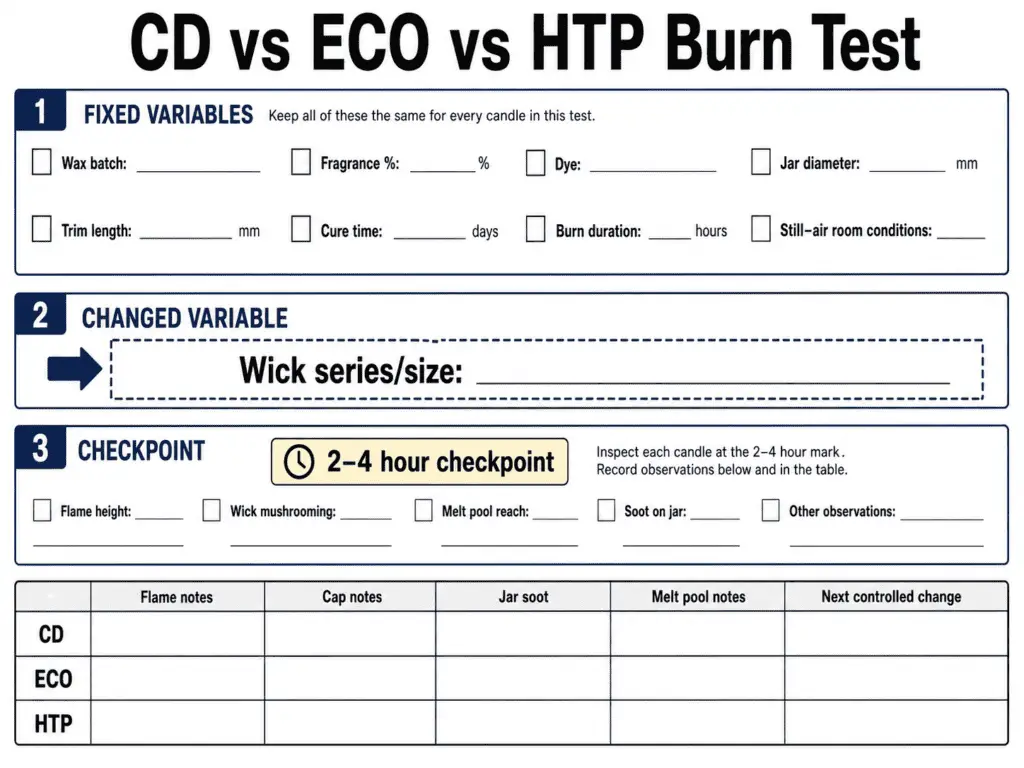
What to record after each burn
The test record should capture the variables that separate wick-size failure, formula overload, and wick-series mismatch.
| Date | Jar (ID/diameter) | Wax | Fragrance (% + name) | Wick (series/size) | Burn conditions (still air?) | Flame notes | Cap notes | Jar soot? | Melt pool notes | Next controlled change |
If the same mushrooming pattern appears across CD, ECO, and HTP, route the next test toward formula, dye, airflow, or burn duration instead of forcing another wick-family change.
How to Tell if Series-Based Mushrooming Is Normal or a Problem
Series-based mushrooming is normal only when the carbon cap stays small and stable, the flame stays steady, and the jar does not collect visible soot during comparable burns. It becomes a problem when the cap grows quickly, flakes, smokes, or appears with repeated flame instability.
Normal vs concerning cues during comparison burns
- Cap behavior:
- Acceptable during comparison burns: a small, firm cap that doesn’t keep growing dramatically.
- Concerning: a cap that balloons quickly, turns fragile, or sheds black flakes into the wax.
- Acceptable during comparison burns: a small, firm cap that doesn’t keep growing dramatically.
- Flame behavior:
- Acceptable during comparison burns: steady, upright flame with minimal dance.
- Concerning: frequent flicker, leaning hard to one side, or a flame that looks like it’s “searching” for air.
- Acceptable during comparison burns: steady, upright flame with minimal dance.
- Jar and air:
- Acceptable during comparison burns: light haze at most, no persistent soot line.
- Concerning: obvious soot on the rim/upper jar, or a smoky plume when you glance at the burn.
- Acceptable during comparison burns: light haze at most, no persistent soot line.
- Repeatability:
- Acceptable during comparison burns: similar results burn-to-burn with normal trimming.
- Concerning: the issue escalates each burn even when you keep conditions consistent.
- Acceptable during comparison burns: similar results burn-to-burn with normal trimming.
False alarms before changing wick series
Rule out airflow and burn-habit problems before treating CD, ECO, or HTP as the cause. A ceiling fan, open window, HVAC vent, skipped trim, or extra-long burn can create soot and cap growth that would make any wick series look worse than it is.
Use basic care checks as a boundary only: trim before each burn, test in still air, and stop a comparison burn early when soot, continuous smoking, flare-ups, or fast cap growth appears. Full trimming and candle-safety guidance belong on their own care pages.
When to Wick Down, Reduce Fuel Load, or Switch Wick Series
When mushrooming persists, use a fixed decision path: wick down within the same series first, reduce fragrance or dye when fuel load appears to drive the issue, then switch series when adjacent sizes repeat the same cap and soot pattern.
Default series-switch decision path
- Confirm it’s truly persistent.
Run at least two comparable burns with consistent trimming and still air. If the cap keeps growing fast and soot appears, treat it as a real mismatch. - Wick down within the same series first.
Oversizing is the most common root cause. Test one smaller size while keeping wax, fragrance, dye, jar, and burn schedule identical. - If the smaller size fixes caps but fails performance, adjust the formula.
If the smaller wick can’t maintain an even melt pool, don’t instantly wick back up. Consider a lighter fuel load (fragrance percentage or dye intensity) and re-test. - If two nearby sizes both misbehave, switch series.
Keep the jar and formula the same and trial two candidates from a different line, such as CD to ECO or CD to HTP. - Run a side-by-side comparison burn.
Compare two candidates under the same conditions and log cap stability, soot, flame steadiness, and melt pool behavior. The target is the best tested balance for that formula: smaller stable cap, less soot, steadier flame, and acceptable melt pool.
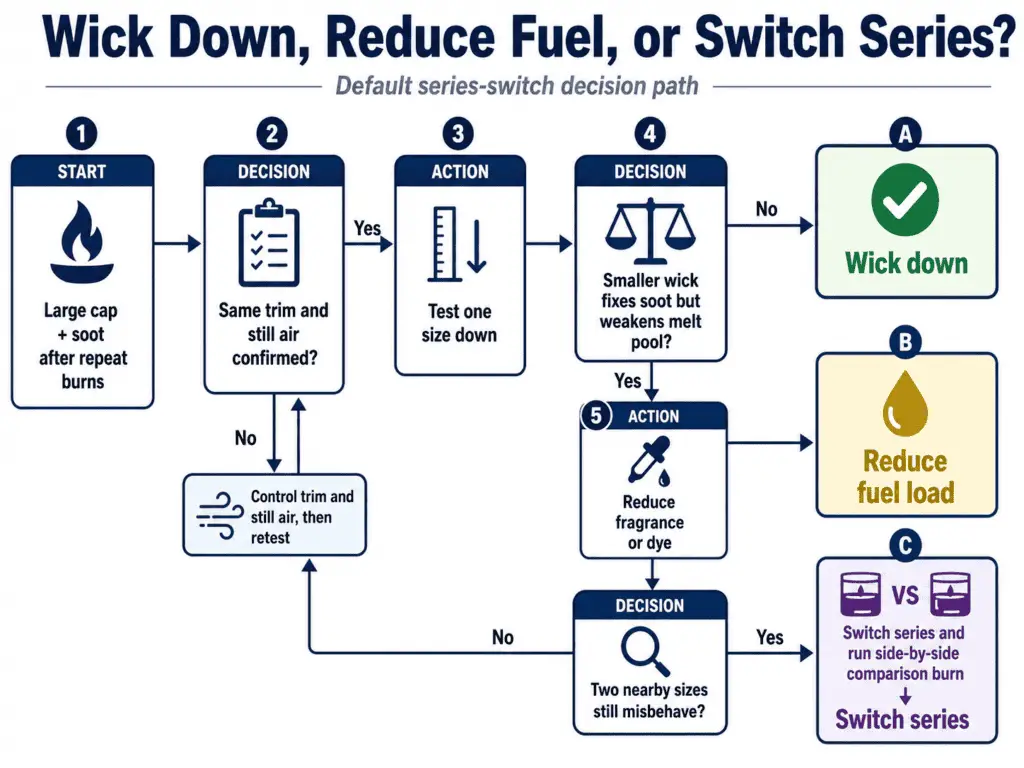
Example test path
- Starts with: CD 18 in a soy jar shows large caps and rim haze
- Next: tests CD 16 with the same wax and fragrance; caps shrink but melt pool is a bit weak
- Next: slightly reduces the fuel load and re-tests CD 16; improves steadiness
- If still unhappy: runs ECO 10 and HTP 93 as controlled alternatives in the same jar, then chooses the better balance of clean jar + stable flame
General mushrooming fixes, wick trimming, candle safety, and wick-buying choices should stay on their dedicated pages. This page should only summarize those topics when they help decide whether CD, ECO, or HTP is the better series for the same tested candle.