
To scent candles properly, use candle-safe fragrance, measure it by wax weight, add it at the right wax temperature, mix thoroughly, let the candle cure, and test cold and hot throw before scaling.
Candle fragrance and scenting is the controlled process of selecting, measuring, adding, mixing, curing, and testing fragrance in candle wax. This guide is for beginner and small-batch candle makers who want scent results they can repeat. Properly means measured, wax-compatible, temperature-aware, mixed, cured, tested, and recorded. It does not mean adding more oil, using drops, relying on bottle smell, or assuming one percentage works for every wax.
The basic process is:
- Choose a fragrance documented or intended for candle use.
- Measure fragrance oil from wax weight.
- Add fragrance at the right wax temperature.
- Mix until the fragrance is dispersed through the wax.
- Cure the candle before judging scent.
- Test cold throw and hot throw before scaling.
How Much Fragrance Oil Should You Use?
Use fragrance load as a percentage of wax weight, not jar size, drops, caps, spoonfuls, bottle smell, or finished candle weight.
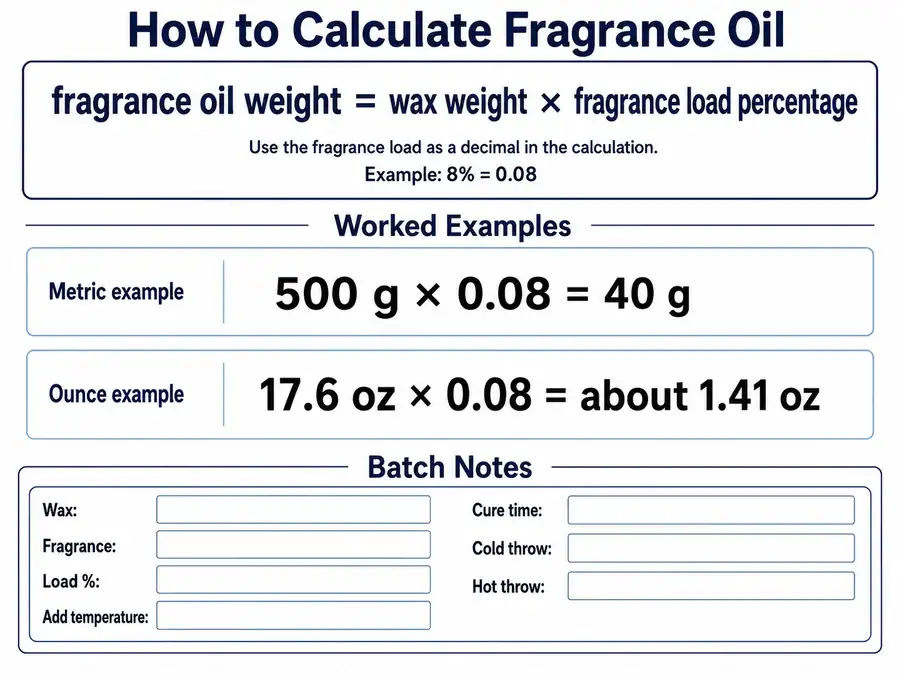
Fragrance load is the amount of fragrance oil compared with the weight of candle wax. The basic formula is:
fragrance oil weight = wax weight × fragrance load percentage
For example, 500 g of wax at 8% fragrance load needs 40 g of fragrance oil.
500 g × 0.08 = 40 g
In ounces, 17.6 oz of wax at 8% fragrance load needs about 1.41 oz of fragrance oil.
The same formula works for any batch size as long as wax weight and fragrance percentage are known. Start with wax weight, choose a test percentage within the wax and fragrance guidance, then record the result.
This article uses fragrance load relative to wax weight, so keep that method separate from finished-candle-weight or total-blend calculations when you compare recipe records.
| Planner input | What to enter | Example |
|---|---|---|
| Wax weight | Weight of wax before fragrance | 500 g / 17.6 oz |
| Test fragrance load | Percentage approved for your wax and fragrance | 8% |
| Formula | Wax weight × 0.08 | 500 g × 0.08 |
| Fragrance oil amount | Amount to weigh | 40 g / about 1.41 oz |
| Batch note | What to record | wax, fragrance, load %, add temperature, cure time, cold throw, hot throw |
Method note: treat the percentage as a test setting, not a promise of scent strength. A candle scented at a lower load can outperform a higher-load candle if the wax, wick, add temperature, mixing, and cure time fit the fragrance.
A simple test ladder works better than guessing:
| Test batch | What changes | What stays the same | What you learn |
|---|---|---|---|
| Batch A | Lower approved fragrance load | same wax, wick, jar, fragrance, cure time | baseline scent and burn behavior |
| Batch B | Middle approved fragrance load | same wax, wick, jar, fragrance, cure time | whether scent improves cleanly |
| Batch C | Higher approved fragrance load | same wax, wick, jar, fragrance, cure time | whether added oil creates problems |
Do not compare different fragrances, waxes, jars, and wicks at the same time. That hides the real cause of weak scent, sweating, poor tops, or unstable burn behavior.
Keep the wax weight, fragrance weight, load percentage, add temperature, mixing time, cure time, and scent-test notes in one place so the next test has a clear comparison.
Measure Fragrance by Weight, Not Drops
Measure fragrance oil by weight because fragrance load is based on wax weight, and drops do not give a repeatable candle formula.
Drops change by bottle opening, oil thickness, temperature, and pour speed. Weight gives the same amount each time, so the candle fragrance can be repeated, compared, and adjusted.
Use this process for each test batch:
- Weigh the wax before melting.
- Choose a supplier-approved fragrance load for the test.
- Calculate fragrance oil weight from the wax weight.
- Weigh the fragrance oil in grams or ounces.
- Add it at the wax-appropriate temperature.
- Record the amount before pouring.
A process error often starts with “just a little more.” A few extra drops may look harmless, but they break the formula because the real fragrance load is no longer known. If the candle later smells weak, sweats, burns poorly, or performs well, you cannot repeat the result with confidence.
| Measurement method | Why it fails or works | Result |
|---|---|---|
| Drops | varies by oil, bottle, and pour speed | not repeatable |
| Spoonfuls | inaccurate for small batches | easy to overload |
| Bottle smell | measures scent strength in air, not wax performance | misleading |
| Weight | matches the fragrance-load formula | repeatable testing |
Use the scale reading as the value that makes the next test useful.
Treat Maximum Load as a Ceiling, Not a Target
Maximum fragrance load is a ceiling, not the amount every candle recipe should use.
Maximum fragrance load is the upper amount a wax or fragrance supplier allows for a recipe. A starting load is the first test amount, a target load is the amount that performs best after testing, and a maximum load is the upper boundary.
Use this decision rule:
| If the candle shows… | Do not assume… | Check first… |
|---|---|---|
| Weak cold throw | it needs the maximum load | cure time, wax type, fragrance choice |
| Weak hot throw | it needs more oil | wick, melt pool, vessel size, burn test |
| Sweating or oily surface | the scent is stronger | overload, poor wax fit, cooling conditions |
| Uneven scent between candles | the fragrance is bad | weighing, mixing, pour consistency |
| Poor burn behavior | the candle needs another scent | wick match, load level, wax limits |
More fragrance oil can make a candle worse. Too much oil can separate from wax, create sweating, affect burn behavior, or hide the real reason scent throw is weak.
Check both sides of the limit before increasing the load. The wax must be able to hold the fragrance amount, and the fragrance must be suitable for that use level. If the candle fails at a high load, check for overload, wax incompatibility, poor wick fit, poor cure timing, or testing error before increasing the percentage.
Blend within the total fragrance load: a blend divides the fragrance amount; it does not add extra full-dose oils. If a 500 g wax batch uses 40 g total fragrance, a two-oil blend might use 24 g of one oil and 16 g of another, not 40 g of each.
Keep blends within the total fragrance amount and test them the same way as a single-fragrance candle.
Match the Fragrance to Your Wax Type
Wax type changes how candle fragrance oil is held, released, cured, and tested.
Candle wax is the carrier that holds and releases fragrance. Proper scenting changes by wax type because soy, paraffin, coconut, beeswax, and blends can hold and release fragrance differently.
The same fragrance load, add temperature, and cure time may not work the same way in every wax.
| Wax type | Scenting behavior to watch | Practical decision |
|---|---|---|
| Soy wax | often needs planned cure time before judging scent | do not judge hot throw immediately after pouring |
| Paraffin wax | often releases scent readily, depending on blend and wick | still test load, wick, and burn behavior together |
| Coconut wax or coconut blends | often accepts fragrance well, but blend formulas vary | follow the wax supplier’s load and temperature notes |
| Beeswax | has its own natural aroma | test whether the added fragrance still reads clearly |
| Wax blends | behavior depends on the blend, not just the label name | treat the supplier sheet as the recipe boundary |
This table is a recipe-planning aid, not a wax ranking. A wax that works well for one fragrance may perform poorly with another fragrance, wick, vessel, or cure time.
Do not use one universal fragrance load for every wax. Proper scenting means adjusting the scenting plan to the chosen wax and blend, then testing cold throw and hot throw before scaling.
Choose Candle-Safe Fragrance Oil Before You Scent
Choose oils documented or intended for candle use rather than assuming any pleasant-smelling oil is suitable.
Fragrance oil is a scenting oil intended for candle making. Essential oil is a volatile plant extract that may not perform or qualify for candle use in a wax-and-wick candle.
Use the scent material that fits the candle system, not just the one that smells best from the bottle. A candle-safe fragrance source should mix into wax, stay within the approved use range, cure predictably, and burn with the chosen wick and vessel.
| Scent source | Candle-use fit | Main risk | Best use in this guide |
|---|---|---|---|
| Candle fragrance oil | usually made for wax-and-wick use | still needs supplier limits and testing | main beginner starting point |
| Essential oil | may work only when documented for candle use | weak scent, poor burn behavior, unsuitable use notes | test only with candle-use documentation |
| Diffuser oil | made for diffusion, not candle wax | wrong product purpose | do not assume candle-safe |
| Perfume oil | made for body fragrance or perfume use | may not suit wax or flame exposure | do not use unless documented for candles |
| Soap fragrance oil | made for soap or bath products | skin-safe does not equal candle-safe | check candle-use notes before using |
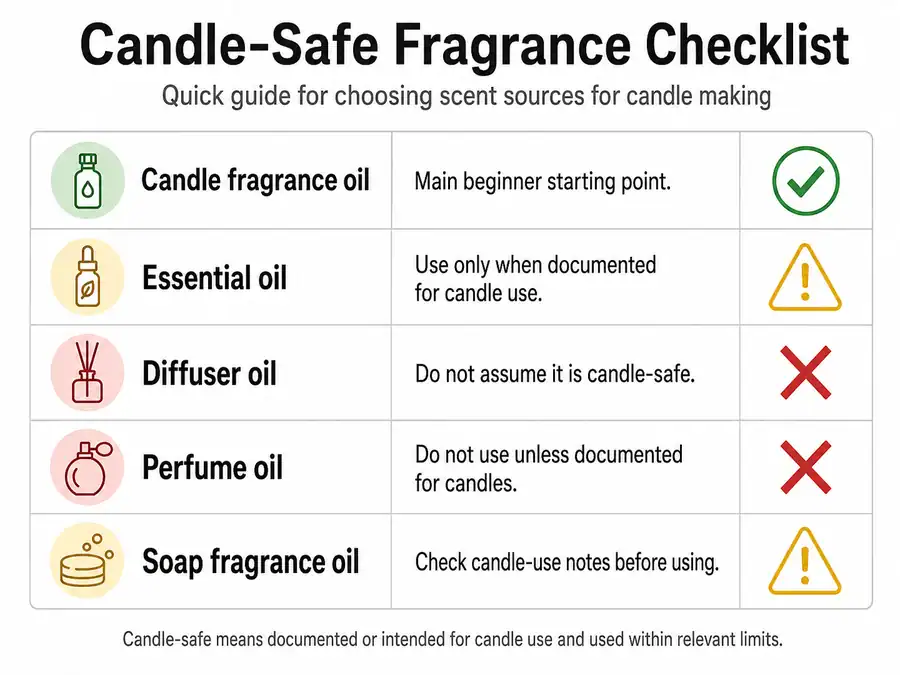
Safe has a narrow meaning here: intended for candle use, supported by supplier documentation, and used within relevant limits. It does not mean natural, therapeutic, non-toxic, skin-safe, allergen-free, or legally compliant everywhere.
Natural does not automatically mean safer for candles. Some essential oils smell strong in the bottle but fade, change character, or perform poorly after being mixed into wax. Some fragrance oils perform well, but they still need a supplier page, use guidance, and batch testing.
Check Supplier Guidance Before Using a Fragrance
A candle-safe fragrance is a scent product documented or intended for candle use and used within the relevant supplier and wax limits.
Safe does not mean natural, non-toxic, therapeutic, skin-safe, or legally compliant everywhere. It means the product belongs in a candle-making workflow and has enough supplier information to support a test batch.
Before adding any fragrance to wax, check these items:
| Supplier check | What to look for | Why it matters |
|---|---|---|
| Intended use | candle, wax, or candle-making use listed | confirms the product category |
| Wax compatibility notes | soy, paraffin, coconut blend, beeswax, or general wax use | helps match fragrance to carrier |
| Maximum use note | supplier’s upper use guidance for that fragrance | prevents treating scent strength as unlimited |
| Wax maximum load | wax supplier’s fragrance-holding limit | prevents overload even if the oil smells good |
| Safety Data Sheet (SDS) | handling, storage, and safety data | supports safer material handling |
| International Fragrance Association (IFRA) use guidance | fragrance-use documentation, when supplied | helps identify whether use guidance exists |
| Testing notes | cure, discoloration, acceleration, or performance comments | warns about recipe behavior before scaling |
Supplier max use and wax max load are not the same thing. The fragrance supplier may allow one limit, while the wax may hold less. Use the lower practical boundary until a small test batch proves the candle behaves well.
Do not interpret full IFRA categories, legal labels, toxicology, or regional compliance from this guide. Those questions require dedicated safety, legal, or compliance review beyond a practical candle-scenting article.
Add Fragrance at the Right Wax Temperature
Add fragrance oil when melted candle wax is within the wax or supplier range for fragrance integration.
Add temperature is the wax temperature at the moment fragrance oil is mixed into melted candle wax. Do not choose the add temperature by flashpoint alone, and do not assume one universal temperature fits every wax.
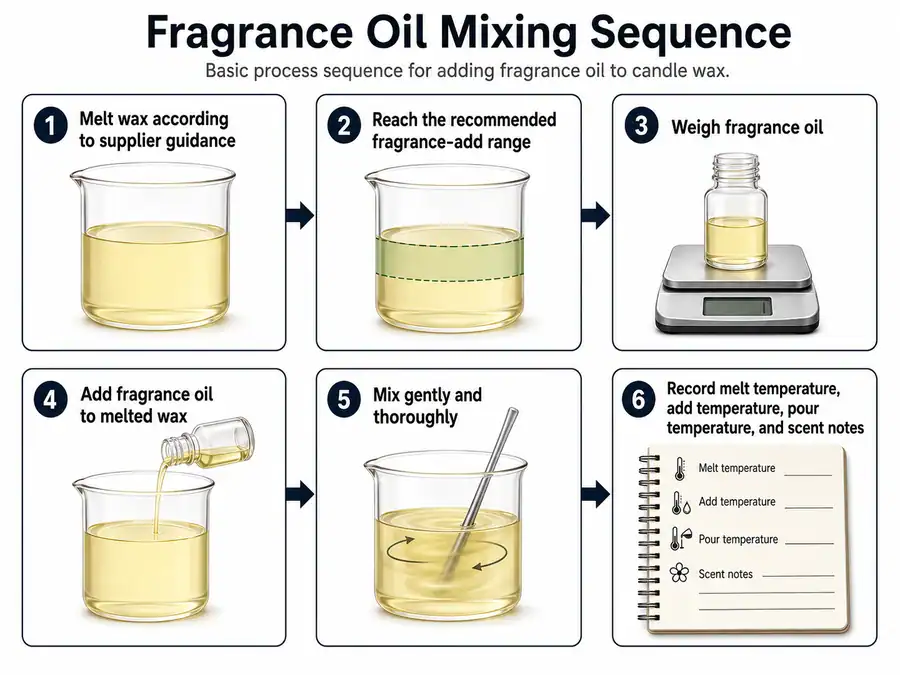
Use this process rule:
- Melt the wax according to the wax supplier’s guidance.
- Let the wax reach the recommended fragrance-add range.
- Weigh the fragrance oil before adding it.
- Add fragrance oil to the melted wax.
- Mix gently and thoroughly.
- Record melt temperature, add temperature, pour temperature, and any scent notes.
| Temperature term | What it means | What it controls |
|---|---|---|
| Melt temperature | temperature used to fully melt the wax | wax preparation |
| Add temperature | temperature when fragrance is mixed into wax | fragrance integration |
| Pour temperature | temperature when scented wax goes into the vessel | finish, cooling, and process consistency |
| Flashpoint | safety-related temperature listed under test conditions | handling information, not scent throw proof |
Flashpoint is not the same as add temperature.
Fragrance flashpoint is not the temperature for adding fragrance oil to candle wax. It is a safety and handling property, not the main rule for scent performance or wax integration.
A fragrance does not automatically burn off the moment wax is warmer than the listed flashpoint. Practical add temperature still depends on wax behavior, fragrance guidance, supplier handling notes, and your batch record.
Mix Slowly and Long Enough for Even Dispersion
Mix fragrance gently and thoroughly so it disperses evenly through melted wax.
Mixing technique is the controlled stirring process that spreads fragrance oil through melted wax. Pouring fragrance into wax is not the same as fully mixing it.
Use this small-batch checklist:
- Add the weighed fragrance oil at the chosen add temperature.
- Stir slowly enough to avoid whipping in air.
- Scrape the sides and bottom of the melting container.
- Keep the motion steady instead of aggressive.
- Record the stir time and any visible separation.
- Pour only after the batch looks uniform.
Under-mixing can make candles from the same batch smell different. One jar may receive more fragrance-rich wax, while another receives less, even though the formula looked correct on paper.
Aggressive stirring can create another problem. If the wax takes on air, the finished candle may show bubbles, surface flaws, or inconsistent texture. Gentle, complete mixing is the safer control point.
If uneven scent continues after correct weighing, add temperature, mixing, curing, and testing, review the scenting variables before adding more fragrance oil. Keep the stir time in your notes so the next test has a clear comparison.
Protect the Scent During Pouring and Cooling
Fragrance retention in candles depends on add temperature, mixing, pouring, cooling, curing, and test timing.
Fragrance retention is how well scent remains detectable after heating, mixing, pouring, cooling, curing, and testing. Scent fade can come from process variables, not only poor oil quality.
| Process point | What to control | What to record |
|---|---|---|
| Add temperature | fragrance mixed at the planned wax temperature | add temperature |
| Mixing | fragrance dispersed through the full wax batch | stir time and visible separation |
| Pouring | scented wax poured with the same method each test | pour temperature |
| Cooling | candles cooled in a stable area | room condition and surface result |
| Cure timing | candle judged after the chosen wait | cure day tested |
Do not blame every scent-loss problem on evaporation or bad oil. A candle can smell weak because the fragrance was added outside the wax’s working range, mixed unevenly, poured inconsistently, cooled in changing conditions, or tested too early.
Change one process variable at a time. If you change fragrance load, add temperature, pour temperature, vessel, wick, and cure time in the same test, the result cannot show which variable helped.
Use the batch record as the guardrail. Note the pour temperature, cooling conditions, cure day, cold throw, and hot throw before deciding whether the next test needs a temperature change, a longer cure, or another controlled adjustment.
Let the Candle Cure Before Judging the Scent
Wait for a planned cure period before judging cold throw or hot throw.
Cure time is the waiting period after pouring when wax and fragrance stabilize before the candle is judged or test burned. Cooling enough to handle is not the same as being ready for scent evaluation.
A candle can look finished after it sets, but the wax-and-fragrance system may still need time before cold throw and hot throw are reliable.
| Stage | What it means | What not to assume |
|---|---|---|
| Set time | wax has cooled and turned solid | scent is ready to judge |
| Cure time | wax and fragrance rest before testing | one universal wait fits every wax |
| Cold throw check | unlit scent is evaluated after waiting | jar smell on day one proves performance |
| Hot throw test | candle is burned after curing | early burn test gives final scent strength |
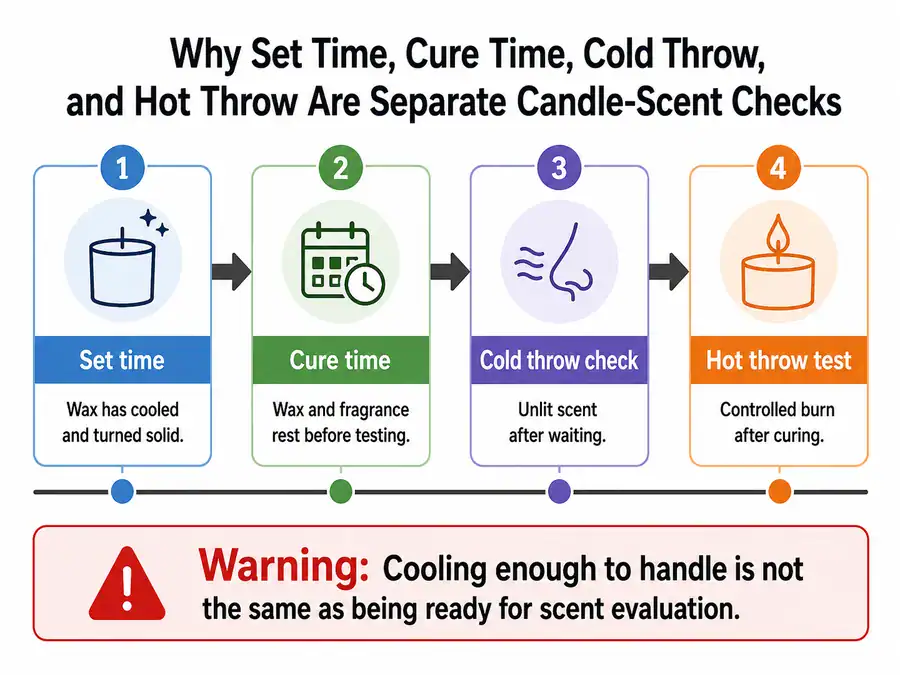
A practical test schedule is simple: record the pour date, note the first possible test day, then compare scent on the same cure day across test batches. If Batch A is tested after 24 hours and Batch B is tested after a week, the comparison is not clean.
Wax type and recipe affect cure expectations, so avoid universal claims. Soy and some blends often need more patience than faster-setting systems, but the useful rule here is narrower: test after a planned cure period, record the cure day, and compare like with like.
If scent improves after several days, the original problem may have been early testing rather than weak fragrance. If scent is still weak after a fair cure, review the formula, wick fit, vessel, room size, and burn-test conditions before increasing the fragrance load.
Judge Cold Throw and Hot Throw Separately
Cold throw is how a candle smells before burning, and hot throw is how it smells while burning.
Good candle scenting needs both checks. Jar smell can tell you whether the unlit candle has scent, but it cannot prove the candle will smell strong, balanced, or pleasant during a burn test.
| Scent check | When to judge it | What it can prove | What it cannot prove |
|---|---|---|---|
| Cold throw | after the candle has cured | how the unlit candle smells in the jar or nearby space | whether the candle will scent a room while burning |
| Hot throw | during a controlled burn test | how the candle performs with flame, melt pool, wick, vessel, and room size | whether the fragrance load alone is right |
| Bottle smell | before making the candle | whether you like the raw fragrance | how the oil will perform in wax |
| Early jar smell | right after cooling | whether fragrance is present | final scent performance after cure |
Neither cold throw nor hot throw matters more in every case. A gift candle, market-table candle, or retail jar needs good cold throw because people smell it before buying. A candle made for use in a room needs hot throw because the scent has to perform while burning.
A candle can smell strong cold and weak while burning because hot throw depends on more than fragrance load. Cure time, wick fit, melt pool, vessel size, room size, wax type, and fragrance choice can all affect the result.
Test hot throw after the planned cure period, not as soon as the wax sets. If the candle still smells weak during a fair burn test, review the full scenting and burn system before raising fragrance oil first.
Test Scent Throw Before You Scale the Recipe
Test scent throw under controlled conditions before making larger batches.
A scent throw test is a controlled cold and burn evaluation that records recipe, cure time, room setting, and scent strength. One sniff or one uncontrolled burn does not validate a candle recipe.
Proper scenting means the candle is checked in a repeatable way before you make a larger batch.
| Scent throw test card | What to record |
|---|---|
| Wax | type, brand, blend, and batch if known |
| Fragrance | name, supplier, and fragrance load |
| Fragrance amount | grams or ounces used |
| Add temperature | wax temperature when fragrance was mixed |
| Stir time | how long and how gently the batch was mixed |
| Pour temperature | temperature when wax entered the vessel |
| Cure day | number of days between pour and test |
| Vessel | jar size, diameter, and fill weight |
| Wick | wick series and size used in the test |
| Room | small, medium, large, open-plan, or closed room |
| Cold throw score | 1–5 score after cure |
| Hot throw score | 1–5 score during burn |
| Next action | keep, retest, lower load, adjust wick, change wax, or test longer cure |
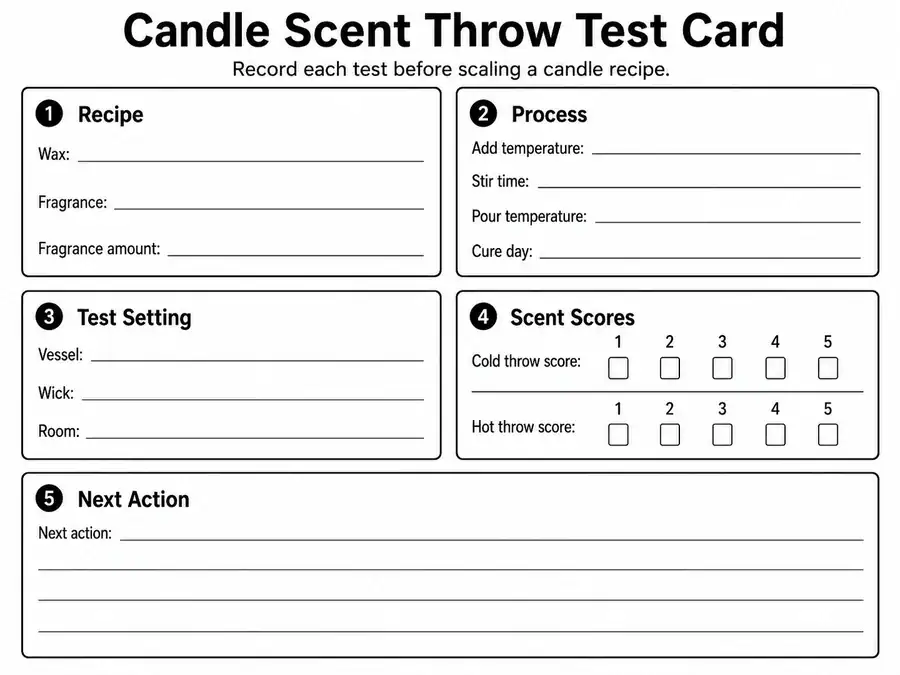
Method note: score cold throw and hot throw on the same scale each time. A simple 1–5 score is enough for small-batch testing when the same person, room type, cure day, and burn window are used.
Check the burn system before adding more fragrance: weak hot throw is not always a fragrance-load problem. A poor wick match, incomplete melt pool, oversized room, or wrong vessel can make a good scent formula seem weak.
Test in the intended vessel and room: a small candle may smell fine in a bathroom and weak in an open living area. Strong enough means strong enough for the vessel and room where the candle is meant to be used.
Do not turn one test into a full lab program. The goal is to make the next candle decision clear: keep the recipe, adjust one variable, or test a different candle-making variable.
Record the Variables That Affect Scent Throw
A candle batch record lets you repeat or improve a scent result instead of guessing what changed.
A candle batch record is a scent-performance note, not a legal, inventory, or production-compliance record. It should capture every variable that can change cold throw, hot throw, or repeatability.
| Scenting field | What to record |
|---|---|
| Wax type | soy, paraffin, coconut blend, beeswax, or blend name |
| Wax weight | amount of wax used before fragrance |
| Fragrance | scent name and supplier |
| Fragrance load | percentage used |
| Fragrance weight | grams or ounces added |
| Add temperature | wax temperature when fragrance was mixed in |
| Stir time | how long the fragrance was mixed |
| Pour temperature | record if you track it |
| Cure days | how long the candle rested before testing |
| Vessel | jar size, diameter, and fill weight |
| Wick | wick series and size |
| Room size | where the hot throw was tested |
| Cold throw | scent score before burning |
| Hot throw | scent score while burning |
| Next action | keep, retest, change one variable, or stop |
Repeatability fails when key variables are missing, so use the batch record to change one variable at a time and keep the next test comparable.
Adjust One Variable Before Scaling Up
Scale only after a small test batch gives repeatable cold and hot throw in the intended vessel.
Small-batch adjustment means testing fragrance variables in a limited batch before making larger or sellable quantities. It protects wax, fragrance oil, jars, wicks, and time because the recipe has to pass the scent test before the batch size grows.
Do not change all of these at once:
- fragrance load
- wick
- wax
- vessel
- add temperature
- cure time
- room condition
Use this one-variable adjustment ladder:
| Test round | Change one variable | Keep the same | Scale decision |
|---|---|---|---|
| Round 1 | fragrance load | wax, wick, vessel, cure day, room | compare scent strength and burn behavior |
| Round 2 | add temperature | fragrance load, wax, wick, vessel, cure day | check whether integration improves |
| Round 3 | cure time | formula, wick, vessel, test room | see whether scent improves after waiting |
| Round 4 | wick | formula, wax, vessel, cure day | test whether hot throw is a burn-system issue |
| Round 5 | vessel size | formula, wax, wick family, cure day | test scent in the intended candle format |
A scent recipe is ready to scale when the same formula gives repeatable cold throw and hot throw in the vessel and room where the candle is meant to be used. One promising cold sniff is not enough.
If scaling means selling, labels, safety files, or business operations, treat that as a separate safety, legal, and production-planning task rather than a scenting step.
Common Scenting Mistakes to Avoid
Most beginner scenting mistakes happen when fragrance is selected, measured, added, mixed, cured, or tested without a controlled process.
Beginner scenting mistakes are process errors. They do not automatically prove the fragrance oil is bad, the wax is poor, or the candle needs more oil.
| Mistake | Likely cause | Better fix |
|---|---|---|
| Guessing the fragrance amount | no wax-weight formula | calculate fragrance oil from wax weight |
| Measuring by drops | drops vary by oil and bottle | weigh fragrance in grams or ounces |
| Using non-candle oils | wrong product category | choose fragrance documented for candle use |
| Adding at the wrong temperature | add temperature confused with flashpoint | follow wax or supplier guidance |
| Stirring too quickly or briefly | fragrance not dispersed evenly | mix gently and record stir time |
| Judging scent right after pouring | set time confused with cure time | wait for the planned cure period |
| Testing only by jar smell | cold throw treated as full performance | test cold throw and hot throw separately |
| Adding more oil first | weak scent misread as low fragrance load | check wick, melt pool, vessel, room, and cure |
| Using the maximum load by default | maximum treated as the target | start lower, test, and stay within limits |
| Scaling after one good test | recipe not repeated yet | retest one variable before making more |
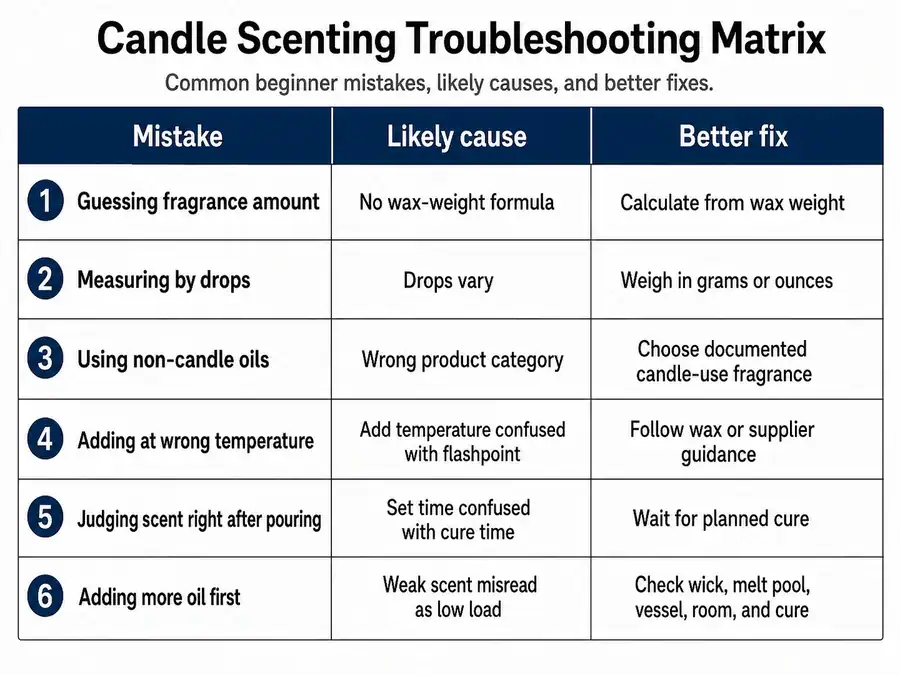
Use this final sequence before changing the recipe: choose candle-safe fragrance, weigh it, add it at the right wax temperature, mix it fully, cure the candle, test cold and hot throw, record the result, then adjust one variable.
Know What This Guide Does Not Replace
This guide covers practical candle-scenting safety checks, but it does not replace supplier documentation, SDS/IFRA review, labeling rules, or legal compliance advice.
Candle-safe means documented or intended for candle use and used within relevant wax and fragrance limits. It does not mean non-toxic, allergen-free, therapeutic, risk-free, skin-safe, or legally compliant everywhere.
Use this page for practical scenting decisions:
| Practical check | Use this guide for… | What needs separate review |
|---|---|---|
| Intended use | checking whether the scent product is meant for candles | interpreting legal product categories |
| Supplier notes | following wax and fragrance use guidance | resolving conflicts between suppliers |
| Fragrance limits | staying within wax and fragrance boundaries | building a supplier-by-supplier compliance database |
| SDS availability | knowing that safety paperwork should exist | interpreting toxicology or transport rules |
| IFRA or use notes | knowing when use guidance matters | interpreting IFRA categories in detail |
| Labeling | recognizing that selling adds requirements | jurisdiction-specific label wording |
| Claims | avoiding therapeutic, non-toxic, or risk-free claims | medical, legal, or compliance advice |
If you are making candles for personal testing, this section keeps safety language practical. If you are selling candles, changing markets, making label claims, or answering customer safety questions, get qualified safety, legal, or compliance guidance for that use case.
The safe ending point is simple: scent the candle with documented materials, stay within wax and fragrance limits, test the recipe, and treat legal or toxicology questions as separate from basic candle-scenting technique.