

A candle wick burn test validates one chosen wick family and size in one fixed candle setup across repeated controlled burns, because one good burn alone is not enough.
On this page, comparable repeated burns mean the same wick family and size burn in the same unchanged candle setup under stable conditions so one burn can be judged against the next.
Candle wicks need repeat-burn validation before you keep, resize, or replace a wick choice. The job here is to test whether one selected wick setup burns correctly under controlled conditions, not to cover full wick sizing, full troubleshooting, or deep measurement rules. Keep the wick family, wick size, wax, fragrance load, vessel, and room conditions fixed so the burn reflects wick performance instead of shifting variables. If you have not chosen a wick yet, handle sizing first, then use repeat burns to watch flame shape, melt progress, soot, and mushrooming before you decide what to do next.
How to Set Up a Candle Wick Burn Test That Produces Usable Results
A candle wick burn test setup locks one wick family and size into one fixed candle formula before the first burn.
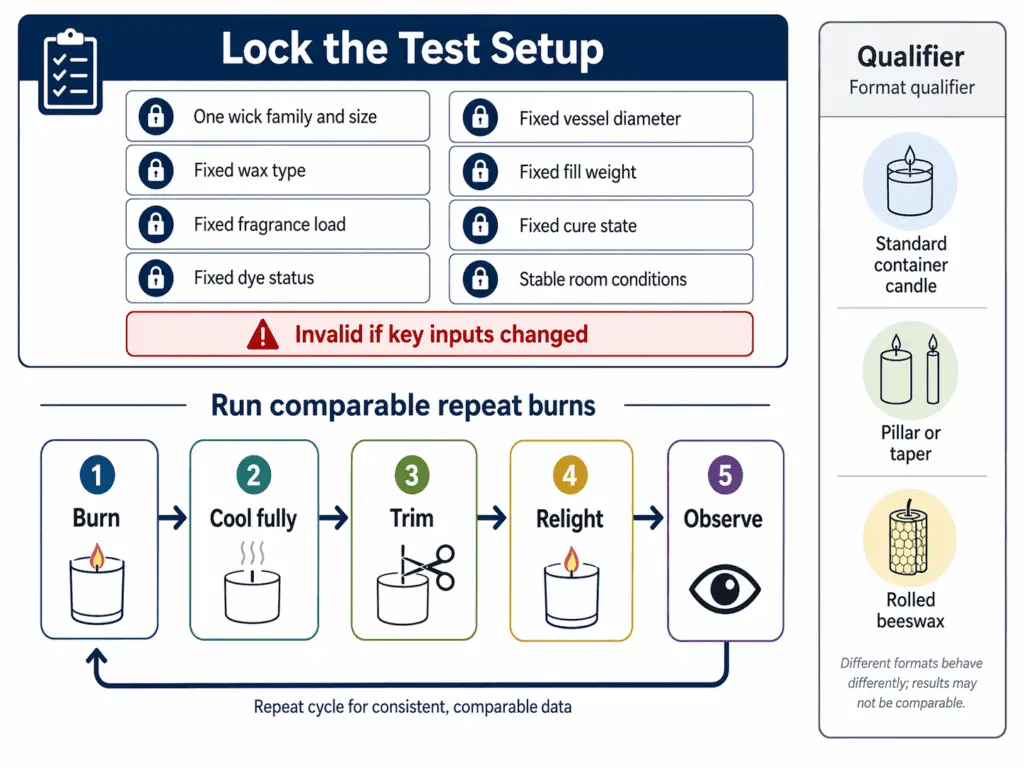
Set up the test by fixing the wick, wax, vessel, fragrance load, dye status, fill, cure state, and room conditions so later burns reflect wick behavior instead of shifting inputs. A candle wick burn test validates a chosen setup under controlled repeat burns. It is not full candle QA, and it is not the place to choose a wick from scratch. If you still need to size the wick before testing it, do that first. If later results point to a weak pattern, learn what makes a candle fail a burn test before changing several variables at once.
- Pick one wick family and one wick size for one candle setup.
- Keep the wax type, fragrance load, dye status, vessel diameter, fill weight, and cure state the same.
- Test one candidate at a time, not several wick or formula changes at once.
- Burn in a room with stable conditions, without drafts or other avoidable shifts.
- Treat the setup as invalid if key inputs changed before the first comparison burn.
Repeat-Burn Cadence, Trim, Cooldown, and Reset Rules
Repeat-burn control makes one wick comparable across several burns, not just one session.
One good burn is not enough, trimming is not optional, and different session lengths should not be compared as if they mean the same thing. The pattern you want is simple: burn, extinguish, cool fully, trim, relight, and observe again under the same setup. If you need exact numbers, measure flame height and jar temperature during burn tests on the dedicated page. If the repeated pattern keeps pointing the wrong way, see what makes a candle fail a burn test before you call the wick a pass.
For this page, a pattern is sufficient to judge only when repeated burns in the same unchanged setup keep pointing the same way instead of splitting between conflicting signals.
- Run the first burn and record what the flame and wax do.
- Extinguish the candle and let it cool fully.
- Trim the wick to the same trim length before the next relight.
- Keep the next burn session comparable to the prior one.
- Repeat the same cycle until you have a pattern, not a one-burn impression.
Format Exceptions That Change How to Read the Setup
These notes qualify the main setup rule for formats that do not behave like a standard container candle.
Container assumptions stay the default unless the format itself changes how the wick should be judged. Pillars, tapers, and rolled beeswax only qualify how you read early burn behavior on this page. If you need a full format path, choose the best wick for beeswax candles or size the wick for this candle format instead of stretching this page into format-specific sizing or build instructions.
- Standard container candle: Use the default fixed-setup method.
- Pillar or taper: Treat the shape change as a qualifier before judging the wick by container habits alone.
- Rolled beeswax: Do not assume poured-container behavior applies unchanged.
- Any format with unresolved sizing questions: Stop and move that decision off-page before burn testing.
What to Observe During Each Burn Test
Wick test observations are the visible signals that show how the selected candle wick behaves in one fixed setup during each burn cycle.
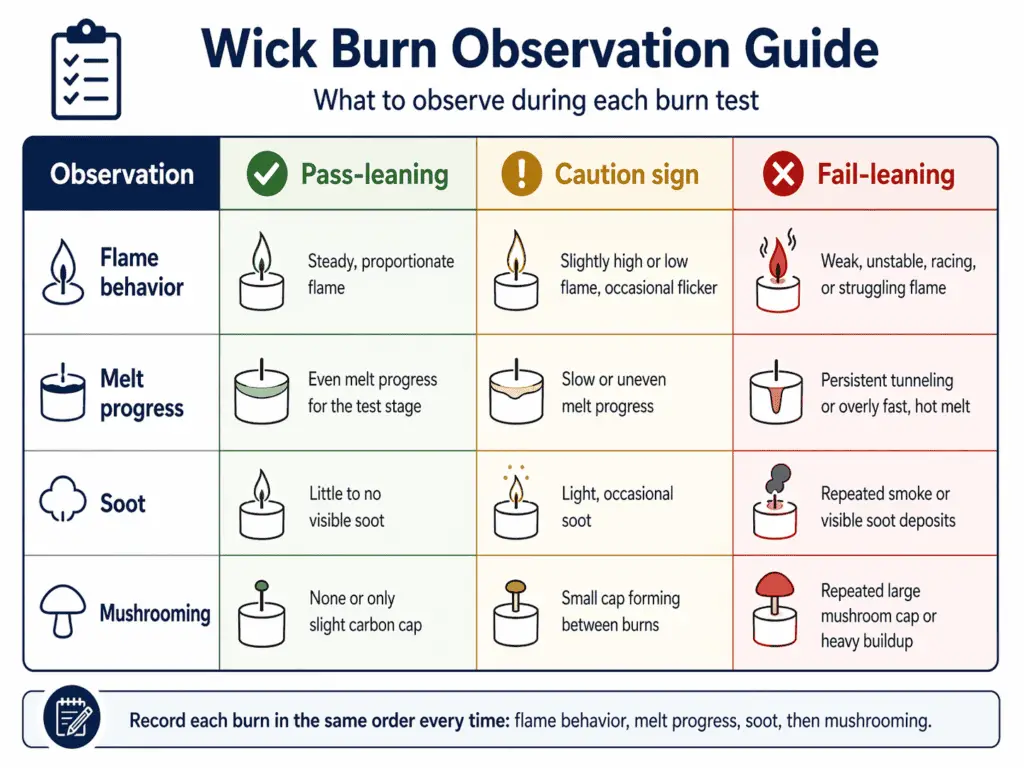
Watch flame behavior, melt progress, soot, and mushrooming as summary-level evidence for later pass-or-fail decisions. This observation layer is not full diagnosis and not a threshold page, so odd-looking behavior is not always an automatic fail by itself. For exact numbers, measure burn-test thresholds on the dedicated page, and for root-cause fixes after the observation pass, fix wick issues like mushrooming or drowning on the troubleshooting page.
Record each burn in the same order every time—flame behavior, melt progress, soot, then mushrooming—so each cycle can be compared fairly with the next.
- Flame behavior
Pass-leaning: The flame looks stable enough to compare from burn to burn.
Fail-leaning: The flame stays unusually erratic, very tall, or clearly unstable across repeated burns. - Melt progress
Pass-leaning: Wax melt develops in a way that can be compared fairly across repeated burns.
Caution sign: Early uneven melt on one burn does not settle the result by itself.
Fail-leaning: Repeated poor melt progress keeps showing the same weak pattern. - Soot
Pass-leaning: No visible soot, or only minor signs that do not keep building across burns.
Caution sign: Light soot once is a warning to watch, not an instant fail.
Fail-leaning: Visible soot repeats and becomes part of the pattern. - Mushrooming
Pass-leaning: Little or no tip buildup, or a minor sign that stays small and does not keep growing.
Caution sign: Slight mushrooming can be a warning sign rather than a final verdict.
Fail-leaning: Heavy mushrooming repeats and lines up with other weak signals.
The point here is to label each sign as an observation, a warning, or a likely fail indicator so the later decision is based on a repeated pattern instead of guesswork.
How to Tell Whether the Tested Wick Passed or Failed
A tested candle wick passes only when repeated controlled burns show a stable pattern in the same unchanged setup.
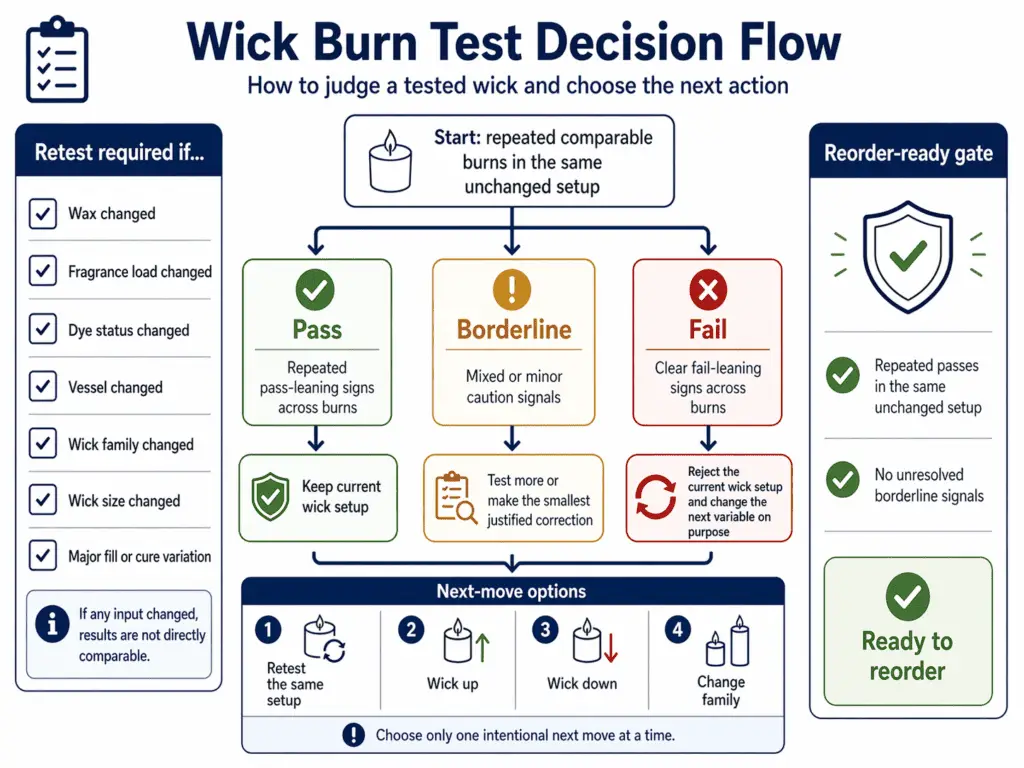
Candle wicks pass or fail here by repeated performance in the exact setup tested, not by one attractive melt pool or one dramatic warning sign. A pass means repeated comparable burns in the same unchanged setup support keeping the current wick family and size. A borderline result means repeated burns in the same unchanged setup stay mixed enough that you should retest or make the smallest justified correction to the wick setup.
A fail means repeated comparable burns in the same unchanged setup keep pointing away from the current wick family and size. For deeper cause, see what makes a candle fail a burn test. For symptom-level correction, fix wick issues after a failed test. If the setup is clearly mismatched, resize the wick when the setup is fundamentally off.
Method note: Judge the wick from repeated observations in the same unchanged setup. A full melt pool alone does not create a pass, and one odd signal alone does not always create a fail.
Wick Burn Test Decision Card
| Outcome | What Repeated Burns Show | Decision |
|---|---|---|
| Pass | The pattern stays acceptably consistent across repeat burns in the same unchanged setup | Keep the current wick setup |
| Borderline | The pattern is mixed, inconsistent, or promising but not settled | Test more or make the smallest justified correction |
| Fail | The repeated pattern keeps pointing the wrong way | Reject the current wick setup and change the next variable on purpose |
Use this as a decision check for the tested setup only, not as a universal approval for every future formula or vessel.
What to Change After a Failed or Borderline Result
After a failed or borderline wick test, make the smallest justified change that matches the repeated pattern.
The next move depends on the repeated burn pattern, not on one isolated symptom. When the repeated pattern points to a size issue, resize the wick for this setup. When the issue is clearly symptom-led, keep fix wick issues after a failed test in view. When the cause still is not clear, go back and see what makes a candle fail a burn test before stacking more changes on top of each other.
Method note: Start with the smallest justified correction first. A dramatic single burn can push you toward overcorrection, but the decision rule gives more weight to the repeated pattern.
| Repeated Pattern | Smallest Justified Next Move |
|---|---|
| The wick looks consistently underpowered for the setup | Wick up |
| The wick looks consistently overpowered for the setup | Wick down |
| Nearby size changes do not match the pattern well | Change family |
| The evidence is mixed and overcorrection risk is high | Retest the same setup before changing anything |
This ladder stays inside wick validation. If the whole setup is fundamentally mismatched, move the decision toward sizing rather than turning this page into a full wick-selection method.
When a Previous Wick Test Result No Longer Counts
A wick burn-test result stops counting when the core tested setup changes.
A wick test result applies only to the setup that was actually tested. Change the wax, fragrance load, dye, vessel, wick family, wick size, or other core setup inputs, and the old pass or fail is no longer reliable enough to reuse without checking again. When that happens, resize the wick after setup changes if the change reopened a sizing problem, and fix wick issues after the formula changed if the new setup created symptom-level behavior that now needs its own remedy.
Method note: Compare the current setup against the setup that produced the old result. If a core input changed, treat the old result as expired rather than trying to stretch it across a different candle.
Retest Required Checklist
- Wax changed
- Fragrance load changed
- Dye status changed
- Vessel changed
- Wick family changed
- Wick size changed
- Major fill or cure variation changed the setup
A small observation note is not the same as a setup change, but a real setup change breaks comparability and calls for a fresh test.
When a Passed Wick Is Ready to Reorder
A passed wick is ready to reorder only after repeated passes in the same unchanged setup.
Reorder-ready means the same wick family and size passed repeated controlled burns in the same unchanged setup, with no unresolved borderline pattern still hanging over the result. One promising burn is not enough. If the setup still looks marginal, resize the wick before reordering. If the setup changed after the pass, retest after setup changes before buying more of the same wick.
Method note: Reorder confidence here is a validation decision, not a vendor, pricing, or inventory decision. The question is whether the tested wick setup has enough repeat-pass evidence behind it, not whether it is the cheapest or best bulk-buy option.
Reorder Now vs Test More
| Reorder Now | Test More |
|---|---|
| Repeated pass pattern | Only one promising burn |
| Same unchanged setup | Setup changed later |
| No unresolved borderline signals | Mixed or drifting signals |
| The wick still fits the tested formula and vessel | The setup still looks marginal |
A wick can move out of reorder-ready status later if the tested setup changes or new failure signals appear.