

A candle jar holds the wax-only fill weight that fits to the planned fill line after headspace, not the nominal ounce label on the container. Estimate that fill weight from the jar’s usable internal space, the planned fill line, jar shape, and the wax-density assumption used in the calculation.
Candle jars are measured fill containers, not exact wax labels. On this page, jar size means usable internal fill capacity at the planned fill line after headspace, not the number in the product name or the brim-full volume. That keeps wax-only fill weight separate from vessel weight and stops common 8 oz and 10 oz labels from being treated as fixed wax amounts. Once the fill line is set, the estimate comes from inside diameter, usable fill height, jar shape, and the wax-density assumption you use.
Use this quick rule before you calculate:
- Nominal jar labels do not state a fixed wax-only fill weight.
- Straight-sided jars can be estimated from internal measurements and the fill-weight formula on this page.
- Tapered or shouldered jars should be verified with the water-and-scale method at the planned fill line.
What Candle Jar Size Actually Means for Wax Fill
Jar size is not the same as wax weight. For wax planning, use the jar’s usable fill capacity at the intended fill line, not the nominal ounce label.
A candle jar label is a size name for the container, not a fixed wax amount. For filling, use the internal space up to the planned finished fill line after headspace.
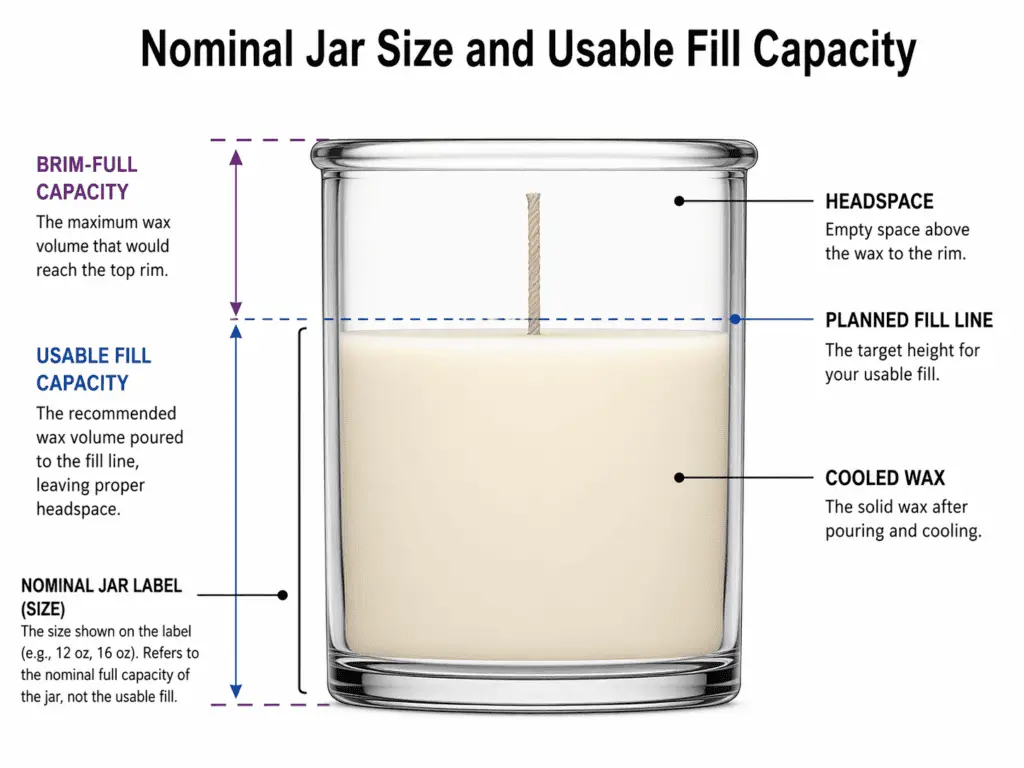
| Capacity term | What it means | Use it for wax planning? |
|---|---|---|
| Nominal jar label | The size name used to sell or describe the jar | No |
| Brim-full capacity | The jar filled to the rim with no empty top margin | No |
| Usable fill capacity | The internal space up to the planned finished fill line | Yes |
This distinction clears up a common problem with 8 oz and 10 oz jars. Two jars can share the same label and still hold different wax weights because the inside width, inside height, and fill line are not always the same. Diameter matters here only as a fill input, not as a wick-selection answer.
How Headspace Changes Usable Fill Capacity
Headspace is the empty space above the cooled wax surface. More headspace lowers usable fill height and lowers the amount of wax the jar will hold.
On this page, headspace means measured empty top margin, not a visual choice with no effect on the estimate. If a jar has 4.0 inches of inside height and you leave 0.5 inch of headspace, the usable fill height becomes 3.5 inches. If you leave 0.25 inch of headspace instead, the usable fill height becomes 3.75 inches.
Usable fill height = inner height − headspace
Method note: This example changes only headspace and keeps jar shape the same, so the difference comes from fill height alone.
Start with the planned fill line, not the full rim height. The worked examples later fit only when the jar shape, headspace, and wax assumption match your jar.
How to Measure a Candle Jar for Wax Fill Calculations
Measure the jar’s internal diameter and usable fill height, not its outer width or total rim height. Those internal measurements are the inputs used in the estimate.
| What to measure | What to use | What to avoid | Why it matters |
|---|---|---|---|
| Diameter | Inside diameter where the wax will sit | Outside jar width | Glass thickness changes the number |
| Height | Usable fill height from base to planned wax surface | Full rim height | Headspace must already be removed |
| Shape | Straight-sided, tapered, or shouldered | Hidden shape changes | Shape affects how well cylinder math fits |
Use this order:
- Set the planned fill line.
- Measure the inside diameter where the wax will sit.
- Measure the usable fill height from the base to the planned wax surface.
- Note whether the jar stays straight-sided through the fill zone.
- Keep all measurements in the same unit.
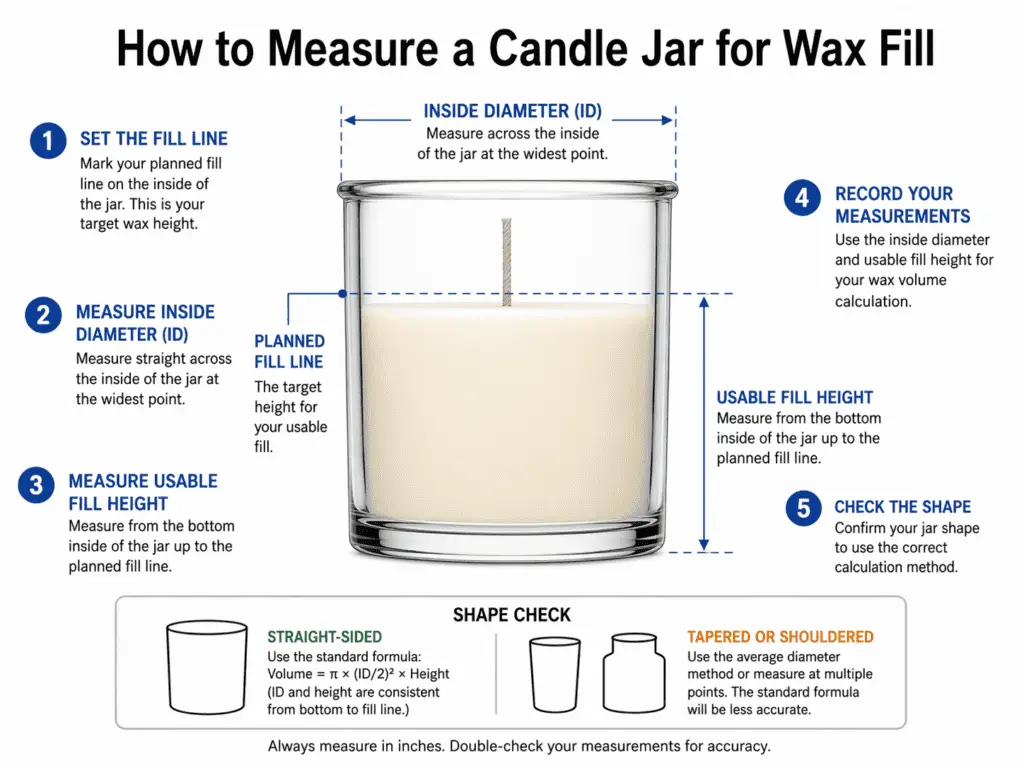
If the jar narrows, widens, or forms a shoulder inside the fill zone, note that before using the formula. Diameter still matters here only as a fill input, not as a separate product-choice decision.
Formula to Calculate Candle Jar Fill Weight
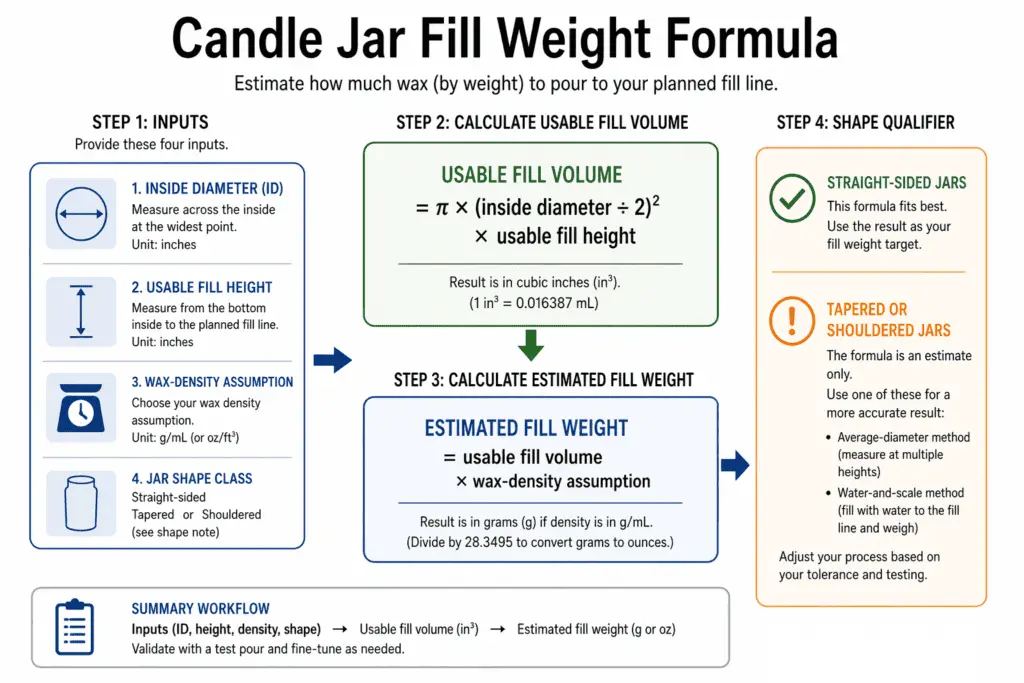
To estimate candle jar fill weight, calculate usable fill volume from internal dimensions, then convert that volume using a stated wax-density assumption.
Fill weight means wax-only weight needed to reach the chosen fill line in one jar. It does not mean the total candle weight, and it does not mean the nominal ounce label on the container. Run the calculation with one jar, one fill line, and one stated wax assumption at a time.
Quick calculator inputs
Use four inputs to estimate wax-only fill weight for one jar: inside diameter, usable fill height, a stated wax-density assumption, and the jar shape class.
| Input | What it means | Unit example |
|---|---|---|
| Inside diameter | Internal width where the wax will sit | inches or centimeters |
| Usable fill height | Internal height up to the planned wax surface | inches or centimeters |
| Wax-density assumption | Your chosen volume-to-weight conversion | oz/in³ or g/cm³ |
| Jar shape class | Straight-sided, tapered, or shouldered | text note |
Formula box
This formula turns usable internal space into an estimated wax-only fill weight for one jar at one chosen fill line.
Usable fill volume = π × (inside diameter ÷ 2)² × usable fill height
Estimated fill weight = usable fill volume × wax-density assumption
Output rules
Read the result as a starting fill estimate for the measured jar and stated wax assumption, not as a fixed answer for every jar sold under the same label.
| If your result shows this | Read it this way |
|---|---|
| Straight-sided jar with matched internal measurements | Good starting fill estimate |
| Shoulder or taper inside the fill zone | Qualified estimate, not a fixed answer |
| Same jar with a different wax assumption | Recalculate before ordering wax |
| Label and estimate do not match | Trust measured fill inputs over the label |
- Straight-sided jars with matched internal measurements can use the formula as a starting fill estimate.
- If a shoulder or taper sits inside the fill zone, verify the result with the water-and-scale method.
- If the label and measured fill line disagree, trust the measured fill inputs over the nominal jar label.
Worked example
This example shows how one set of internal measurements and one stated wax assumption produce one estimated wax-only fill weight.
A straight-sided jar with a 3.0-inch inside diameter and a 2.83-inch usable fill height has about 20.0 cubic inches of usable volume. If the wax assumption is 0.45 oz per cubic inch, the estimated fill weight is about 9.0 oz.
Method note: This example uses one straight-sided jar, one set of inch measurements, and one sample wax conversion. Change the wax assumption or jar shape and the result changes with it.
How to Estimate Candle Jar Fill Weight With Water and a Scale
Use a water-and-scale method when the jar shape changes through the fill zone or when one inside diameter does not describe the real fill area well. Use cylinder math for straight-sided jars, and use a measured water fill reference when shoulders or taper change the fill zone.
- Set the planned fill line.
- Tare the empty jar on a scale.
- Fill the jar with water to the planned line.
- Record that measured water amount as the jar’s fill reference at that line.
- Use that measured fill reference with the same stated wax-density assumption used for your jar math on this page.
This method keeps the fill estimate tied to the real fill line inside the jar instead of forcing the whole fill zone into one fixed cylinder.
For batch wax totals or fragrance-load math, use the broader candle wax calculator workflow instead of expanding this one-jar fill estimate.
When Jar Shape Changes the Estimate
Straight-sided jars fit the baseline formula best. Tapered or shouldered jars need a qualified estimate because their internal width changes across the fill height.
Jar shape changes the estimate the moment the jar narrows, widens, or forms a shoulder inside the fill zone. A straight-sided jar usually works with one inside diameter. A jar that changes width inside the fill zone should not be treated as one fixed cylinder from base to fill line.
| Jar shape | How well the baseline formula fits | What to do |
|---|---|---|
| Straight-sided | Best fit | Use one inside diameter |
| Shoulder above fill line | Usually acceptable | Measure below the shoulder |
| Shoulder inside fill zone | Limited fit | Base the estimate on the real fill zone |
| Tapered | Limited fit | Treat the number as a starting estimate |
How Wax Type Changes the Weight Estimate
The same jar volume can produce different wax weights when the conversion assumption changes. Volume stays the same, but the weight result moves with the wax-density assumption.
On this page, wax type changes the weight estimate only by changing the conversion from volume to weight. It does not change the jar volume itself. Questions about scent throw, cure time, or burn behavior sit outside this page’s fill-weight job.
| Usable volume | Wax-density assumption | Estimated fill weight |
|---|---|---|
| 20.0 in³ | 0.42 oz/in³ | 8.4 oz |
| 20.0 in³ | 0.45 oz/in³ | 9.0 oz |
| 20.0 in³ | 0.48 oz/in³ | 9.6 oz |
These sample conversion figures are working assumptions for example calculations, not fixed values for every wax or every supplier jar.
Method note: This comparison holds jar volume constant and changes only the conversion assumption, so the shift comes from the wax factor alone.
That is why the worked examples below are reference examples, not fixed promises for every jar sold under the same label.
Worked Examples for Common Candle Jar Sizes
Common 8 oz, 9 oz, 10 oz, and 12 oz jars can be estimated, but the result is only as good as the internal dimensions, headspace, shape, and wax assumption behind it.
The table below uses example internal dimensions, moderate headspace, straight-sided jars, and one sample conversion factor of 0.45 oz per cubic inch. It shows how headspace changes usable fill capacity, how the fill-weight formula works in practice, and why a different wax assumption shifts the final number.
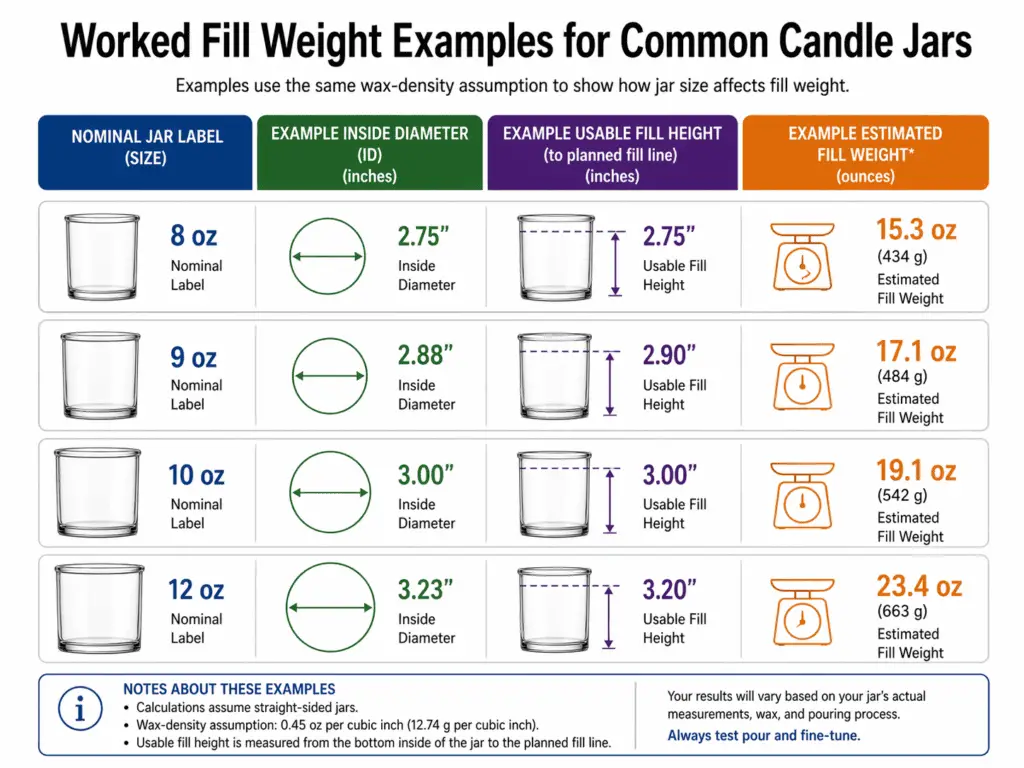
Under these assumptions, the 8 oz example estimates at 7.2 oz of wax and the 10 oz example estimates at 9.0 oz of wax.
| Nominal jar label | Example inside diameter | Example usable fill height | Example estimated fill weight |
|---|---|---|---|
| 8 oz | 2.75 in | 2.70 in | 7.2 oz |
| 9 oz | 2.90 in | 2.75 in | 8.2 oz |
| 10 oz | 3.00 in | 2.83 in | 9.0 oz |
| 12 oz | 3.20 in | 3.00 in | 10.9 oz |
Method note: These are assumption-based examples, not supplier-wide rules. If your jar dimensions or wax assumption differ, recalculate with your own inputs.
If your jar does not match these assumptions, measure first and run the formula again rather than copying the table. Fill sizing answers a different problem from wick choice, batch wax planning, or container prep, so keep those steps separate from jar fill-weight estimation.