

Why Candle Additives Cause Weak Scent Throw, Soot, or Poor Burn Performance
Candle additives can weaken scent throw, raise soot, or hurt burn quality when the additive role, amount, wax fit, or interaction pattern works against the formula instead of supporting it.
This page diagnoses whether candle additives are the cause and routes outward when wick size, fragrance load, soot troubleshooting, or recent process changes explain the problem better.
Candle additives are non-fragrance ingredients added to wax to change hardness, opacity, adhesion, UV resistance, appearance, or burn behavior. In this page, poor burn performance means additive-linked weak hot throw, soot, mushrooming, residue, unstable flame behavior, or a melt pool that no longer behaves as expected. The main question is not whether additives can affect performance, because they can. The real question is how to tell when the additive is the cause and when the stronger cause is wick size, fragrance load, wax fit, or a recent process change.
How to Tell When Candle Additives Are Actually the Problem
Additives are the likely cause when performance changes after an additive change and the strongest clues match additive role, dose, or wax-fit shifts.
Use this triage to judge likelihood, not certainty: candle additives are formulation modifiers, and poor burn performance here means additive-linked weak throw, soot, residue, unstable flame, or melt-pool disruption.
An additive-led problem is most likely when one additive change lines up with a new symptom and the wax, wick, fragrance load, vessel, and cure routine stayed the same. It is less likely when the defect existed before the additive change, several variables moved together, or the pattern points more strongly to wick size, fragrance load, or a recent process shift. Timing matters because additives often get blamed after a reformulation, but many failed test batches contain two or three changed variables instead of one. If you do not isolate the change, the additive can look guilty even when it is only sitting next to the real cause.
This fast diagnosis flow keeps the additive test inside one variable.
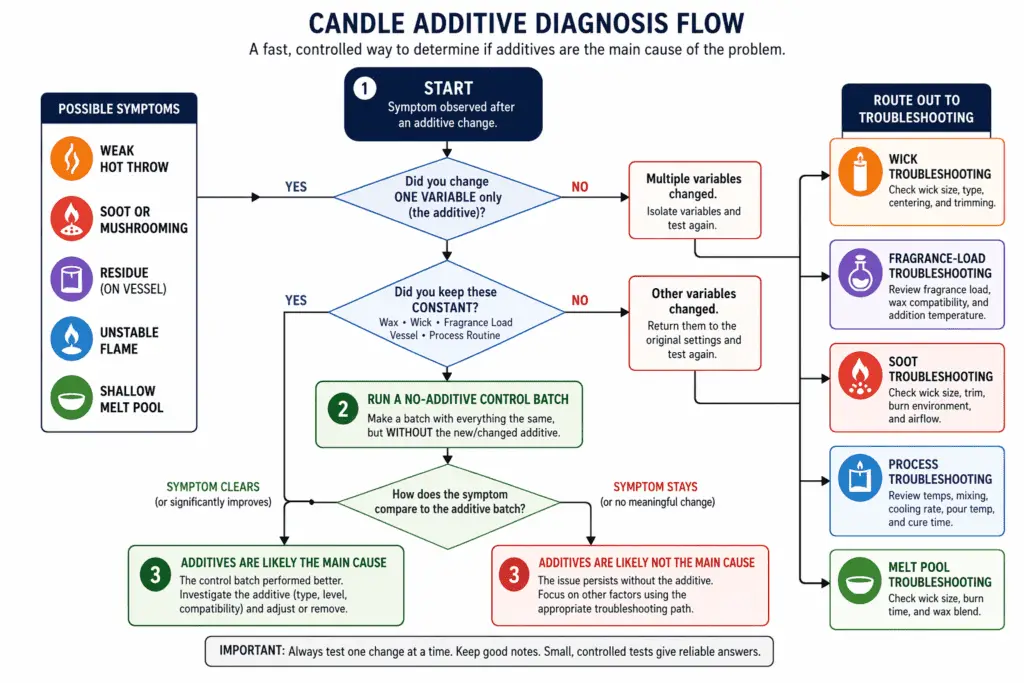
- Go back to the last version of the formula that burned acceptably.
- Hold wax, wick, fragrance load, vessel, and process routine steady.
- Remove only the additive you are testing.
- Burn the control batch against the additive batch under the same conditions.
- If the symptom clears, keep additive diagnosis open. If the symptom stays, route to wick, fragrance-load, soot, or process troubleshooting instead of changing more additives.
These quick answers cover the overlap questions that send many test batches in the wrong direction. Could it still be wick-related? Yes, especially when the flame shape, capillary feed, or burn depth changed first, so candle troubleshooting causes and fixes should stay in view before you blame the additive. Could cure time mimic this? Yes, because recent process changes can mimic additive failure when curing, mixing, or pouring changed near the same time. Can one additive cause both soot and weak throw? Yes, because one additive can dirty combustion while muting scent release at the same time.
| Symptom | Stronger additive clue | Lookalike cause to rule out first | Next best test |
|---|---|---|---|
| Weak hot throw | The scent drop started right after one additive change, while oil load and cure routine stayed the same | weak throw may be a fragrance-load issue instead when oil load, oil quality, or cure time changed too | Retest the same formula without the new additive |
| Soot or mushrooming | Mushrooming is carbon buildup on the wick tip, and a new additive started the dirtier burn | Wick trim, wick size, or airflow changed at the same time | Remove the additive and keep wick, jar, and fragrance load fixed |
| Residue on glass or wax surface | The residue appears only after the additive enters the batch | Overdyeing, fragrance seep, or incomplete mixing | Run a no-additive control batch |
| Unstable flame | Flicker, surging, or lazy burning began after the additive change | A wick shift, draft, or fuel-flow change outside the additive | Compare two identical burns with and without the additive |
| Shallow melt pool | A melt pool is the melted wax around the flame, and it changed only after the additive shift | Wick size, vessel shape, or pour changes | Hold vessel and wick steady, then remove the additive |
These signal groups help you decide whether to keep testing additives or route elsewhere.
- A strong additive signal appears when one additive changed, the symptom appeared right away, and wick behavior changed after additives without a wick swap or oil-load change.
- A medium additive signal appears when the additive change and the symptom appeared together, but cure time, room conditions, or minor process details were not tightly controlled.
- A weak additive signal appears when weak throw or soot existed before the additive, several variables moved together, or the formula changed during curing, mixing, or pouring.
- A stop-and-route signal appears when the candle keeps showing the same defect after you remove the additive and hold the rest of the formula steady.
A simple way to lower confusion is to ask one question before each retest: what is the one changed variable I am trying to prove or disprove? If the answer is not clear, the next test is probably too messy to trust. That matters because additive problems usually reveal themselves through repeatable change, not through one dramatic bad burn.
If the symptom map still points at the additive itself, the next check is whether the additive’s basic job clashes with what the formula needs.
Why the Wrong Additive Choice Can Weaken Scent Throw or Burn Quality
The wrong additive can hurt a candle when its job conflicts with the formula and cuts fragrance release or makes the burn dirtier.
Here, the wrong additive means a formulation mismatch: the additive role, dose, wax fit, or interaction pattern works against the performance target in this formula. It does not mean the additive is unsafe, low-quality, or undesirable in every other context.
This page is about candle additives as formulation modifiers, not fragrance oil or wax itself. A role mismatch can lower hot throw, the scent a candle gives off while burning, add residue, or disturb combustion before dosage or wick changes enter the picture. That is why weak scent throw here is not automatically a fragrance-load problem, and poor burn performance here is not automatically wick failure. A candle can become firmer, glossier, or more stable in one narrow sense and still burn worse overall. That tradeoff is where many additive mistakes begin.
A common pattern looks like this: a container candle burned clean before a hardener was added. After the hardener went in, hot throw dropped, the melt pool narrowed, and soot showed up by mid-burn. The wick, oil load, and vessel stayed the same, so the new clue was the additive role, not a sudden wick-only failure. Another common pattern is a formula that looks better on the shelf after an appearance additive is added, but starts leaving more residue or throwing less scent during a real burn. When the visible improvement happens at the same time as a burn decline, the additive role deserves closer attention.
| Additive role | What the additive is trying to do | Common backfire pattern |
|---|---|---|
| Hardening additive | Raise firmness or slow deformation | Narrower melt pool, weaker scent release, dirtier burn |
| Decorative or opacity additive | Change color or appearance | Residue, duller throw, altered flame behavior |
| UV or protective additive | Slow fading or color change | Lower scent release or a different burn feel than the base formula |
| Adhesion or release helper | Change how wax behaves on the vessel or mold | Surface issues, extra residue, or shifted burn rhythm |
| Combustion-affecting modifier | Change how the wax feeds or burns | Soot, mushrooming, unstable flame, or weak throw |
A role mismatch often looks simple at first: the candle meets one goal and loses another. Before another swap, compare candle additive roles before reformulating so the next test matches the job you actually need. If one wax family keeps failing, remember that some additive roles fail because the wax system is a bad fit. When the pattern is still mixed, start with the main candle troubleshooting guide before changing more variables.
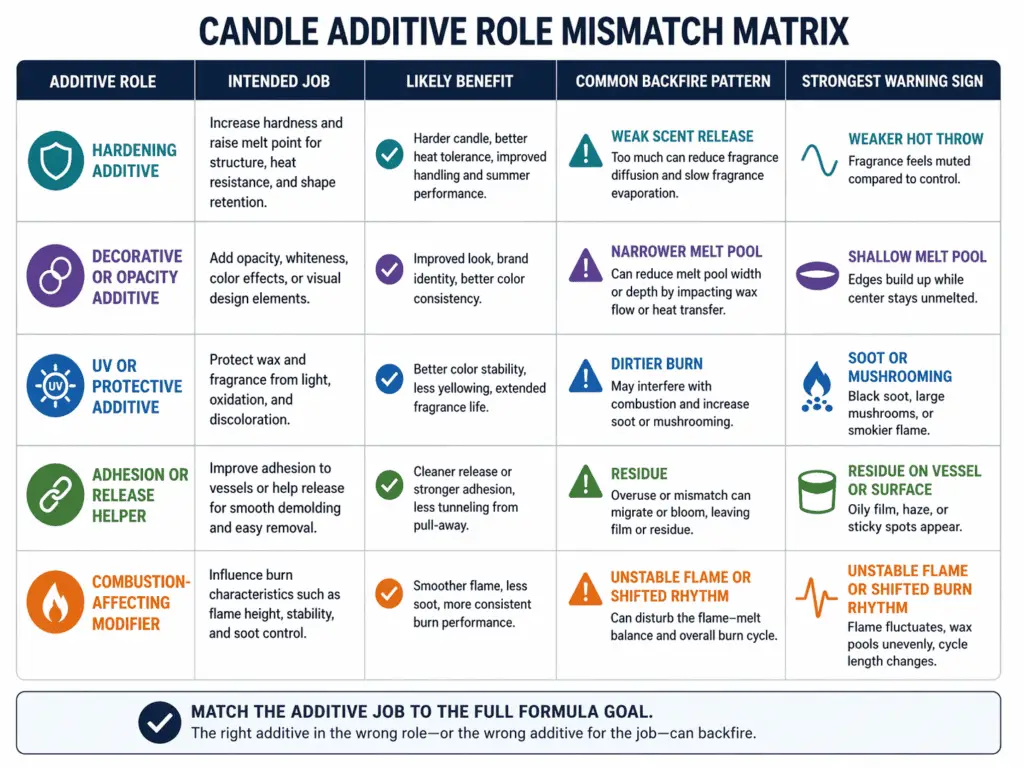
The easiest mistake is choosing an additive because it sounds useful in isolation. Harder, smoother, brighter, cleaner, or more stable can all sound attractive until the candle has to hold fragrance, feed the wick, and burn evenly under heat. Additive choice has to serve the whole formula, not one benefit on a label. When one small advantage creates three new performance defects, the role is probably wrong even if the ingredient is not bad in every other context.
How Decorative or Protective Additives Can Hurt Performance
Decorative or protective additives can still change burn and scent behavior even when they were added for looks or stability rather than burn control.
Many candle makers only test additives sold as burn helpers and miss the quieter changes made by dye, opacity agents, and UV-focused additives. That blind spot matters because dyes can affect how a candle burns, and UV additives can change stability and performance tradeoffs even when the original goal was appearance, not throw or combustion. Decorative additives are easy to under-test because the candle can look finished and professional before the first real burn tells a different story.
| Additive class | Usual goal | Common side effect |
|---|---|---|
| Dye | Stronger color | Duller throw, residue, or a dirtier-looking burn |
| UV additive | Better color hold | A change in scent release or burn rhythm |
| Opacity modifier | Different finish or appearance | Narrower melt pool or altered flame behavior |
Appearance gains can cost burn quality when the formula has little room for extra solids or extra modification. Darker color can look rich on the shelf but still leave a dirtier jar wall or a duller scent in use. A more opaque finish can make the wax look smoother while still changing how the candle melts and feeds. If the pattern is still mixed, compare other candle troubleshooting causes before you treat color or UV changes as harmless side notes.
Why Multiple Additives Can Create New Problems Together
Multiple additives can create new interaction effects that do not appear in single-additive testing.
A stacked formula can fail even when each additive looked acceptable on its own. The newest additive is not always the only culprit, because older additives can change how the new one behaves, and stack conflicts can get worse when the wax system is a poor fit. What worked separately can fail together because the candle is not reacting to one ingredient anymore. It is reacting to the combined load, the new melt behavior, and the new burn rhythm of the full system.
This checklist shows how to isolate a stacked formula without guessing.
- Remove the newest additive first and keep the rest of the formula fixed.
- If the defect stays, go back to the last clean version of the batch.
- Add back one additive at a time in the original order.
- Stop stacking changes when the same symptom returns.
A common pattern looks like this: a candle handled one hardener well and one dye well in separate tests. When both stayed in the formula and a UV additive was added, soot rose, throw fell, and the flame lost stability. In that case, stacked additives can create conflicts that need deeper formulation review, and it helps to compare other candle troubleshooting causes before you blame only the last addition.
Stacking becomes risky when each added ingredient is treated as a small independent tweak. The formula does not always behave that way. One additive can increase firmness, another can affect appearance, and a third can shift the way fragrance comes off the wax. The candle then stops behaving like a simple sum of parts. It becomes a new system, and that new system may need a full retest rather than one more quick fix.
Once the additive role looks wrong or stacked, the next check is whether the formula is failing from the amount used rather than the type alone.
How Additive Dosage Changes Throw, Soot, and Burn Behavior
Additive dosage is the amount of additive in the wax system, not the fragrance percentage, and both overload and underload can hurt performance.
Additive dosage means how much additive is in the wax formula, not how much fragrance oil is in the candle. Underload means too little additive to do its intended job, while overload means enough additive to start pushing the formula toward weaker throw, more residue, soot, or a less steady burn. What counts as too much or too little is formula-specific, so poor burn performance here does not automatically mean you need a new wick plan. A dose that feels minor on paper can still be large enough to move the formula away from its last stable version.
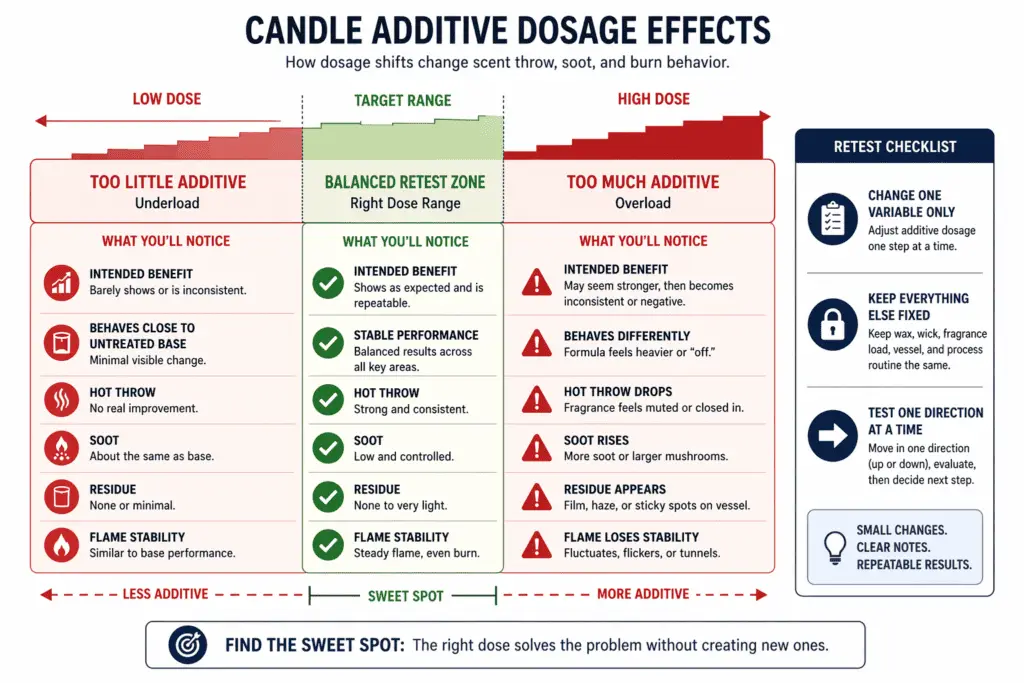
| Dose pattern | What it often looks like | Better next move |
|---|---|---|
| Too little additive | The intended benefit barely shows, and the candle behaves close to the untreated base | Retest one small dosage step up while keeping wax, wick, and oil load fixed |
| Too much additive | Hot throw drops, soot rises, residue appears, or the flame loses stability | Retest one small dosage step down without changing other variables |
| Dose seems stable but symptoms stay | The same weak throw or soot remains even after a careful retest | Route to the next variable instead of forcing more dose changes |
This checklist shows how to retest dosage without turning one batch into a moving target.
- Start from the last version of the formula that burned acceptably.
- Change only the additive amount.
- Keep wax, wick, fragrance load, vessel, pour routine, and cure routine the same.
- Test one direction at a time, either lower or higher, not both in one batch.
- Stop changing dosage when the symptom no longer tracks with the additive amount.
These patterns help answer the overlap questions. Can too much additive reduce throw? Yes, because excess additive can slow or disturb scent release even when oil load stayed the same. Can too little additive still cause problems? Yes, because the additive may fail to do the job it was added for, which can leave the formula with the same weakness you were trying to correct. What counts as too much? The useful answer is not one universal percentage, because dosage tolerance depends on the wax system and on the additive’s job inside that wax.
A helpful way to read dosage failure is to watch for direction. If more additive makes the problem stronger and less additive makes the problem weaker, dosage is probably part of the cause. If changing the amount barely moves the symptom, the additive may be the wrong type, the wrong wax fit, or not the main problem at all. That directional clue is more useful than guessing from one label claim or one past batch note.
If the same additive starts changing flame shape or fuel draw, additives can change wick demand after dosage changes, but that still belongs to a narrower wick recalibration step rather than a full wick lesson here. If the burn stays steady and the throw still fades after careful retests, weak throw may still come from fragrance load rather than additive level. The next check is whether the additive itself fits the wax family you are using.
Which Additives Fit Your Wax System and Which Ones Backfire
Additive–wax compatibility is how a specific additive behaves inside a specific wax system, and fit here means the additive supports scent release, combustion behavior, and melt behavior without creating new performance defects. Backfire here means the additive achieves one intended effect but causes weaker throw, soot, residue, unstable flame behavior, or melt-pool disruption in that formula. It does not mean the additive creates a legal problem, a fire-safety finding, or a universal product defect.
Compatibility here means additive behavior inside a given wax, not a ranking of waxes overall. A hardener, stabilizer, dye, or other modifier can support one wax family and backfire in another by changing scent release, soot tendency, residue, or burn stability. That is why additive performance depends on wax compatibility instead of broad claims about a good or bad additive. The same ingredient can look predictable in one wax and frustrating in another because the wax changes how the additive dissolves, holds, releases, or burns.
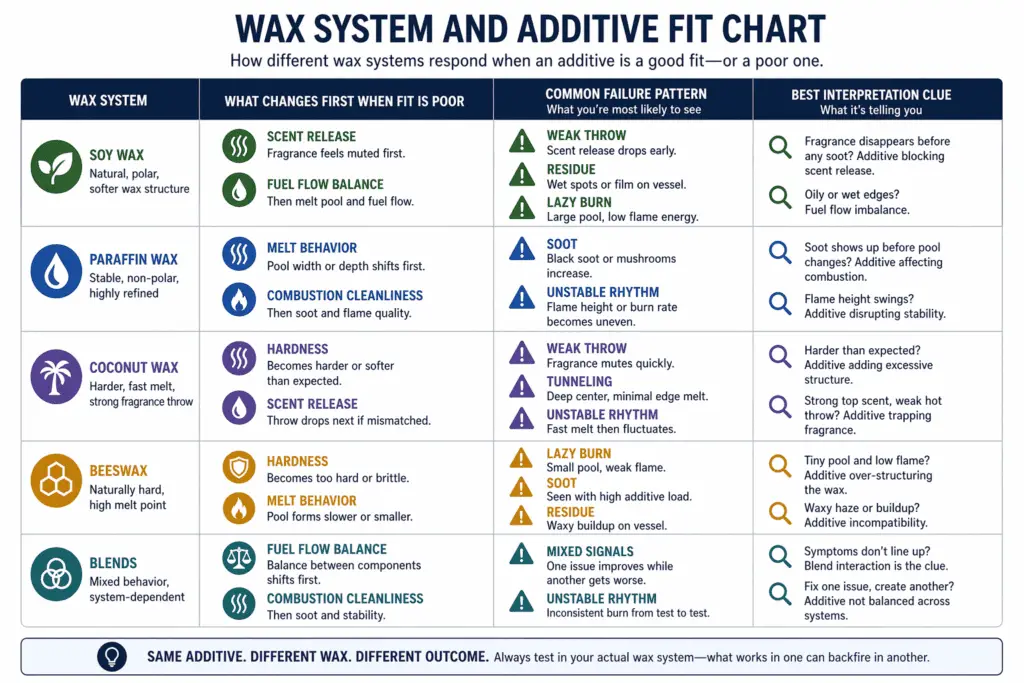
| Wax system | What often changes first when fit is poor | Common failure pattern |
|---|---|---|
| Soy | Scent release or melt behavior | Duller hot throw, smaller melt pool, residue, or a lazy burn |
| Paraffin | Combustion cleanliness or additive response speed | Dirtier burn, stronger soot pattern, or a formula that reacts faster to additive shifts |
| Coconut | Softness and fuel flow balance | Uneven burn rhythm, weak throw, or surface residue |
| Beeswax | Hardness and combustion balance | Tight melt behavior, lower scent release, or a sharper reaction to the wrong modifier |
| Blends | One wax hides the reaction of another | Mixed signals that look acceptable at first, then drift into weak throw or soot |
A single additive can look useful in one test and harmful in the next because the wax is changing the response. In practice, soy wax can change how additives perform when a modifier tightens melt behavior or interferes with scent release in a softer wax system. On the other hand, paraffin wax may respond differently to the same additive because the burn and fuel behavior can stay more tolerant in one formula and much less tolerant in another. Blends make this harder to read because one wax can partly mask the mismatch until the burn reaches a later stage.
Compatibility problems often show up as inconsistency. A formula looks improved in cold appearance, then loses throw after cure. Another formula burns clean at first, then starts leaving residue by the second or third burn. These mixed results are easy to misread as testing noise, but they often point to wax fit. When the candle gives conflicting signals, the additive may not be universally wrong. It may simply be wrong in that wax system.
Why Some Additives Mute or Distort Fragrance Performance
Additive–fragrance interaction means an additive changes fragrance release or burn behavior; it does not automatically mean the oil is defective.
On this page, weak scent throw means additive-linked scent loss, not every possible throw problem. Some additives can trap, mute, or reshape how fragrance comes off the wax during burning, so a candle can lose hot throw, the scent released while the candle is burning, even though the oil itself is still usable. That is why a candle can smell fine cold, then disappoint once lit after one additive change.
| Pattern | Additive interaction is more likely | Fragrance-load issue is more likely |
|---|---|---|
| Throw dropped right after one additive change | Yes | Less likely |
| Oil load changed at the same time | Less clear | Yes |
| Throw returns when the additive is removed | Yes | Less likely |
| Throw stays weak across stable additive retests | Less likely | Yes |
A typical example is a candle that kept the same wax, wick, and oil load, but hot throw dropped after one stabilizing additive was added. When the additive came back out, the scent returned. That pattern points to interaction, not bad oil. If the pattern does not hold, weak throw may be a fragrance-load issue instead. If the scent changed after curing or pouring also changed, recent curing or process changes can mimic additive scent problems. When the evidence stays mixed, compare other candle troubleshooting causes before raising oil load and moving three variables at once.
The key clue is reversibility. If the scent comes back when the additive goes away, the additive deserves more attention. If the scent stays weak after the additive is removed and every other condition is stable, the problem may belong to oil load, oil quality, or another variable outside this page’s main scope.
Container and pillar formats can qualify additive diagnosis, but only as a short compatibility check: the same additive may look acceptable in one format and fail in the other because melt behavior, hardness, and fuel flow change. Treat that as a wax-fit qualifier, not as a separate format-optimization problem on this page.
When dosage and compatibility still do not explain the failure clearly, the next clue is how the additive changes melt behavior, fuel flow, and burn stability.
How Additives Change Melt Behavior, Fuel Flow, and Burn Stability
Some additives change melt behavior and fuel flow, which can weaken throw, alter the melt pool, and make the flame burn dirtier or less steadily.
Troubleshooting often stops at the symptom list and leaves the mechanism unstated. The missing clue is that candle additives can change how melted wax moves to the flame, so weak throw, soot, residue, or an unstable burn may begin before you make a wick change. Viscosity is how easily melted wax flows, and a shift in viscosity can change both scent release and flame behavior. When the fuel moves differently, the candle can stop behaving like the earlier version even though it still contains the same wax, wick, and oil load.
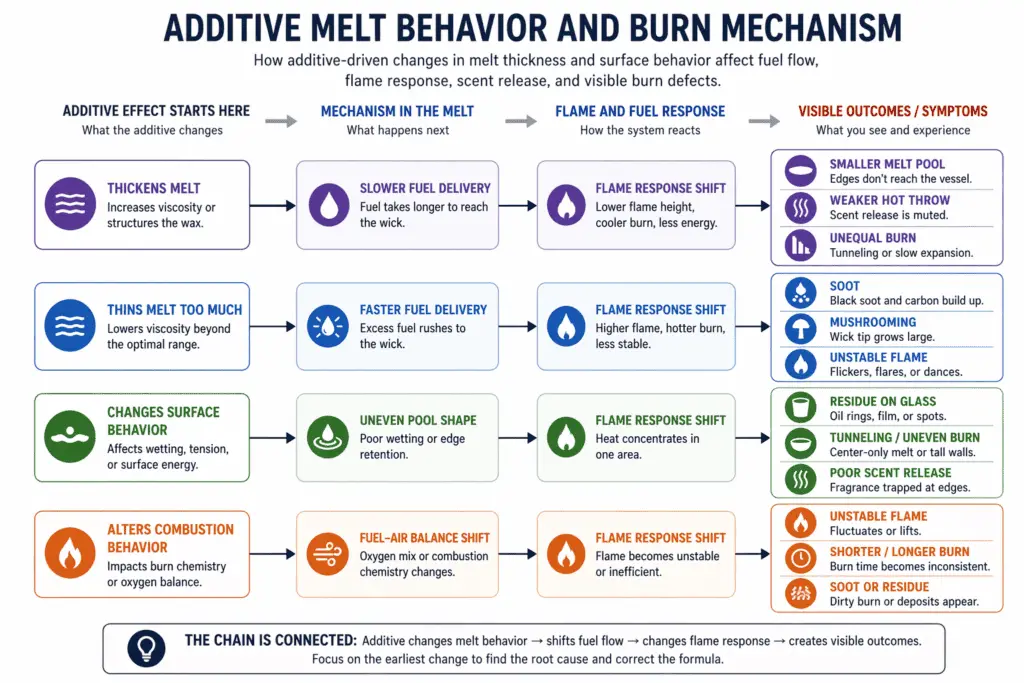
| Additive effect on the wax | What usually changes first | Common visible result |
|---|---|---|
| Thickens the melt | Fuel reaches the flame more slowly | Smaller melt pool, weaker hot throw, slower or uneven burn |
| Thins the melt too much | Fuel reaches the flame too quickly | Dirtier burn, soot, residue, or a less stable flame |
| Changes surface behavior | Pool shape and wax movement become less even | Patchy melt pool, uneven release, or residue on glass |
| Alters combustion behavior | Flame response changes under the same wick and oil load | Mushrooming, soot, or a burn that no longer looks steady |
A candle that burns differently right after an additive change is often showing a mechanism clue, not just a random defect. That is why poor burn performance on this page includes additive-linked melt-pool and fuel-delivery changes, not vessel design or heat-modeling lessons. If the main clue is pool depth or burn spread, remember that additives can change melt-pool behavior. In jars, container burn conditions can change how additive effects appear even when the additive stayed the same. When the pattern still looks mixed, compare other candle troubleshooting causes before changing the additive again.
Additives can change wick demand, but this page is not a wick-sizing framework. A fuel-flow shift can make a previously workable wick look underpowered or overworked, so additives can change wick demand enough to require recalibration when the additive diagnosis is already strong. Suspect that shift when the same wick behaves differently only after the additive change, but do not change wick, fragrance load, and additive together. If the next real task is wick recalibration, see the full wick troubleshooting guide after you compare other candle troubleshooting causes and confirm the additive is the trigger.
Mechanism-focused testing is useful because it explains why one symptom often arrives with another. A tighter melt can weaken throw and shrink the pool. A dirtier feed can raise soot and change flame shape. A surface shift can leave residue and make the candle look less stable. When the mechanism makes sense, the symptom pattern becomes easier to trust.
Soot, mushrooming, or residue can be worsened by additive choice or additive dose.
These signs make the additive explanation stronger.
- The soot or residue started right after an additive or dose change.
- The same wick behaved acceptably before the additive change.
- The residue pattern appeared with weaker throw or a dirtier flame at the same time.
- The problem eases when the additive is reduced or removed in a control retest.
When these signs stay after the no-additive control, route to soot or smoking troubleshooting instead of expanding soot diagnosis on this page.
What Process Changes Can Mimic an Additive Problem
Recent curing, mixing, or pouring changes can imitate additive failure, so process confounders must be ruled out before the additive is blamed.
A process confounder is a recent cure, mixing, or pouring change that can imitate additive failure. It matters here because weak throw, soot, residue, or a rough burn should not be treated as additive-caused when the additive changed close to a process shift. This is a boundary check, not a full production workflow, and it is most useful when several changes happened so close together that the real cause is hard to see.
A common pattern looks like this: a candle maker added a new additive and changed mixing time in the same batch, then noticed weaker throw and a rougher burn. When the next retest kept the additive but restored the earlier process routine, the candle improved. The additive looked guilty at first, but the process change had moved the result. That kind of false blame is common after reformulation because the test notes often focus on the new ingredient and overlook the surrounding routine.
Rule out these process changes before changing the additive again.
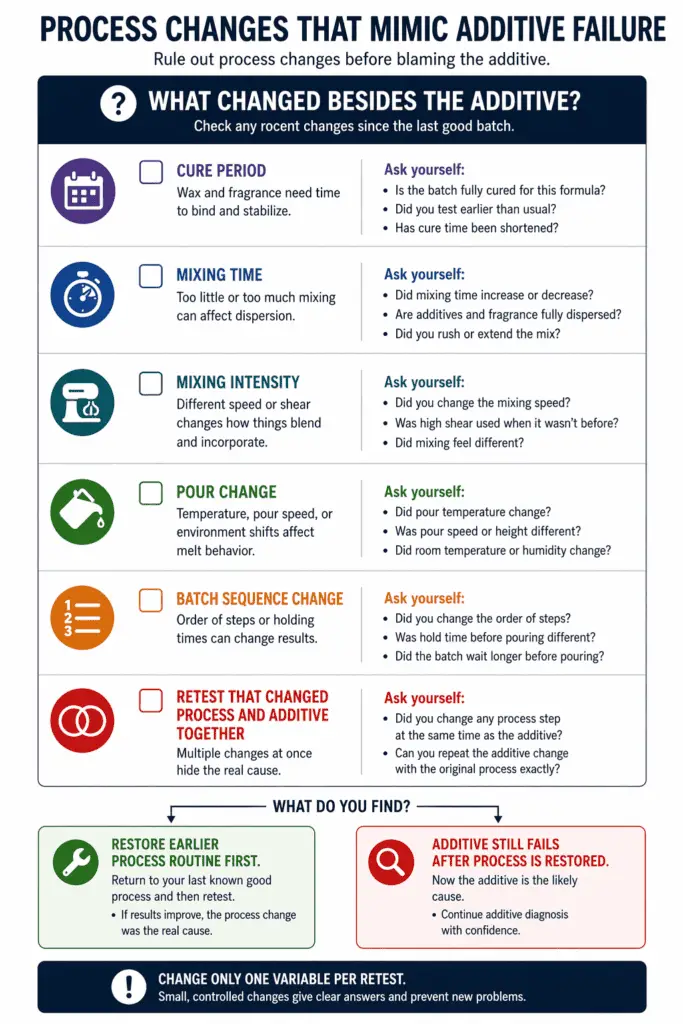
- A shorter or longer cure period than the last clean batch
- A different mixing time or mixing intensity
- A pour change that altered how the wax set and behaved
- A batch sequence change that moved several variables together
- A retest that changed process and additive at the same time
These checks answer the overlap questions directly. Is it the additive or cure time? Start by holding the additive steady and restoring the earlier cure routine. Can process changes mimic additive failure? Yes, and recent process changes can mimic additive failure closely enough to send retesting in the wrong direction. What should you rule out before changing additives again? Rule out recent cure, mixing, and pour changes first, because pour temperature can change how the candle behaves after reformulation. If the pattern still does not line up, compare other candle troubleshooting causes before making another formulation change.
The safest retest is usually the simplest one: go back to the last version that burned acceptably, repeat the same process routine, and change only one variable. If the candle improves without removing the additive, the process change deserves more attention. If the candle only improves when the additive is removed and the process stays stable, the additive case becomes much stronger.
If the no-additive control still fails after process conditions are restored, stop additive swapping and move to wick, fragrance-load, soot, or broader process troubleshooting instead.