

Candle product labels are the on-pack disclosures that identify the item, state its net contents, and identify the responsible business; extra warning, CLP, or Proposition 65 text becomes mandatory only when a specific rule or market trigger applies.
This page covers the baseline candle label fields and the extra modules that become mandatory when a jurisdiction or selling channel triggers them; it does not replace dedicated CLP build, label-application, or gift-packaging workflows.
A candle label is part safety warning, part product ID, and part paper trail for your batches. Small brands get tripped up by missing net weight, vague maker details, or a warning that disappears on a tiny tin. If you sell in the US and the EU, the tricky part is knowing which pieces are law-triggered versus “expected by the industry.” A quick jurisdiction-first check keeps you from over-labeling in one market and under-labeling in another.
What labels are legally required on candle products?
In the US, the legal baseline for most candles is product identity, net contents, and the name and place of business; extra warning, hazard, or marketplace text becomes mandatory only when a separate rule or selling channel triggers it.
That distinction is easiest to use when you sort label content into three buckets and start from broader candle safety compliance: law-triggered requirements, voluntary standards and safety guidance, and marketplace or retailer rules.
- Law-triggered requirements: these apply only when a rule applies to your specific product (for example, when a hazardous substance rule or a hazard-classification rule is triggered).
- Voluntary standards and safety guidance: not laws, but widely used and often expected by insurers/retailers.
- Marketplace/retailer rules: not laws, but practically mandatory if you want your listing approved or your product accepted.
Do ordinary US candles legally need a warning label?
Not always. For many ordinary US candles sold without a separate hazard-triggered labeling duty, the universal packaging baseline is identity, net contents, and the name and place of business; the familiar fire-warning block is widely expected by retailers, insurers, or industry practice, while legally mandatory cautionary labeling is triggered when a separate hazard rule applies.
In the US, CPSC explains that metal-cored candlewicks (and candles that use them) have a lead limit, and it notes that candles containing a hazardous substance (as defined under FHSA) must bear cautionary labeling; it separately lists key ASTM candle standards as voluntary consensus standards.
In California, the Proposition 65 program explains that “safe harbor” rules describe compliant ways to provide warnings, including minimum type-size rules for short-form warnings and methods for showing warnings online before purchase. In the EU/EEA context, CLP rules include minimum label and pictogram sizing requirements when CLP labeling applies; for the broader framework behind those label elements, use the main candle safety compliance guide.
Does every EU candle need a CLP label?
No. An EU candle needs CLP label elements when the finished product is classified as a hazardous mixture, and some non-classified mixtures can still need supplemental statements such as EUH208; if CLP is not triggered, you still need the other product and seller information that applies in that market.
Minimum required fields (by situation)
The minimum required field set changes by market and by whether a hazard, classification, or channel-specific trigger applies.
| Situation | What you must have on the product/pack | What is “voluntary but widely expected” | What marketplaces/retailers often require |
| US: typical candles (no special hazard classification) | Product identity + net contents + business name and place of business | A clear cautionary fire-safety label (often aligned to ASTM/NCA-style safety rules) | A standard warning block + burn directions; consistent responsible-party line; readable placement in photos/listings |
| US: regulated or hazard-triggered cases | FHSA cautionary labeling if the candle contains a hazardous substance; lead limits for metal-cored wicks (and related statements for certain bulk shipping contexts) | Extra burn directions and container-use limits | Batch/lot code, barcode, packaging warnings, listing disclosures |
| EU: CLP applies (hazard classification triggered) | CLP label elements where applicable: product identifier, supplier details, hazard pictograms, signal word, hazard statements, precautionary statements, and any required supplemental info | Additional fire-safety instructions (separate from CLP) can still be helpful | Local-language expectations; e-commerce presentation that shows the label clearly |
| California: Proposition 65 warning required | A clear-and-reasonable warning provided prior to exposure; for online sales, warnings are provided before purchase as well (safe-harbor methods explain how) | Extra context on safe use and ventilation for strongly scented products | Platform-specific placement (PDP text, images, popups); consistent wording across variants |
Practical takeaway: fix the universal basics (identity, net contents, responsible party), then add jurisdiction “modules” only when they apply; readable safety text is widely expected for ordinary candles, while EU CLP elements and Prop 65 warnings are trigger-based requirements.
How candle warning labels work (fire-safety basics)
A candle warning label works by pairing a short hazard signal with clear do-not-do rules and safe-use directions, so the risk is obvious before the candle is lit.
Many makers treat the “three-rule” cautionary label as the minimum that customers, retailers, and insurers expect. In practice, it is usually driven by voluntary candle safety standards, retailer expectations, and general product-safety risk control rather than one candle-specific statute dictating exact wording. Where FHSA hazard labeling is triggered, cautionary labeling becomes a legal requirement.
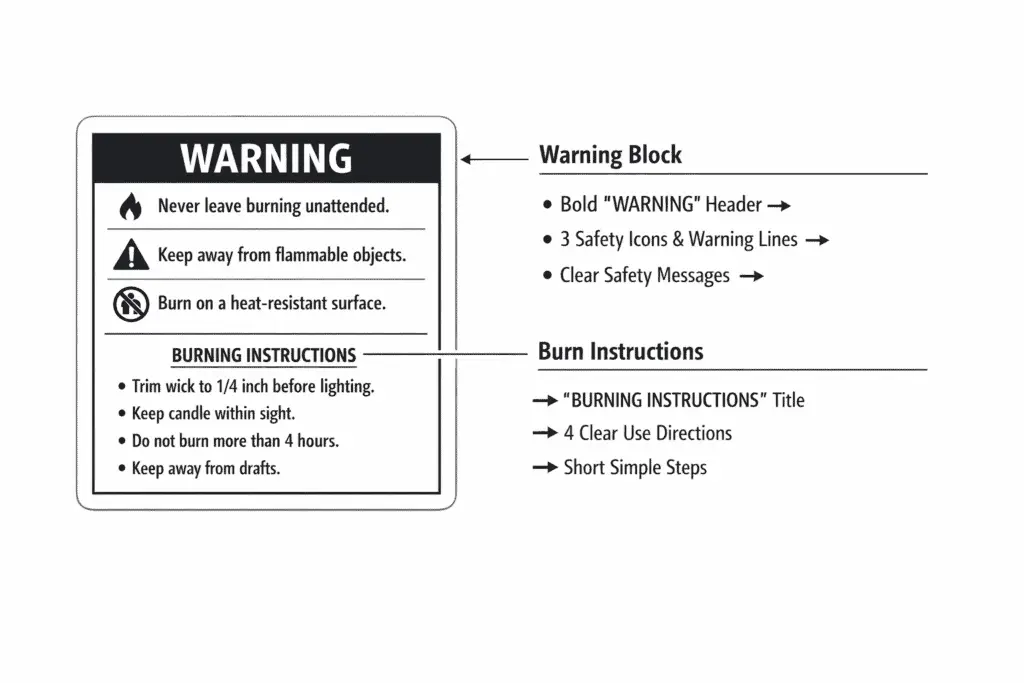
A practical warning block example (template)
Use this as a practical fire-safety wording example, not as a universal legal safe-harbor text for every candle or market.
WARNING
Burn within sight.
Keep away from things that catch fire.
Keep away from children and pets.
Then add 3–6 lines of burning instructions that prevent common incidents (unattended burning, drafts, unstable surfaces, and wick flare-ups). Avoid cute rewrites; safety copy should be short, standardized, and hard to misread.
What to include: identity of product & net contents
A compliant candle label states what the product is and how much wax is inside, using readable units and a layout that can’t be mistaken at a glance.
Identity should describe the product type plainly on the principal display panel (for example, “Scented Candle” or “Candle”) rather than relying on a collection name alone. Net contents should also appear on that main display panel, and for a wax candle they are typically stated by weight or mass in both U.S. customary and metric units rather than by volume.
A simple, repeatable method: weigh the filled candle, weigh the empty container (tare), subtract, and label the wax weight only.
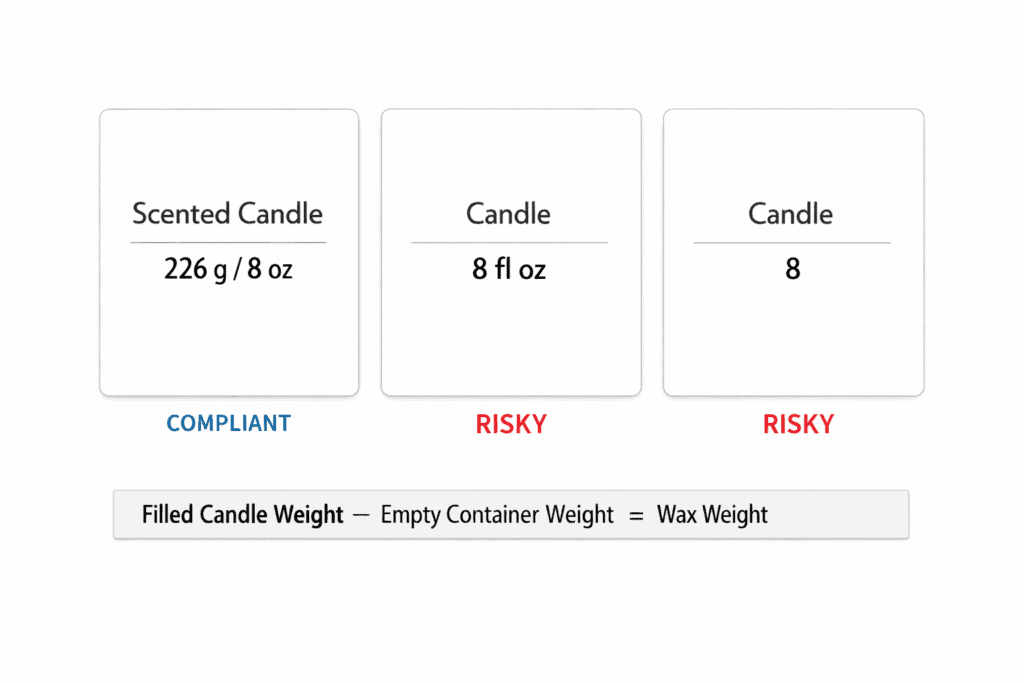
- Compliant: “Scented Candle” + “226 g / 8 oz” (weight-based, unit shown, easy to scan)
- Risky: “8 fl oz” on a wax candle (volume unit suggests liquid measure)
- Risky: “8” with the unit tucked elsewhere (a shopper can’t verify what it means)
Who made it: manufacturer/importer name & address
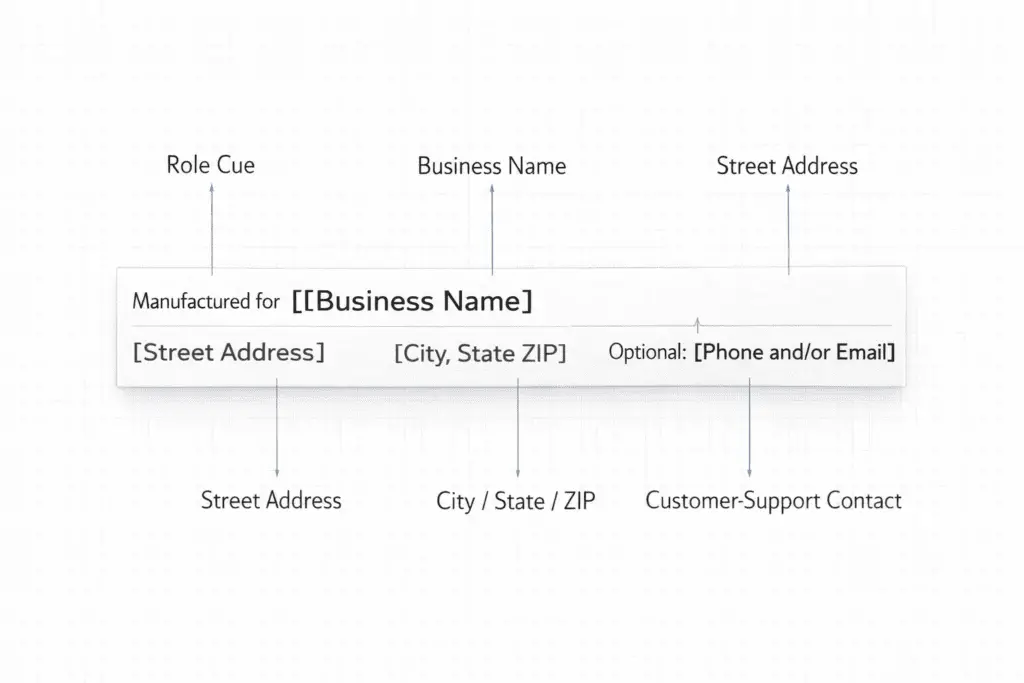
Candle packaging should identify the responsible party—manufacturer, importer, or “manufactured for/by” brand—using a contact format that lets customers and regulators reach the accountable business.
In the US baseline, the label should show the business name and place of business, and you should include the street address on-pack unless that address is already publicly available through a current directory or similar listing. Where EU CLP or GPSR obligations apply, the required product information can include the supplier or responsible-economic-operator name plus a postal and electronic address on the product, packaging, or an accompanying document, depending on the rule and packaging format.
A compact responsible-party line usually includes:
- Business name (legal or consistent trading name)
- Contact details appropriate for your market (commonly a full mailing address; sometimes a customer-service channel as well)
- A role cue like “Manufactured for” when you’re the brand owner using a contract manufacturer
Fire safety statement & burn instructions
Your safety text should include a clear cautionary warning plus short burning instructions that prevent the most common incidents.
Important framing: for many ordinary US candles, the familiar warning block is driven more by voluntary standards, retailer expectations, and general product-safety risk control than by one candle-specific statute dictating exact wording. Where FHSA hazard labeling is triggered, cautionary labeling becomes a legal requirement.
High-value burn instructions (the ones that prevent real problems):
- Trim wick before lighting; keep wick centered and upright
- Keep away from drafts; burn on a stable, heat-resistant surface
- Do not move the candle while lit or while wax is hot
- Keep wax pool free of matches and debris
- Stop use if the container cracks or the flame becomes unusually high
Placement & size: where labels go and minimum legibility
Your label must stay readable at the moment of use, which means placing warnings where they’ll be seen and printing them large enough to read under normal indoor light.
Practical placement rules:
- Keep branding/identity on the primary face.
- Put warnings and burn directions on the side/back or the base so they stay with the candle after unboxing.
- If you sell sets, repeat core warnings on the outer packaging so the message isn’t thrown away with the box.
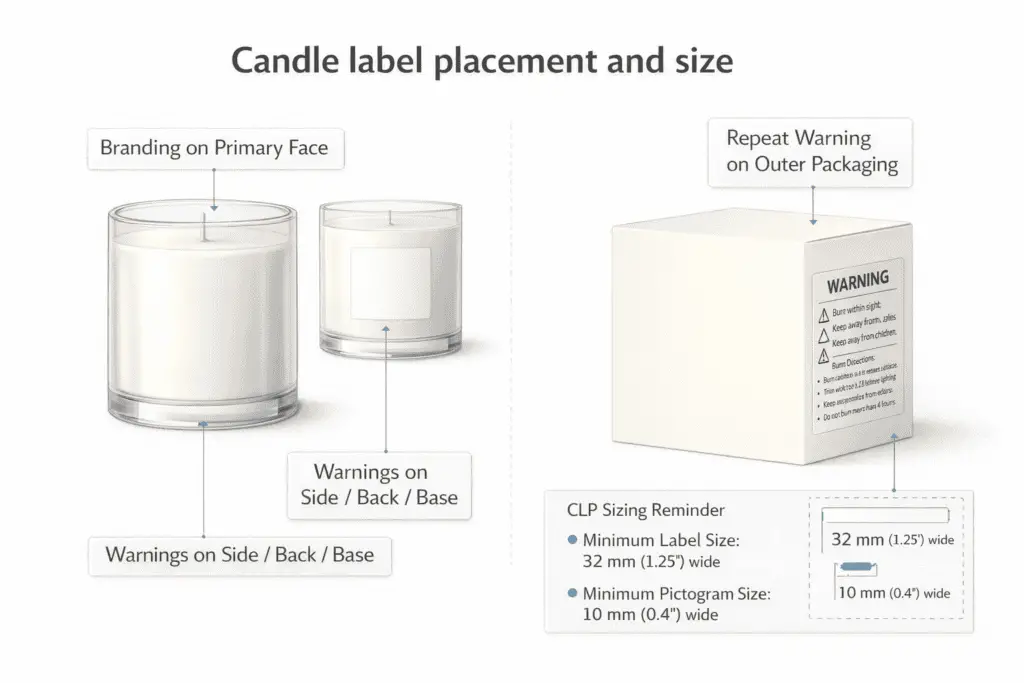
For legal minimums, rely on the rule set that applies to that market instead of a universal point-size rule. For example, Prop 65 short-form warnings have their own type-size floor, and CLP has separate label and pictogram sizing rules when CLP labeling applies.
EU CLP: minimum dimensions when CLP labeling applies
CLP includes minimum dimensions for labels and pictograms by package capacity, and it requires each pictogram to be at least 1/15 of the label space and not smaller than 1 cm².
For packages not exceeding 3 litres, a commonly cited minimum is a 52 × 74 mm label “if possible,” with pictograms at least 16 × 16 mm “if possible” (and not smaller than 10 × 10 mm).
Material & durability: labels that withstand heat and oils
Label material, adhesive choice, and application method affect usability rather than the legal baseline on this page; keep those execution details aligned with your broader candle safety compliance workflow.
Scent and colorants: disclosures and allergen signals
Scent and colorant disclosures become mandatory here only when the finished product triggers hazard-classification or supplemental-statement rules in the destination market; for the broader workflow behind those decisions, use the main candle safety compliance guide.
Children’s items & gift sets: special packaging considerations
Candle gift sets should repeat the core fire-safety warning on the outer packaging, and any age or small-parts notice belongs there when an included accessory creates that risk; beyond that summary, accessory-specific packaging detail should stay inside your broader candle safety compliance workflow rather than expand this page.
E-commerce vs. retail shelves: differences in labeling
Online listings should show key disclosures before purchase, while the physical package must carry the full identity, net contents, and safety/hazard information at the moment of use.
Treat online vs. shelf as two checkpoints:
For EU distance sales, make sure the online offer shows the manufacturer name or trade name, a postal and electronic address, the responsible person when the manufacturer is outside the EU, enough product identification to match the item, and any required warnings or safety information before checkout.
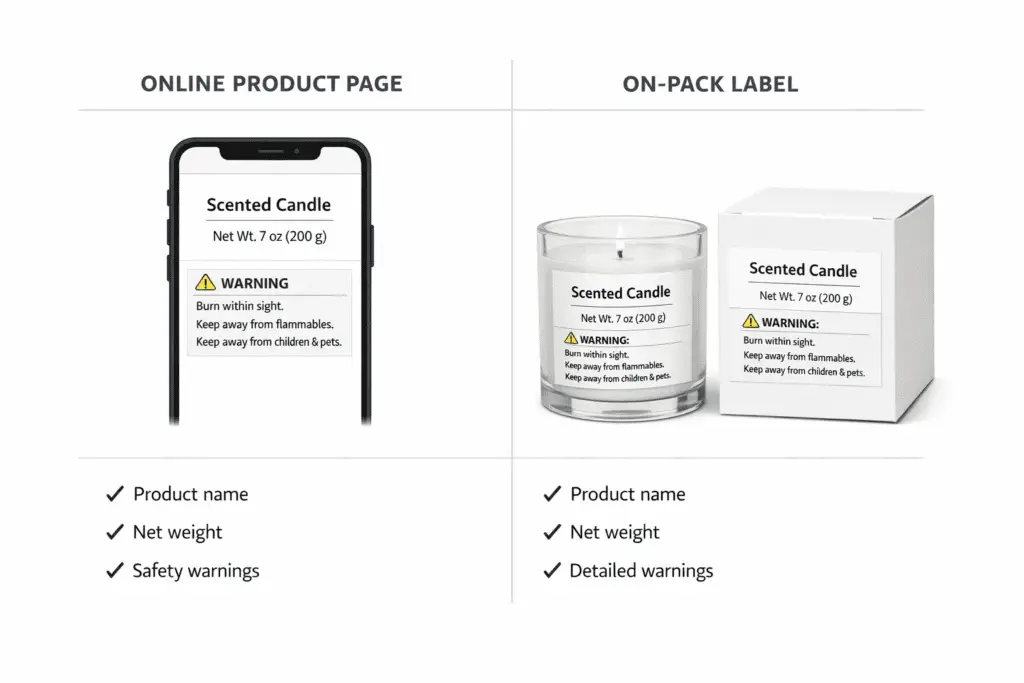
- Before purchase (PDP): identity, net contents, and any required warnings shown clearly, including at least one image where the warning block is readable on a phone.
- In-hand (on-pack): the same core information, readable on the actual curved container and not hidden by lids, bands, or gift packaging.
For EU distance sales, the online offer should also make the manufacturer or responsible EU economic operator and any required safety information easy to see before checkout.
For Proposition 65 safe-harbor approaches, OEHHA’s business FAQ gives an example of posting a photograph of the warning label on the website so the purchaser sees it prior to completing the purchase (and again prior to exposure).
US vs EU at a glance: scope, symbols, and wording
US candle labels typically rely on identity, net contents, and widely used fire-safety messaging, while EU sales may require CLP hazard classification with pictograms and standardized statements when ingredients trigger it.
Don’t treat US safety text as an EU-ready label. If EU CLP labeling applies to your product, you must design space for the CLP element set (pictograms, signal word, hazard statements, precautionary statements, supplier details), and you must also meet the minimum label/pictogram size rules by package capacity.
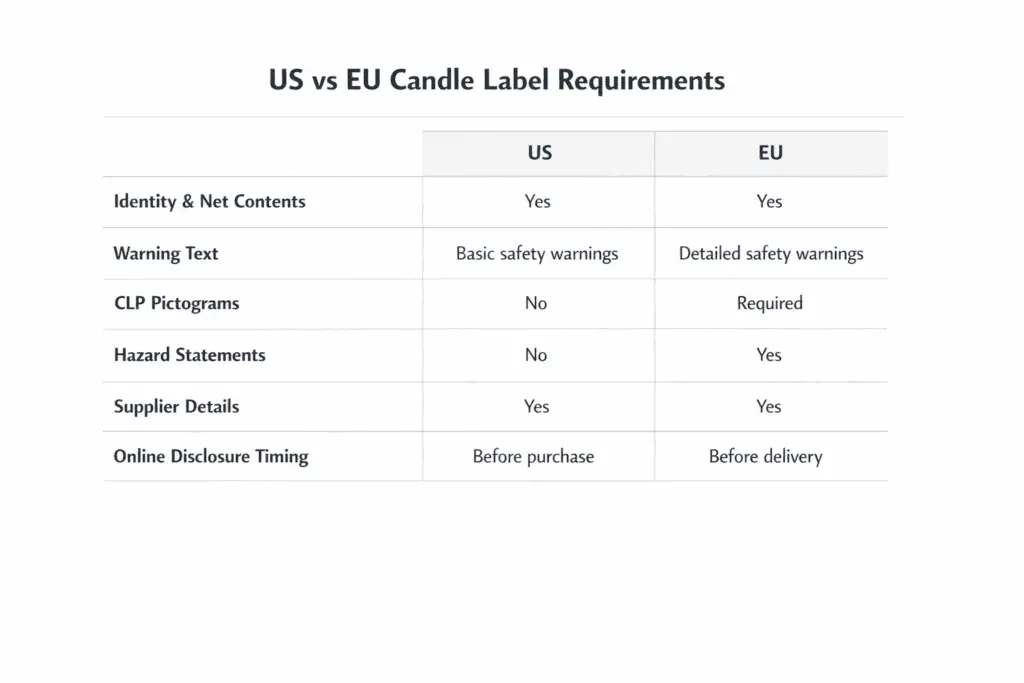
For EU sales, that compliance picture can also include manufacturer or responsible-economic-operator identification and traceability details beyond the CLP panel itself.
Recordkeeping & batch codes: traceability on the label
In the EU, a type, batch, serial number, or other identifying element can be part of the required traceability information; outside those rule-triggered cases, a batch code is still a practical traceability tool for candle makers and becomes especially useful when a marketplace, retailer, or internal quality system makes you identify a production run or product version.
The simplest batch/lot code is compact and human-readable:
- Date + line + batch: YYMMDD-LN-BB (example 251214-A3-07)
- Date + batch counter: YYYYMMDD-B### (example 20251214-B042)
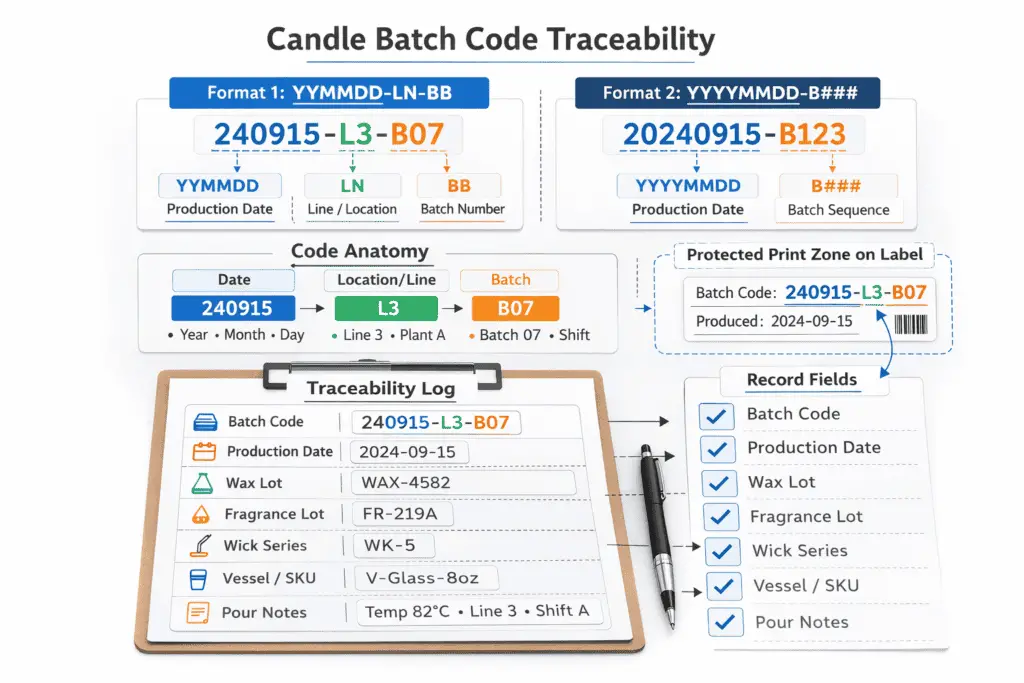
How to make it work in practice:
- Pick one schema and keep it across all scents and vessels.
- Log the code with wax lot, fragrance lot, wick series, vessel, and pour notes.
- Print it where it won’t smear (base label or a protected footer zone).
Common questions makers ask (quick answers)
- My retailer rejected my label—what’s usually missing? Net contents, responsible-party details, or a readable warning block are the most common gaps, especially in listing photos. For the broader compliance checklist that helps catch those issues before submission, use candle safety compliance.
- Is a PO box okay? Sometimes, but many retailers prefer (or require) a full physical address for accountability; in regulated contexts, follow the rule set that applies to your market and product.
- Do I have to list fragrance allergens? It depends on where you sell and whether your product’s classification triggers specific disclosures; for EU sales, start with classification and remember EUH208 can apply even when the mixture is not classified as sensitising. For the broader rule set behind those triggers, use candle safety compliance.
- Can I put warnings only on an insert card? Inserts help, but relying on an insert alone is risky because it can be discarded before use; keep warnings on the product or immediate packaging. For the broader placement framework, use candle safety compliance.
- Do online stores need to show warnings too? For disclosures that must reach the consumer prior to purchase or prior to exposure (for example, Proposition 65 when applicable), build the warning into your PDP flow and not only the shipped box.
For the broader pre-purchase disclosure framework, use candle safety compliance.
Before you print your next batch, do a quick label pass: confirm identity + net contents, verify the responsible party line, and make sure the warning block is readable on the actual container under normal indoor light. If you sell across borders, keep separate US and EU label versions so safety text stays legible even when hazard disclosures are triggered. Finally, add a batch code you can decode later, because it turns “something went wrong” into a fixable production note instead of a mystery.