

Yes, stearic acid and Vybar can sometimes be used in the same candle formula, but whether they should be combined depends on the wax type, candle goal, and whether one additive already solves the main problem.
Stearic acid and Vybar are candle additives with overlapping but non-identical jobs. Here, together means using both in the same candle formula or wax system, not treating them as interchangeable and not assuming the pairing is always the best choice. In many candles, one additive is enough, while limited co-use makes more sense when the formula needs help in two different areas. The main job of this page is to sort that decision without turning into a recipe page.
| Formula situation | Main problem | Is one additive often enough? | Are both worth testing? | Better next step |
| Paraffin-heavy formula needs stronger fragrance support | Fragrance behavior | Yes, often Vybar first | Sometimes | Test Vybar first, then compare against a paired batch only if a second problem remains |
| Formula mainly needs more hardness or opacity | Structure or appearance | Yes, often stearic acid first | Rarely | Test stearic acid first before adding a second additive |
| One additive already fixes the main weakness | Redundancy risk | Yes | No, usually not | Stop and evaluate the single-additive result before pairing both |
| Two separate weaknesses remain after a controlled test | Different unresolved problems | Not always | Sometimes | Compare a paired batch against the control and the single-additive batch |
What Stearic Acid and Vybar Actually Do in Candles
Stearic acid is mainly used to increase hardness and opacity, while Vybar is mainly used to support fragrance retention and hardness, so their functions can overlap without being identical.
Stearic acid and Vybar are both candle additives, but they do not serve the same primary formulation role. In simple terms, candle additive functions split here: stearic acid is used more directly when the wax needs a firmer or more opaque body, while Vybar is used more directly when the formula needs better fragrance support along with added structure. A plain way to remember what stearic acid does in candles is that it pushes the wax toward hardness and opacity, while what Vybar does in candles is help hold fragrance and support performance in many paraffin-heavy systems.
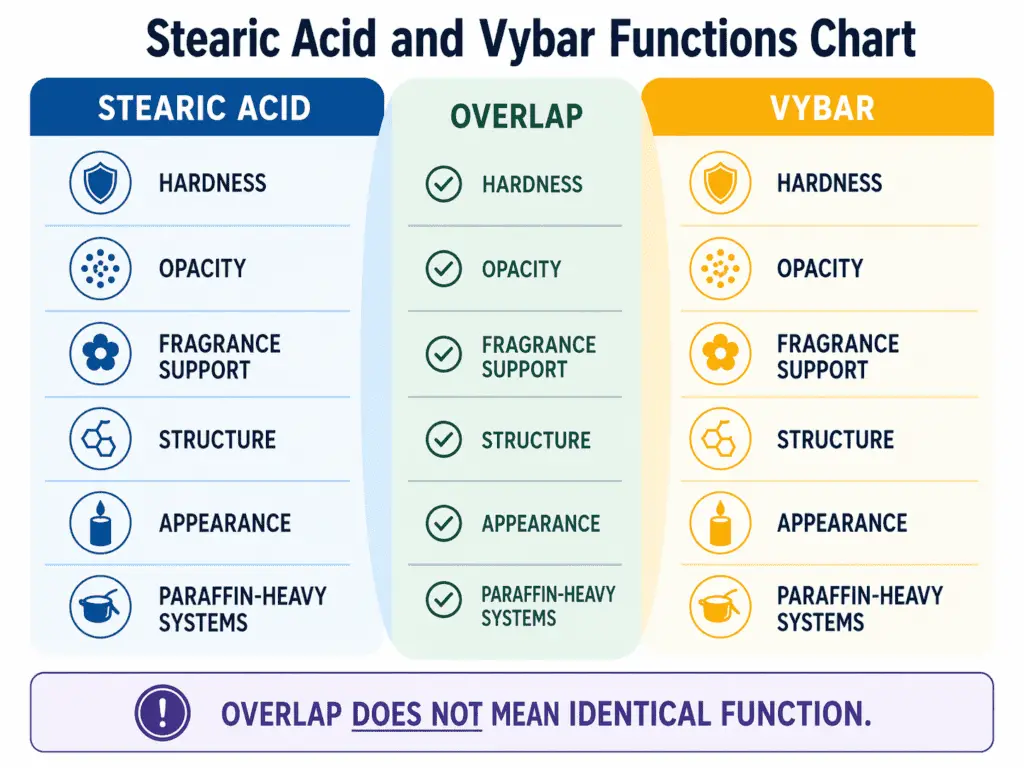
| Additive | Primary job | Common secondary effect | Where overlap happens | Where it stays distinct |
| Stearic acid | Increases hardness | Adds opacity | Can make the candle feel firmer | Less tied to fragrance support |
| Vybar | Supports fragrance retention | Adds structure and can improve finish | Can support hardness and appearance | More tied to fragrance behavior, especially in paraffin-heavy systems |
The overlap matters because readers often see the same outcome words used for both additives and assume that the additives do the same work. They do not. Shared results, such as more firmness, do not erase the fact that one additive is usually chosen for hardness and opacity first, while the other is usually chosen for fragrance support first.
That difference is why a function chart alone does not answer the next question. Two additives can move a formula in a similar direction without making both necessary in the same candle.
For the single-additive version of this question, use what stearic acid does in candles and what Vybar does in candles.
Can You Use Stearic Acid and Vybar Together?
You can sometimes use stearic acid and Vybar together, but a yes answer does not mean both additives are necessary or recommended in every candle.
A qualified yes is correct, but compatibility still has to be judged by candle goal and wax system. Here, together means co-use in the same formula, not a standard recipe rule and not proof that both additives always work better as a pair. In many formulas, one additive already covers the main need, so adding both can create overlap without adding much value.
A simple way to sort the answer is to separate possible, useful, and unnecessary.
Possible: the additives can exist in the same formula in some situations.
Useful: each additive is solving a different problem that matters in that formula.
Unnecessary: one additive already covers the main goal, so the second one mostly repeats the job.
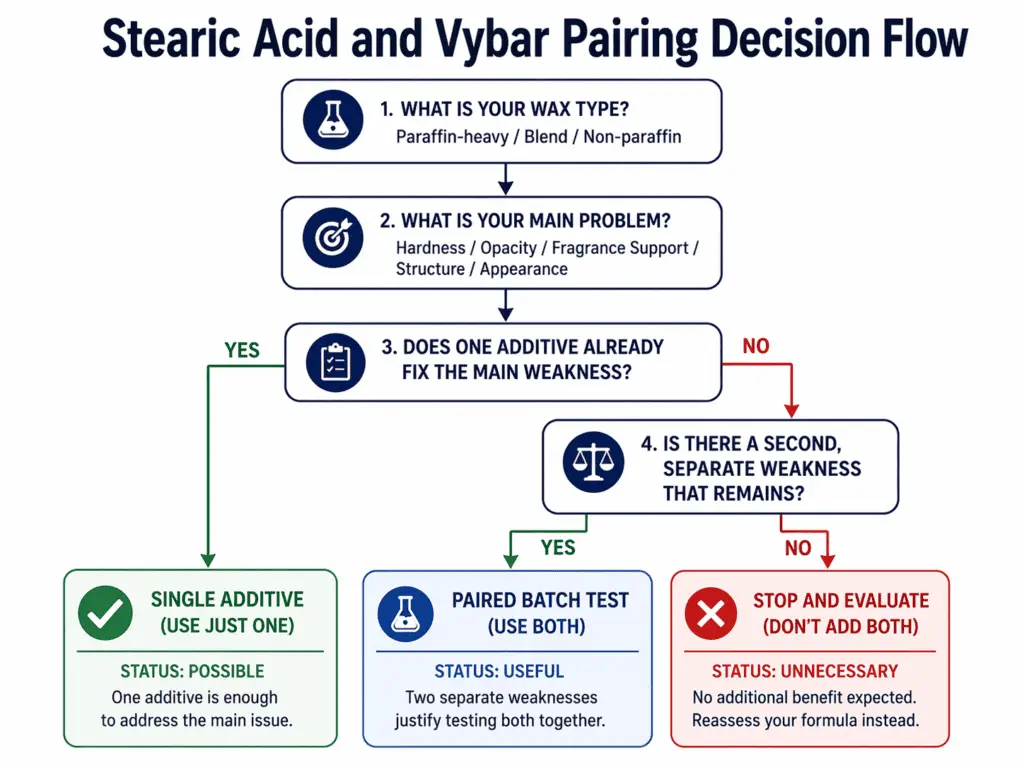
A paraffin-heavy container candle is where the qualified yes usually makes the most sense, because Vybar may be there for fragrance support while stearic acid may be considered for more firmness or opacity. Even then, the better question is not “Can I add both?” but “What problem is each additive fixing?”
When They Overlap, Replace Each Other, or Complement Each Other
Overlap does not make stearic acid and Vybar the same additive. In some candles, Vybar can cover part of the job that a maker might otherwise ask stearic acid to handle, especially when the formula is already paraffin-heavy and the main target is fragrance support plus a cleaner overall result. In other candles, stearic acid can cover the more pressing need on its own because the formula mainly needs hardness or opacity. That is the difference between overlap, partial replacement, and limited complementarity.
A useful rule is to ask whether the second additive changes the result in a different way or just repeats the first one. If it repeats the first one, the pairing is closer to redundancy. If it improves a separate weakness in the formula, limited complementarity can make sense. That is why “can” should never be read as “should,” and why “replaces” should never be read as “identical.”
When Using Both Is More Likely to Be Unnecessary or Counterproductive
Using both is more likely to be unnecessary when the first additive already fixes the main problem, because the second additive then adds overlap instead of a different benefit.
On this page, useful means each additive addresses a separate unresolved weakness in the same formula. Unnecessary means the second additive mostly repeats the first or adds another variable before the first change has been judged against a control batch. That is where co-use starts to increase formula noise instead of clarifying the decision.
Questions about exact additive dosage by wax type do not belong on this page because there is no single correct percentage that works across wax systems and candle types. The same boundary applies to mixing order for candle additives, because process sequence depends on the wax system and recipe method, so a generic step list here would mislead more than it would help.
This page only gives a narrow qualifier on candle additive safety. Full handling detail, supplier safety data sheets, and broader safety rules belong on a separate safety page so this comparison stays focused on additive choice.
Once compatibility is clear, the next step is to decide whether the formula still needs a second additive or whether the comparison should move to Stearic Acid vs Vybar for the broader side-by-side question.
What to Test First Before Using Both Additives
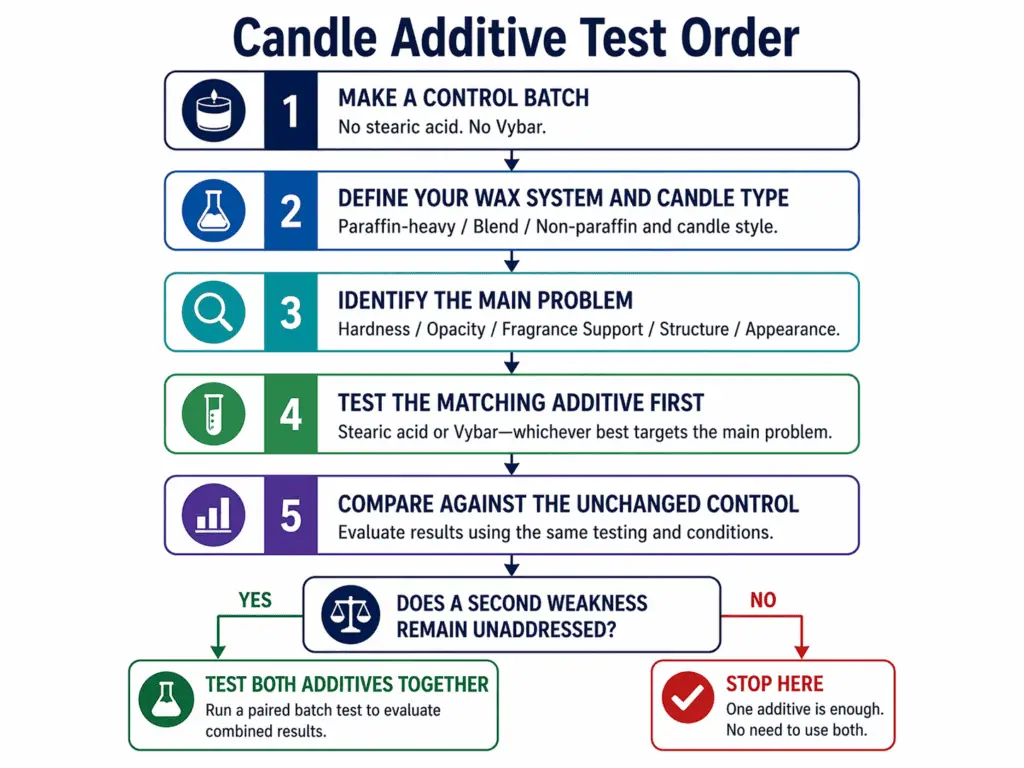
Test one additive at a time against a control batch before pairing both, because the goal is to confirm whether the second additive fixes a different problem or only repeats the first.
A short test order keeps the decision narrow:
- Start with the wax system and candle type, because paraffin-heavy formulas and softer blends do not react the same way.
- Name the main problem before you add anything else, such as weak fragrance support, low hardness, or a more opaque look.
- Test the additive that matches that main problem first, then compare it against an unchanged control batch.
- Only test both together when a second weakness still remains after the first additive has been judged on its own.
If the next step is controlled batch testing rather than a broader comparison, use how to test candle additives in small batches.
When to Use One Additive Instead of Both
Use one additive instead of both when one additive already matches the main problem in the formula, because adding a second additive too early can repeat the same job instead of fixing a different weakness.
Here, better means the better first additive to test for the main problem in the current formula, not the better additive overall.
When one additive already matches the main problem, using one additive instead of both usually makes the result easier to judge and keeps the formula closer to a single-variable test.
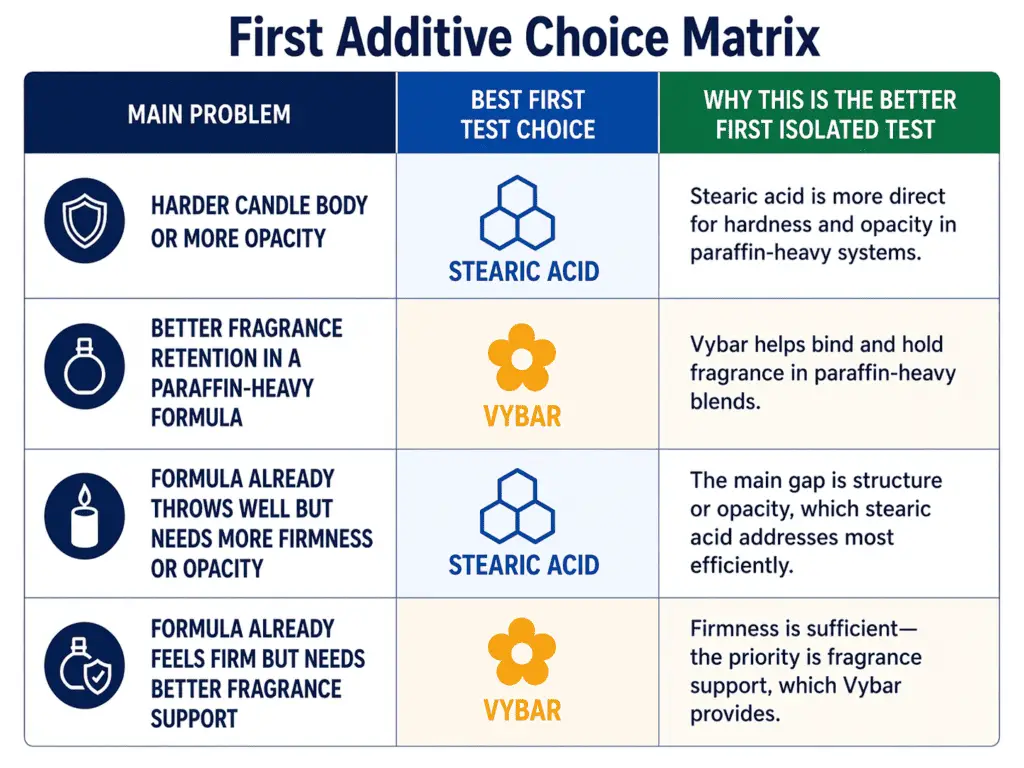
| Main problem | Better first additive to test | Why one additive may be enough |
| Harder candle body or more opacity | Stearic acid | It already targets firmness and opacity directly |
| Better fragrance retention in a paraffin-heavy formula | Vybar | It already targets fragrance support and added structure |
| Formula already throws well but still needs more firmness or opacity | Stearic acid | The second additive may repeat work that is not missing |
| Formula already feels firm but still needs better fragrance support in a paraffin-heavy system | Vybar | The decision stays tied to the unresolved problem instead of a general additive preference |
Visual and structural goals usually pull the first test toward stearic acid. Scent-focused goals in paraffin-heavy systems usually pull the first test toward Vybar. If the question is no longer about co-use, use Stearic Acid vs Vybar for the broader comparison or Choose Candle Additives for a wider additive-selection page.
Tradeoffs in Hardness, Opacity, Fragrance Behavior, and Release
These tradeoffs matter because an additive that improves one result first may still be the wrong first test for another result.
| Performance area | First test more often points to stearic acid | First test more often points to Vybar |
| Hardness or opacity | Yes | Less often |
| Fragrance support | Less often | Yes, especially in paraffin-heavy formulas |
| Appearance cleanup in paraffin-heavy formulas | Sometimes | Often |
| Release behavior in harder molded applications | Sometimes | Less often the first reason it is chosen |
These tradeoffs explain why pairing both is not automatically the better choice. They only show which additive is more likely to deserve the first isolated test.
How Wax Type Changes the Answer
Wax type changes the recommendation because paraffin-heavy and softer candle systems do not always benefit from the same additive choice.
A stearic-acid-versus-Vybar answer should be qualified by wax system, especially when paraffin-heavy logic may not transfer directly. This page uses wax type only to qualify the compatibility answer, not to replace a wax-specific guide.
| Wax system | Likely direction | Why the answer shifts |
| Paraffin-heavy wax | Vybar often gains ground when fragrance support is the main issue | Fragrance behavior and paraffin performance carry more weight |
| Paraffin formula needing more hardness or opacity | Stearic acid can gain ground | The main problem shifts toward firmness and appearance |
| Softer or soy-leaning blend | Qualify before choosing | Paraffin-first logic may not transfer cleanly |
When the reader needs blend-specific percentages or wax-specific process steps, move to dosage guidance or mixing guidance instead of extending this page.
Container vs Pillar vs Votive: Which Additive Fits Better?
Candle type changes additive fit because container, pillar, and votive candles prioritize different performance goals.
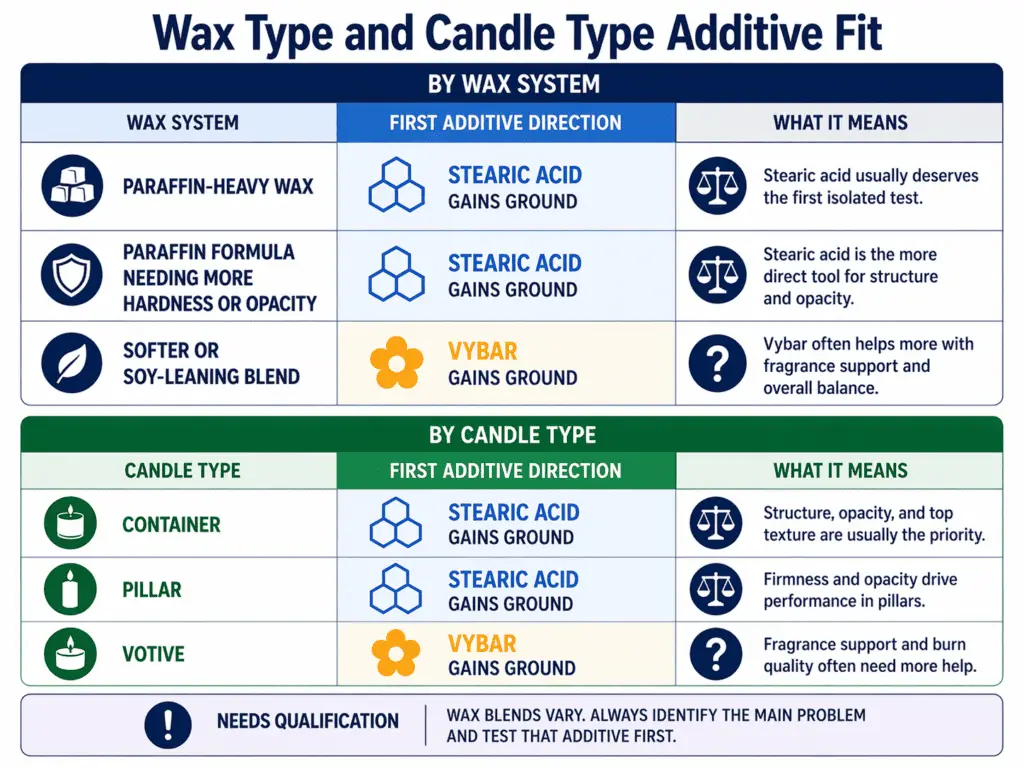
Here, fits better means fits the first isolated test for that candle type, not the better additive in every formula.
| Candle type | Stearic acid fit | Vybar fit | Why the fit changes |
| Container | Medium | Medium to strong | Fragrance behavior and softer-wax performance often matter more |
| Pillar | Strong | Medium | Hardness, structure, and shape-holding matter more |
| Votive | Strong | Medium | Firmness and release can carry more weight |
This application view stays subordinate here. It only explains why the first test can change by candle type; it does not replace a wax-specific or recipe-specific page.
If the remaining question is about overall additive choice rather than co-use, use Stearic Acid vs Vybar. If the remaining question is about one additive on its own, use what stearic acid does in candles or what Vybar does in candles.
When the reader needs exact percentages, step order, or full troubleshooting for a particular wax and candle type, the next step is to leave this compare page and use a narrower wax or application page instead.