
The best candle jars are purpose-fit containers for normal container-candle use, chosen by heat-safe construction, material, size tier, and workable shape rather than by appearance alone.
For most makers, the best default candle jar is a straight-sided glass jar in an everyday-use size tier because it gives the clearest balance of heat-safe screening, repeatability, labeling ease, and lineup flexibility. Ceramic suits gift-led candles when presentation matters more, while tins work better as a simpler adjacent container option than as the default jar family on this page. For broader format decisions, see How to Choose the Best Container for Your Candles in Candle Containers & Jars within Candle Making.
A candle jar here means a vessel chosen for normal container-candle heat exposure, not a random pantry jar, drinkware piece, or decorative storage container. On this page, best means safer candle use, better fit for the job, and easier day-to-day work, not the cheapest or prettiest option. Heat-safe means suited to intended normal burn conditions, and sizes means sample, gift, everyday, or larger-format tiers rather than exact fill-capacity math. The goal is to help you compare and select candle jars by material, heat-safe cues, size fit, and shape or width fit without drifting into burn-testing protocol, exact wick charts, headspace formulas, or wholesale sourcing.
Best Candle Jar Materials for Container Candles
The best candle jar material depends on use case: glass is the most flexible default, ceramic can suit gift-led presentation, and tins often keep beginner setups simpler.
For this comparison, candle jars means containers used for container candles, not general storage vessels that happen to look sturdy. Best material means the material that gives you the clearest fit for normal candle use, the least choice friction, and the fewest avoidable tradeoffs for the type of candle you want to make.
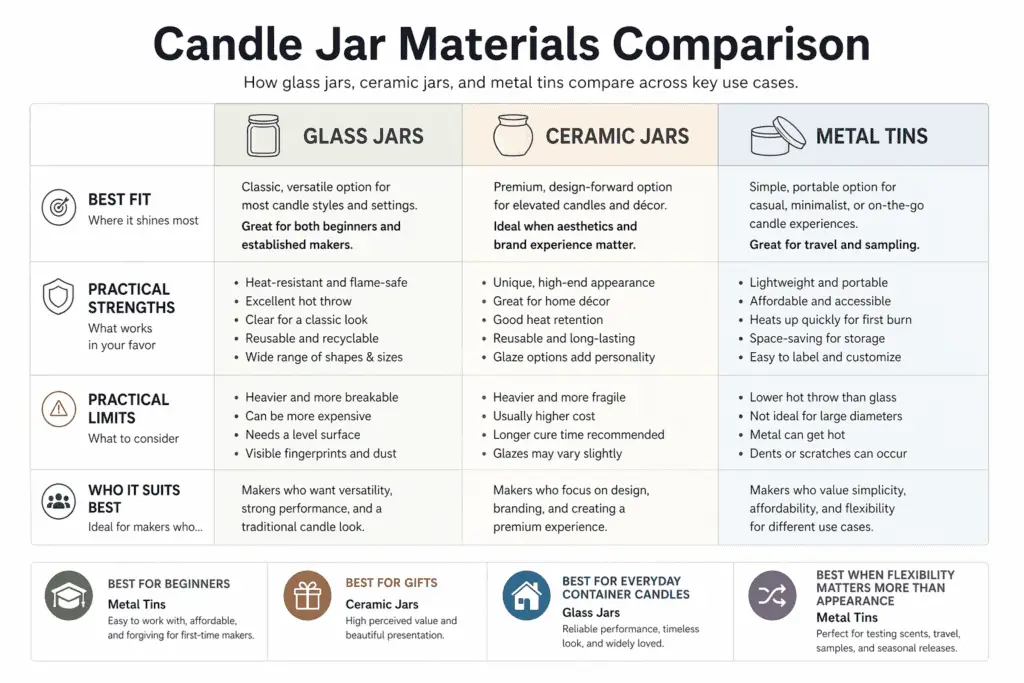
| Material | Best fit | Practical strengths | Practical limits | Suits best |
|---|---|---|---|---|
| Glass jars | Everyday container candles, broad product lines | Easy to match across styles, easy to label, easy to repeat | Not every glass container belongs in the candle-jar category | Makers who want one dependable starting point |
| Ceramic jars | Gift-led candles, smaller premium lines, display-focused releases | Strong presentation, solid shelf presence, often feels more special | Less flexible as a one-size default across many use cases | Makers who want a more presentation-led look |
| Metal tins | Starter lines, travel candles, simple everyday formats when a non-jar container is acceptable | Light, practical, compact, often easier for first projects | Useful as an adjacent candle-container option, not as the core candle-jar category on this page. For a direct format comparison, see Glass vs Tin Candle Containers: Which One Is Better?. | Beginners who are open to a non-jar container |
Glass is usually the safest default when you want one jar family that can carry the widest range of everyday use cases. Ceramic can work well when the candle needs a more gift-ready or decorative feel from the start. Tins are often the easiest first step when you want to keep the setup simple and avoid overcomplicating your first container choices.
A quick best-by-scenario split makes the tradeoffs easier to read:
| Scenario | Best starting pick | Why |
|---|---|---|
| Best for beginners | Tins | They usually keep the setup simpler and reduce choice overload |
| Best for gifts | Ceramic | The presentation does more of the work |
| Best for everyday container candles | Glass | It stays the most flexible across a wider range of lineups |
| Best when flexibility matters more than appearance | Glass | It gives the broadest all-around fit for repeat use |
One point matters early: thick glass alone is not enough. A container can look heavy, solid, or familiar and still not belong in the candle-jar category on this page. If your question turns into proof-level thermal limits, deep material safety science, or pass-fail testing, that belongs in Heat-Resistant Glass for Candles: Annealing & Thermal Shock rather than here.
What Makes a Candle Jar Heat-Safe?
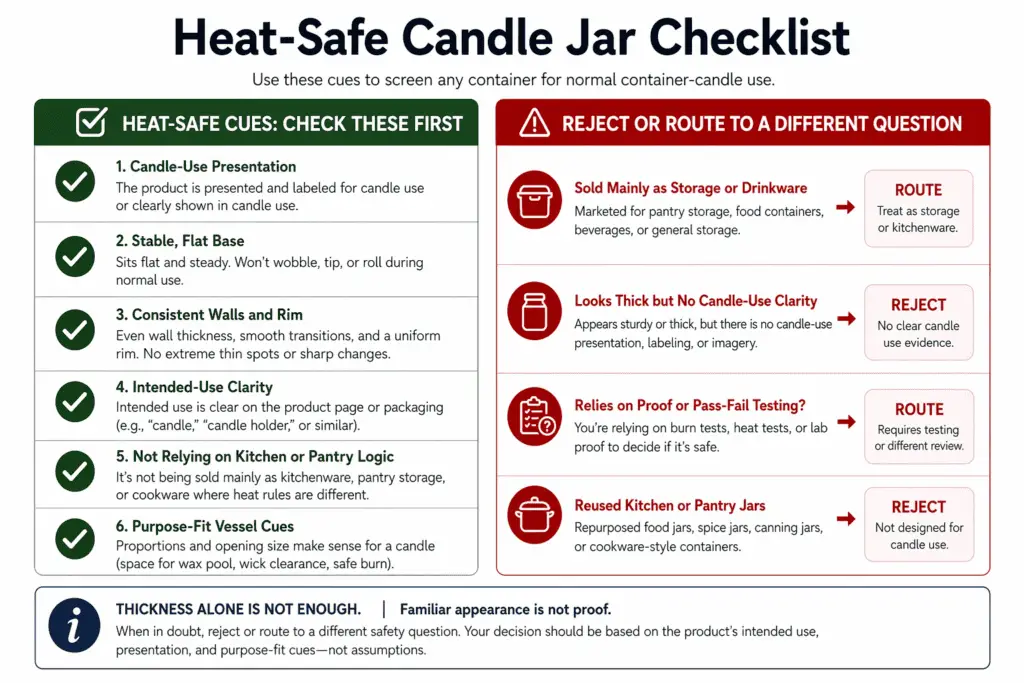
A heat-safe candle jar is a container suited to normal candle-burn conditions through intended-use clarity and reliable construction signals, not just thickness or familiar appearance.
On this page, heat-safe does not mean oven-safe, misuse-proof, unbreakable, or validated for every possible setup. It means the jar gives you the right screening cues for normal container-candle use before deeper testing questions start.
Use this checklist before you shortlist a jar:
- The product is presented for candle use or for candle-ready container use, not just for storage, drinks, or general décor.
- The base looks stable and the overall profile does not look awkward for normal candle use.
- The walls, rim, and body look consistent rather than thin in one place and heavy in another.
- The product details give you some intended-use clarity instead of leaving you to guess from appearance alone.
- The jar does not depend on kitchen logic, ovenware logic, or pantry logic to sound suitable.
- The container looks like a purpose-fit vessel, not like a household item being pushed into a second job.
Use this reject-or-route check when the fit is weak:
| What you see | What it means on this page | What to do |
|---|---|---|
| Sold mainly as storage, drinkware, or décor | It is outside the candle-jar decision set until proven otherwise | Reject it for this page |
| Looks thick but gives no candle-use clarity | Thickness alone is not a decision rule | Do not treat it as candle-ready |
| You want proof, protocol, or pass-fail testing | The question has moved beyond screening | Route it to Heat-Resistant Glass for Candles: Annealing & Thermal Shock |
| You are comparing reused kitchen or pantry jars | The question has moved into a separate risk path | Route it to Are Recycled Jars Safe for Making Candles? or Can You Use Mason Jars for Candles? (Are They Safe?) |
The most common false assumptions are easy to name once the modifier is defined. Thick glass is not the same as candle-safe. Oven-safe is not the same as candle-safe. Pantry-safe is not the same as candle-ready. A familiar jar shape is not proof that the jar belongs in a normal container-candle setup.
Repurposed Household Jars vs Candle-Made Jars
Purpose-made candle jars belong to the candle-jar category by design, while repurposed household jars require separate screening and should not be treated as equivalent by default.
This is a boundary-setting qualifier only. Its job is to keep the article on purpose-fit candle jars and route reused-jar, pantry-jar, and mason jar safety questions to separate pages.
| Jar origin | Intended-use confidence | Decision confidence | Route outcome |
|---|---|---|---|
| Candle-made jar | Built or sold for container-candle use | Higher at the screening stage | Keep it in this page’s decision set |
| Repurposed household jar | Built for another job first | Lower until separately screened | Move it to a separate safety and testing path |
A candle-made jar belongs in the candle-jar universe from the start because it is selected and presented for container-candle use. A repurposed household jar belongs in a different decision path because appearance and thickness do not answer the same question. If the real question is whether a mason jar or reused kitchen jar is safe for candles, move to Can You Use Mason Jars for Candles? (Are They Safe?) or Are Recycled Jars Safe for Making Candles?.
Best Candle Jar Sizes by Use Case
Candle jar sizes should be chosen by use case first, with tier-based selection for samples, gifts, everyday candles, or larger formats rather than exact fill-capacity math.
On this page, sizes means practical buying and selection tiers. It does not mean finished wax weight, exact headspace, or fill-capacity calculations. The first job is to match the jar to the role the candle will play, then narrow the range so the lineup stays easier to manage.
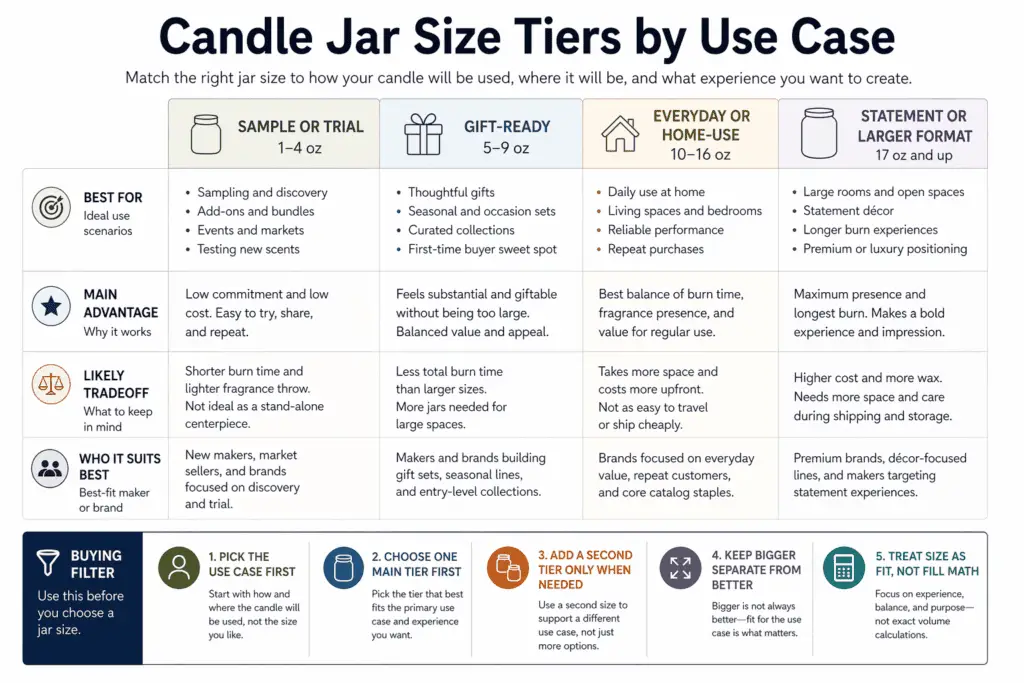
| Size tier | Best for | Main advantage | Likely tradeoff | Who it suits best |
|---|---|---|---|---|
| Sample or trial | Test pours, sampler sets, low-commitment gifts | Easy to test ideas without building a full-size line | Can feel too small for everyday use | New makers and sample-led lines |
| Gift-ready | Event favors, seasonal gifts, smaller premium candles | Feels presentable without becoming bulky | Less useful as a single default for every buyer | Gift-led lines |
| Everyday or home-use | Core range, repeat buyers, daily burning | Usually the easiest tier to build around | Can feel less special than a larger format | Most makers and most home-use ranges |
| Statement or larger format | Bigger display candles, shelf-led pieces, stronger gifting | More visual presence and a more dramatic format | Raises fit and setup questions sooner | Makers with a clear format plan |
For most makers, the best starting size is the everyday or home-use tier because it covers the broadest middle ground for normal use without turning jar choice into a special-case or display-first decision.
A good beginner move is to start in the everyday or home-use tier, because it usually sits in the broadest middle ground between gifting, repeat use, and lineup consistency. Sample jars make sense when testing or sampler selling is the point. Larger formats make sense when shelf impact is part of the goal, but they should not be the first choice just because they look more impressive.
Use this quick buying filter before you add more than one size tier:
- Pick the use case first.
- Choose one main tier before adding edge-case sizes.
- Add a second tier only when the first already has a clear job.
- Keep “bigger” separate from “better.”
- Treat size as a fit decision, not as a fill-capacity calculation.
When the question becomes exact fill amount, headspace, or finished wax-weight math, stop the size discussion and move to Candle Jar Fill Capacity & Headspace Guide. When width starts driving the decision more than overall size, the next useful question is How Jar Shape and Diameter Affect Wick Choice, Hot Throw, and Overheating.
Best Candle Jar Shapes and Width Profiles
The best candle jar shape is the one that keeps pouring, labeling, and repeatability easier, with width used as a practical fit signal rather than a full wick-engineering answer.
Shape and width matter because they change how easy the jar is to work with, how consistent the lineup looks, and how quickly setup questions start to get more technical. On this page, best shape means easier workability and clearer fit, not the most decorative silhouette.
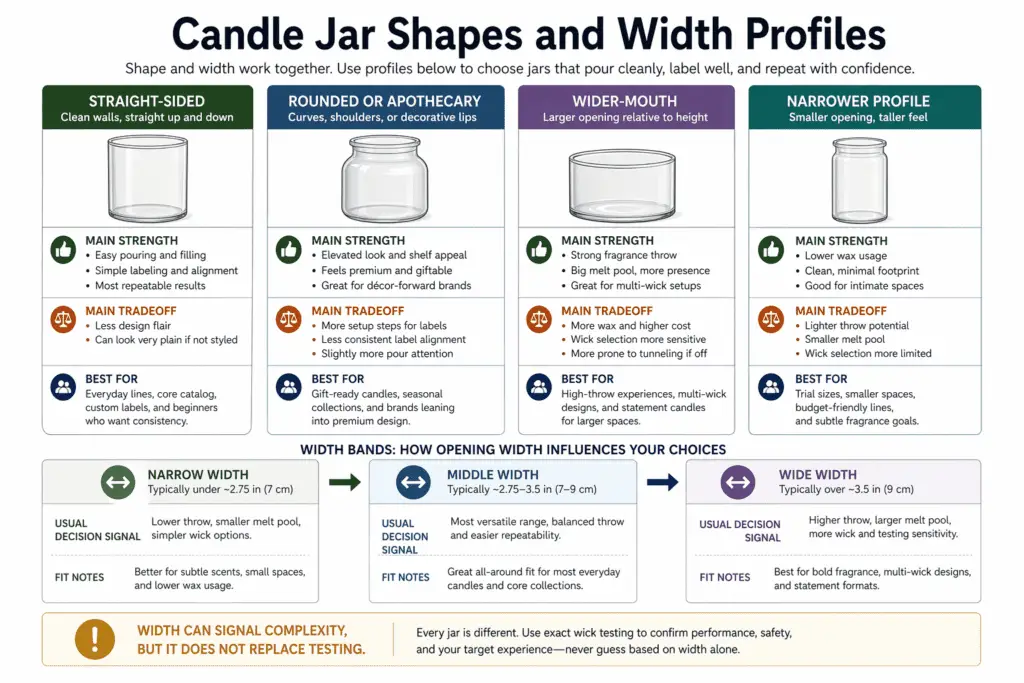
| Profile | Main strength | Main tradeoff | Best for |
|---|---|---|---|
| Straight-sided | Easier pouring, labeling, and lineup consistency | Less decorative character | Everyday lines and repeatable formats |
| Rounded or apothecary | Stronger decorative feel | More workflow tradeoffs | Gift-led or display-led candles |
| Wider-mouth | Easier access during pouring and a broader look | Width-related setup questions appear sooner | Makers who want easier access and more shelf presence |
| Narrower profile | Compact look and tighter format control | Less room for larger presentation styles | Small-format lines and tidy, uniform ranges |
Straight-sided jars usually win when repeatability matters most. Rounded or apothecary jars can work well when the look is part of the product story, but they tend to add tradeoffs in labeling, workflow, or lineup consistency. Wider-mouth jars can feel easier to fill and more open in presentation, while narrower profiles can feel more compact and controlled.
Single-Wick vs Multi-Wick Suitability by Jar Width
Jar width can indicate when setup complexity is likely to rise, but it does not replace exact wick testing or chart-based selection.
Width matters here only at decision level. It shows when the setup is likely to stay simple and when the jar starts pushing the choice toward a more technical path.
| Width band | Usual decision signal | Best fit |
|---|---|---|
| Narrow | Simpler setup is more likely | Beginners and compact formats |
| Middle | Often the easiest balance of fit and flexibility | Core product lines |
| Wide | Setup questions become more important | Makers ready for more testing and format planning |
This section does not turn jar width into a wick chart. It only marks where jar choice stops being simple. When wick count, wick series, or test cycles become the main question, move to How Jar Shape and Diameter Affect Wick Choice, Hot Throw, and Overheating.
Straight-Sided vs Rounded/Apothecary Usability
Straight-sided jars are usually easier to standardize and label, while rounded or apothecary jars add decorative appeal with more workflow tradeoffs.
This comparison is about practical use, not visual taste alone. If you are choosing between these profiles, the useful question is not “Which one looks better?” but “Which one is easier to repeat, label, pour, and keep consistent across a line?”
| Profile type | Workflow ease | Labeling ease | Lineup consistency | Best for |
|---|---|---|---|---|
| Straight-sided | Easier | Easier | Easier to repeat | New makers and core ranges |
| Rounded or apothecary | More variable | More variable | Harder to keep uniform | Decorative or gift-led candles |
If you want fewer avoidable decisions, start with straight-sided jars. If the decorative upside matters enough to accept more tradeoffs, rounded or apothecary jars can still fit the page’s scope. When the choice becomes mostly about style inspiration, stop here and move to Decorative Candle Jar Styles.
Lid and mouth-width details belong after the main profile choice is already clear. A wider opening can make pouring and re-lidding easier, and lid fit can matter for storage, gifting, and everyday handling. Those details help with convenience, but they do not prove heat-safety. Deeper accessory questions belong in Lids & Accessories Guide.