
Natural candle dyes suit muted, ingredient-led candles with more testing, while synthetic candle dyes suit brighter, more repeatable results and are the practical default for most candle makers.
On this page, natural candle dyes mean plant- or mineral-derived colorants used to tint candle wax, while synthetic candle dyes mean purpose-made candle dyes formulated for wax. It does not cover undyed wax color, general craft colorants or food coloring, or mica and other special-effect additives.
This page is for candle makers who need to choose the right dye family before they test or scale. On this page, right means the dye family that fits your visual goal, repeatability needs, wax or product form, and tolerance for testing, not a safety, health, sustainability, or compliance judgment. It compares natural and synthetic candle dyes by color strength, consistency, fade risk, and project fit. It keeps format-specific and troubleshooting questions separate so the first choice stays clear. The next step is to decide when each dye family fits your wax, finish, and batch goal.
What is the difference between natural and synthetic candle dyes?
Natural candle dyes usually give a softer, more muted result, while synthetic candle dyes usually give stronger color and easier repeatability.
For the full guide to dye types, wax fit, and next-step decisions, start with Candle Dye & Coloring.
Natural colorants usually keep a softer, less saturated look and accept more shade drift, while candle-safe synthetic dyes are usually easier to repeat across batches, waxes, and product types. That border matters because not every natural-looking ingredient or general craft colorant belongs in candle formulas.
| factor | natural candle dyes | synthetic candle dyes | better choice when |
| finished look | softer, earthier, more muted | brighter, cleaner, more saturated | pick the look you actually want |
| repeatability | more variable from batch to batch | more consistent and easier to match again | choose synthetic for repeat formulas |
| testing burden | usually higher | usually lower | choose natural only if you can test more |
| fade resistance | can be less predictable | often more stable in standard candle formulas | choose synthetic for display-heavy products |
| wax flexibility | can be more selective by wax and project | usually easier across common wax systems | choose synthetic for broader compatibility |
| brand fit | ingredient-led, artisan positioning | performance-led, production-friendly positioning | match the product promise |
| main trade-off | less intensity and less predictability | less natural positioning | accept the trade-off that matters less to your buyer |
This matrix compares natural and synthetic candle dyes by finish, repeatability, fade risk, wax flexibility, and brand fit.
Natural colorants usually cost more in time because they often need more reformulation, more batch checks, and more acceptance of shade drift, while synthetic dyes usually take less effort to repeat.
When should you use natural vs synthetic candle dyes?
Use natural candle dyes when a softer, naturally styled result matters more than maximum brightness, and use synthetic candle dyes when strong color and repeatable batches matter more.
On this page, the right choice means the dye family that fits your visual goal, repeatability needs, wax or product form, and tolerance for testing. That usually points to natural when muted, ingredient-led color matters more than batch matching, and to synthetic when clean repeatability matters more than natural positioning.
That choice gets easier when you decide what matters most before you buy or dose anything. Start with the visual goal, then check how much variation you can tolerate, and then ask how much testing you are willing to repeat before you lock a formula.
Natural candle dyes usually make more sense in these cases:
- You want muted, warm, rustic, or ingredient-led color.
- Your brand positioning values naturally derived ingredients more than vivid saturation.
- You are making small batches and can test before scaling.
- Perfect shade matching matters less than the overall visual style.
Synthetic candle dyes usually make more sense in these cases:
- You want bright, dark, or highly saturated color.
- You need a formula that repeats cleanly across batches.
- You work across multiple waxes or product forms and want easier control.
- You want faster troubleshooting and simpler color adjustment.
If you plan to scale production or need easier reordering and shade matching, synthetic candle dyes are usually the more practical default because candle-safe options are easier to source and repeat.
What actually changes the choice between natural and synthetic dyes?
The real decision usually comes down to wax fit, form factor, color strength, repeatability, and how much testing you can support.
Ingredients matter, but they do not decide the whole outcome on their own. A dye family that fits one wax, container, or visual goal can be the wrong fit for another, so the practical choice should follow the finished product you want to make.
The safest starting point is still a candle-specific colorant. Random food colorings, water-based craft colorants, or other non-candle additives are not a normal substitute just because they look natural or easy to find.
Wax and form factor
Wax and form factor change the natural-vs-synthetic choice because containers usually reward more controlled, repeatable color systems, while pillars, votives, and melts leave more room for softer or appearance-led color choices.
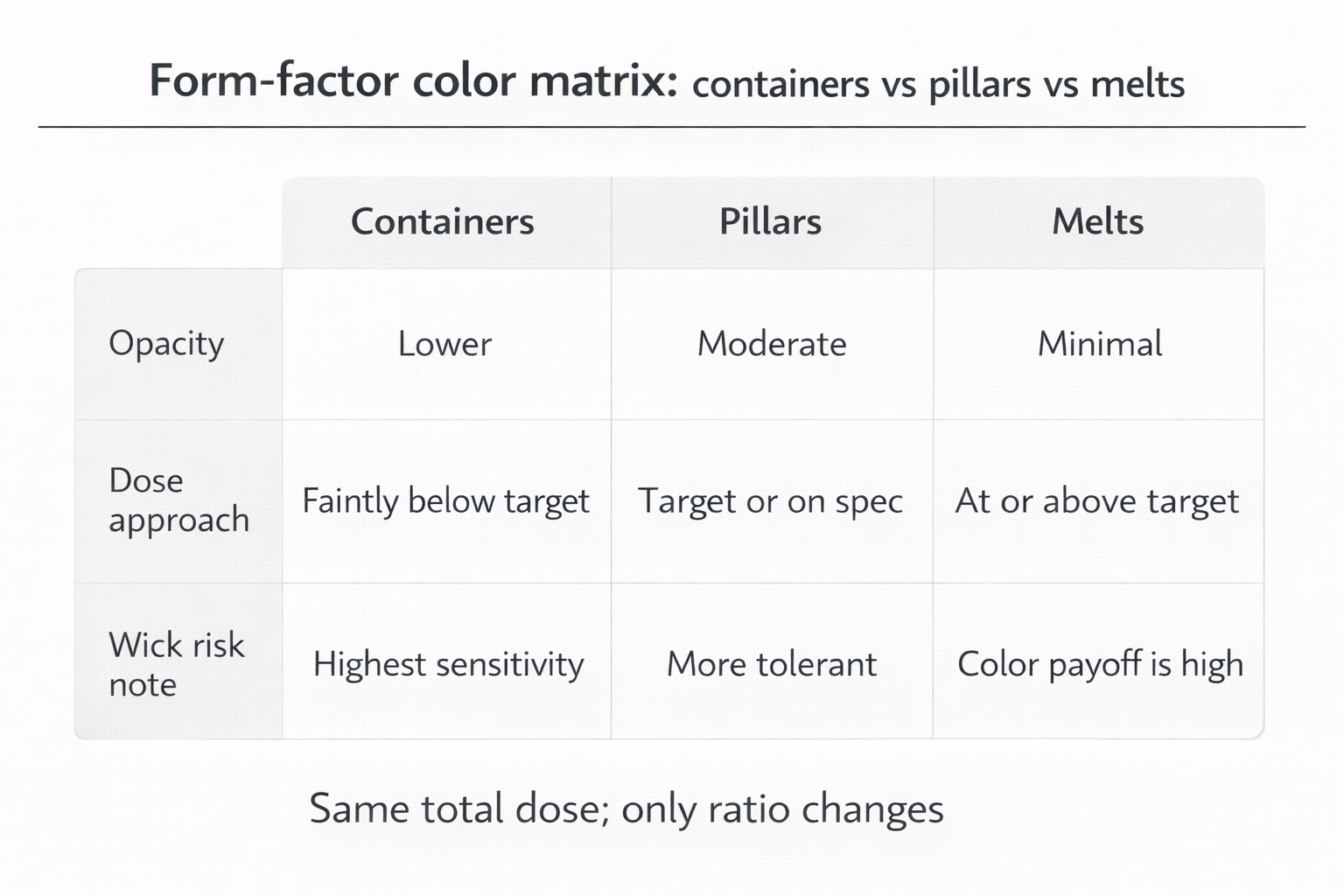
This matrix shows how colorant choices shift across containers, pillars, votives, and melts.
Containers trap heat, so heavy dye or particle loads can push wick systems toward soot or unstable burns. Pillars and votives usually give you a little more room for stronger color decisions, while melts let you care more about appearance than flame performance. When you change from containers to pillars or melts, rerun at least a small test instead of assuming the same formula still behaves the same way.
Color strength and finish
If you want bright or dark shades, synthetic candle dyes are usually the easier path, while natural colorants are often a better fit for muted or naturally styled color.
Soy is a good example of that trade-off. Very bright color can be harder to hold cleanly in soy, so gentle pastels, warm neutrals, and mid-depth shades often look better than forcing deep saturation. For a soy-specific color discussion, use Best Candle Dye for Bright Color in Soy Candles.
Repeatability and testing burden
Natural colorants usually need more small-batch testing, while synthetic dyes are usually easier to dose, repeat, and troubleshoot.
For display-heavy products or lines that need repeat shade matching, synthetic dyes are usually the steadier choice because the color tends to stay more predictable from batch to batch and through storage.
The finished shade can shift with wax, fragrance, cooling, and source variation, so repeatability matters as much as the first good result. If your main problem is mixing or streaking, go to How to Color Candle Wax Without Clumps or Bleeding. If the batch already cured wrong, use How to Fix Uneven or Off-Color Candles. If the shade fades later in storage, sunlight, or display, use How to Keep Candle Color from Fading.
Special-effect materials are a separate decision
Mica and other special-effect additives should not be treated as a normal extension of the natural-vs-synthetic choice.
Particles can change opacity, residue, and wick behavior, especially in containers, so they need their own test path instead of being folded into a standard color formula. When the real question is shimmer, particles, or additive safety, the correct next page is Can You Use Mica Powder in Candles?.
What should you read next?
Read the next page that matches the narrow problem you still need to solve after you choose between natural and synthetic candle dyes.
This page handles the comparison. The pages below handle the narrower jobs that need more detail, more troubleshooting, or a more specific format.
- Types of Candle Dye: Liquid, Chips, Blocks, and More — use this when you still need to compare the dye formats themselves.
- How to Choose the Right Dye for Your Candles — use this when you want the fastest project-level recommendation.