To ship candles safely, inspect each finished candle, protect the container, cushion it, box it with clearance, control heat risk when needed, seal it, label it, and add presentation only after protection is secure.
Shipping candles means preparing finished jar, tin, pillar, or container candles for parcel transit so the candle, container, label, and customer presentation survive handling. Here, “package” means protective transit packaging, not decorative gift wrapping or product-label design. A safe candle shipment is one that arrives intact, leak-free, scent-contained, label-protected, and presentable under reasonable carrier-handling and heat-risk conditions. The focus stays on packing finished candles for customer delivery, not candle formulas, shipping-rate calculation, full carrier law, or international customs guidance.
Most finished candles can be shipped through parcel carriers when the product is allowed by the carrier, packed to prevent breakage or leakage, and checked against any ingredient, destination, or marketplace restrictions.
Why Candles Need Special Packaging Before Shipping
Candles need special packaging because they combine fragile containers, wax that can soften, movable lids, scuffable labels, transferable scent, and clean-delivery expectations. Shipping candles means preparing finished jar, tin, pillar, or container candles for parcel transit so the candle, container, label, and customer presentation survive handling. “Safe” means practical risk reduction: intact, leak-free, scent-contained, label-protected, and presentable, not legally certified, heat-proof, or impossible to damage.
| Failure mode | Why it happens | Packaging prevention | Related section |
|---|---|---|---|
| Broken glass | Jar walls hit the box, another candle, or a hard surface during drops. | Wrap the jar, add cushioning, and stop candle-to-box contact. | How to Protect Candle Jars, Tins, Lids, and Labels |
| Dented tins | Metal containers compress or rub against other products. | Add surface wrap and keep tins separated. | How to Protect Candle Jars, Tins, Lids, and Labels |
| Loose lids | Vibration works the lid away from the container. | Check the lid, restrain it, and wrap over the closure. | How to Protect Candle Jars, Tins, Lids, and Labels |
| Wax softening | Warm vehicles, delays, or soft wax make the surface unstable. | Reduce heat exposure with timing, insulation, and containment. | How to Ship Candles in Warm Weather Without Overpromising Heat Protection |
| Oil seepage | Warm wax or fragrance movement reaches the container edge or label. | Bag or contain risky candles and protect label surfaces. | How to Ship Candles in Warm Weather Without Overpromising Heat Protection |
| Scent transfer | Fragrance reaches paper, inserts, or nearby items. | Wrap candles individually and avoid loose scented contact. | Bubble Wrap, Paper, or Void Fill: What Works Best for Shipping Candles? |
| Label abrasion | The label rubs against wrap, paper, or another candle. | Shield the label face with a smooth barrier. | How to Protect Candle Jars, Tins, Lids, and Labels |
| Poor unboxing | Protection shifts, inserts crush, or wax marks the package. | Lock the candle in place before adding presentation layers. | Add Presentation Layers Without Replacing Protective Packaging |
This risk table is based on common seller-reported shipping failures and practical packaging analysis, not carrier certification. It helps match each candle failure to a packaging decision before the candle goes into the outer box.
Keep rate, destination, and carrier-rule questions outside the protective packing workflow. Use calculate candle shipping costs for rates, zones, weight, or service level; use international candle shipping rules for cross-border delivery. Broader seller operations belong under Candle business and sales, not inside the candle-protection workflow.
How to Protect Candle Jars, Tins, Lids, and Labels
Protect candle jars, tins, lids, and labels by inspecting the finished candle, securing the lid, wrapping vulnerable surfaces, shielding scuffable labels, separating multiple candles, and keeping every candle away from box walls. Candle container protection covers the jar, tin, ceramic vessel, lid, and label surface during parcel transit. Here, “protect” means absorbing impact, stopping abrasion, limiting lid movement, and preventing direct contact, not designing labels or proving the container cannot break.
Use this sequence before box-level cushioning:
- Inspect the jar, tin, vessel, lid, wax surface, and label before wrapping.
- Press-test or check the lid so it does not lift during normal handling.
- Wrap the container surface with a protective layer that covers edges and corners.
- Place a smooth barrier over the label face if the wrap could scuff ink or paper.
- Add a separator when shipping more than one candle in the same box.
- Check that wrapped candles cannot touch each other, the outer box wall, or loose inserts.
Glass jars need impact protection around the sides, base, shoulder, and rim because cracks often start at hard contact points. Tins need dent control and lid restraint more than glass-style edge protection, since metal can deform without shattering. Ceramic vessels need chip protection at rims, feet, handles, and decorative raised areas. Labels need surface protection only; product artwork, ingredient wording, and brand layout belong under candle labels and branding.
If a container is already cracked, chipped, or unstable, do not treat wrapping as a fix. Fixing cracked candle containers is a separate damage or product-quality problem, not a shipping-wrap step. If the real issue is choosing stronger jars before production, Candle jar sourcing belongs outside this shipping section because it answers procurement rather than parcel protection.
Bubble Wrap, Paper, or Void Fill: What Works Best for Shipping Candles?
The best material for shipping candles is the one that both cushions the candle and stops movement inside the chosen box. Bubble wrap, honeycomb paper, kraft paper, inserts, peanuts, air pillows, and crinkle paper serve different roles, so “best” means best fit for candle protection, candle weight, fragility, label safety, movement control, and presentation. Cushioning absorbs impact, while void fill controls empty space; decorative fill is not protective unless it immobilizes the candle and prevents contact damage.
| Material | Best use case | Movement control | Impact absorption | Label abrasion risk | Unboxing appearance | Caution |
|---|---|---|---|---|---|---|
| Bubble wrap | Fragile glass jars, ceramic vessels, and heavier candles | Medium | Strong | Medium if placed directly on paper labels | Basic, protective | Can look less polished unless covered with tissue or paper. |
| Honeycomb paper | Jar protection with a cleaner paper-based look | Medium | Medium to strong | Low to medium | Clean and gift-friendly | Needs enough tension and overlap to protect corners and rims. |
| Kraft paper | Void fill, bottom padding, and top compression control | Strong when packed firmly | Medium | Low if smooth against the label | Simple and clean | Loose paper settles if it is not packed tightly enough. |
| Corrugated inserts | Multiple candles, jar separation, and repeatable box packing | Strong | Medium | Low | Neat and structured | Must match the candle diameter and box size. |
| Biodegradable peanuts | Light void filling around wrapped candles | Medium | Medium | Low | Less controlled | Can shift during vibration and may look messy. |
| Air pillows | Top fill or lightweight void control | Low to medium | Low to medium | Low | Clean but generic | Not ideal beside heavy glass because air can compress or burst. |
| Crinkle paper | Presentation layer after protection is already secure | Low | Low | Medium if it rubs labels | Strong | Decorative crinkle should not replace real cushioning or separators. |
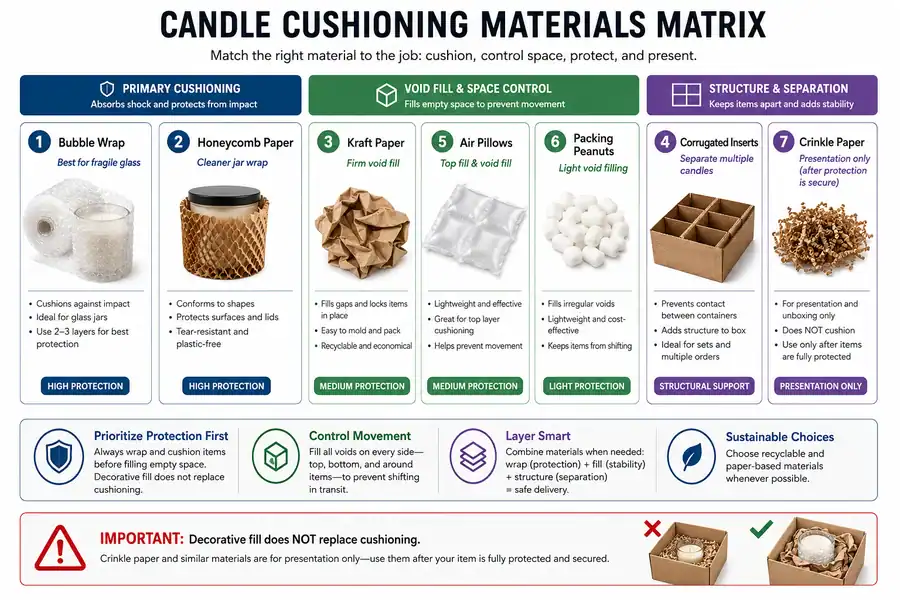
These comparisons are practical guidance based on candle-shipping failure patterns, not lab-tested certification. The safest material choice is the one that stops the candle from moving, protects the container from impact, and keeps the label from rubbing during carrier handling.
For one fragile jar, wrap the jar first, place cushioning under it, fill the side gaps firmly, and add top fill before closing the box. For multiple candles, use separators or individually wrapped candles so glass, tins, lids, and labels cannot touch. Route material-selection branches elsewhere: use Sustainable candle packaging for recyclable or low-waste criteria, Wholesale candle packaging supplies for bulk sourcing or supplier comparison, and Packaging seasonal candles for gifts when holiday wrap, ribbons, or gift styling becomes the main goal.
How to Choose the Right Box Size for Candle Shipping
Choose a candle shipping box that leaves enough room for bottom, side, and top cushioning without allowing the wrapped candle to shift. The right candle shipping box is the outer corrugated box or mailer that fits the finished candle plus protective material. It is different from a decorative candle box, retail display box, or branded product carton because its job is parcel protection, not shelf presentation.
| Candle type | Shipping setup | Clearance need | Box-fit note | Primary risk |
|---|---|---|---|---|
| Single glass jar | Wrapped jar inside a corrugated box | Room for bottom, side, and top cushioning | The jar should not touch any box wall after wrapping. | Breakage from impact or compression |
| Tin candle | Wrapped tin with lid restraint | Enough space to prevent denting and lid rub | Keep pressure off the lid and side wall. | Dents, loose lids, label scuffs |
| Ceramic vessel | Wrapped vessel with edge protection | Extra edge and rim protection | Protect raised feet, rims, handles, and decorative surfaces. | Chips and cracks |
| Pillar candle | Wrapped wax surface with firm void fill | Snug support without pressure marks | Prevent wax from rubbing against rough fill or box seams. | Surface dents and wax marks |
| Multiple candles | Individually wrapped candles with dividers | Separation between each candle | Do not rely on loose fill alone between glass containers. | Candle-to-candle impact |
| Candle in retail carton | Product carton inside an outer shipper | Space around the retail carton for shipping fill | Treat the retail carton as presentation, not the main shipping protection. | Crushed product box |
A box that is too small fails because it removes space for cushioning and puts pressure directly on the container, lid, corners, or label. A box that is too large fails because the candle can travel inside the package, hit the walls, crush fill unevenly, and create a messy unboxing. The final movement test is simple: after sealing the internal packing but before final dispatch, gently move the parcel; if you feel or hear the candle shifting, add or reposition cushioning.
This matrix gives practical packaging guidance, not an exact universal formula. Candle size, finished weight, container fragility, number of candles, cushioning thickness, and separator needs all change the final box choice.
Keep box sizing separate from price, supply, and operations decisions. Use calculate candle shipping costs for rates, weight, dimensions, zones, or service levels; use Candle packaging supplies for boxes, dividers, inserts, tape, or protective materials; use candle business fulfillment when box choice becomes part of higher-volume order processing.
How to Ship Candles in Warm Weather Without Overpromising Heat Protection
Warm-weather candle packaging can reduce melting risk with dispatch timing, insulation, leak containment, label protection, and customer expectation setting, but it cannot guarantee that candles will never soften, sweat, leak, or melt during transit. Heat-sensitive candle shipping means preparing finished wax candles for transit conditions where warm vehicles, sun exposure, delays, or soft wax can move fragrance oils, affect labels, transfer scent, or create leakage.
A candle can melt in the mail if the package sits in high heat long enough, especially during summer routes, weekend delays, or long vehicle exposure. Packaging can slow heat exposure and contain mess, but it is not temperature control. “Heat-proof” means practical heat-risk reduction, not a promise that the candle cannot soften or a replacement for a suitable wax formula.
Use layered heat controls when the forecast, route, candle type, or customer distance makes heat damage more likely:
- Avoid risky dispatch timing when possible, especially late-week shipping before weekends or holidays.
- Use insulation when heat exposure is likely and the candle’s value justifies the added material.
- Contain possible oil seepage with a protective inner barrier before the candle touches paper inserts or labels.
- Protect label surfaces from wax, oil, condensation, or insulation contact.
- Keep scented items separated so fragrance does not transfer into paper, cards, or nearby products.
- Use faster transit when the order is high-risk, fragile, expensive, or traveling through hot regions.
- Set customer expectations when warm-weather delivery could affect the candle surface.
| Symptom | Likely cause | Packaging prevention | When to handle the issue separately |
|---|---|---|---|
| Melted wax surface | High transit temperature or long exposure | Ship earlier in the week, insulate when needed, and shorten transit when possible. | Use Candle wax types if wax softness is the main reason the candle fails. |
| Sweating candle surface | Soft wax or fragrance movement under heat | Keep the candle contained, upright when practical, and away from absorbent inserts. | Use Candle curing and storage if the candle was not ready before packing. |
| Oil seepage | Heat plus weak containment around the candle | Add an inner barrier and protect the label from oil contact. | Use candle formulation support when seepage happens before shipping. |
| Scent transfer | Fragrance reaches paper, cards, tissue, or nearby products | Wrap each candle individually and avoid overpacking scented materials together. | Use product-development support when scent load is the main problem. |
| Warped packaging | Heat, thin materials, condensation, or crushed insulation | Use sturdier outer packaging and keep insulation from wetting labels or paper layers. | Use Shipping delays and customer service policies when delivery timing or buyer communication becomes the main issue. |
This heat-risk log reduces risk during warm-weather candle shipping, but it is not temperature-control certification. If a candle repeatedly softens, leaks, or sweats before it is packed, solve the wax, cure, or storage issue before treating packaging as the answer.
Step-by-Step Checklist for Packaging Candles for Shipping
Package candles for shipping by confirming the candle is finished, inspecting it, securing the lid or exposed surface, wrapping the container, cushioning the box, preventing movement, sealing the parcel, labeling it, and checking it before dispatch. This candle packing sequence applies to finished candles that are clean, cured, and ready for customer delivery. “Step by step” means a physical parcel-prep workflow, not marketplace setup, inventory systems, shipping software, or a full customer-service process.
- Confirm the candle is finished, clean, cured, and ready to ship.
- Inspect the jar, tin, lid, wax surface, and label for cracks, looseness, scuffs, oil, dust, or surface damage.
- Secure the lid or exposed surface so vibration does not loosen the closure or mark the wax.
- Wrap the candle container with enough surface protection to cover sides, base, rim, and vulnerable edges.
- Protect the label face if wrap, paper, or movement could rub the printed surface.
- Add bottom cushioning before placing the candle into the shipping box.
- Place the candle upright by default when the lid, wax surface, or label benefits from that position; use another orientation only when the wrap and box hold the candle more securely without pressure damage.
- Fill voids so the candle cannot move toward the box walls, corners, top, or another candle.
- Separate multiple candles with individual wrapping, dividers, or firm cushioning between each item.
- Add warm-weather controls at this stage when needed: insulation, containment, label protection, or faster transit.
- Perform a gentle movement test before sealing; if the candle shifts, add or reposition cushioning.
- A candle package passes the security check when you cannot feel internal shifting, hear container movement, see lid pressure, or find label surfaces touching rough fill, another candle, or the box wall.
- Seal seams securely, then apply the shipping label and useful handling cues.
Missed steps usually create predictable failures. Skipped inspection lets a loose lid, cracked rim, or damaged label ship unnoticed. No movement test lets a wrapped candle slide inside the box during transit. A presentation insert added too late can crush, rub the label, or sit where cushioning should be.
This checklist covers the physical packing workflow for finished candle parcels. Use Candle business fulfillment for staffing, batch processing, shipping software, or order volume; use Shipping cost calculation for box weight, dimensions, zones, or service levels; use Packaging seasonal candles for gifts when gift styling becomes the main purpose.
Seal, Label, and Mark the Candle Package After Protection Is Complete
Sealing and labeling a candle shipment means closing the outer box securely and applying carrier-readable shipping labels or handling cues after the candle is already protected inside. Shipping labels, fragile stickers, orientation cues, and heat warnings can support handling, but they do not replace wrapping, cushioning, void fill, or movement control.
In this section, “label” means the carrier shipping label, thermal label, label sleeve, handling sticker, fragile cue, this-side-up cue, or heat warning placed on the parcel. It does not mean the candle jar’s product label, ingredient label, brand sticker, or regulatory label.
Use this final parcel-readiness checklist:
- Seal the main box seam with packing tape that fully closes the carton.
- Reinforce weak edges if the candle is heavy or the box flexes.
- Place the shipping label flat on the largest clean surface.
- Keep the barcode readable and free from tape glare, folds, seams, or wrinkles.
- Add the return address where it will not interfere with scanning.
- Use fragile, orientation, or heat cues only when they match the package contents.
- Check that no tape, paper, insert, or label sleeve has loose edges.
- Lift the sealed parcel gently and confirm the candle still does not shift inside.
Fragile stickers can signal care, but they do not protect candles by themselves. A “this side up” cue is useful only when the candle is already internally stable. A heat warning can help communicate handling preference, but it cannot keep wax cool without the warm-weather controls already built into the package.
If the question turns into jar artwork, product-label appearance, ingredient wording, or brand sticker design, use candle labels and branding because that topic affects the candle itself rather than final parcel readability. If sealing and labeling become part of order volume, staff packing stations, or repeatable seller operations, use candle business fulfillment. If label decisions shift into box weight, carrier service, dimensions, or rates, use calculate candle shipping costs instead of turning this section into a rate-planning guide.
Add Presentation Layers Without Replacing Protective Packaging
Presentation packaging for shipped candles is the customer-facing layer added after the candle has already been protected for transit. Tissue paper, insert cards, stickers, care cards, crinkle paper, and clean inner wrap can improve unboxing, but they should not replace cushioning, create movement, rub labels, trap scent, or weaken protection.
“Professional” candle packaging means clean, secure, customer-ready packaging that arrives neat and supports trust. It does not mean expensive gift wrapping, luxury brand redesign, retail display packaging, or decorative fill that ignores transit damage. The goal is not just “arrives intact,” but “arrives intact and customer-ready.”
| Do | Why it helps | Don’t | Why it fails |
|---|---|---|---|
| Add tissue, cards, or stickers after the candle is immobilized. | Presentation stays clean without weakening protection. | Use tissue paper as the main cushioning layer. | Thin paper can crush, shift, or leave the candle underprotected. |
| Keep inserts away from label faces and wax surfaces. | Cards will not scrape labels or leave marks. | Slide rigid cards directly against printed labels. | Movement can scuff paper labels or glossy finishes. |
| Use crinkle paper only after movement is controlled. | It can improve appearance around an already stable product. | Let crinkle paper act as loose void fill around glass. | It can compress and allow the candle to move. |
| Keep scented products separated. | Scent stays cleaner and does not soak into paper layers. | Overpack scented items tightly against inserts. | Fragrance can transfer into cards, tissue, or other items. |
| Keep brand touches lightweight and flat. | The package feels intentional without crowding protection. | Add bulky decoration that creates pressure points. | Decoration can press into the lid, jar, label, or wax surface. |
A good protection-first order is simple: protect the candle container, immobilize the candle inside the box, separate decorative materials from fragile surfaces, place insert cards where they cannot scratch labels, then add light presentation details only in open space that does not affect the fit. Crinkle paper and tissue can make the shipment look finished, but they count as protection only when they help control movement and prevent contact damage.
If the main goal becomes holiday wrapping, ribbons, gift sets, or decorative seasonal presentation, use package seasonal candles for gifts because gift styling has a different purpose than parcel protection. If the main question becomes logo systems, brand identity, or product-label design, use candle labels and branding instead of expanding this section. If recyclable, biodegradable, reusable, or low-waste material choice becomes the main decision, use sustainable candle packaging as the better material-selection path.
Candle Shipping Edge Cases That Need Separate Guidance
Candle shipping edge cases are delivery questions that affect sellers but require separate cost, compliance, international, wholesale, insurance, marketplace, or product-specific guidance beyond protective packaging. These topics matter, but they should not replace the core candle-packing workflow: inspect, protect, cushion, box, seal, label, and keep presentation secondary to protection.
| Edge case | Why it is separate from protective candle packaging | Better next topic |
|---|---|---|
| Shipping cost calculation | Rates depend on weight, dimensions, zones, service level, carrier pricing, and current surcharges. | calculate candle shipping costs |
| International candle shipping | Cross-border delivery depends on destination rules, customs requirements, carrier availability, and current restrictions. | international candle shipping rules |
| Hazmat or dangerous-goods questions | Compliance can depend on ingredients, format, carrier policy, destination, and current rules. | candle shipping compliance |
| Shipping insurance claims | Insurance applies after loss or damage, while this article focuses on packaging decisions before dispatch. | shipping insurance for candle orders |
| Wholesale or freight fulfillment | Bulk orders change box strength, unit count, cartons, pallets, and logistics planning. | wholesale candle shipping |
| Wax melts packaging | Wax melts share heat and scent concerns, but their form, leakage risk, and presentation needs are different. | package wax melts for shipping |
| Marketplace shipping policy | Marketplace rules depend on platform settings, seller account requirements, and fulfillment policies. | marketplace shipping setup for candle sellers |
This routing table is a boundary guide, not a carrier-law, rate, insurance, customs, or wholesale-freight interpretation. Rules, rates, surcharges, dimensional-weight treatment, and destination limits can change, so those topics need current, dedicated guidance.
The safest candle-shipping workflow is protection-first: inspect the finished candle, protect the container, immobilize it with cushioning, choose a box with proper clearance, reduce heat risk when needed, seal and label the parcel, and add presentation only after protection is secure. A candle package should look professional only after it can survive ordinary parcel handling without glass contact, lid movement, label abrasion, wax leakage, or loose internal movement.