

Choose candle label size and placement from the usable label area, container or box shape, required information, readability, and how the product will be displayed.
Candle label size and placement means the physical label dimensions and the surface where the label sits on a candle container or package. The right fit leaves the scent, brand, weight, safety-adjacent details, and secondary information readable without crowding the jar, tin, votive, or box. A label should be chosen from measured usable space, not from candle ounces, total container height, or the largest sticker that fits. Good placement makes the product look balanced from normal viewing distance while keeping legal wording, material choice, full branding, and packaging cost as separate decisions.
On this page, the right label size means the label fits the measured usable surface, stays readable, leaves clearance, and matches the viewing surface. It does not decide legal wording, adhesive material, full visual design, or print setup.
Measure the Usable Label Area Before Choosing a Candle Label Size
Measure the usable width and height of the flat, visible surface, then subtract edge, lid, seam, curve, bevel, or fold clearance before choosing the label size.
A candle label should be sized from the usable label area: the visible, flat, printable space left after subtracting edges, lids, seams, curves, bevels, and box folds. Candle label size and placement means the physical label dimensions and applied location that keep product information visible, readable, and balanced. Fit means usable, visible, printable, readable fit, not maximum coverage.
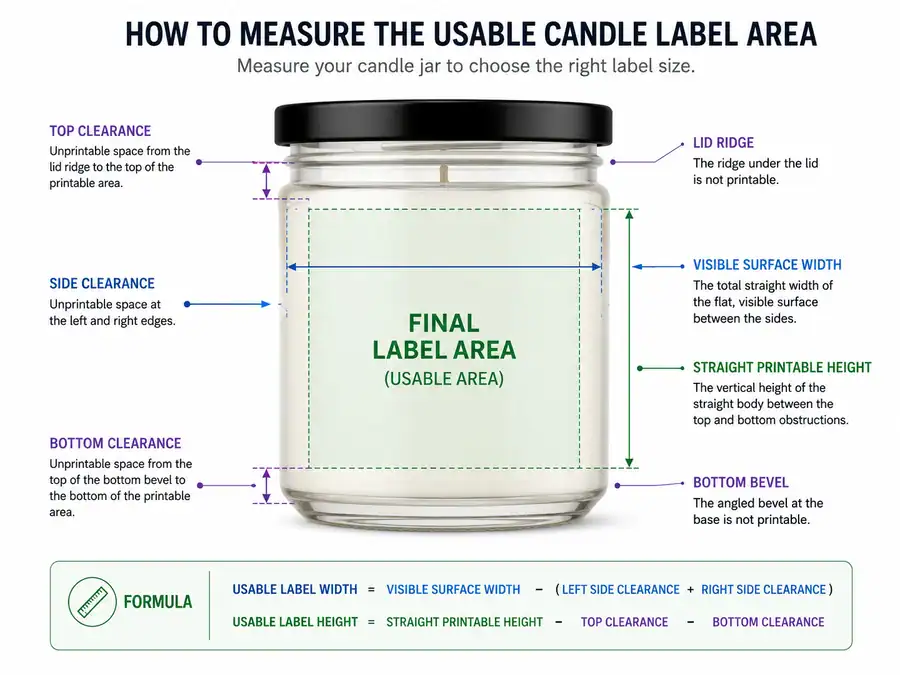
Measurement checklist:
- Pick the exact surface first: jar body, tin lid, tin side, votive body, box front, box side, or box top.
- Measure usable width across the visible label zone.
- Measure usable height within the straight printable area.
- Subtract clearance for edges, lids, seams, curves, bevels, shoulders, and box folds.
- Test the draft size on the real container before ordering labels.
Formula:
- Usable label width = visible surface width minus side or seam clearance.
- Usable label height = straight printable height minus top and bottom clearance.
Use Common Candle Label Sizes Only as Starting Points
Common candle label sizes are starting points only; the actual usable surface still controls the final width, height, and placement.
Use the examples below to narrow the first draft, then measure the real jar, tin, votive, mini, sampler, favor, or box before ordering final labels.
| Candle format | Common starting label shape | Example starting size | Use only when | Recheck before printing |
|---|---|---|---|---|
| Straight-sided 8 oz jar | Square or rectangle front label | 2 in x 2 in or 2.5 in x 2 in | The front wall is straight, smooth, and clear. | Measure the visible face, lid ridge, and bottom bevel. |
| Wide tumbler jar | Rectangle front label | 3 in x 2 in | The jar has a wide front face and a stable vertical wall. | Check whether the lower wall curves inward. |
| Round tin lid | Round top label | 2 in or 2.5 in round | The lid is the first surface shoppers see. | Subtract rim, ridge, and grip clearance. |
| Tin side wall | Narrow rectangle label | 2.5 in x 1 in | The tin is displayed upright and the side wall is readable. | Keep the label away from rolled edges. |
| Votive, mini, sampler, or favor | Small square, round, or short rectangle label | 1.5 in x 1 in or 1.5 in round | Only the scent, brand cue, or short identity needs to fit. | Move overflow to a box, lid, back label, or insert. |
| Product box front | Panel-based rectangle label | 3 in x 3 in or smaller than the clean panel | The box is the main first-view surface. | Keep the label inside folds, edges, windows, and flaps. |
Do not treat these example sizes as universal rules. A same-ounce candle can need a smaller or larger label when the container shape, shoulder, taper, lid, box panel, or display surface changes.
| Container or package type | Measured surface | Recommended width input | Recommended height input | Clearance note |
|---|---|---|---|---|
| Straight-sided jar | Front body wall | Visible front face | Straight wall height | Keep away from lid ridge and bottom bevel. |
| Tumbler jar | Front body wall | Display face, not full circumference | Smooth vertical wall | Reduce height if the wall curves near the base. |
| Apothecary jar | Body below shoulder | Flat front area | Area below shoulder curve | Do not cross the shoulder unless tested. |
| Mason jar | Front panel between embossing or curves | Usable flat panel | Straight section below threads | Avoid raised glass, ribs, and lid threads. |
| Round tin | Lid or short side wall | Lid diameter or visible side face | Lid diameter or side-wall height | Lid often gives more readable space than the side. |
| Votive or mini | Small body or lid | Small visible face | Short straight wall | Limit information instead of shrinking everything. |
| Candle box front | Front panel | Panel width minus side clearance | Panel height minus fold clearance | Keep labels off folds and panel edges. |
| Candle box side | Side panel | Side-panel width | Side-panel height | Use for secondary information when front space is tight. |
Do not choose candle label size from ounces alone. An 8 oz jar can be straight, tapered, shouldered, wide, narrow, embossed, or boxed, and each version creates a different label area. Do not use total jar height as label height either; lids, wax visibility, shoulders, and bottom bevels can reduce the printable zone. Full circumference only matters for wrap labels, and even then, seam clearance still matters.
For jars, measure the flat body area where the front label will sit. For tins, decide whether the lid, side wall, or base is the main label surface before measuring. For votives and minis, measure the surface, then decide what information must move elsewhere because tiny labels have limited readable space. For boxes, measure the product box panel, not a shipping carton or mailer.
If warning or compliance text affects the amount of space you need, keep the sizing decision here and check candle warning label requirements separately. If a label wrinkles, lifts, or fails after the size is correct, the next question may be best candle label materials, not a larger label. If you need a repeatable measuring sheet after the first hand measurement, use printable candle label templates to turn the measured area into draft label dimensions.
Choose Label Width, Height, and Clearance
Choose label width and height by measuring the usable surface, subtracting clearance, and checking whether the remaining space can carry essential information clearly.
Width, height, clearance, and readable space work together as one sizing decision. A label that is wide enough but too tall can wrinkle near a shoulder; a label that is short enough but too narrow can force crowded text. The best size is the one that fits the measured surface, leaves physical breathing room, and keeps product information readable.
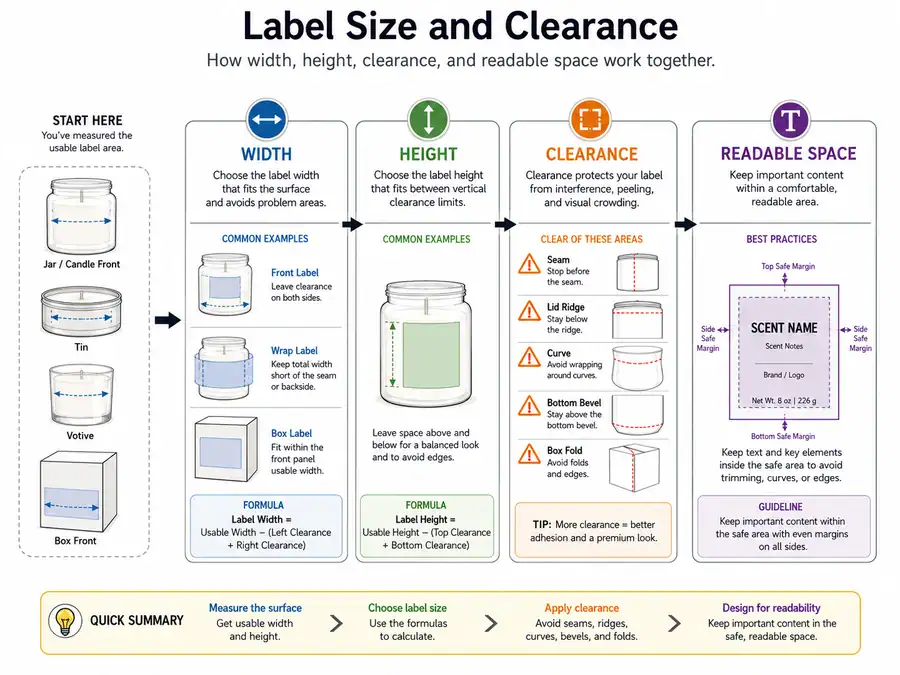
| Sizing choice | What it controls | Use this rule | Covered below |
|---|---|---|---|
| Width | How far the label spreads across the front, wrap, lid, or panel | Fit the visible display area, not the largest possible surface. | Choose the Right Label Width |
| Height | How much vertical space the label uses | Use straight printable height, not total container height. | Choose the Right Label Height |
| Clearance | Space around obstacles and label edges | Subtract space for lids, seams, curves, bevels, folds, and trim. | Leave Clearance Around Edges, Lids, Seams, and Curves |
| Readable space | Whether the label can carry the needed information | Split information across surfaces if one label becomes crowded. | Make Sure the Label Has Enough Readable Space |
Choose the Right Label Width
The best candle label width fits the visible display area while leaving clearance, not the widest label that can physically wrap around the container.
Label width is the horizontal label dimension across the customer-facing surface or, for a wrap label, around the container body. Wider is not automatically better because a wide label can hide text near the side curve, cross a seam, look oversized on a small candle, or force awkward placement. A front label should usually stay within the visible display face, while wrap width depends on circumference minus seam or overlap space.
Width formula:
- Front label width = visible display face minus side clearance.
- Wrap label width = container circumference minus seam gap or overlap allowance.
- Box label width = panel width minus edge and fold clearance.
Front label versus wrap label:
- Use a front label when the main goal is a clean first-view product identity.
- Use a wrap label only when the container has enough smooth, straight area and the extra space improves readability.
- Do not place scent name, net weight, warning cues, or barcode text directly across a seam.
A straight jar may handle a wider front label than a curved votive, even if both candles hold similar wax weight. A round tin may need a lid label because the side wall is too short for a wide readable front label. A product box can often use a larger front-panel label than the container inside it, but folds and edges still reduce usable width.
If the width looks too large, reduce the width before shrinking all text. Use wraparound candle label sizing, readable candle label design, or best candle label materials only when the problem shifts from physical width to wrap planning, layout hierarchy, or label-stock behavior.
Choose the Right Label Height
The right candle label height comes from the straight, usable printable area, not the full height of the jar, tin, votive, or box.
Label height is the vertical dimension inside the stable printable zone. Total container height includes areas that may not accept a clean label, such as lid ridges, shoulders, tapers, bottom bevels, wax-viewing space, feet, and box folds. The right height is proportional, readable, and physically stable, not simply large.
Height formula:
- Label height = straight printable wall height minus top and bottom clearance.
- Box label height = panel height minus fold and edge clearance.
- Lid label height = available top diameter or shape minus edge clearance.
Clearance warning:
If the label crosses a shoulder, taper, lid ridge, bottom bevel, or fold, reduce height before assuming the design or material is the problem.
A straight jar can usually use more vertical label height than an apothecary jar with a shoulder. A short tin may not have enough side-wall height for product identity and secondary information, so a lid label or box label may work better. A votive may need a smaller front label because the wall is short and curved. A box panel can carry more height, but only inside the clean panel area.
Do not place a label over the shoulder of a jar unless that curved area has been tested with the actual label shape. Do not cover most of the glass unless readability, wax visibility, and clearance still work. If warning-space needs make the label too tall or crowded, keep the sizing issue here and check candle warning label requirements for the wording decision. If the label wrinkles near the top, the better next check is curved, tapered, and shouldered container label fit, not a taller label. If the height is correct but the information still feels hard to read, use readable candle label design for the layout side of the problem.
Leave Clearance Around Edges, Lids, Seams, and Curves
Candle labels need clearance from edges, lids, seams, curves, bevels, and folds because a label that technically fits can still peel, wrinkle, look cramped, or become hard to read.
Clearance is the physical and readable space around label edges and container or package obstacles. It is not the same as legal safety wording, and it is not the same as print bleed. Here, safe area means the space that keeps the label away from problem surfaces and keeps important text from sitting too close to an edge.
Use clearance as obstacle-based spacing, not a universal number. Keep label edges and important text away from lids, seams, curves, bevels, folds, ridges, and trim edges, then confirm the gap on the actual candle or box.
| Obstacle | Why it matters | What to subtract | Mistake prevented |
|---|---|---|---|
| Lid ridge | The label can look crowded or rub against the lid. | Top clearance | Label placed too high |
| Bottom bevel | Curved lower glass can lift label edges. | Bottom clearance | Peeling or wrinkling near base |
| Side curve | Text can bend out of the display face. | Side clearance | Oversized front label |
| Wrap seam | Text can be hidden or split. | Seam gap or overlap space | Important text at seam |
| Jar shoulder | Flat labels distort on curves. | Height above the straight wall | Wrinkles near top |
| Box fold | Labels can crease or look misaligned. | Fold and edge clearance | Label crossing a box crease |
| Print trim | Cut variation can clip artwork or text. | Trim margin inside the label | Text too close to cut edge |
There is no single clearance value that works for every jar, tin, votive, and box. Use obstacle-based clearance: subtract space where the surface changes, where the label may bend, and where the customer’s eye needs breathing room. If the label peels near an edge, first check whether it is too close to a curve, bevel, seam, lid, or fold.
Print bleed and cutline details belong with label printing setup, while adhesive failures after correct sizing belong with best candle label materials. If warning space affects where a label can sit, keep the placement question here and route exact wording to candle warning label requirements.
Make Sure the Label Has Enough Readable Space
A candle label is not the right size if required information fits physically but cannot be read clearly at normal viewing distance.
Readable space is the physical label area available for essential information. It is not just font choice, color choice, or style. A label can fit on the jar and still fail if the scent name, product identity, weight cue, short instructions, batch code, barcode, or warning cue becomes crowded.
Information-capacity checklist:
- Can the customer read the scent or product name without picking up the candle?
- Does the brand or maker name have enough room without crowding the scent name?
- Is any weight, size, batch, barcode, or short instruction text placed on a surface that can carry it clearly?
- Are important words kept away from seams, curves, lid ridges, bevels, and folds?
- Is the label still readable after leaving clearance?
- Would a back label, lid label, box label, or insert solve the overflow better than shrinking everything?
Pass or fail prompt:
- Pass: essential information is readable at normal viewing distance, with no critical text on seams or curves.
- Fail: information fits only because the text was made too small, crowded, or placed on an unstable surface.
If all information does not fit, do not force it onto one label. Use a back label, box label, lid label, bottom label for suitable secondary details, or candle care cards and box inserts when the information does not need to live on the primary display label. If the issue is exact wording, check candle warning label requirements instead of guessing. If the issue is visual hierarchy, spacing, or type treatment, use readable candle label design after the physical label size is chosen.
Place the Front Label Where Shoppers Can Read It First
The front candle label should sit on the side customers see first and should be visually centered within the usable label area.
A front label is the primary product-identity label on the candle container or package. It usually carries the brand, scent, product name, or strongest first-view information. Front placement is not the same as mathematical center around a round container. It means the label looks centered from the customer’s real viewing angle on a shelf, market table, gift display, or product photo.
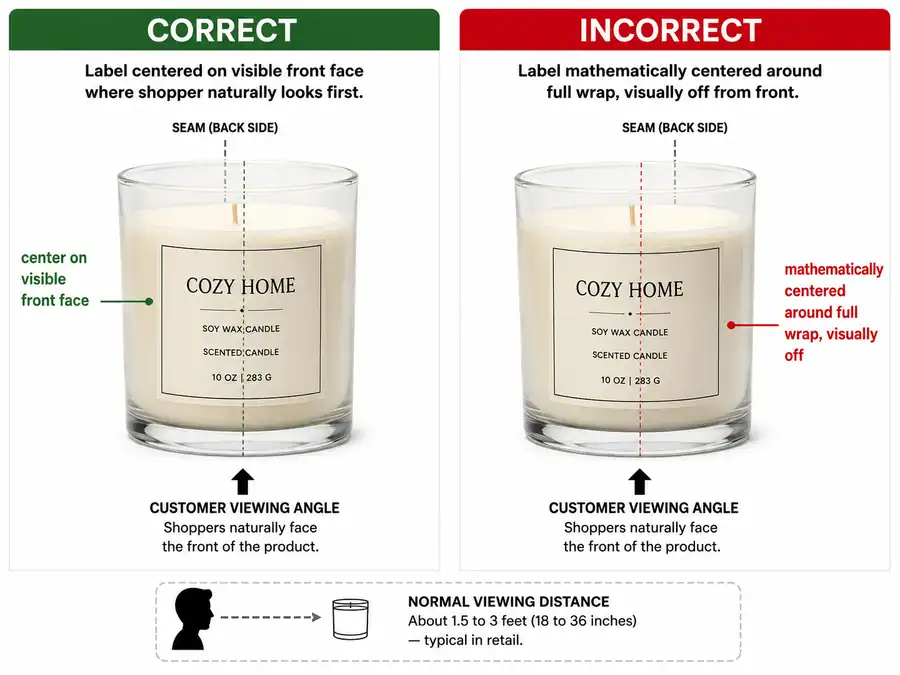
Visual centering checklist:
- Choose the customer-facing side before applying the label.
- Keep jar seams, back labels, or batch details away from the display face.
- Center the label within the measured usable area, not the full circumference.
- Check vertical balance inside the straight printable wall or clean box panel.
- Leave space near lid ridges, shoulders, bevels, curves, and folds.
- Step back and view the candle from normal shopping distance.
- Take a straight-on photo and check whether the label still looks centered.
- Move secondary information elsewhere if the front begins to feel crowded.
| Placement check | Correct front placement | Incorrect front placement |
|---|---|---|
| Display side | The scent and product identity face the shopper first. | The label faces away from the shelf or table view. |
| Horizontal centering | The label looks balanced on the visible front face. | The label is centered around the full round container but looks off from the front. |
| Vertical placement | The label sits inside the straight usable wall or panel. | The label crosses a shoulder, lid ridge, bevel, or fold. |
| Seam control | The seam or back information stays out of the front view. | A seam, barcode, or back label interrupts the display face. |
| Readability | The label can be read without turning the candle. | The shopper must rotate the candle to understand the product. |
For a round jar, pick the side that will face the customer and treat that as the front. The seam, back label, or secondary information should sit behind or away from that view. For a tin, the front may be the lid if the tin is displayed flat, or the side wall if the tin is displayed upright. For a box, the front label belongs on the product-facing panel, not on a fold or shipping-facing side.
Vertical placement should feel balanced inside the usable area. A label can sit slightly above the measured midpoint if the lid, wax line, jar base, or shoulder makes the true visual center look lower than expected. If a label looks centered by ruler but wrong in photos, trust the real viewing angle and adjust the placement test before applying a full batch.
Keep the front label simple when readable space is limited. Move burn instructions, batch details, barcodes, long maker details, or warning-adjacent information to a back, lid, bottom, or box label, then use readable candle label design, candle warning label requirements, or a label placement QA checklist only when the issue shifts to layout, wording, or repeatability.
Decide Front, Back, Wraparound, and Multi-Label Placement
Use the front label for first-view identity, then add back, wraparound, lid, bottom, or box labels only when they improve readability or information placement.
A candle label surface strategy decides where information belongs across the container and package. The front label should explain what the candle is at first glance. Other surfaces should solve a clear placement problem: not enough readable space, secondary information that does not belong on the front, a smooth container that can support a wrap, or a box panel that gives the customer a better first view.
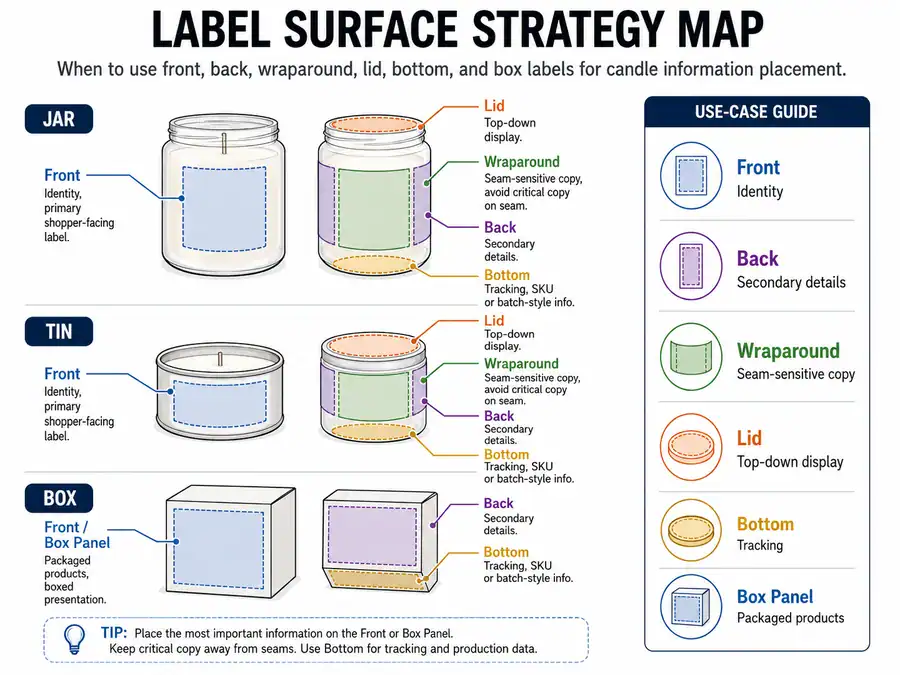
| Label surface | Best use | Avoid using it for | Placement check |
|---|---|---|---|
| Front label | Brand, scent, product identity, main first-view message | Long instructions or dense secondary copy | Can the shopper understand the candle first? |
| Back label | Instructions, batch details, barcode, maker details, warning-adjacent planning | Hiding information that must remain visible | Does it reduce front clutter without creating visibility problems? |
| Wraparound label | Extra information on a smooth, straight container body | Automatic full coverage on curved or tapered containers | Is there seam clearance and no hidden important text? |
| Lid or top label | Tins, small jars, gift sets, top-down displays | Replacing all needed body or package information | Is the top the surface customers see first? |
| Bottom label | Supplemental tracking or secondary details | Primary product identity or retail-critical information | Will the customer need to lift the candle to find it? |
| Box label | Packaged candles, gift sets, overflow from small containers | Shipping labels or full box design systems | Does the product panel match the display orientation? |
Use a Back Label for Secondary Information
A back label can hold secondary information, but secondary placement is a layout decision, not legal approval.
A back label is a non-front informational label placed away from the primary display face. It can help keep the front label clean by holding short instructions, ingredient or material summaries, barcode details, batch numbers, maker information, website details, or warning-adjacent planning. It should not be used to hide information that needs to stay visible for legal, retail, or customer-use reasons.
| Information type | Front label | Back label |
|---|---|---|
| Brand or maker name | Usually yes | Optional repeat if space allows |
| Scent or product identity | Yes | Only as a repeat or support detail |
| Short burn instruction | Usually no | Often yes, if readable |
| Ingredient or material summary | Sometimes, if short | Often yes |
| Barcode | Usually no | Often yes, when retail flow allows |
| Batch number or internal code | Usually no | Often yes |
| Website or maker details | Sometimes | Often yes |
| Warning-adjacent information | Only if needed for visibility | Possible, but verify requirements elsewhere |
Use a back label when the front label becomes crowded or when secondary information is useful but not part of the first-view identity. A back label works better than shrinking all text on the front, especially on jars, votives, and small boxed candles. It also gives repeat makers a cleaner way to separate product identity from production or retail details.
Legal wording, regional warning details, and required visibility should be checked separately through candle warning label requirements and CLP candle label requirements when those rules apply. If the main issue is production tracking rather than label placement, use barcode and batch tracking for candle labels as the next planning step. Keep this decision focused on where secondary information can fit, not whether the wording satisfies every jurisdiction.
Compare Front Labels and Wraparound Labels
Wraparound labels work best when the container has enough straight, smooth surface to wrap without hiding important text at the seam.
A wraparound label extends around the container body, but it does not have to cover the full circumference. It should be sized from the container circumference minus seam gap or overlap space, with important information kept away from the seam. A front label is better when first-view recognition matters most, while a wrap label is better only when the extra surface improves readability and applies cleanly.
| Decision point | Front label | Wraparound label |
|---|---|---|
| First-view identity | Strongest choice | Works if the main panel is clear |
| Information capacity | Limited to the display face | More room if the surface is smooth |
| Seam risk | Low | Higher, especially if text reaches the seam |
| Curves and tapers | Easier to control | More likely to wrinkle or lift |
| Small candles | Often cleaner | Often too crowded or hard to apply |
| Retail shelf view | Strong when front is obvious | Good only if key text stays on the front-facing zone |
| Application difficulty | Lower | Higher because alignment must stay level around the body |
Wrap width logic:
- Measure the container circumference around the label path.
- Subtract seam gap or overlap allowance.
- Keep scent, weight, warning cues, barcode, and instructions away from the seam.
- Avoid shoulders, tapers, bevels, and textured areas unless the actual label has been tested.
A wrap label is not better just because it uses more surface. It is worse when it crosses a taper, hides important text at the seam, makes the front less clear, or wrinkles around the container. If a wrap fails because the surface is curved, the next placement issue is curved, tapered, and shouldered container label fit. If it fails because the label stock cannot bend or hold, the next material question is best candle label materials. If the main issue is first-view recognition, return to the front label placement zone instead of forcing a wrap.
Decide When to Use More Than One Label
Use more than one candle label when one surface cannot keep product identity, secondary details, and required space readable without clutter.
A label set is a functional distribution of information across surfaces, not a full brand identity system. More labels are justified when they make the candle easier to read, easier to shop, or easier to organize without overcrowding the front. One label is enough when the product identity and necessary information remain clear on a single usable surface.
| Situation | Best label setup | Why it works |
|---|---|---|
| Small jar with enough front space | One front label | Keeps the product simple and readable. |
| Jar with instructions or barcode | Front and back labels | Separates first-view identity from secondary information. |
| Tin displayed from above | Lid label plus optional bottom or side detail | Uses the surface customers see first. |
| Votive or mini with limited body space | Small front label plus box, lid, or insert | Prevents tiny crowded text. |
| Smooth straight-sided jar with more copy | Front label or measured wrap label | Adds space only if the wrap stays readable. |
| Gift set or boxed candle | Container label plus box label | Makes the package readable before opening. |
| Batch-tracked product line | Front label plus back or bottom tracking label | Keeps production details away from the main display face. |
Start with the front label and assign only the information that must be seen first. Move useful but secondary copy to the back, lid, bottom, or box. Remove duplicate copy unless it helps the customer understand the product from a different viewing angle. Do not add more labels just to fill space; each label should solve a readability, placement, or display problem.
If the label set becomes a style system with fonts, colors, logos, and visual hierarchy, move that decision to candle label design or readable candle label design. If the label set raises legal wording or regional compliance questions, check candle warning label requirements and CLP candle label requirements rather than deciding from placement alone.
Choose Label Size and Placement for Candle Jars
Candle jar label size should be chosen from the jar’s usable body area and shape, not from the jar’s ounce capacity.
Jar label placement means label position on the jar body unless a lid, bottom, or box label is specifically named. An 8 oz candle jar can be straight-sided, tapered, shouldered, embossed, wide, narrow, or boxed, so ounce size is not enough to choose a label. Measure the straight visible wall, subtract clearance, then choose the label width and height from that usable body area.
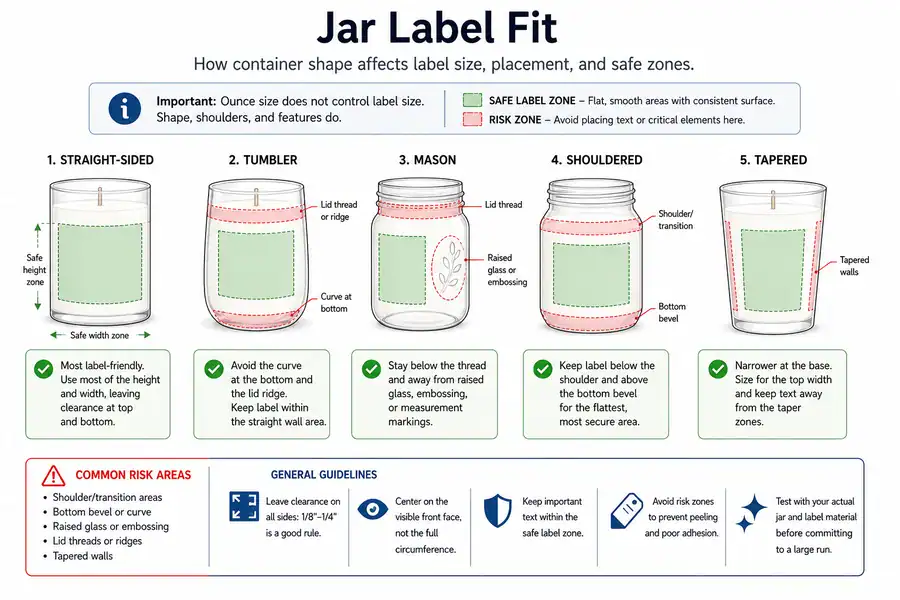
| Jar type | Best label surface | Sizing caution | Placement caution | Bridge note |
|---|---|---|---|---|
| Straight-sided jar | Front body wall or measured wrap area | Width can often be larger because the wall is stable. | Keep clear of lid ridge and bottom bevel. | Use wrap only when seam placement stays clean. |
| Tumbler jar | Front body wall | Measure where the wall stays smooth and visible. | Reduce height if the lower wall curves inward. | Test the lower edge before applying a batch. |
| Mason jar | Flat front panel between raised areas | Avoid ribs, embossing, lid threads, and shoulders. | Center on the usable flat panel, not the whole jar. | Use a smaller front label if glass texture interrupts space. |
| Apothecary jar | Body area below the shoulder | Height is limited by the shoulder curve. | Do not cross the shoulder unless the label is tested there. | Route curve problems to curved candle jar label fit. |
| Shouldered jar | Straight wall below the shoulder | Use less height than the total jar height suggests. | Keep label edges off the shoulder transition. | Use lid label sizing for candles if the body is too limited. |
| Tapered jar | Narrowest stable front area | Width and height may need to shrink together. | Avoid full wraps unless the taper has been tested. | Check materials only after placement is corrected. |
For a straight-sided jar, the label can usually sit on the front body wall with even left, right, top, and bottom clearance. For a mason jar, place the label on the smoothest front-facing panel and avoid raised glass. For an apothecary or shouldered jar, keep the label below the shoulder because flat labels can wrinkle when they cross curved glass. For a tapered jar, size the label to the most stable visible area, not the widest part of the container.
A good jar label answers three questions before printing: does it fit the straight wall, does it read from the customer-facing side, and does it leave enough space for required or secondary information? If the front label becomes crowded, use a smaller front label with a back label, a measured wrap label, or a lid label. If the legal or warning information does not fit cleanly, keep the jar placement decision here and check candle warning label requirements for the wording and visibility question.
Troubleshooting:
- If the label wrinkles near the top, check whether it crosses a shoulder, taper, or lid ridge.
- If the label looks off-center, check the customer-facing view instead of the full circumference.
- If the label feels crowded, move secondary information to a back, lid, bottom, or box label.
- If the label lifts after the size and placement are correct, then review best candle label materials.
- If the label worked once but not across the batch, measure the usable candle label area on each jar variation.
- If the size still feels uncertain, test a candle label before printing the final run.
Do not turn jar label sizing into jar sourcing. Glass thickness, supplier comparison, jar manufacturing, and heat behavior are separate buying or materials questions. This section only uses jar shape to decide where the candle label can sit cleanly and remain readable.
Adjust Labels for Curved, Tapered, or Shouldered Jars
Curved, tapered, and shouldered candle containers usually need smaller or repositioned labels because flat labels distort when they cross unstable surfaces.
Fit means smooth physical placement on the usable surface, not premium style or material performance. A flat label works best when all label edges sit on the same stable plane. When the label crosses a shoulder, taper, bevel, rounded wall, or narrow curve, the label can wrinkle, lift, look slanted, or bend text out of view.
| Visible problem | Likely placement cause | First fix to check | When to route elsewhere |
|---|---|---|---|
| Label wrinkles near the top | Label crosses a shoulder or lid ridge. | Reduce label height or lower the label. | Material page only if placement is already stable. |
| Label lifts at one edge | Edge sits on a curve, bevel, or taper. | Move the edge onto the flat wall. | Check adhesive only after the edge placement is fixed. |
| Label looks slanted | Container taper changes the visual baseline. | Use a smaller label and align by sight. | Use a test print before batch application. |
| Text bends around the side | Label is too wide for the visible face. | Reduce width or avoid full wrap. | Review wrap sizing if the surface is smooth enough. |
| Wrap label puckers near seam | Wrap crosses taper or seam pressure area. | Shorten wrap width or move seam. | Check material flexibility only after seam placement is corrected. |
A shoulder is usually the wrong place for a standard front label unless the label shape and stock are physically tested on that curve. A tapered jar may need a smaller label even when the measured diameter looks large. A beveled base can make a label peel if the bottom edge sits too low.
If failure appears material-based after the label sits fully on stable glass, review best candle label materials. If failure appears measurement-based, return to measure the usable candle label area and subtract the unstable zones. If failure appears only after production starts, test a candle label before printing and applying the full batch.
Choose Label Size and Placement for Candle Tins
Candle tins often need a different label strategy from jars because the lid may be more visible and readable than the short side wall.
A tin label can sit on the lid or top, side wall, bottom or base, or product box if the candle is packaged. It should not automatically be treated as a side-body label. Choose the most visible readable surface first, then size the label from that surface’s flat area and clearance.
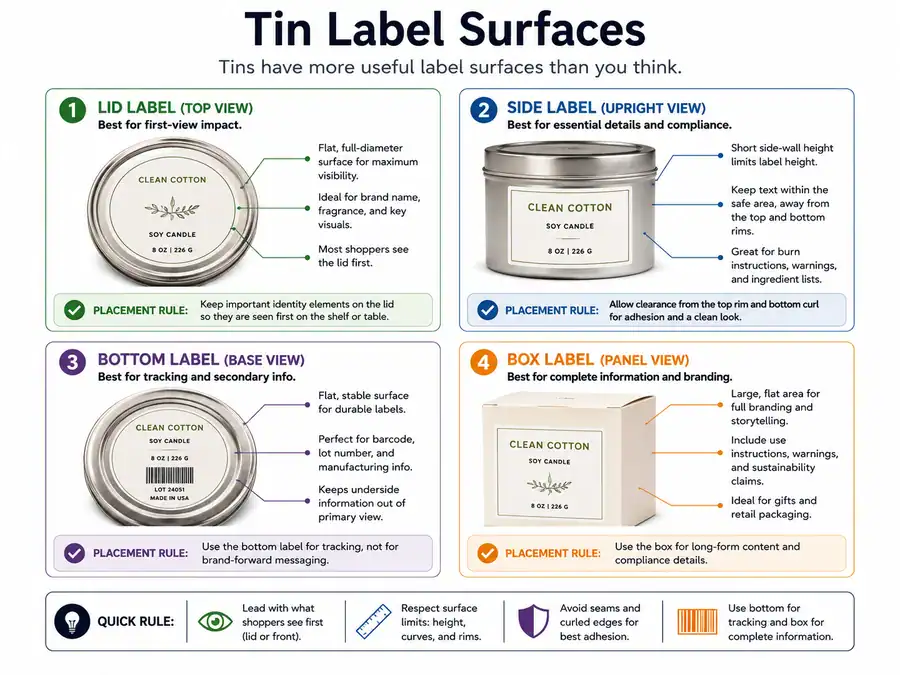
| Tin surface | Best use | Visibility | Space limit | Mistake to avoid |
|---|---|---|---|---|
| Lid or top | Main identity on flat tins, market tables, and top-down displays | High when customers see the tin from above | Limited by flat lid diameter, ridges, and edge grip | Placing the label too close to the lid edge |
| Side wall | Scent or brand cue on upright displays | Good when tins stand facing the customer | Limited by short wall height | Shrinking too much information onto a short side |
| Bottom or base | Batch code, internal SKU, or supplemental tracking | Low unless the customer lifts the tin | Limited by flat base and bevels | Hiding first-view or required information underneath |
| Box panel | Product identity or extra information when the tin is packaged | High before opening | Limited by product-box panel size | Treating the box like a shipping label area |
A candle tin label should go on the lid when the lid is the first visible and most readable surface. It should go on the side only when the tin is displayed upright and the side wall has enough straight height for readable text. The bottom can carry secondary information, but it is a risky place for anything customers, retailers, or regulators may need to see before lifting the candle.
For a tin lid label, measure the flat lid diameter and subtract edge, ridge, or grip clearance. For a side label, measure the short wall height and keep the label away from rolled edges. If the side label looks cramped, the problem is usually limited wall height and readability, not a need to add more text.
Use lid label sizing for candle tins when top-surface details need their own sizing pass. Use bottom label placement for candles when deciding what can safely move to the base. If a correct size still lifts on metal or curved edges, review best candle label materials after the surface choice is fixed.
Size Lid and Top Labels for Tins and Small Jars
Lid and top labels work best when the top surface is the most visible readable surface, especially on tins or small candles with short side walls.
A lid or top label is a label applied to the top-facing surface of a tin, jar lid, or small container. It can be the primary visible label when shoppers view candles from above, but it does not automatically replace body, back, bottom, or box information. It solves a surface-selection problem, not every information-placement problem.
Round-label checklist:
- Measure the flat lid area, not the full lid diameter if the edge curves downward.
- Subtract clearance for the lid rim, grip area, ridge, embossing, handle, or textured zone.
- Keep the main scent or product identity centered inside the flat top area.
- Choose a smaller round label if the lid has a ridge.
- Use a side or box label if the top label cannot carry the information clearly.
- Confirm that the label is readable in the way the tin or jar will be displayed.
| Surface choice | Use it when | Avoid it when |
|---|---|---|
| Lid label | The top is what customers see first. | The lid has ridges, texture, or too little flat area. |
| Side label | The tin or jar faces customers upright. | The side wall is too short for readable text. |
| Box label | The candle is sold inside packaging. | The box is only a shipping or storage container. |
A candle tin label can often go on the lid because the side wall is short. A small jar can also use a lid label when the body label would be too crowded. A lid label can be the only label only when all information and visibility needs are satisfied elsewhere or are not required on another surface.
If legal visibility is the concern, check candle warning label requirements instead of assuming a lid label is enough. If secondary details need a separate surface, use back label placement for candle information or the multi-label placement logic. If the question becomes style, hierarchy, or top-label artwork, keep this sizing decision separate from readable candle label design.
Use Bottom Labels Only for Appropriate Secondary Information
Bottom labels should be used only for secondary or supplemental information unless required visibility and compliance needs are satisfied elsewhere.
A bottom label is applied to the underside or base of a jar, tin, votive, or small container. “Can go on bottom” means the surface may physically hold a label; it does not mean important information may be hidden there. The bottom is usually better for internal, supplemental, or tracking information than for first-view product identity.
| Information type | Bottom label | Back label |
|---|---|---|
| Batch code | Often appropriate | Appropriate when visibility helps production or customer support |
| Internal SKU | Often appropriate | Appropriate if staff need faster access |
| Short maker or website detail | Sometimes appropriate | Usually more visible |
| Supplemental tracking | Often appropriate | Appropriate when customer-facing clarity matters |
| Non-primary barcode | Only when retail handling allows | Often better for scanning and visibility |
| Primary scent or product identity | Poor fit | Better on front or display-facing surface |
| Required warning or required visibility item | High-risk placement | Usually safer, but still needs rule-specific review |
| Net weight or first-view retail information | Usually poor fit | Better on visible label or package panel |
Bottom sizing method:
- Measure only the flat base area.
- Subtract bevel, recessed edge, foot ring, or curved-base clearance.
- Keep text away from the outer edge where it may rub or lift.
- Use a smaller label if the base is recessed or uneven.
- Do not use the bottom to solve front-label overcrowding when the information needs to be visible.
Bottom labels work well for batch codes, internal SKUs, and supplemental tracking because those details do not always need first-view placement. They work poorly for information the customer should see before lifting or turning the candle. If the bottom label carries a barcode, confirm that the scan path and selling channel can support that placement before production.
Warning questions should route to candle warning label requirements, and EU-specific compliance questions should route to CLP candle label requirements. Barcode and batch policy questions belong with barcode and batch tracking for candle labels, not with a general placement decision.
Choose Label Size for Votives, Minis, Samplers, and Favors
Small candle labels should be sized around readable essential information, not by shrinking a full-size candle label design.
A small candle label is a constrained label for a votive, mini candle, sampler, or favor where readable space is limited. “Small” means limited information capacity, not only reduced physical dimensions. Start with the minimum information that must be readable, then move overflow to a lid, back label, bottom label, box label, or insert.
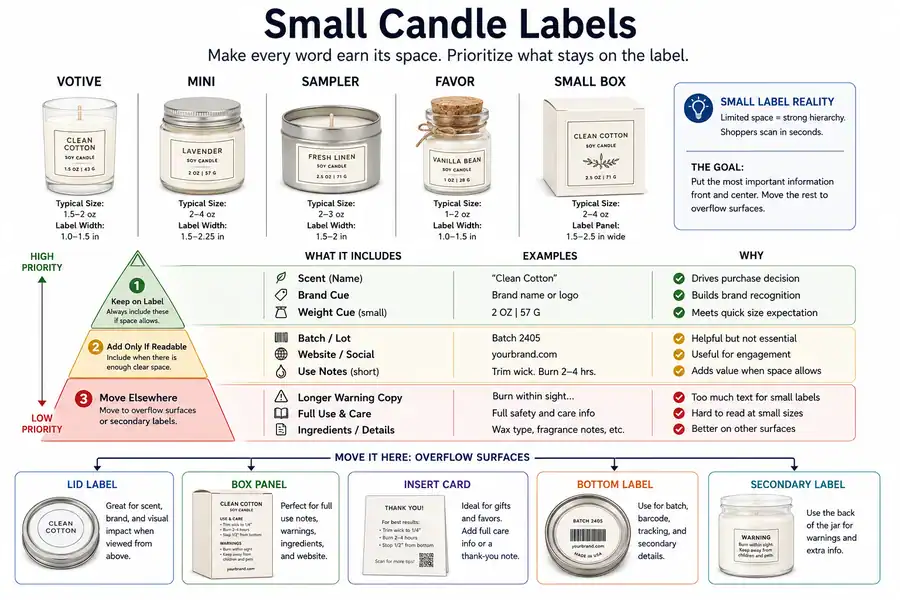
Small-label information-priority checklist:
- Put scent or product identity first if the candle will be sold or gifted individually.
- Add the maker or brand name only if it stays readable.
- Include a weight or size cue where needed and where space allows.
- Leave space for any safety or warning cue without squeezing it into tiny text.
- Add batch, website, or extra maker details only after the main information is readable.
- Move overflow to packaging, a back label, an insert, or a box instead of shrinking everything.
- Check the label from normal viewing distance before printing a full run.
| Small format | Best label approach | What to keep on the label | What usually moves elsewhere |
|---|---|---|---|
| Votive | Small front label or top label if the lid is visible | Scent or product identity | Long instructions, batch notes, dense warning copy |
| Mini candle | Small front label, lid label, or box label | Brand cue and scent | Website, long maker story, detailed use notes |
| Sampler | Tiny identity label plus set packaging | Scent or number code | Full product copy and longer instructions |
| Favor | Simple identity label or package label | Scent, event cue, or maker name | Theme story, care details, and extra wording |
| Small boxed candle | Box front or side label | Main product identity before opening | Overflow copy that does not need front placement |
A votive label should be chosen from the usable flat area on the candle body or packaging. A mini candle often cannot carry the same information as a larger jar, so the label set must reduce the information load. A sampler can use short scent labels, number codes, or set packaging if each small candle has too little readable space. A favor label should stay simple; do not turn the sizing decision into wedding theme design or gift styling.
Small-label readability check:
- Print one draft at actual size.
- Hold it at the distance a customer or gift recipient would view it.
- Read the scent, brand, and any required cue without squinting.
- Turn the candle once and check whether the label disappears around the curve.
- Place the candle beside the box or insert and decide where overflow belongs.
If warning space will not fit, keep the size implication here and check candle warning label requirements for the wording and visibility decision. If overflow belongs on the product package, use box panel label placement rather than forcing the container label to carry everything. If the label fits physically but the type still feels cramped, route the style and hierarchy problem to readable candle label design. If longer use notes or care details do not belong on the container, move them to candle care cards and inserts instead of shrinking them onto a tiny label.
Troubleshooting:
- Crowded text: remove secondary information before reducing the main scent name.
- Unreadable warning cue: choose a larger package surface or secondary label, then check the warning rules separately.
- Label lifting on a tiny curve: reduce width or move the edge onto the flatter part of the surface.
- Overdesigned favor label: simplify the information hierarchy before changing the label shape.
- No space left after essentials: use box label placement or an insert rather than treating the label as a full brochure.
Choose Candle Box Label Size and Panel Placement
Candle box label size should be based on the product box panel where the customer will first see or need the information, not the total box size.
Box placement means label placement on a candle product box panel, not shipping labels, mailers, dielines, or shipping cartons. Measure the panel that will carry the label, then subtract fold, edge, and visual margin clearance. The best panel depends on whether the box is the main retail face, an overflow surface for a small candle, or a package that must be understood before opening.
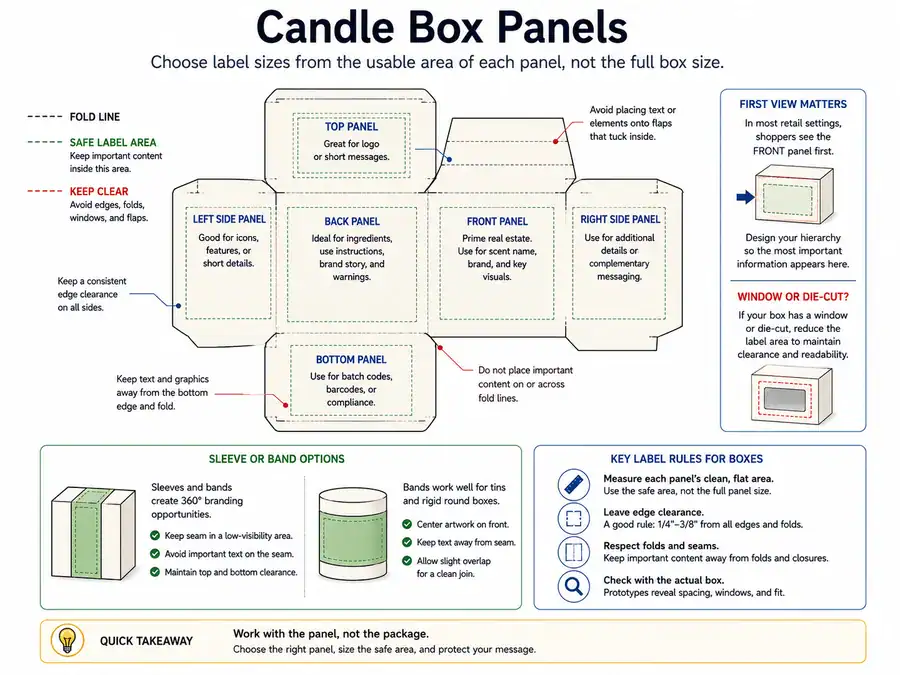
| Product box panel | Best use | Measure this area | Placement caution |
|---|---|---|---|
| Front panel | Main product identity, scent, brand, first-view information | Panel width and height minus edge clearance | Do not place the label across side folds. |
| Back panel | Instructions, maker details, barcode, warning-adjacent planning | Back panel width and height minus folds | Do not hide first-view identity here. |
| Side panel | Secondary details or scent cue on side-facing displays | Side panel width and height | Use only if the side is visible to the customer. |
| Top panel | Gift boxes, top-down trays, or stacked displays | Flat top area minus edge clearance | Keep text oriented for the first viewing angle. |
| Bottom panel | Supplemental tracking or production details | Flat bottom area only | Do not rely on it for customer-first information. |
| Box sleeve or band | Identity or scent cue across a controlled wrap area | Smooth sleeve panel area | Avoid folds unless the label is designed for them. |
Box label sizing method:
- Choose the product panel before choosing label dimensions.
- Measure that panel’s width and height.
- Subtract clearance from folds, edges, thumb notches, windows, seams, and lid flaps.
- Keep important text inside the clean flat area.
- Test the box closed, upright, flat, and beside the candle if both will be displayed together.
A box label can solve space limits on votives, minis, samplers, and tins because a product box often has more readable area than the container. It should not become a full packaging-design project. Box label sizing is about the panel, clearance, first-view information, and overflow logic. If the question shifts to pricing, sourcing, or packaging spend, route that to candle packaging cost. If the question shifts to mailers, cushioning, address labels, or postage labels, that belongs with shipping packaging content. If overflow belongs on a separate insert rather than the box panel, use candle care cards and inserts. If legal or warning information affects box placement, check candle warning label requirements without expanding the legal wording here.
Match Label Orientation to Shelf, Market, or Gift Display
Candle label placement should match the way the product is first seen on a shelf, market table, gift display, or product box.
Display orientation means the customer’s first viewing angle before they pick up the candle. Retail-ready here means visible and recognizable from that first view, not wholesale pricing, line sheets, planograms, or booth design. A centered label can still fail if the scent name faces the wall, the lid label is hidden on a shelf, or the box side label is treated as the front.
Display-context decision checklist:
- Boutique shelf: face the front body label or box front panel toward the aisle.
- Craft or market table: use a lid label only when shoppers view the candle from above.
- Gift box: place the main label on the panel seen before opening.
- Top-down tray: prioritize lid or top labels if body labels are hidden.
- Side-facing shelf: place a readable cue on the side panel only if that side is the first view.
- Boxed display: make the product box front panel carry the scent and product identity.
- Photo check: photograph the candle from the shopper’s first view and confirm the label reads correctly.
| Display situation | Best first label surface | Common mistake | Fix |
|---|---|---|---|
| Upright jar on shelf | Front body label | Scent faces away from the aisle | Rotate the jar and mark a repeatable front point. |
| Tin on market table | Lid label | Side label is too low to see | Put the main cue on the top surface. |
| Boxed candle | Box front panel | Container label is hidden inside the box | Put product identity on the outer panel. |
| Gift set | Visible box or sleeve panel | Primary label is blocked by set packaging | Shift the main cue to the visible panel. |
| Side-facing display | Side panel or narrow scent cue | Front panel faces another product | Add a readable side-facing label only if needed. |
Use craft fair display content only when the question becomes selling setup, booth layout, or table planning. Use wholesale packaging/business collateral content only when the question becomes line sheets, buyer materials, or wholesale presentation. For label visibility mistakes after application, use a placement QA checklist before repeating the layout across a batch.
Use a Measuring Template or Calculator After Measuring the Surface
A candle label measuring template or calculator should estimate label dimensions only after the usable surface has been measured.
A candle label calculator is a measurement-to-size aid for candle containers and candle boxes. It should help estimate label width, label height, placement surface, clearance warnings, and the next test-print step, not pricing, shipping, legal compliance, printer calibration, or label material choice.
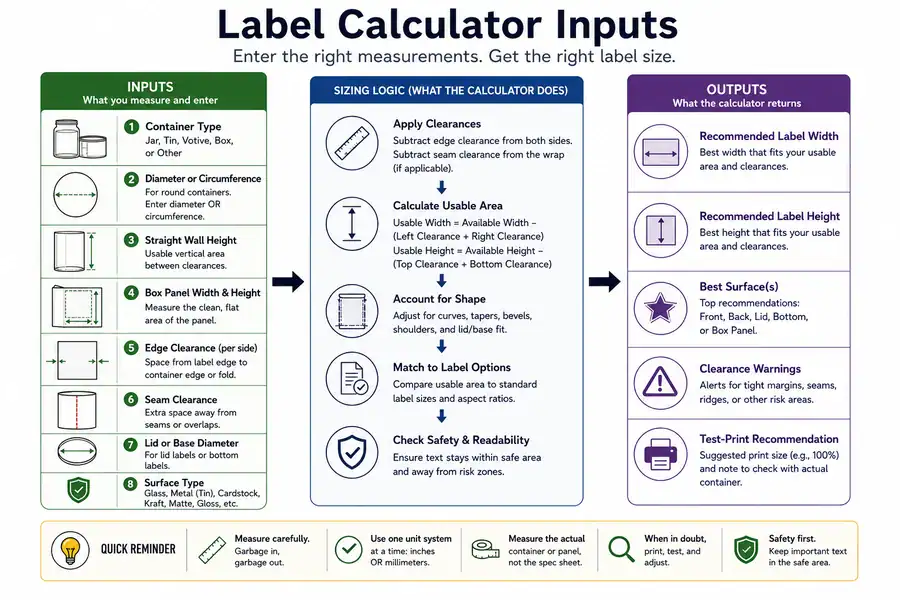
| Input | What to enter | Why it matters |
|---|---|---|
| Container type | Jar, tin, votive, mini, sampler, favor, or box | The best label surface changes by format. |
| Diameter or circumference | Diameter for round top labels; circumference for wrap labels | Diameter and circumference are not the same input. |
| Straight wall height | The flat vertical space on the body | This prevents labels from crossing shoulders, tapers, bevels, or lid ridges. |
| Box panel width and height | The exact product-box panel area | Box labels should be sized from the panel, not the total box. |
| Edge clearance | Space near rims, folds, bevels, and cut edges | Clearance prevents cramped placement and edge problems. |
| Seam clearance | Space kept away from a wrap seam | Important text should not land on or near the seam. |
| Lid or base diameter | Flat top or bottom label area | Round labels must stay inside ridges, curves, and recessed areas. |
| Surface type | Flat, curved, tapered, shouldered, ridged, or folded | Risky surfaces need smaller or repositioned labels. |
Calculator output should include:
- Recommended label width
- Recommended label height
- Best placement surface
- Clearance warning
- Test-print recommendation
Simple sizing logic:
- Front label width = visible front surface minus side clearance.
- Front label height = straight printable wall height minus top and bottom clearance.
- Wrap label width = circumference minus seam gap or overlap allowance.
- Box label width and height = product panel size minus fold and edge clearance.
- Lid label size = flat lid area minus rim, ridge, and grip clearance.
Use one unit system at a time. If the container is measured in inches, keep the label calculation in inches until the final template step. If the container is measured in millimeters, keep all measurements in millimeters. Switching units mid-calculation can create small fit errors that show up as crooked placement, clipped edges, or labels that look right on screen but wrong on the actual candle.
A calculator cannot replace the printable test-label workflow because it estimates the size before the label is physically checked. It can narrow the choice, flag risky surfaces, and reduce guessing, but the label still needs to be printed at actual size and placed on the real jar, tin, votive, or box. If the calculator result looks too wide, check whether you entered circumference when you needed only the visible front face. If it looks too tall, check whether you used total container height instead of straight printable wall height.
A calculator does not check candle warning label requirements, pricing, sourcing, printer scaling, bleed, cutlines, or page setup. Use printable candle label templates for draft layout transfer and label printing setup for printer-specific setup after the physical label size is chosen.
Print a Test Label Before Ordering or Applying Final Labels
Every candle label size should be physically test-printed at actual size before ordering or applying final labels.
A test label is a paper or draft mockup used to validate physical size and placement on the real surface. It checks whether the label fits the jar, tin, votive, mini, sampler, favor, or box before production, but it does not approve color accuracy, final material behavior, or professional prepress settings.
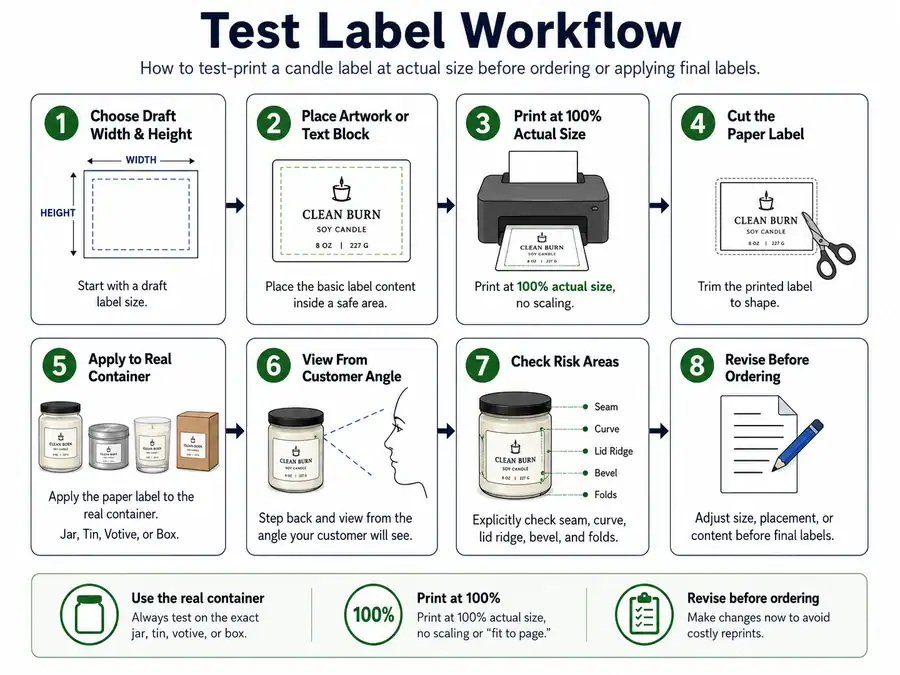
Proofing checklist:
- Print at 100% actual size.
- Do not use fit-to-page scaling.
- Cut the label to the intended shape.
- Tape or lightly apply it to the real surface.
- Check the front view, side view, seam, clearance, and readability.
- Revise size, placement, or information allocation before ordering.
Failure log:
- Label printed too large for the usable surface.
- Label looked readable on screen but too small on the jar.
- Wrap label crossed a curve or seam.
- Box label covered a fold.
- Lid label sat too close to the rim.
- Small candle label became unreadable after trimming.
Test workflow:
- Choose a draft width and height from the measured usable area.
- Place the label artwork or text block into the draft size.
- Print one copy at actual size.
- Cut the paper label along the intended edge.
- Apply it to the exact jar, tin, votive, mini, sampler, favor, or box.
- View it from the customer-facing angle.
- Rotate the container and check the seam, side curve, lid ridge, base bevel, and box folds.
- Revise before ordering final labels or applying a batch.
A regular paper mockup is acceptable for size and placement testing. It can show whether the label is too wide, too tall, off-center, crowded, or sitting on an unstable surface. It cannot prove waterproofing, oil resistance, adhesive strength, label-stock flexibility, or final color match.
Use printable candle label templates when the issue is placing the measured size into a printable layout. Use label printing setup when the issue is printer scaling, margins, cutlines, or page setup. Use best candle label materials when the paper mockup fits but the final label stock lifts, puckers, smears, or fails on the candle surface. Use placement QA checklist and photo review after application to check straightness, display orientation, spacing, and repeatability before scaling production.
If the test label looks wrong, do not fix everything at once. Reduce width when text disappears around the side curve. Reduce height when the label touches a shoulder, lid ridge, bevel, or box fold. Move secondary information when readability fails. Remeasure the surface when the candle container differs from the one used for measuring candle container label area earlier in the process.
Check Label Placement Quality Before Scaling Production
Label placement quality should be checked on the finished candle from the same viewing angle a customer will see before making more labels or scaling production.
Placement quality means repeatable visual and physical consistency: straightness, centering, clearance, readable orientation, and secondary-label visibility. It does not mean legal approval, material durability testing, product photography quality, or formal manufacturing inspection. A candle label size can be correct on paper and still fail if the applied label looks crooked, faces the wrong direction, or hides important text near a seam, lid, curve, or box fold.
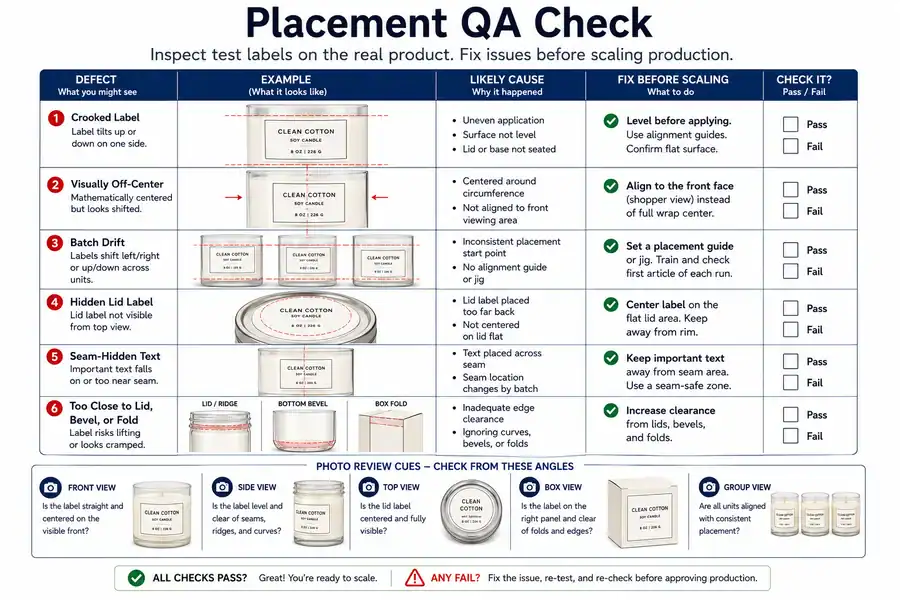
Use this checklist on the finished candle:
- The label is straight against a repeatable reference line.
- The label looks visually centered from the customer-facing side.
- The front label faces the display direction.
- Clearance looks even around lids, rims, bevels, seams, curves, and folds.
- Text is not hidden by a wrap seam, side curve, lid edge, box fold, or base bevel.
- Secondary labels do not hide information customers need before buying or using the candle.
- The label still reads from normal shopping distance.
- The same placement can be repeated across the next candles in the batch.
Photo-review prompts:
- Front view: Does the scent or product identity face the customer clearly?
- Side view: Does the label disappear too far around a curve?
- Top or lid view: Is the lid label readable if the candle is displayed from above?
- Box display view: Does the product box label face the first viewing angle?
- Group view: Do several candles in the same batch look aligned together?
| Defect | Likely cause | Fix before scaling |
|---|---|---|
| Label looks crooked | No reference line, guide, or applicator was used | Add a repeatable horizontal guide before applying more labels. |
| Label measures centered but looks off | Visual center differs because of seam, jar shape, or display side | Re-center from the customer-facing view, not the full circumference. |
| Labels drift across the batch | Placement point changes from candle to candle | Use a jig, applicator, or marked reference point. |
| Lid label is hidden on a shelf | The display angle is side-facing, not top-down | Use body, side, or box placement for the first-view cue. |
| Text is hidden at the seam | Wrap label was not planned around seam clearance | Move key text away from the seam or shorten the wrap. |
| Label sits too close to a lid, bevel, or fold | Clearance was not checked after application | Reduce size or move the label into the stable area. |
A label applicator, jig, or reference line is useful when the first few candles look acceptable but later candles drift. Use one when the label must sit at the same height across a batch, when a round container makes hand alignment inconsistent, or when the front-facing side needs to stay fixed for retail display. If the applied label fits but lifts, smears, puckers, or fails on the surface, route the material issue to best candle label materials instead of changing placement alone.
This is not legal review. If placement raises safety or warning visibility questions, check candle warning label requirements separately. If the label faces the wrong way in a boutique, market table, gift box, or top-down tray, return to retail shelf and market-display orientation. If the issue is repeated production control rather than one label check, use candle business scaling as the next business process layer after the physical label placement is stable.
Maintain Label Specs Across Batches and Container Variations
Candle label specs should be rechecked whenever the usable label surface changes, even when the candle ounce size stays the same.
Batch consistency means repeatable label size, placement height, front orientation, and readable spacing across production runs. Variation tolerance means the amount of container, lid, box, or label-shape change allowed before the old label spec must be measured again. A label spec is safe to reuse only when the usable surface, clearance points, display orientation, and label shape still match the previous batch.
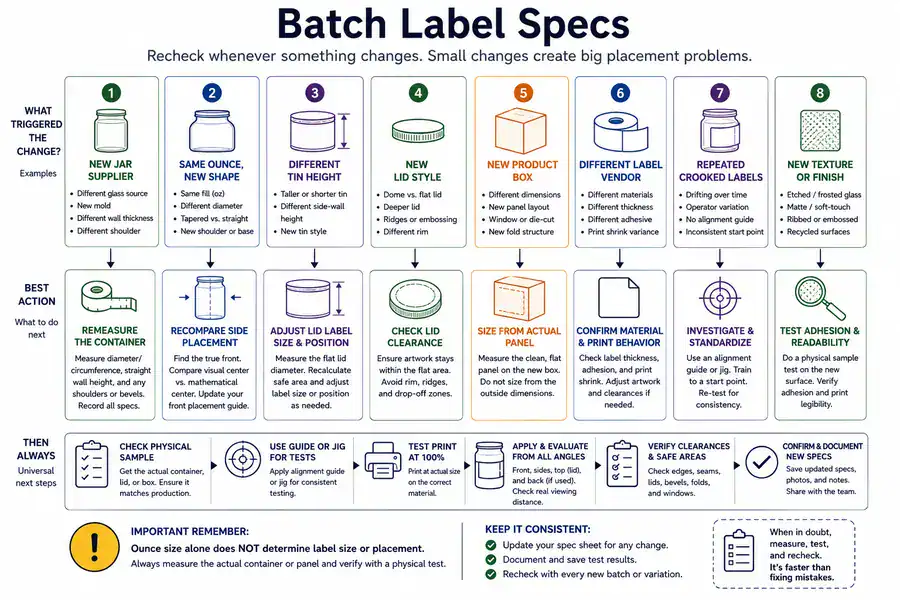
| Change in the batch | What to recheck | Risk if ignored | Best action |
|---|---|---|---|
| New jar supplier | Straight wall height, shoulder, bevel, visible front width | The old label may cross a curve or sit too low | Remeasure and test print |
| Same ounce jar, new shape | Usable body area and display face | The label may look oversized or off-center | Resize before ordering |
| Different tin height | Side-wall height and lid area | A side label may become unreadable | Recompare side and lid placement |
| New lid style | Flat lid diameter, rim, ridge, or grip clearance | A round label may sit too close to the edge | Adjust lid label size |
| New product box | Front, side, top, and back panel dimensions | The box label may cross folds or look misaligned | Size from the actual panel |
| Different label vendor | Finished label dimensions, die-cut shape, and corner radius | Old clearance may no longer hold | Check a physical sample |
| Repeated crooked labels | Placement height and front reference point | Batch labels may drift across containers | Use a guide, jig, or applicator |
| New texture or finish | Flat contact area and edge behavior | The label may apply unevenly | Check placement first, then material |
Do not reuse a label size just because the jar is still 8 oz, 10 oz, or 12 oz. A new container can have a taller shoulder, shorter straight wall, wider bevel, raised glass, different lid ridge, or narrower visible front face. Those small changes can move the label onto a curve, reduce readable space, or make a centered label look wrong from the shelf view.
Use a label placement QA checklist when several finished candles need to match as a group. It should confirm straightness, centering, clearance, front-facing direction, seam position, and readability from normal viewing distance. If the first candle in a batch looks right but later candles drift, the problem is usually the application reference point, not the artwork.
Before ordering a repeat run, test a candle label before printing if any container, tin, lid, box, label shape, or display surface changed. Start again with measure the usable candle label area when the old label suddenly looks too tall, too wide, or too close to a curve. If the question becomes staffing, production roles, or growth planning, keep the label spec here and handle the broader workflow through candle business scaling after the physical placement rule is stable.