

Hot-weather candle shipping is a packing and timing problem caused by warm routes, trucks, warehouses, porches, humidity, and delays that can soften wax, damage labels, or weaken boxes.
Hot-weather candle shipping means preparing candle orders for heat exposure during transit, not changing the wax formula. Candle product labels and packaging here mean the product label, shipping materials, packing layers, and handling choices that protect candles before the customer opens the box; they do not mean carrier postage labels. The main risks are wax softening or sweating, label peeling or smearing, and shipping boxes losing strength under heat, humidity, and pressure. The focus here is packing and timing, not carrier-rate comparison, retail shelf packaging, refund policy, or legal shipping rules.
- What Hot-Weather Shipping Does to Candles, Labels, and Boxes
- Build a Hot-Weather Candle Packing Stack That Reduces Melt Risk
- Protect Candle Labels From Peeling, Smearing, and Adhesive Transfer
- Stop Soft Boxes, Crushed Corners, and Heat-Weakened Presentation
- Ship Candles When Heat Exposure Is Lowest
- Final Hot-Weather Candle Shipping Checklist
- FAQs About Shipping Candles in Hot Weather
What Hot-Weather Shipping Does to Candles, Labels, and Boxes
Hot-weather candle shipping exposes candles to warm routes, trucks, warehouses, humid handling, porches, and delays that can soften wax, loosen labels, and weaken boxes.
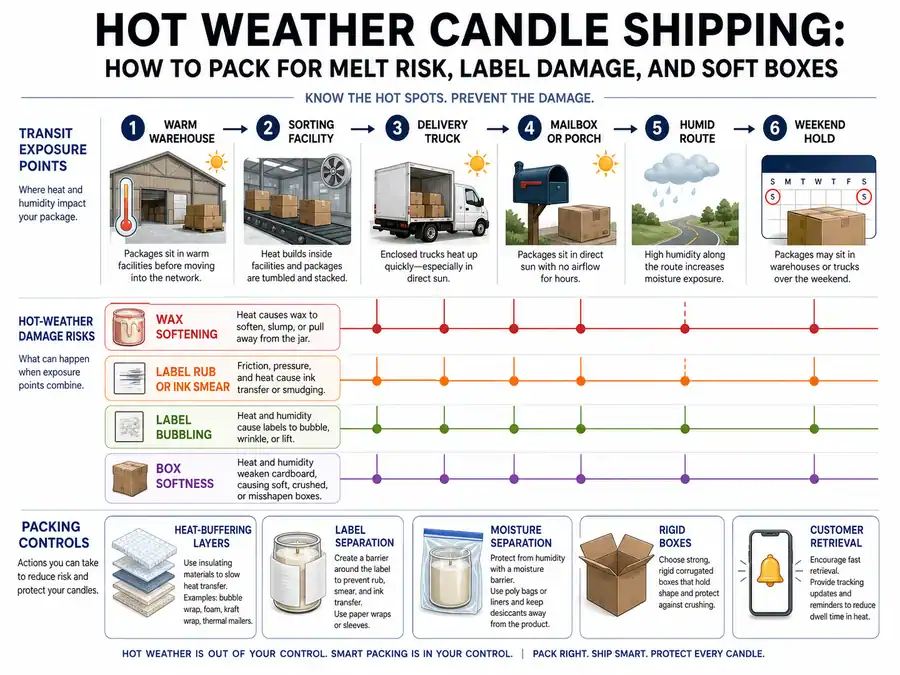
Labels and packaging here means the shipping materials, packing layers, and handling choices used to reduce candle damage during hot-weather transit. For general candle packaging and shipping overview planning, the key difference is that hot-weather packing treats heat, humidity, movement, and compression as connected risks.
| Exposure point | Damage mode | Visible sign | Packing control | When to route the issue elsewhere |
|---|---|---|---|---|
| Warm warehouse | Wax softening | Glossy surface, sweating, or shifted top | Add heat-buffering layers and protect the candle surface | Use Best Candle Wax for Hot Climates and Summer Shipping if the main problem is formula or melt point. |
| Sorting facility | Label rub or ink smear | Scuffed label, transferred ink, or dull finish | Keep labels away from rough wrap and loose filler | Use label-material guidance if the label stock fails even when packed correctly. |
| Delivery truck | Wax smearing or rim marks | Wax on lid, rim, or insert | Secure lids and immobilize the container | Use the cold-pack placement section below if cooling support becomes the main decision. |
| Mailbox or porch | Heat soak after delivery | Softened wax, sweaty container, or warped presentation wrap | Add customer retrieval reminders and avoid long exposure where practical | Use customer-notice guidance if the need is policy wording. |
| Humid route | Label bubbling or box softness | Lifted edges, damp paper, or crushed corners | Separate moisture-sensitive surfaces from cold packs, tissue, and damp filler | Use cold-pack guidance if condensation control is the main issue. |
| Weekend hold | Longer heat exposure | More surface damage despite careful packing | Ship earlier in the week when practical and avoid known hold windows | Use carrier comparison only when the question is rates or service levels. |
A candle can be damaged by heat without fully melting. Wax may soften enough to sweat, shift, smear against a lid, or lose a clean surface before it turns liquid. Labels can fail from adhesive creep, ink smear, bubbling, or surface rub, while soft boxes usually mean weakened corrugated shipping boxes rather than decorative gift packaging.
Good hot-weather packing controls four variables: exposure, movement, moisture, and compression. It does not replace wax formulation, burn-safety advice, retail shelf packaging, legal shipping rules, or live carrier-rate comparison. The practical goal is to keep the candle stable, the label readable, and the box strong until the customer opens it.
Build a Hot-Weather Candle Packing Stack That Reduces Melt Risk
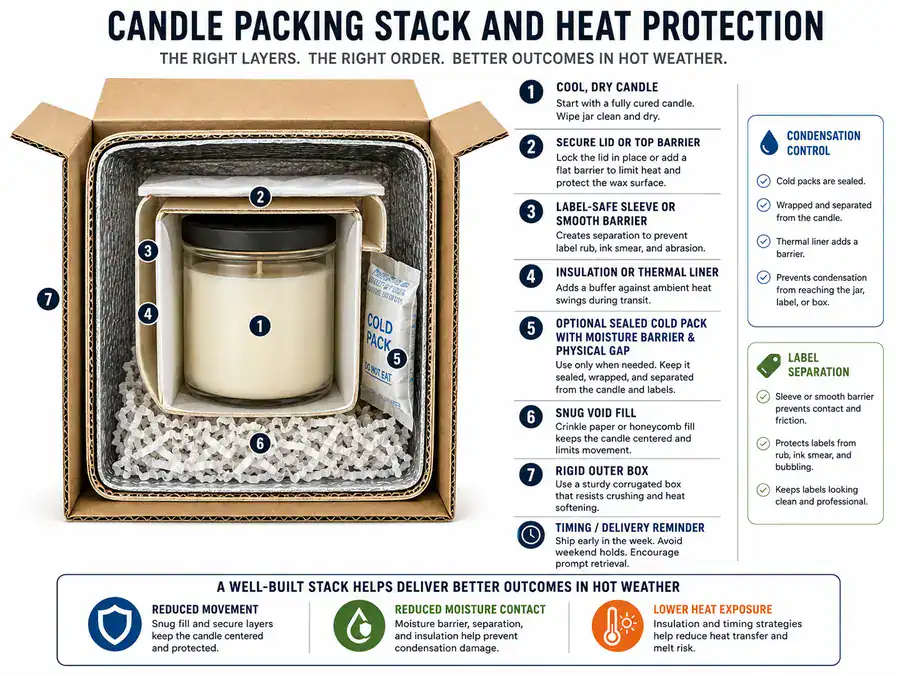
A hot-weather candle packing stack slows heat transfer, protects the candle surface, controls movement, supports the box, and reduces avoidable heat exposure.
Melt risk means wax softening, sweating, shifting, rim smears, surface deformation, or cosmetic damage during transit. For General candle shipping packaging, the stack should protect the product without promising that any package is temperature-proof.
- Start with a clean, stable candle. Make sure the candle is cool, dry, sealed, and not overfilled before it goes into the shipping box.
- Protect the candle surface. Use a lid, inner wrap, sleeve, or top barrier so softened wax does not smear against nearby material.
- Protect the label face. Keep labels away from abrasive filler, damp tissue, cold-pack condensation, and tight wrap pressure.
- Add a heat-buffering layer when the route needs it. Use insulation or a thermal liner to slow heat transfer, not to guarantee a frozen or cool arrival.
- Immobilize the candle. Use snug void fill, dividers, molded pulp, or paper support so the jar, tin, pillar, or wax melt cannot shift.
- Use a rigid outer box. The outer shipping box should resist compression and protect the candle from pressure during warm, humid handling.
- Plan timing and delivery communication. Avoid unnecessary hold windows where practical and remind customers to retrieve warm-weather deliveries quickly.
Before Packing, Check That the Candle Is Ready to Ship
A candle is ready to pack when it is cooled, clean, stable, dry, sealed, and label-bonded. This is a packing-readiness check, not a full cure-time or production-quality lesson. If the rim is smeared, the lid is loose, the label edge is lifting, or the candle feels warm from production, fix that before adding insulation or filler.
Choose Insulation, Cold Packs, or Both Without Creating Moisture Damage
Insulation slows heat transfer; cold packs add cooling support but can create condensation. Use the cold-pack placement guidance below when the decision depends on placement, condensation control, or moisture separation.
Use cold packs only when route heat, transit time, or product softness makes insulation alone risky. Keep the cold pack sealed, separated from labels and paper, and unable to press directly against the candle, because condensation can protect wax while damaging labels, tissue, inserts, or corrugated walls.
| Route condition | Insulation-only choice | Cold-pack-assisted choice | Main risk to manage |
|---|---|---|---|
| Mild warm-weather route | Thermal liner or insulated mailer may be enough | Usually unnecessary | Overpacking and cost |
| Hot route with short transit | Insulation helps slow heat transfer | Cold pack may help if isolated | Condensation near labels or paper |
| Long delivery window | Insulation helps but may not offset delays | Cold pack may warm before delivery | False confidence in cooling duration |
| Humid route | Insulation still helps | Cold pack needs moisture separation | Damp labels and weakened boxes |
| Premium presentation order | Protect tissue, inserts, and labels first | Use only with a barrier layer | Wet or stained unboxing materials |
Separate Cold Packs, Labels, and Boxes to Control Condensation
Cold-pack support can protect wax while harming labels or boxes if moisture reaches paper surfaces. Keep any cooling element away from label faces, tissue, paper filler, thank-you cards, and corrugated walls. Use a moisture barrier and a physical gap so the cold surface does not press directly against the candle label or presentation wrap.
Do not treat freezing the candle itself as the default heat-control method. Keep the page’s decision on pack-out controls: insulation, sealed cold packs when needed, moisture separation, immobilization, and shorter heat exposure.
| Failure sign | Likely cause | Packing fix |
|---|---|---|
| Wax surface smeared | Lid pressure, movement, or surface contact | Add top separation and tighten internal support. |
| Candle shifted in the box | Loose void fill or oversized box | Reduce empty space and use firmer side support. |
| Rim smeared | Loose lid, overfilled candle, or warm surface | Check readiness before packing and protect the rim. |
| Label lifted | Heat, humidity, or wrap pressure | Let the label bond and avoid tight pressure on label edges. |
| Box arrived soft | Humidity, condensation, or weak board | Use a stronger outer box and separate moisture sources. |
The packing stack reduces risk; it does not guarantee that wax will never soften during hot-weather transit. If the question becomes which wax blend ships best in heat, route that to Best Candle Wax for Hot Climates and Summer Shipping instead of turning this packing workflow into wax chemistry.
Protect Candle Labels From Peeling, Smearing, and Adhesive Transfer
Label damage in hot-weather shipping means adhesive lift, ink smear, bubbling, staining, scuffing, or presentation failure during shipment.
Protect candle labels by letting adhesive bond before packing, keeping labels dry, avoiding direct wrap pressure, and separating labels from filler, condensation, and abrasive contact. In Labels & Packaging cluster planning, label protection is a packing and surface-contact problem, not a label artwork, printer, warning-label, or brand-identity problem.
Heat can soften adhesive. Humidity can weaken paper, ink, or label edges. Condensation from a cooling layer can wet the label surface. Loose filler, tight tissue, or a rough wrap seam can rub the label until the candle arrives looking damaged.
| Label symptom | Likely cause | Packing fix |
|---|---|---|
| Label peeling | Heat plus adhesive creep or pressure on the label edge | Let labels bond before packing and keep wrap pressure off the edge. |
| Ink smearing | Moisture, condensation, or surface rub | Keep labels dry and separate them from damp tissue or loose filler. |
| Label bubbling | Humidity, trapped air, or wet contact | Use a smooth sleeve or barrier layer that does not press wet material against the label. |
| Adhesive transfer | Label face touching wrap, insert, or filler | Keep the label face away from contact points and avoid sticky or abrasive surfaces. |
| Scuffed label | Movement inside the box | Immobilize the candle so the label does not scrape during transit. |
| Stained label | Colored tissue, damp paper, or leaking moisture | Use a dry barrier between the label and any decorative or moisture-sensitive material. |
Use Candle label materials guidance when label stock, adhesive, laminate, or print method is the root problem. Keep this page focused on packing: sleeves, glassine, smooth tissue, outer bags, barrier layers, and label-safe wrap direction. If the customer-facing label also affects the unboxing layer, Ecommerce vs retail candle packaging can help separate shipping protection from retail display decisions.
Keep Labels Away From Wrap, Filler, and Hot Glass Contact
Label-to-surface separation means arranging wrap, sleeves, and filler so the label does not rub, stick, peel, or transfer against other materials.
Use this tactic when the label material is acceptable, but packed contact is causing damage. The label face should not sit against a wrap seam, damp tissue, abrasive filler, insert card, or hot glass contact point. A smooth sleeve or barrier can protect the label without hiding branding once the candle is removed from the shipping layer.
- Let the label bond before packing.
- Turn the label away from wrap seams and pressure points.
- Add a sleeve, glassine layer, or smooth barrier.
- Keep damp tissue, colored paper, and abrasive filler off the label face.
- Immobilize the candle so heat-softened surfaces do not rub.
- Check the label face before the box closes.
Use a Heat-sensitive packaging checklist before handoff when label protection depends on several small checks, such as bond time, sleeve placement, filler contact, and moisture separation.
Stop Soft Boxes, Crushed Corners, and Heat-Weakened Presentation
Soft boxes are weakened or compressed shipping boxes, not soft gift packaging, retail display boxes, or aesthetic packaging softness.
Prevent soft boxes by using a rigid shipping box, controlling moisture, filling voids tightly, and avoiding decorative packaging that collapses under heat, humidity, or compression. In General candle shipping packaging, box strength protects the candle, label, and customer-visible package even when the candle itself survives.
Heat and humidity can make weak board, loose filler, and decorative packaging perform worse under pressure. A retail candle box may look polished on a shelf, but it usually needs an outer shipping box for ecommerce delivery. The shipping box takes the compression; the retail box or presentation layer should stay clean inside it.
| Box condition | Risk sign | Packing control | Offload note |
|---|---|---|---|
| Thin mailer | Sagging sides or crushed edges | Use a rigid mailer or corrugated shipping box. | Use Ecommerce vs retail candle packaging when the issue is shelf display versus delivery protection. |
| Weak corrugated box | Corners crush during handling | Choose a stronger outer box and fill empty space tightly. | Avoid turning this into corrugated engineering. |
| Oversized box | Candle shifts, label rubs, or filler collapses | Use snug void fill, dividers, or molded inserts. | Use Fragile candle shipping without breakage if cracked glass or drop damage is the main issue. |
| Decorative filler only | Pretty unboxing but poor support | Pair decorative filler with structural void fill. | Keep decorative choices secondary to support. |
| Damp outer packaging | Soft walls, stained paper, or crushed presentation | Separate moisture sources and protect paper layers. | Route cold-pack moisture issues to the cooling setup decision. |
| Retail box mailed alone | Damaged corners or scuffed gift box | Place it inside a shipping box with padding around it. | Keep retail display design outside this packing workflow. |
Use Void Fill to Stop Movement, Label Rub, and Wax Shift
Void fill is internal packaging that limits movement, protects surfaces, and supports the candle inside the shipping box.
Void fill reduces hot-weather damage by keeping wax, labels, lids, and presentation layers from rubbing or shifting during warm transit. Heat-softened wax marks more easily, label edges lift faster under rub, and loose filler can compress until the candle moves. For breakage-only problems such as cracked jars or drop damage, How to Package Candles for Shipping Without Breakage belongs on a separate path.
| Filler type | Main function | Hot-weather use | Watch out for |
|---|---|---|---|
| Decorative filler | Looks good in the box | Use only after structural support is solved. | It can collapse or rub labels. |
| Support filler | Holds the candle in place | Use around the candle to stop shifting. | Too little support leaves rattle space. |
| Wrap layer | Separates surfaces | Use around jars, tins, or boxes to reduce rub. | Tight wrap can pull label edges. |
| Molded insert | Holds shape and position | Use when repeatable positioning matters. | Poor fit can press on lids or labels. |
| Divider | Separates multiple candles | Use to stop candle-to-candle contact. | Loose dividers can shift with the load. |
A packed box should have no rattle, no candle shift, no direct label-to-filler rub, and no overcompression. If the box feels full but the candle still moves, the filler is decorative, not supportive. Use a Heat-sensitive packaging checklist when movement control, label protection, moisture separation, and box strength need a final pass before shipping.
Keep the Package Clean, Giftable, and Customer-Ready
Keep a hot-weather candle package clean and giftable by separating moisture-prone shipping protection from customer-facing tissue, inserts, labels, sleeves, and retail boxes.
Separate protective shipping layers from customer-facing presentation layers so the candle arrives clean, dry, supported, readable, and giftable. Presentation protection means keeping tissue, inserts, labels, sleeves, and outer package layers clean after hot-weather transit. It does not mean luxury branding, product photography, retail shelf design, or a full brand system.
| Presentation choice | Better hot-weather role | Risky use | Better control |
|---|---|---|---|
| Protective sleeve | Separates labels and paper from rub | Used so tightly it pulls label edges | Keep it smooth and pressure-free. |
| Loose tissue | Adds unboxing polish | Touches labels or moisture sources | Put it outside the protective layer. |
| Structural void fill | Supports the candle and box | Hidden under too much decorative filler | Use it before decorative material. |
| Retail display box | Holds the candle for presentation | Mailed as the only outer box | Place it inside a shipping box. |
| Outer bag | Shields inserts and tissue | Traps moisture against labels | Keep wet surfaces separated. |
A package can look damaged even when the candle is intact. Stained tissue, warped inserts, rubbed labels, crushed decorative boxes, and damp paper make the order feel mishandled. Use Candle label materials only when the presentation failure starts with label stock or adhesive, and use Customer notice and care inserts when the last risk is porch heat after delivery.
Ship Candles When Heat Exposure Is Lowest
Ship candles when the package is least likely to sit in hot trucks, warehouses, weekend holds, or porch heat.
Shipping-window planning means seller-controlled dispatch timing and buyer communication that reduce heat exposure during transit and after delivery. Here, faster shipping means shorter heat exposure and fewer hold windows, not the cheapest rate, a delivery guarantee, insurance advice, or a full carrier comparison.
Timing matters because a candle can be packed well and still fail after handoff. A hot warehouse, delayed truck, weekend hold, or sunny porch can soften wax, loosen labels, or weaken presentation layers after the box leaves the seller. Use timing as one more packing control, not as a promise that heat damage cannot happen.
| Timing choice | Heat-exposure risk | Packing adjustment | Customer notice needed |
|---|---|---|---|
| Early-week dispatch | Lower hold risk | Use the normal hot-weather packing stack and confirm box strength. | Yes, if delivery may land during a hot afternoon. |
| Late-week dispatch before a weekend | Higher hold risk | Add stronger heat-buffering layers or delay handoff where practical. | Yes, especially if tracking may pause over the weekend. |
| Known hot route or heat wave | Higher route risk | Add insulation, stronger void fill, moisture separation, and label protection. | Yes, tell the customer to retrieve the package quickly. |
| Short local or regional route | Lower exposure risk | Keep the candle immobilized and the label protected. | Optional, unless porch heat is likely. |
| Premium gift order | Medium presentation risk | Protect tissue, inserts, labels, and retail boxes inside the shipping box. | Yes, because presentation damage is still customer-visible. |
| Cold pack used | Medium moisture risk | Separate cold packs from labels, paper, and the outer box. | Yes, if retrieval timing affects warmth after delivery. |
| Repeated delay problem | Higher operational risk | Review dispatch day, packing stack, and customer notice wording. | Yes, and route policy wording to Shipping policy/customer notification page. |
Use forecast and route-risk awareness as planning signals, not as guarantees. A shorter exposure window can reduce risk, but it does not make a candle package heat-proof. If the real question is price, speed tier, insurance, or service comparison, keep that on Carrier pricing and shipping method comparison instead of turning heat-aware packing into a carrier page.
A simple timing rule works for many small sellers: pack for heat first, then choose the handoff time that creates the fewest avoidable holds. The best timing decision supports the same goal as the box, filler, label sleeve, and insulation: reduce heat exposure before the customer opens the package.
Final Hot-Weather Candle Shipping Checklist
Before shipping candles in hot weather, verify the candle, label, box, insulation, void fill, moisture separation, timing, and customer notice.
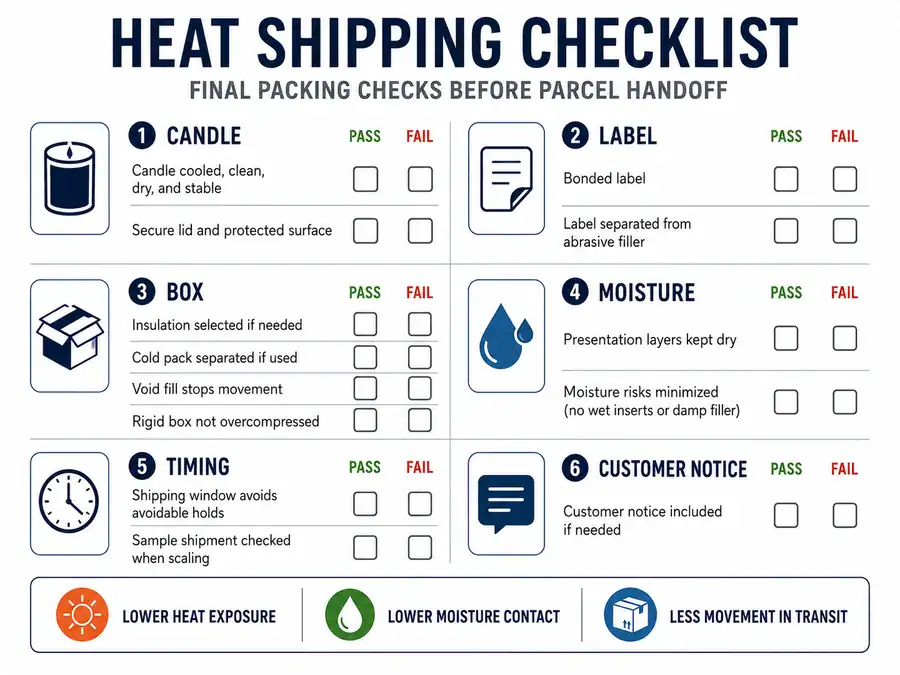
This checklist is a final heat-shipping control for small ecommerce candle shipments before parcel handoff. It is not inventory management, wholesale fulfillment, subscription-box assembly, refund drafting, carrier policy, or wax formulation guidance. Use it as a pass/fail check after the packing stack is built, especially when General candle shipping checklist planning needs a hot-weather version.
| Check item | Failure mode prevented | Pass condition | Bridge if failed |
|---|---|---|---|
| Candle is cooled, clean, dry, and stable | Wax smears, rim marks, residue transfer, or unstable surface | Candle feels stable, rim is clean, lid area is dry, and surface is protected. | Route production or cure-time questions away from this packing checklist. |
| Lid is secure and surface is protected | Wax contact, rim smearing, or lid movement | Lid fits firmly and the candle surface has a safe separation layer where needed. | Review the melt-risk packing stack before handoff. |
| Label is bonded | Peeling, bubbling, or edge lift | Label edges sit flat and do not lift under normal handling. | Use Candle label materials if stock, adhesive, or print method is the root problem. |
| Label does not face abrasive filler | Scuffs, ink rub, adhesive transfer, or stained label | Label face is separated from seams, rough filler, damp tissue, and pressure points. | Rework sleeve placement or label-facing wrap direction. |
| Insulation or thermal liner is selected if needed | Wax softening, sweating, or cosmetic heat damage | Heat-buffering layer matches the route risk without crushing the package. | Rebuild cold-pack placement and moisture separation before shipping. |
| Cold pack is separated if used | Wet labels, damp tissue, softened boxes, or condensation stains | Cold pack does not touch labels, inserts, paper filler, or corrugated walls. | Rebuild moisture separation before shipping. |
| Void fill immobilizes the candle | Wax shift, label rub, lid movement, or box collapse | The candle does not rattle, slide, tilt, or press hard against the label face. | Use stronger support filler before adding decorative filler. |
| Box is rigid and not overcompressed | Soft walls, crushed corners, or damaged presentation | Outer shipping box holds shape and filler supports the candle without forcing the lid or label. | Use a stronger shipping box, not retail packaging alone. |
| Presentation layers are protected from moisture | Stained tissue, warped inserts, or giftable-package damage | Tissue, insert cards, sleeves, and customer-facing packaging stay dry and separate from cold surfaces. | Reorder the protective layer before the decorative layer. |
| Shipping window avoids avoidable heat holds | Weekend heat exposure, warehouse delays, or porch heat | Dispatch timing limits avoidable holds where practical. | Route rate or service-level decisions to carrier comparison instead of expanding this checklist. |
| Test shipment is checked when scaling hot-weather orders | Repeated melt damage, label rub, box softness, or cold-pack condensation | One sample package is sent through a realistic warm route before large summer volume. | Keep this as packing validation; route formula failures to wax selection and carrier failures to shipping-method comparison. |
| Customer notice is included if needed | Post-delivery porch heat or warm handling damage | Tracking reminder or warm-weather note is included for likely heat exposure. | Use Shipping policy/customer notification page if the wording becomes policy, refund, or support language. |
A failed row does not always mean the whole shipment must be rebuilt. Fix the specific failure first: relabel a weak label, add a sleeve, tighten filler, separate a cold pack, replace a soft box, or change the handoff day. If the failure belongs to wax formula, cold-pack testing, carrier pricing, or refund wording, treat it as a separate decision instead of adding that topic into the shipping checklist.
Add a Heat-Delivery Note So Customers Retrieve Candles Quickly
Ask customers to retrieve warm-weather candle packages quickly and let warm candles return to room temperature before handling.
A customer notice is delivery-care communication tied to heat exposure after the parcel arrives. It supports packaging but does not replace it, and it should not sound like a legal disclaimer or refund policy. For small shops, Heat-sensitive packaging checklist use works best when the final row confirms whether a delivery note belongs in the box or order message.
Use wording like this:
Warm-weather delivery note: Please track your package and bring it indoors as soon as possible. If your candle feels warm, let it return to room temperature before opening or handling. Contact us if anything looks damaged.
Keep the note practical and calm. Do not blame the customer, promise perfect delivery, or turn the message into chargeback, liability, or carrier-guarantee language. If the note affects broader buyer communication, delivery expectations, or shop policy, route it to Shipping policy/customer notification page rather than expanding the packaging workflow. For presentation-focused orders, Ecommerce candle packaging can keep the note, insert, tissue, and protective layers working together without turning shipping protection into retail display design.
FAQs About Shipping Candles in Hot Weather
Hot-weather candle shipping FAQs should stay focused on packing, insulation, cold packs, label protection, box strength, and customer retrieval.
These answers reinforce the packing workflow without turning the page into wax formulation, carrier pricing, refund policy, or retail display advice.
Can candles melt in the mail during summer?
Candles can soften, sweat, shift, smear, or show surface damage during summer transit even when they do not fully melt. Packaging should slow heat transfer, stop movement, protect labels, support the box, and reduce porch exposure.
Is insulation enough for shipping candles in hot weather?
Insulation may be enough for moderate heat risk, but higher-risk routes may need stronger timing, moisture control, or cold-pack support. Use the cold-pack placement section above when the question becomes cold-pack placement, condensation control, or moisture separation.
Should I use cold packs when shipping candles?
Use cold packs only when heat exposure risk is high and the package separates the cold pack from labels, paper, tissue, inserts, and corrugated box walls. Cold packs can reduce wax softening risk, but they can also create condensation damage when packed without a barrier.
How do I keep candle labels from peeling during shipping?
Let labels bond before packing, keep labels dry, avoid tight wrap pressure, and separate label faces from filler, damp tissue, seams, and cold-pack condensation. Use Candle label materials when the real problem is label stock, adhesive, laminate, or print durability rather than packing contact.
What kind of box is best for summer candle shipping?
For this page, best means best at reducing movement, moisture contact, label damage, and box compression during hot-weather parcel transit. Use a rigid shipping box with enough internal support to prevent movement, compression, and crushed corners. A retail candle box alone is usually not enough for parcel shipping because presentation packaging is not the same as heat-aware shipping protection.
Should I tell customers to retrieve candles quickly after delivery?
Yes, a short delivery-care note can reduce porch heat exposure by asking customers to track the package and bring candles indoors quickly. Use Shipping policy/customer notification page if the wording becomes a refund, support, or policy issue.
Which wax is best for shipping candles in hot weather?
On this page, best is limited to shipping protection, not wax formula performance. Wax selection belongs outside this packing workflow because it changes the topic from packaging control to product formulation. Use Best Candle Wax for Hot Climates and Summer Shipping when the main question is wax type, melt point, additives, or formula performance.
Which carrier is cheapest for summer candle shipping?
Carrier price comparison belongs outside hot-weather packing because the core issue here is heat exposure, movement, moisture, and box protection. Use Carrier pricing and shipping method comparison when the decision is live rates, insurance, speed tier, or service-level comparison.