You do not need a thermometer for every candle, but it becomes the practical default once fragrance timing, finish quality, or repeatable results matter.
A plain practice candle can work without measuring every step. That changes when fragrance timing, pour timing, and finish quality all need to line up. A thermometer matters more with sensitive waxes, repeat batches, and any candle you want to remake with the same result. The sections below separate the low-stakes cases from the ones where measuring saves wasted wax and fragrance.
When a Thermometer Is Actually Necessary
You do not need a thermometer for every candle, but you should use one whenever fragrance timing, finish quality, or repeatable results matter.
For a single unscented practice jar, careful observation may be enough. Once you want stronger scent, smoother tops, or notes you can trust later, measuring becomes part of a steady process. A broader candle making equipment guide can place the tool in the rest of the setup, but the real question here is whether your workflow can tolerate guesswork.
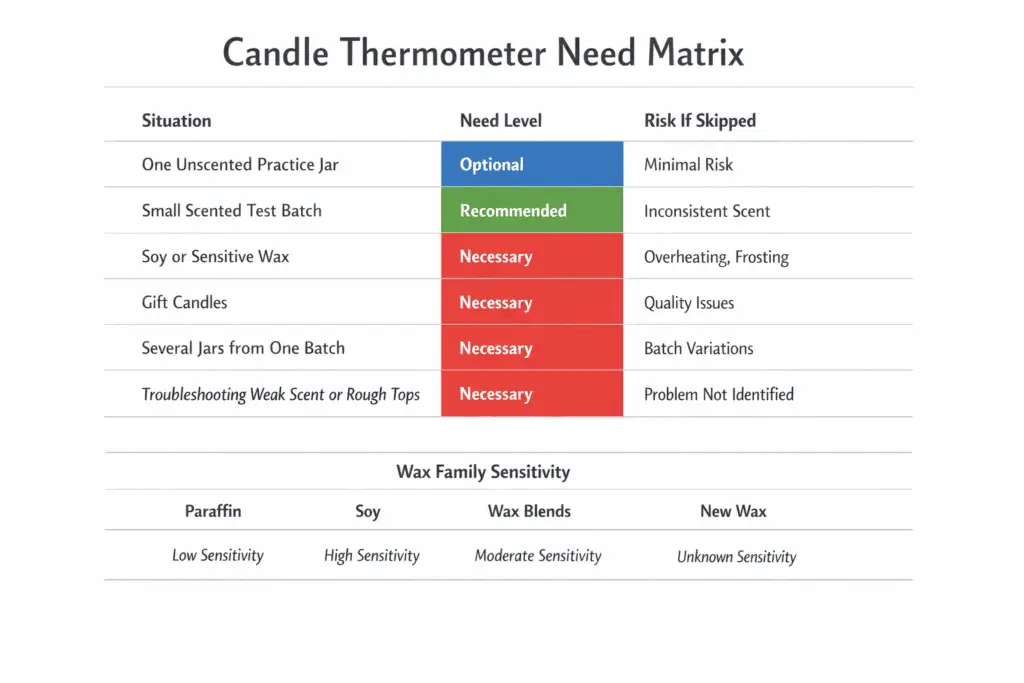
| Workflow scenario | Need level | What can go wrong if you skip it |
| One unscented practice jar | Low | The candle may still work, but the next batch is harder to repeat |
| Small scented test batch | Medium | Scent strength can shift if the fragrance goes in at the wrong stage |
| Soy or another more sensitive wax | High | Timing errors show up faster in scent and surface finish |
| Gift candles where looks matter | High | Rough tops, wet spots, or uneven cooling become more likely |
| Several jars from one batch | High | A small timing mistake gets copied across the full run |
| Troubleshooting weak scent or rough tops | High | Guessing hides the variable you are trying to fix |
In this article, “necessary” means necessary for the workflow, not required by law. It means the thermometer helps you control a few key decisions instead of relying on appearance alone. That matters most in Fragrance oil addition temperature timing, Pour temperature control and finish quality, and any batch where you want the same result twice.
A simple way to think about it is this:
- Check the wax before adding fragrance.
- Check the wax again before pouring.
- Record what worked so the next batch is easier to repeat.
Some Waxes Need Tighter Temperature Control
Some waxes need tighter control than others, so thermometer use depends partly on the wax family and the result you want.
This is where Wax type and batch sensitivity starts to matter. A more forgiving wax can hide small timing mistakes better than a wax that shows frosting, rough tops, or weaker scent from the same miss.
| Wax family | Temperature sensitivity | When measuring becomes strongly recommended |
| Paraffin | Lower to medium | As soon as you want repeatable scented batches |
| Soy | Medium to high | Early, especially if finish quality matters |
| Wax blends | Medium to high | Early if the blend is fragrance-heavy or finish-sensitive |
| New wax you have not tested before | Varies | Right away, so your notes mean something |
This is not a claim that one wax always needs one fixed method. It is a practical rule: the less forgiving the wax, the less useful guessing becomes. If the matrix keeps pushing your batches toward the “measure it” side, the next section on Safe thermometer options for candle makers becomes more useful sooner.
Fragrance Oil Timing Is the First Real Reason You Need One
A thermometer becomes worthwhile as soon as fragrance-add timing matters, because missing the supplier-guided window can weaken scent performance and make batch notes less repeatable.
A fragrance-add window is the point where the wax is ready for fragrance oil based on supplier guidance and batch behavior. This is often when temperature control matters most, because wax that looks ready in the pot can still be too hot or too cool for steady fragrance addition.
| Wax family | What to check | Why guessing fails |
| Soy | Use the supplier add range for that wax and keep stirring time consistent | Soy often shows bigger swings in scent and finish when timing drifts |
| Paraffin | Use the target for that blend instead of copying one number from another recipe | Different blends do not behave the same way |
| Wax blends | Follow the maker guidance for that exact blend and record the result | Mixed waxes can act closer to one parent wax or the other |
A fair way to handle this step is simple. Check the wax before adding fragrance, add the oil in the supplier-guided window, stir for the same amount of time each batch, and write down the result. That gives you a process you can repeat instead of a guess you cannot test.
Many makers report the same pattern after a weak-scent batch: the wax looked ready, but the next pour did not smell the same. That usually is not random bad luck. It usually means the batch needed a measured checkpoint.
Pour Temperature Affects Finish Quality
Pour temperature matters because wax that looks ready in the pot can still cool badly in the jar and create rough tops, frosting, or wet spots.
That is why temperature control affects finish quality. Pour timing changes how the wax settles, shrinks, and grips the glass. It is not the only cause of finish defects, but it is one of the first variables worth checking.
| Finish issue | First temperature check to test | What to check beside temperature |
| Rough tops | Review whether you poured outside the supplier pour range | Room temperature and drafts |
| Wet spots | Recheck pour timing and cooling speed | Jar warmth and glass prep |
| Frosting | Look at pour timing and cooling pace | Wax family, especially soy |
| Sinkholes | Review pour timing before changing other variables | Container size and cooling speed |
A wet spot is a patch where the wax pulls away from the glass and leaves uneven adhesion. A clean way to test this is to change the pour timing first, keep the jar prep the same, and compare the next batch before changing several other things at once.
If the same defect keeps returning, you are already past the point where guesswork saves money. At that stage, measuring becomes part of the fix.
When You Can Skip a Thermometer — and When You Can’t
You can skip a thermometer only for simple, low-stakes batches; once scent, finish quality, or repeatability matter, measuring becomes the safer default.
That is the real line for when you can skip measuring wax temperature. A budget-minded beginner is not careless for starting with less gear. The trouble starts when a one-jar shortcut gets treated like a steady method.
| Situation | Skip for now? | Risk you accept |
| One unscented practice jar | Maybe | Lower repeatability and more guesswork |
| One scented test jar | Usually no | Scent strength can shift without a clear reason |
| Gift or sale candles | No | Surface flaws and batch mismatch matter more |
| Wax that already gave rough tops or frosting | No | You need a real checkpoint to fix the issue |
| Trying to repeat a recipe later | No | Notes without temperature data are harder to trust |
A few failed jars can cost more than a basic thermometer. That is why the false saving often disappears after the first rough batch, weak-scent batch, or inconsistent repeat test. If your guessed-temperature batch already failed, change one variable first, then re-run the batch with measured fragrance-add and pour checks.
Safe Thermometer Options for Candle Makers
For most hobby makers, a readable probe thermometer is the safest default because it tracks actual wax decisions better than guessing or surface-only IR checks.
The fastest way to compare thermometer options for candle making is to match the reading method to the job. The best choice depends on whether you need internal readings, quick surface checks, easier visibility, or simple hobby use.
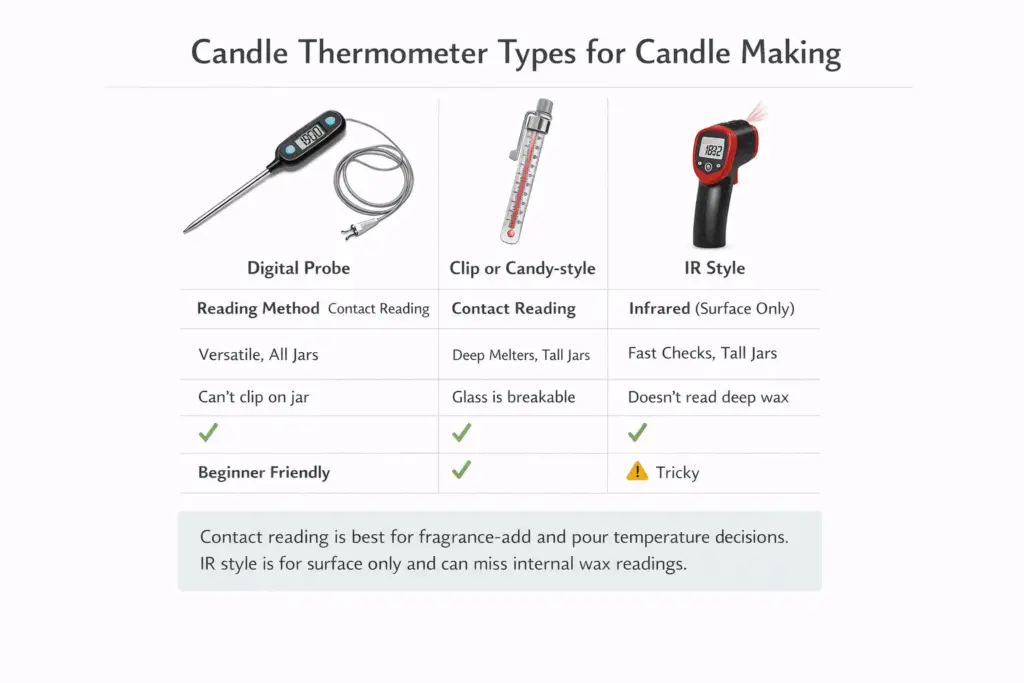
| Thermometer type | Reading method | Best fit | Main limit | Good first buy for most beginners? |
| Digital probe | Contact reading inside the wax | Fragrance timing, pour timing, repeat batches | Needs cleaning and careful placement | Yes |
| Clip or candy-style | Contact reading while attached to the pot | Slower-paced hobby batches with hands-free checks | Can react more slowly and be harder to read on quick shifts | Sometimes |
| IR style | Surface reading without contact | Quick surface checks and spot checks | Does not show the deeper wax temperature | No, not as the only tool |
You can use any thermometer for candle making only if it safely reads hot liquid within your wax’s working range, but probe or other contact reading is still the default for fragrance-add and pour decisions.
A probe-style thermometer works best for most makers because it measures the wax where the decision happens. The surface can cool faster than the wax below it, so an internal reading is usually more useful when you are deciding when to add fragrance or when to pour. That is why When a Thermometer Is Actually Necessary comes before tool choice: your workflow should decide the tool, not the other way around.
What makes a thermometer feel safer in candle work is plain. It should be easy to read around hot wax, stable in the range your recipe uses, simple to place without scraping the pot bottom, and quick enough to catch short decision windows. Response speed matters more in small hobby batches because the wax can move through a key stage fast.
A practical buying checklist looks like this:
- Choose contact reading first if you need fragrance-add or pour decisions.
- Make sure the display is easy to read near a hot pouring setup.
- Check that the thermometer can handle the temperatures your wax reaches.
- Pick a shape you can place without fighting the pot or pouring pitcher.
- Treat IR as a support tool unless surface checks are your only goal.
A short caution on IR thermometer limitations on melted wax matters here. An IR thermometer uses infrared reading to check surface heat without touching the wax. That makes it useful for quick checks, but weaker as the only reading for fragrance-add or final pour decisions. Reflective containers can affect the reading, and the wax under the surface may still be at a different temperature.
After you choose the type, Using a candle thermometer correctly matters as much as the tool class. A modest probe used the same way every batch is usually more useful than a fancier option used at random.