

CLP labels, warning labels, and branding labels are different candle label roles, not interchangeable names for one candle sticker.
On this page, CLP means UK/EU-style classification, labelling, and packaging hazard communication; US cautionary-label rules and product-specific legal checks belong in separate guidance.
Candle labels and packaging work best when each label role has a clear job. A CLP label handles hazard communication when it applies, a warning label handles candle-use and fire-safety communication, and a branding label handles buyer-facing identity. What candle makers need here means knowing which role belongs where before design, sourcing, or deeper compliance checks. This comparison does not replace product-specific CLP advice, legal review, warning-symbol layout, label material selection, or full branding strategy.
What Are CLP Labels, Warning Labels, and Branding Labels?
CLP labels, warning labels, and branding labels are three different candle label roles, not interchangeable names for one product sticker.
Candle labels and packaging form a system of compliance, safety, and branding information areas. A CLP label communicates hazard information when it applies, a warning label explains candle-use and fire-safety precautions, and a branding label presents the candle to buyers.
| Label type | Main purpose | Typical information | What it is not | Where to go deeper |
|---|---|---|---|---|
| CLP label | Hazard communication when the candle product requires it | Hazard wording, hazard symbols, supplier details, or related compliance information where applicable | A general burn warning, brand story, or design label | CLP Candle Label Requirements |
| Warning label | Candle-use and fire-safety communication | Burn within sight, keep away from flammable items, keep away from children and pets, or other safe-use instructions | A CLP hazard label or finished legal review | What Must Go on a Candle Warning Label? |
| Branding label | Buyer-facing product identity and presentation | Brand name, scent name, collection name, product mood, and front-facing design cues | Safety content, CLP content, or a full brand strategy | Candle Label Design and Branding |
| Packaging label area | A place where one or more label roles may be organized | Front label, back label, base label, lid, box, tag, or insert | A substitute for clear role planning | Candle Packaging Design |
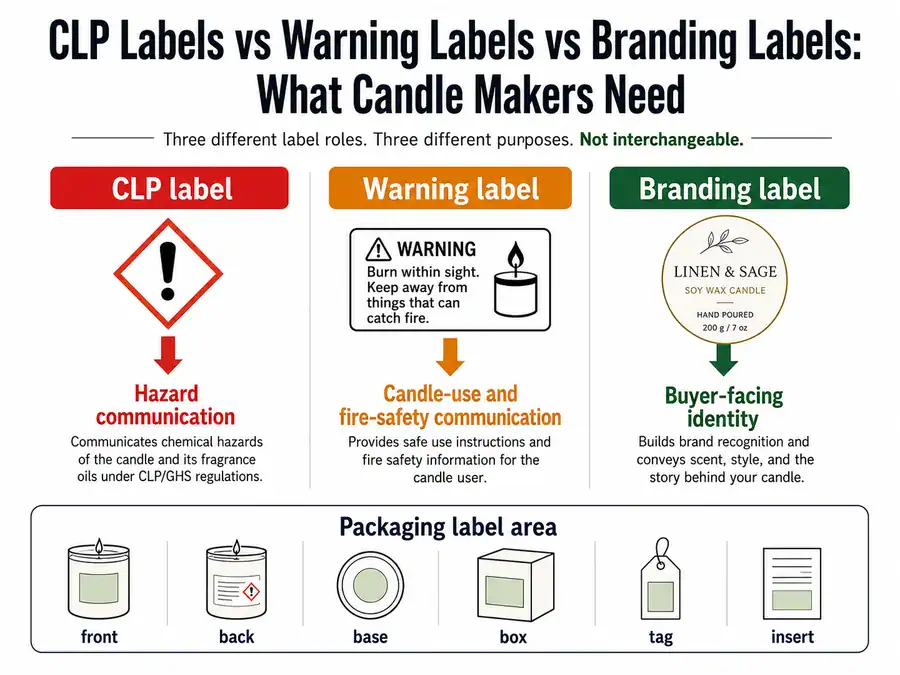
One candle can have all three roles, either across separate label areas or in one combined layout. The key is that each role stays readable and distinct, so the buyer can tell the difference between hazard communication, candle-use safety, and product identity.
A warning label is not the same as CLP because “warning” here means burn-use and fire-safety communication, not hazard classification. Branding is useful for selling the candle, but it should never make safety or compliance information hard to find.
If a CLP label uses the signal word “Warning,” that still belongs to hazard classification; it does not turn the CLP label into a candle-use warning label.
For final CLP or candle-warning verification, use official or standards-based sources inside the dedicated CLP and warning-label guidance instead of treating this comparison as a finished compliance check.
This matters before design or printing because a beautiful front label can still leave the product poorly organized. Plan the roles first, then decide where each role fits on the jar, base, box, or tag. Exact CLP wording, warning-symbol layout, and legal checks belong in deeper label-specific work, not in a broad label-type comparison.
Compliance vs Safety vs Branding: What Each Label Type Is For
CLP labels support compliance communication, warning labels support candle-use safety communication, and branding labels support customer-facing product presentation.
What candle makers need means planning label roles before design, sourcing, or compliance checking. It does not mean every candle in every market needs identical label text, because exact requirements can depend on product composition, selling location, and the rules that apply.
| Purpose category | Label type | User need served | Typical content | Wrong assumption to avoid |
|---|---|---|---|---|
| Compliance communication | CLP label | Helps communicate hazard classification and labelling information when applicable | Hazard wording, symbols, supplier information, and related details where required | Assuming CLP is just another candle warning sticker |
| Candle-use safety | Warning label | Helps the buyer burn and handle the candle more safely | Burn-time, supervision, placement, heat, flame, and child or pet warnings | Assuming CLP replaces candle-use warnings |
| Product presentation | Branding label | Helps the buyer recognize and choose the candle | Brand name, scent, collection, product mood, and front-facing identity | Assuming branding can replace safety or compliance information |
| Document distinction | CLP support materials | Helps route deeper compliance questions to the right source | SDS, IFRA, formulation, or supplier information may inform deeper checks | Treating documents and labels as the same thing |
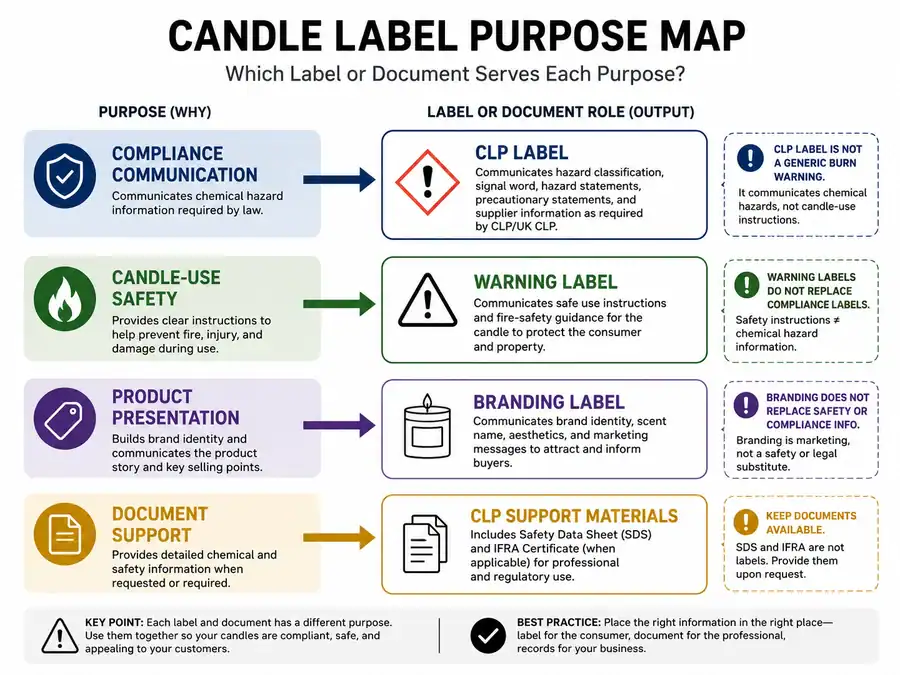
One physical label area can serve more than one purpose if the roles remain readable and distinct. For example, a back label may carry warning information and some product details, while the front label stays focused on the scent and brand.
If CLP document confusion comes up, the next check is CLP vs SDS vs IFRA, not a broader design decision. If the question is exact hazard wording, use CLP Candle Label Requirements instead of guessing from a generic candle label. For exact burn-use wording, route the task to What Must Go on a Candle Warning Label?.
Compliance and safety cannot be replaced by branding. A premium-looking front label may help sell the candle, but it does not answer burn-use safety questions or product-specific hazard communication questions. For buyer-facing identity, packaging story, or product presentation beyond the label role, keep that work separate in Candle Branding Guide or Candle Packaging Design.
Where Each Label Type Usually Fits on the Candle, Jar, or Packaging
Candle label placement should follow information role: branding helps buyers identify the product, while warning information and any required CLP information must stay visible and readable.
A candle label system can use one or more areas across the candle jar, base, lid, box, tag, or insert. CLP means classification, labelling, and packaging; on candles, it relates to hazard communication when it applies. Branding placement does not replace warning or CLP placement, and “professional” placement means role clarity and readability, not label finish or print quality.
| Package area | Best-fit role | Can combine with | Caution | Route if detailed help is needed |
|---|---|---|---|---|
| Front label | Branding label | Scent name, product size, collection cue | Do not overload the front with every safety or compliance role if readability suffers | Candle Packaging Design |
| Back or side label | Warning label, product details, or combined role area | Brand details, batch cues, basic product notes | Keep fire-safety wording separate enough from brand copy to read quickly | What Must Go on a Candle Warning Label? |
| Base or bottom label | Compact supporting information | Batch code, short product details, small warnings where suitable | Small spaces can make important text hard to read | CLP Candle Label Requirements |
| Lid | Brand cue or light product identifier | Scent name, collection mark, short reminder | A lid is not a safe place to hide key use or compliance information | Candle Packaging Design |
| Box | Branding, product information, supporting safety copy | Warning copy, CLP-related information where suitable, insert prompts | A box may be discarded, so do not assume packaging-only placement is always enough | Candle Label Printing Guide |
| Tag or insert | Extra use notes, scent story, care details | Brand story, burn tips, supporting information | Important warnings should not become hard to find | Best Label Materials for Candles |
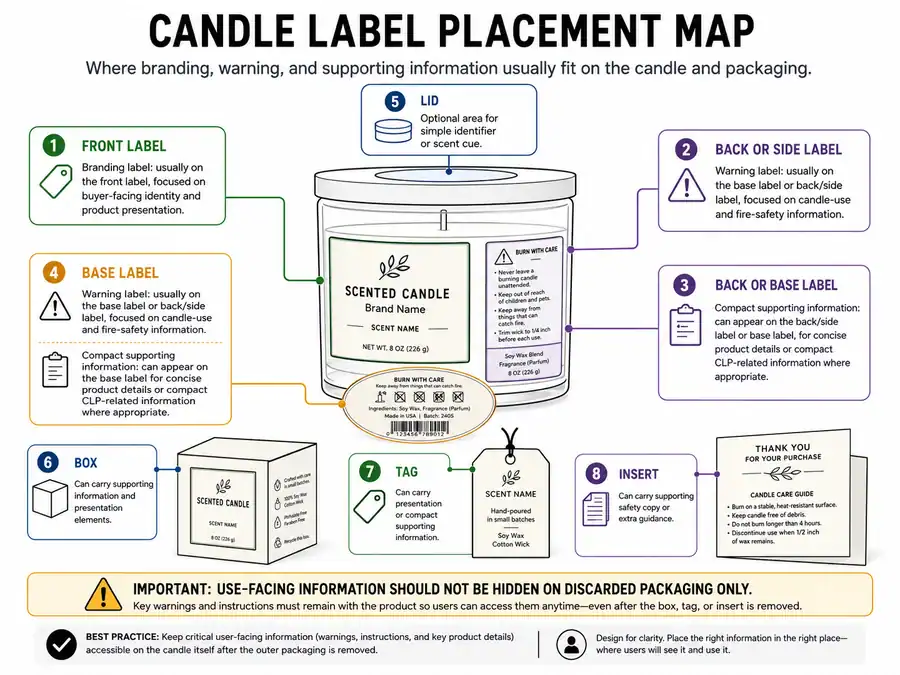
A front label can include more than branding in some layouts, but it often becomes crowded when compliance, fire-safety, and sales copy compete in one small space. A back or side label is often better for role separation because it can give warning information room without weakening the candle’s first impression.
A box, tag, or insert can support the label system, but it should not be used as the only place for information the buyer needs while using the candle. Use placement as a role-planning step before printing. Decide what the buyer must see first, what they must be able to read before burning, and what needs deeper product-specific checking.
Keep adhesive choice, waterproofing, oil resistance, dielines, and printer settings separate from this decision. Those choices matter later, after the compliance, warning, and branding roles are mapped.
Do Candle Makers Need Separate Labels or One Combined Label System?
A candle can use separate labels or one combined label system, but CLP, warning, and branding roles must remain distinct enough to understand.
A combined label can place CLP and candle-use warning information on one physical label, but the two roles should still be separated by headings, spacing, or clear layout hierarchy.
What candle makers need here means a layout decision, not a legal approval. Separate roles do not always require separate stickers. One physical label area can carry multiple roles if hierarchy, readability, and boundaries are clear. “Combined” does not mean mixed together without structure.
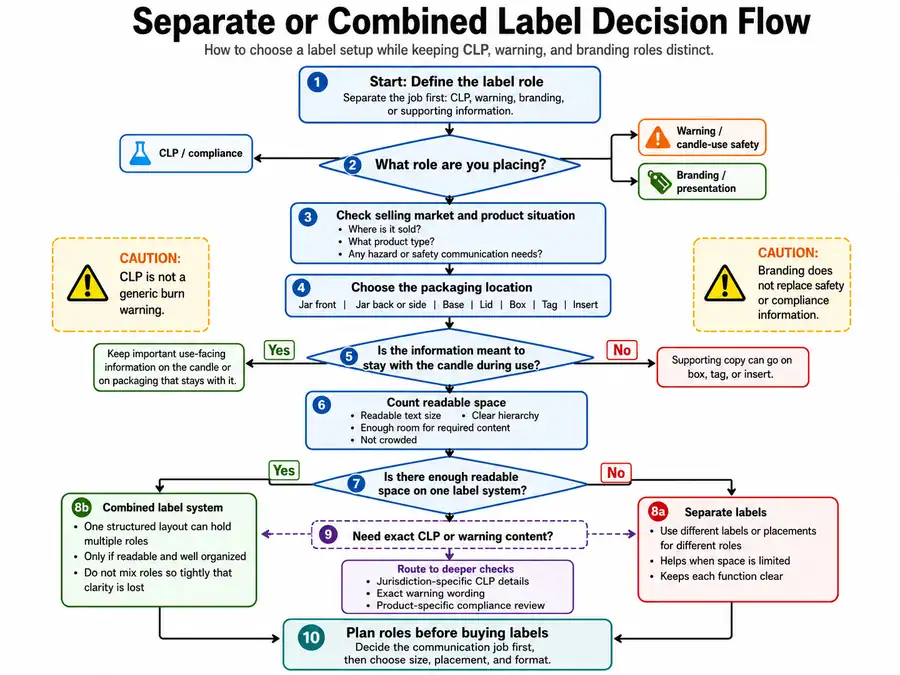
Use this decision tool before design or printing:
- Identify the label role: CLP, warning, branding, or mixed.
- Identify the selling market and product situation before treating anything as required.
- Choose the packaging location: front, back, side, base, lid, box, tag, or insert.
- Count the available label areas and the amount of readable space.
- Decide whether the roles stay clearer as separate labels or as one structured combined label.
- Route exact compliance, warning, or production details to the right next check.
| Situation | Better fit: separate, combined, or depends | Why | Watch-out | Route if details are needed |
|---|---|---|---|---|
| Small candle jar with limited space | Separate or depends | A small front label may not hold brand, warning, and CLP-related information clearly | Tiny text can make important information easy to miss | CLP Candle Label Requirements |
| Boxed candle with jar label and outer packaging | Depends | The box can support information, while the jar still needs clear use-facing details | Do not assume the discarded box solves every placement need | CLP/UFI for Candles: EU vs UK Differences |
| Brand-led front label with clean design | Separate | Branding can stay clear while safety and compliance information sit elsewhere | Do not let design hide fire-safety wording | What Must Go on a Candle Warning Label? |
| Back label with enough space for sections | Combined | A structured back label can separate warning, product, and CLP-related roles | Use clear grouping so the roles do not blur together | Candle Packaging Design |
| Maker buying labels before role planning | Separate planning first | The right sticker count depends on content roles and package areas | Decorative labels alone may leave key roles missing | Best Label Materials for Candles |
| Ready-to-print layout with many small details | Depends | Printing can work only after the role layout is settled | Do not solve readability by shrinking important text | Candle Label Printing Guide |
A separate-label setup usually works well when the front label is brand-heavy, the container is small, or warning and CLP-related information need their own readable area. A combined-label setup can work when the back or side label has enough space for clear sections.
The decision is not “one sticker versus many stickers” on its own. The better question is whether each role can be found, read, and checked without confusion.
Treat the combined label system as organization, not certification. If the next question is exact CLP wording, market-specific UFI handling, or a finished-label legal check, move into dedicated compliance work. If the next question is print finish, stock, adhesive, or production setup, handle that after the content roles are settled.
Common Mistakes When Candle Makers Mix Up CLP, Warning, and Branding Labels
Most candle label mistakes happen when CLP, warning, and branding labels are treated as interchangeable roles in one candle label system.
CLP means classification, labelling, and packaging; here, it belongs to hazard communication when it applies. Mistake prevention means role clarity before printing or buying labels, not legal certification. A candle can look polished and still be poorly labelled if the brand area hides warning information, the warning sticker is treated as CLP, or the maker skips deeper checks.
| Mistake | Confused label roles | Root cause | Quick fix | Where to verify deeper details |
|---|---|---|---|---|
| Front branding label treated as the whole system | Branding vs warning vs CLP | The maker plans the pretty label first | Map the front, back, base, box, or tag by role | Candle Packaging Design |
| CLP wording used as a generic fire warning | CLP vs warning | Hazard wording is mistaken for burn-use advice | Keep burn instructions separate from hazard communication | What Must Go on a Candle Warning Label? |
| Warning sticker assumed to replace CLP | Warning vs CLP | “Warning” is treated as one broad safety bucket | Check whether CLP applies separately | CLP Candle Label Requirements |
| One small label overloaded | All roles mixed | Too much content is forced into one area | Split roles or use a clearer back-label layout | EU CLP Label for Candles: Examples & Template |
| Decorative labels bought before role planning | Branding vs all required roles | Design is treated as the first decision | Plan content roles before material or print choices | Best Label Materials for Candles |
| Important warning information only on discarded packaging | Warning vs packaging support | The box is treated as the whole label system | Keep use-facing information available on the product where needed | What Must Go on a Candle Warning Label? |
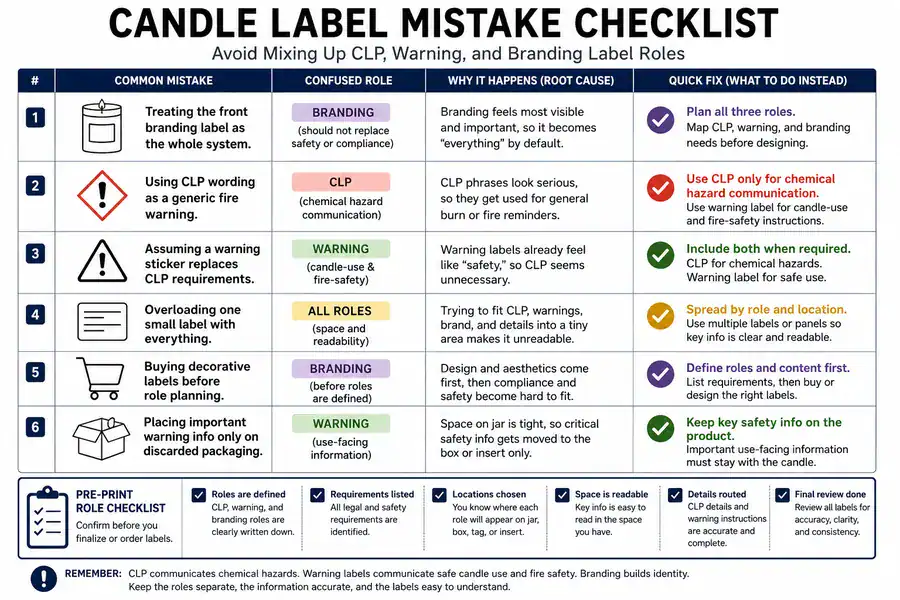
Pre-print role checklist:
- CLP role identified: the maker has checked whether hazard communication needs a separate deeper review.
- Warning role identified: candle-use and fire-safety wording is not buried inside brand copy.
- Branding role identified: the label shows the brand, scent, and product identity without replacing safety or compliance content.
- Exact compliance and warning questions routed: CLP details go to CLP-specific guidance, and burn-use warnings go to warning-label guidance.
- Materials and printing questions routed: paper, vinyl, finish, adhesive, and printer choices are handled after content roles are clear.
- Branding and design questions routed: visual identity, story, and packaging style can move into Candle Branding Guide after the required role map is settled.
The lowest-confusion planning habit is simple: decide what each label area must do before deciding how it should look.