
Fragrance oils for candles are lab-made scent blends that stay stable in wax, giving reliable cold and hot throw when used within safe percentage limits.
On this page, “safe” means approved for candle use, kept within the stricter of the supplier and wax limits, and confirmed by clean finished-candle testing in your wax, wick, and vessel setup; it does not mean skin-use approval or a full labeling review.
This page is for candle makers who want a clear starting point before testing a new scent. It explains what fragrance oils are, why they are widely used in candles, and which limits matter first. Start with candle-use approval, wax load capacity, IFRA Category 12, and the wax maker’s add-in guidance. Then use the linked pages for exact calculations, deeper comparisons, and troubleshooting.
What Are Fragrance Oils Made Of? (Aroma Chemicals, Carriers, and How They Work in Candles)
Fragrance oils for candles are concentrated blends of synthetic aroma chemicals, essential oil components, and solvents that dissolve into wax so the scent releases in a controlled way when the candle burns.
For the full fragrance hub, use candle fragrance & scenting as the parent page for the wider process.
When you plan your candle fragrance & scenting strategy, it helps to picture fragrance oil as a recipe inside a recipe. At the core sit aroma chemicals, essential oil components, and resins blended to hit a specific scent brief. These raw materials are then diluted into carriers or solvents so they pour, dissolve, and burn predictably in wax. In regulated markets, perfumers work within supplier and industry safety rules when building formulas.
Think of this section as fragrance oil composition explained in simple steps. A typical candle-safe fragrance oil contains four building blocks:
Do Candle Fragrance Oils Come in Different Types?
Yes. In practice, candle fragrance oils are usually sold as mostly synthetic blends, blends that include some natural components, or more natural-leaning blends built around essential oils and extracts. That difference changes the scent system, but candle suitability still comes back to supplier approval, wax compatibility, and testing.
- Aroma components: synthetic and natural molecules that create the actual smell.
- Carriers/solvents: neutral liquids that thin the blend so it pours easily and stays dissolved.
- Fixatives and stabilizers: materials that slow evaporation and keep the scent balanced over time.
- Optional naturals: essential oils or CO₂ extracts added for realism or marketing claims.
Carriers do more than “water down” the smell. They affect solvency in wax, help prevent separation, and can influence burn behavior. Some carriers used in broader fragrance blending do not behave the same way in candle wax, so many candle suppliers use carrier systems chosen for wax solubility and stable performance. A supplier’s SDS (Safety Data Sheet) and technical sheet help with hazards and handling, though they may not disclose every ingredient in the blend.
If you still need to learn candle making basics, focus first on melting wax safely and measuring weights accurately. Once you trust your process, you can pay closer attention to how different fragrance bases feel: thin, syrupy, or almost gel-like. That texture often reflects the carrier system and can hint at how easily the oil will blend into soy, paraffin, or coconut wax. Small test batches reveal how that internal chemistry shows up in real candles: smooth top, stable color, and a scent profile that stays recognisable from cure to the last burn.
How Fragrance Oils Are Used in Candles
Fragrance oils are used in candles by choosing an oil approved for candle use, measuring a test amount the wax can hold, mixing it into melted wax in the maker’s temperature window, and then curing and burn-testing the result.
In practice, fragrance oil is part of the candle formula, not a last-minute add-on. A fragrance oil marked for soap or body products is not automatically suitable for candles, and a candle-safe oil is not automatically suitable for skin use.
A simple workflow looks like this:
- Choose a fragrance that the supplier marks as suitable for candles.
- Check the IFRA (International Fragrance Association) certificate, the SDS (Safety Data Sheet), and the technical sheet before you test it.
- Set a test load that stays under both the wax limit and the supplier guidance.
- Mix the oil into fully melted wax in the wax maker’s recommended add-in range.
- Let the candle cure, then test cold throw, hot throw, and burn performance.
That sequence is the practical answer to “how are fragrance oils used in candles?” They are selected, limited, mixed, cured, and tested as part of the finished candle formula.
Which Limits Matter Before You Pour
The main limits are candle-use approval, wax load capacity, IFRA Category 12, and the wax maker’s add-in guidance; flash point mainly matters for storage and transport.
Use the lower or stricter limit when two sources disagree. A fragrance that is allowed on paper can still perform badly if the wax cannot hold that percentage cleanly or the wick cannot burn it well.
Fragrance load is the percentage of fragrance oil in wax by weight. In practice, your real ceiling is the lower of the wax manufacturer’s maximum load and the fragrance supplier’s candle-use guidance for that oil.
If you need the exact grams for one jar or a full batch, use the fuller explainer on fragrance load in candle making.
This page sets the first-pass boundary only: it does not replace exact IFRA certificate reading, label review, or jar-by-jar load calculations.
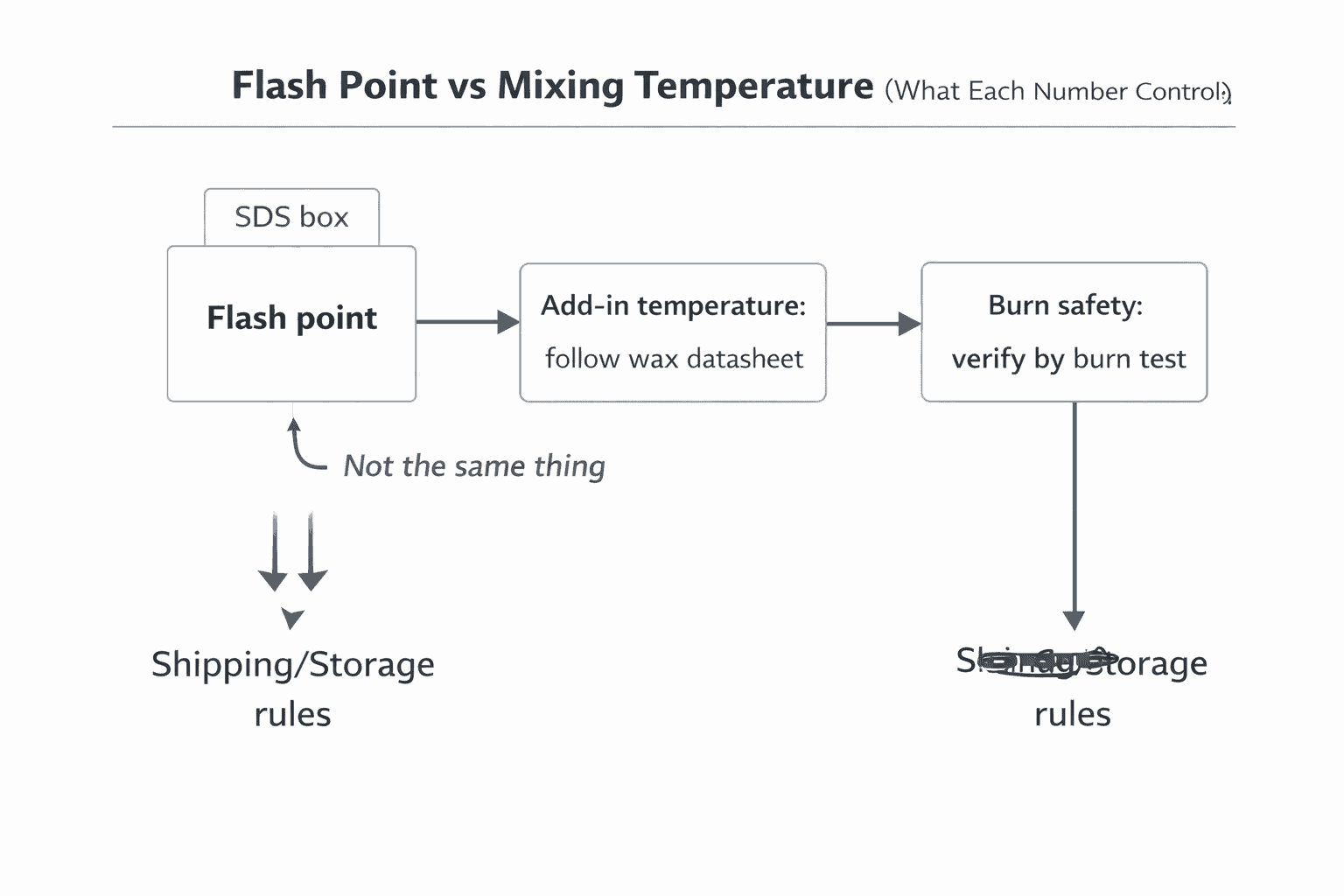
Flash point is the lab-tested temperature at which a fragrance oil’s vapour can ignite near an open flame. It is mainly a storage, handling, and shipping number, not a rule for choosing your candle mixing temperature.
Some suppliers still use flash point as a rough add-in reference, but this page treats it as secondary to the wax maker’s process window and your own test batches.
IFRA Category 12 is the product class used for candles, wax melts, and other non-skin-contact air-care products. IFRA guidance treats non-skin-contact products such as candles as Category 12, and the IFRA (International Fragrance Association) certificate tells you which use limit applies to that fragrance in that class. Exact certificate reading belongs on a dedicated IFRA workflow page rather than this overview.
The Category 12 line on a certificate can show 100%, which means IFRA does not further restrict that fragrance for candles. It does not mean every wax can hold 100% fragrance, and it does not override the wax maker’s load limit or your burn testing.
This quick matrix shows what each document controls and where it stops:
| Document | What it helps you decide | What it does not decide |
|---|---|---|
| IFRA Category 12 | Maximum use level for that fragrance in candles and similar air-care products | Your wax load ceiling, wick size, or hot throw result |
| Wax datasheet | How much fragrance the wax can usually hold and the maker’s add-in guidance | The fragrance’s hazard classification or legal category limit |
| SDS | Hazards, handling, storage notes, and flash point | Your ideal mixing temperature or final scent strength |
Think of flash point in candle making as a separate handling topic. Shipping and storage rules may treat lower-flash-point liquids differently, while ASTM F2417 is a fire-safety standard for finished candles, not a fragrance mixing rule.
Add-in temperature is the heat where you mix fragrance into wax, while pour temperature is the cooler range where you fill containers for adhesion, surface finish, and jar appearance. Follow the wax manufacturer’s temperature window, then test inside that range rather than using flash point as a mixing rule. For the step-by-step mixing order, use how to add fragrance to candle wax.
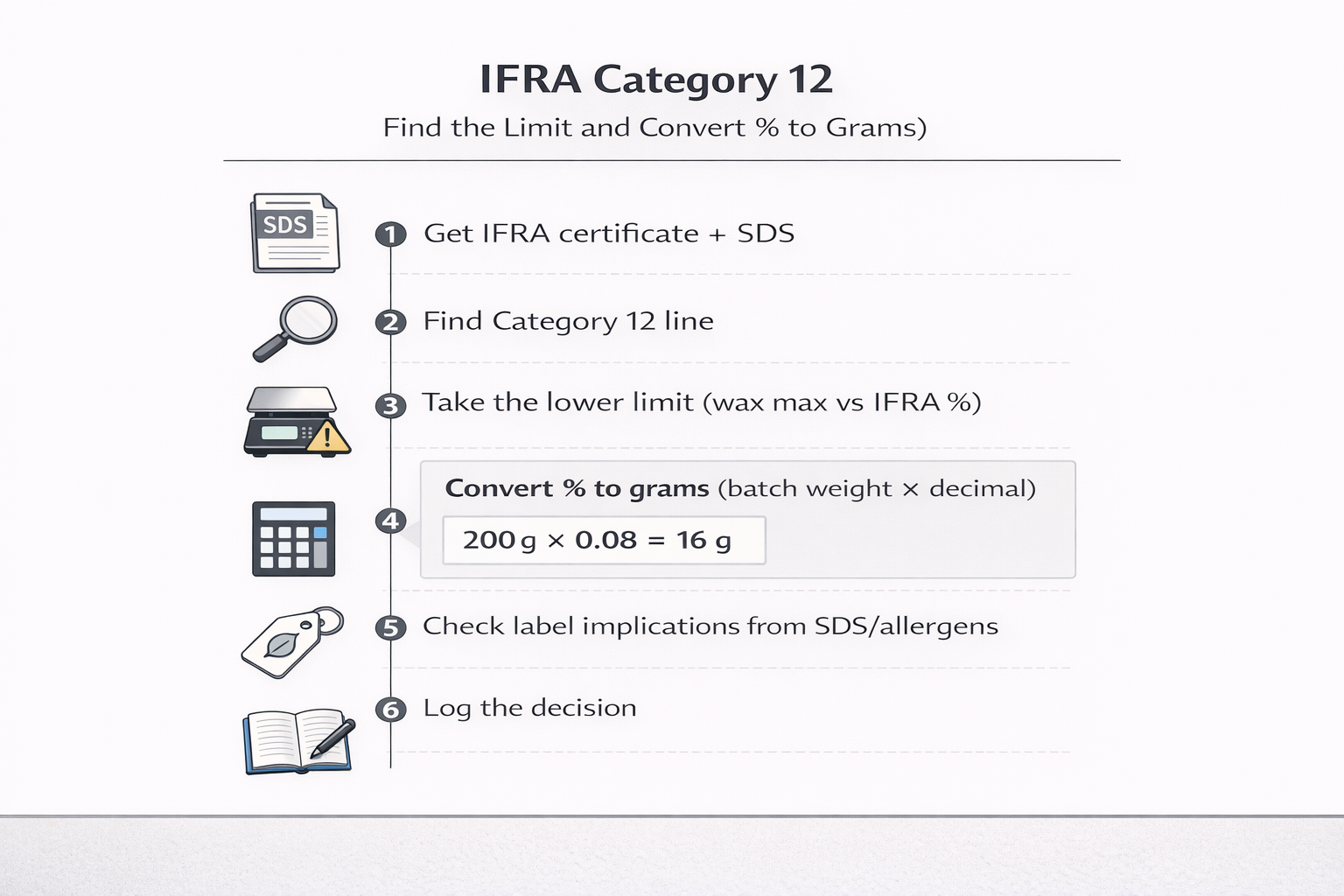
This graphic shows the document-to-test-batch handoff at a high level. Exact IFRA reading, exact load calculation, and label consequences belong on dedicated child pages rather than this overview.
Methods – where these limits and examples come from: The description of Category 12 as a non-skin-contact class that includes candles comes directly from IFRA guidance and certificates. The note that Category 12 is often listed at 100% and that practical candle loads usually sit in single-digit or low-teen percentages comes from supplier examples and maker guidance, not a legal rule. The working ranges here summarise supplier documents and maker guidance rather than controlled lab testing. Always default to your specific supplier paperwork, wax datasheet, and local regulations.
How Fragrance Oils Behave in Different Candle Setups
Fragrance oils behave differently across candle setups because wax type, wick choice, and vessel size change how easily the oil dissolves, cures, and releases scent.
Cold throw is the smell from an unlit candle, while hot throw is the scent released while the candle burns. Both can change when the same fragrance moves from one wax and wick setup to another.
Soy wax often holds fragrance well but may need longer cure time before hot throw reaches its best level. Thick or bakery-style oils can also need more careful wick matching in soy because a formula that smells strong cold may still burn weakly if the wick does not build a full melt pool.
Paraffin blends usually release fragrance faster and often throw well at moderate loads, while coconut and coconut–soy blends can diffuse bright or top-heavy scents well but may become harder to control if load, wick, and vessel are pushed too far together. The result is practical rather than abstract: the same fragrance oil can feel clean and strong in one wax, then burn weakly, soot, or separate in another.
This quick setup guide shows the main differences candle makers usually watch first:
| Setup factor | What it can change | What to watch first |
|---|---|---|
| Soy wax | Slower scent development and longer cure needs | Hot throw after cure and wick match |
| Paraffin blend | Faster scent release at moderate loads | Burn cleanliness and overall throw balance |
| Coconut or coconut–soy blend | Brighter diffusion with some scents | Load, wick, and vessel balance |
Use this section as a behavior guide, not a full testing manual. For deeper tuning, move to how to fix weak scent throw in your candles and how to test candle scent throw in real spaces.
Fragrance Oils vs Essential Oils in Candles
Fragrance oils and essential oils are not interchangeable in candles. Most candle fragrance oils are designed for stronger, more consistent throw in wax, while essential oils are usually more limited by volatility, cost, and safe usage rates.
That difference matters here because many readers first understand fragrance oils by contrasting them with essential oils. For the full comparison, use essential oils vs fragrance oils for candles.
This quick comparison shows where each option usually fits:
| Attribute | Fragrance oils | Essential oils |
|---|---|---|
| Performance in wax | Usually easier to stabilise and repeat from batch to batch | Often lighter, more volatile, and more variable in throw |
| Scent range | Can match natural, abstract, bakery, or seasonal scent briefs | Limited to plant-derived profiles |
| Cost and consistency | Usually easier to source consistently for repeated testing | Often higher cost with more batch variation |
| Best role in this cluster | Default choice for most scented candles | Separate comparison and feasibility topic |
The questions below stay brief and route outward when the task shifts from definition to comparison, calculation, compliance, or troubleshooting.
Frequently Asked Questions About Fragrance Oils for Candles
Most fragrance oil questions for candles come down to suitability, safe use, flash point, load limits, and supplier documents.
Can any fragrance oil be used in candles?
No. Use fragrance oils that the supplier marks as suitable for candles and back that up with the fragrance’s IFRA (International Fragrance Association) certificate, SDS (Safety Data Sheet), and technical data sheet. A fragrance approved for another product type is not automatically suitable for candles.
Are fragrance oils safe in candles?
Yes, when the oil is approved for candle use, tested in the wax, and kept within the stricter of the wax limit and any applicable IFRA Category 12 guidance. Safe use still depends on the finished candle burning cleanly in your setup.
Does flash point tell me when to add fragrance to wax?
No. Flash point is mainly a storage, handling, and transport number. Your actual add-in temperature should come from the wax manufacturer’s process guidance and your own test batches.
What sets the real fragrance limit in a candle?
The real limit is the lower of the wax manufacturer’s maximum load and the fragrance supplier’s candle-use guidance for that oil. Paper allowance does not override poor burn behavior in a specific wax.
Are fragrance oils usually better than essential oils for candles?
For most container candles, yes. Fragrance oils are usually easier to stabilize in wax and more consistent in hot throw, while essential oils are often softer, more volatile, and more expensive.
Which documents should I check before using a new fragrance oil?
Check the IFRA certificate for candle use, the SDS for hazards and flash point, and the technical data sheet for supplier-specific performance notes.