
The best candle label material is usually BOPP or vinyl film for handled, humid, or oil-prone candles, coated paper for dry low-risk candles, and polyester/PET when abrasion, warmth, or premium durability justifies the upgrade.
Candle label materials are the full label system on a candle container: face stock, adhesive, ink or toner compatibility, protective finish, and surface fit. Best means best-fit for the candle’s real conditions, not one universal winner. Waterproof, oil-resistant, and heat-tolerant labels protect against different failures, including smearing, staining, curling, edge lift, and unreadable branding. The right choice depends on moisture, fragrance oil, jar warmth, finish, printer method, handling, and budget.
This page chooses material systems only. It does not decide warning-label text, CLP or ASTM compliance, label size, artwork layout, printer settings, application technique, or shipping packaging. Waterproof here means ordinary moisture, splashes, and condensation, not dishwasher use, submersion, outdoor exposure, direct flame contact, or guaranteed bonding on oily glass.
What Candle Label Materials Actually Include
Candle label materials are the full label system used on candle containers: face stock, adhesive, ink or toner compatibility, protective finish, and container surface fit.
A candle label is not just sticker paper. The material choice decides whether the label stays readable, bonded, and clean-looking when the jar faces moisture, oil, warmth, handling, and display conditions.
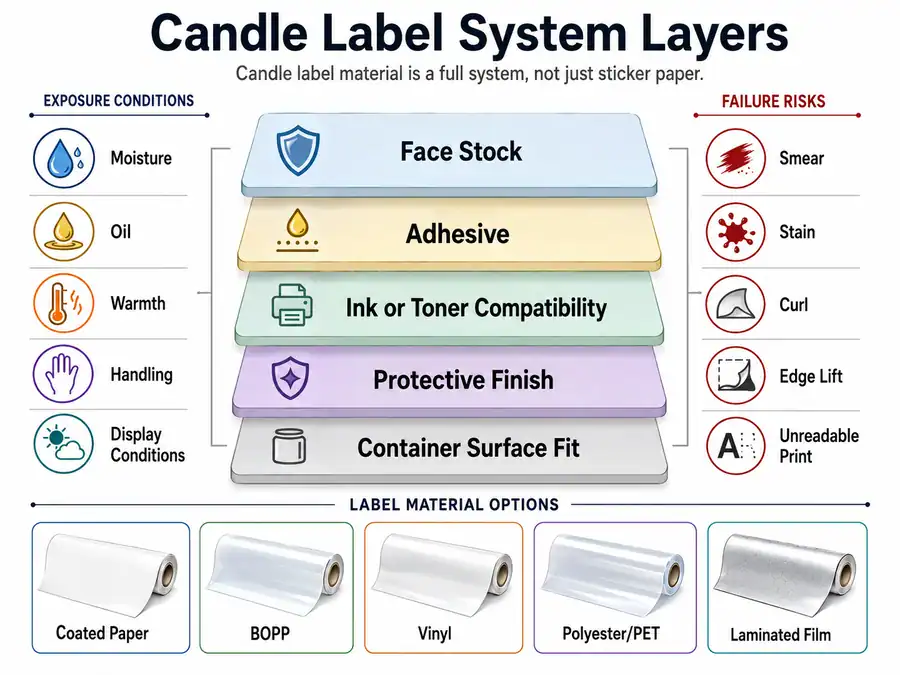
| Label part | What it controls | Why it matters for candles |
|---|---|---|
| Face stock | The visible label material, such as paper, BOPP, vinyl, or polyester | Controls texture, flexibility, water response, oil response, and durability |
| Adhesive | The glue layer that bonds the label to the jar | Controls edge lift, peeling, and bond strength on glass, tins, painted jars, or textured surfaces |
| Ink or toner compatibility | How the printed artwork bonds to the stock | Controls smearing, rubbing, cracking, and readability |
| Protective finish | A coating, varnish, laminate, matte finish, or gloss finish | Controls scuffing, splash resistance, fingerprints, and wipe behavior |
| Container surface fit | How the label system behaves on the actual jar | Controls bubbles, wrinkles, poor bonding, and curved-surface failure |
Use this quick material picker before comparing individual label systems:
| Candle condition | Lowest-risk starting material |
|---|---|
| Dry indoor, low handling | Coated paper |
| Bathroom, spa, humidity, condensation | BOPP or vinyl |
| Fragrance oil, wax residue, fingerprints | BOPP, vinyl, or polyester with protected print |
| Warm storage or premium durability | Polyester/PET or laminated film |
| Curved jars or small hand-applied batches | Vinyl or flexible film |
| Clear no-label look | Clear BOPP, clear vinyl, or clear polyester tested on the exact jar |
“Best” means the best-fit label system for the candle’s use conditions, not one universal material. A dry indoor candle can often use coated paper, while a bathroom candle, spa candle, or handled retail jar usually needs film stock and stronger protection. Waterproof, oil-resistant, and heat-tolerant describe different failure risks, so a label can perform well in one area and still fail in another. For broad material selection, start with candle label materials as a system rather than judging the face stock alone.
This section stays with material choice, not artwork, warning text, printer settings, label sizing, or packaging strategy. Those jobs affect the finished label, but they do not replace the first decision: choosing a label system that fits the jar, exposure, and sales setting.
Waterproof Candle Label Materials: What Survives Moisture, Splashes, and Condensation?
Waterproof candle label performance depends on face stock, adhesive, ink or toner, coating or laminate, and jar surface.
For waterproof candle labels, BOPP, vinyl, and polyester film usually outperform unprotected paper when moisture, splashes, or condensation are likely. “Waterproof” here means resistance to ordinary candle-use moisture, not dishwasher use, outdoor exposure, submersion, or guaranteed bonding on oily glass.
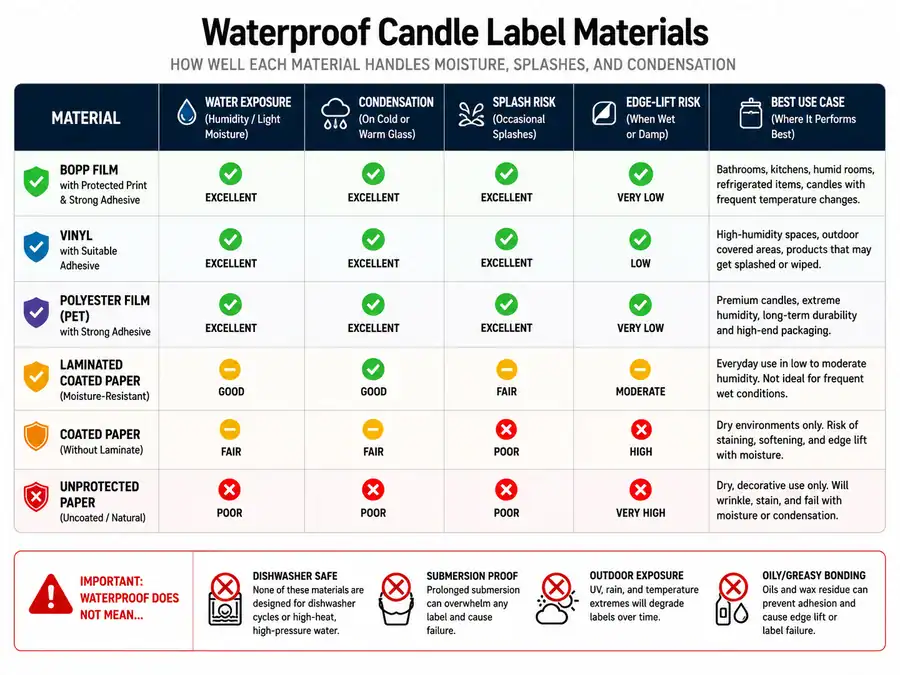
| Material system | Water exposure | Condensation | Splash risk | Edge-lift risk | Printer fit | Best use case |
|---|---|---|---|---|---|---|
| BOPP film with protected print | Strong | Strong | Low to medium | Low with suitable adhesive | Often best through professional roll-label printing | Retail candles, bathroom candles, spa candles, clear or white labels |
| Vinyl with suitable adhesive | Strong | Strong | Low to medium | Low to medium on curves | Depends on printable vinyl type | Durable small-batch labels, curved jars, handled candles |
| Polyester film | Strong | Strong | Low | Low with suitable adhesive | Often professional or specialty printing | Premium durability, warm storage, rough handling |
| Laminated coated paper | Moderate | Moderate | Medium | Medium | Often sheet-label friendly | Low-to-medium exposure candles that still need some splash protection |
| Coated paper without laminate | Light to moderate | Weak to moderate | Medium to high | Medium to high | Often inkjet or laser compatible by stock type | Dry indoor candles, lower handling, textured or kraft-style labels |
| Unprotected paper | Weak | Weak | High | High | Easy to print, weak in moisture | Dry samples, temporary labels, low-risk indoor use |
A water-resistant label may survive light handling or a brief splash, while a waterproof film label is a safer choice for repeated moisture contact. Condensation is different from a splash because moisture can collect at label edges over time and weaken the bond. That is why adhesive choice matters as much as the visible stock.
Waterproof material does not automatically make the printed ink waterproof. For print durability after choosing waterproof stock, use the candle label printing guide when the next question is ink, toner, printer type, or production method. If the label fails because the jar was damp, dusty, waxy, or oily before labeling, that becomes candle label application surface prep, not a material-only issue.
A simple buying screen is enough before bulk ordering: compare one sample after a water splash, one after a cold-jar condensation cycle, and one after a gentle wipe. Treat the result as buyer-side screening, not certification. The later label durability testing checklist gives a fuller way to compare samples across water, oil, heat, rub, peel, and surface fit.
Humidity and Condensation: Bathroom, Kitchen, Storage, and Shipping Conditions
Humidity and condensation are realistic candle-label moisture conditions, but they are not the same as splashes, submersion, dishwasher use, or outdoor labeling.
Bathroom candles, kitchen candles, seasonal storage, and packed candles can face moisture without being directly soaked. In those cases, the highest-risk failures are edge lift, paper wrinkling, ink bleed, and a label that looks worn before the candle is used.
Use this quick check when humidity is part of the use case:
- Choose film stock or laminated paper instead of unprotected paper.
- Check whether the adhesive is rated for the jar surface, not only the face stock.
- Test a labeled sample after cold-to-room-temperature condensation.
- Rub the printed area gently after it dries.
- Inspect the edges after one day for lifting, curling, or bubbling.
- Keep full box selection, carrier handling, and shipping protection in the candle packaging and shipping guide rather than turning this label-material choice into a shipping workflow.
Oil-Resistant Candle Labels for Fragrance Oil, Wax Residue, and Fingerprints
Oil-resistant candle labels need nonporous stock, protected print, and adhesive that can tolerate normal fragrance oil, wax residue, and handling oils without claiming chemical-proof, solvent-proof, or universal fragrance-concentrate resistance.
Oil resistance is not the same as waterproofing. A candle label can survive water and still stain, smear, dull, soften, or lift when fragrance oil reaches porous paper, exposed ink, adhesive edges, or an unprotected finish.
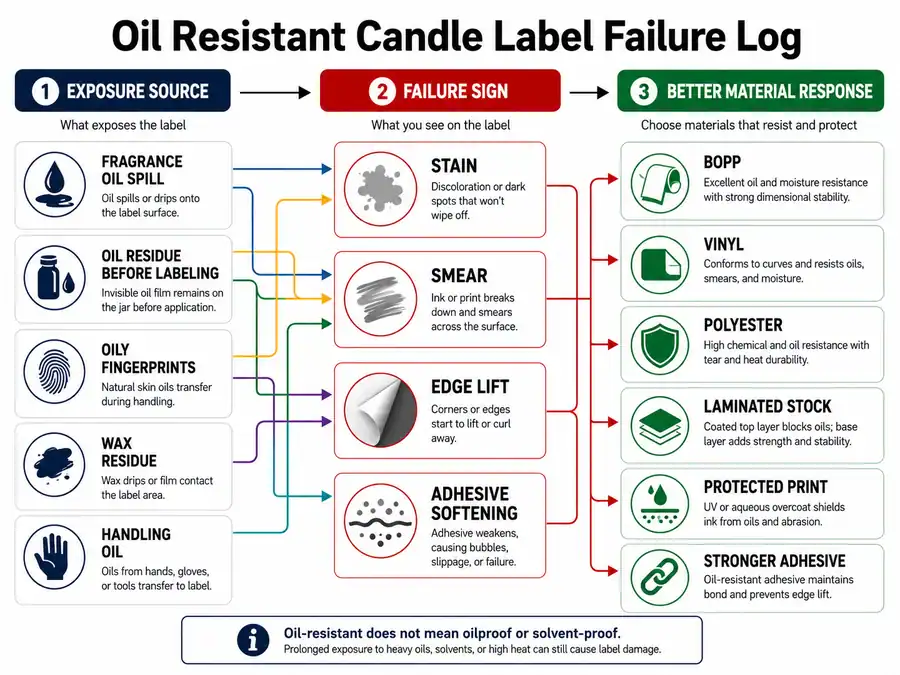
| Oil exposure | Common failure | Likely cause | Better material choice | What to check before ordering |
|---|---|---|---|---|
| Fragrance oil spill after labeling | Stain, dull patch, or soft finish | Porous stock or weak surface protection | BOPP, vinyl, polyester, or laminated stock | Ask whether the finish resists oil marks and rub |
| Oil residue before labeling | Edge lift or weak bond | Jar surface contamination | Film stock with suitable adhesive after clean surface prep | Test surface prep before applying candle labels before blaming the material |
| Oily fingerprints | Visible marks or smudged print | Matte finish, unprotected ink, or absorbent paper | Gloss film, laminated paper, or protected matte film | Rub the print after handling |
| Wax residue | Smear or greasy shadow | Soft wax transfer and weak wipe behavior | Film or coated stock with protective finish | Wipe gently and inspect finish change |
| Handling oil during markets | Gradual dulling or scuffing | Repeated touch, friction, and surface oils | BOPP, vinyl, polyester, or laminate | Compare display samples after repeated handling |
| Oil near label edges | Lifting or adhesive softening | Oil reaches the glue layer | Stronger adhesive plus better surface prep | Check edges after 24 hours |
The safest choices are usually film labels such as BOPP, vinyl, or polyester with a protective finish. Laminated coated paper can work for moderate exposure, but unprotected paper is the highest-risk option when oil contact is likely.
A practical failure log should track four visible outcomes: stain, smear, edge lift, and adhesive softening. Record the material, jar surface, oil exposure, wait time, and failure type. This keeps label troubleshooting focused on the part that failed instead of assuming every problem is the face stock.
Use fragrance oil cleanup as a separate step when the issue is spilled oil on the jar before labeling. Material choice matters, but oil left on glass can weaken even a durable label system. A quick label durability testing checklist can compare water, oil, heat, rub, peel, and surface fit before a bulk order.
Fragrance Oil Scenarios That Change the Best Material Choice
Fragrance oil changes label choice based on when the oil touches the jar: before labeling, during production, after labeling, or during customer handling.
Oil on the jar before labeling mainly threatens adhesion. A spill after labeling mainly threatens the printed face, coating, laminate, and exposed edges. Oily fingerprints mainly affect appearance, especially on matte or absorbent finishes.
| Scenario | Material risk | Better choice | Boundary |
|---|---|---|---|
| Oil residue before labeling | Poor adhesive bond | Clean jar, then test adhesive on the exact surface | Do not treat this as fragrance formulation advice |
| Accidental production spill | Stain, smear, or edge lift | Film stock with protected print | Do not build a chemical compatibility table |
| Oily fingerprints | Dull spots or visible marks | Gloss or protected matte film | Do not assume matte is always worse |
| Post-application exposure | Gradual wear near edges | Stronger adhesive and better finish | Do not claim the label is oilproof |
Method note: Compare at least three labeled samples when possible, and judge visible stain, smear, edge lift, and adhesion after the same exposure time.
Wax Residue, Soot, and Wipe-Clean Handling
Wipe-clean candle labels need material and finish choices that handle wax smudges, soot marks, and post-burn handling without promising stain-proof performance.
Film labels and protected finishes usually wipe cleaner than unprotected paper because they absorb less residue. Gloss finishes may show fingerprints more clearly, while matte finishes may hide glare but hold marks more visibly after oily handling.
| Residue type | Higher-risk label | Lower-risk label | Realistic expectation |
|---|---|---|---|
| Wax smudge | Unprotected paper | Film or laminated stock | May wipe clean if residue is light |
| Soot mark | Textured or absorbent paper | Smooth protected finish | May still leave gray shadows |
| Post-burn handling | Matte unprotected paper | Protected matte, gloss film, or laminate | Reduces marks but does not make the label stain-proof |
| Repeated wiping | Weak coating | Laminate or stronger film finish | Too much friction can still dull the surface |
Keep soot causes and candle-care habits separate from label material choice. If the candle itself produces heavy soot, the label may look dirty faster, but that becomes a burn-quality or candle-care issue rather than a material-only problem.
Heat-Tolerant Candle Labels: What “Heat-Resistant” Means Outside the Flame Zone
Heat-tolerant candle labels are external product labels designed to stay bonded and readable near normal candle-use warmth, not flameproof or fireproof materials.
For candle jars, heat tolerance means the face stock, adhesive, ink or toner, and finish stay stable during jar warmth, warm storage, summer markets, or shipping heat. It does not mean the label belongs near a flame, inside melted wax, in an oven, or in place of safety text.
Use this heat boundary checklist before choosing a material:
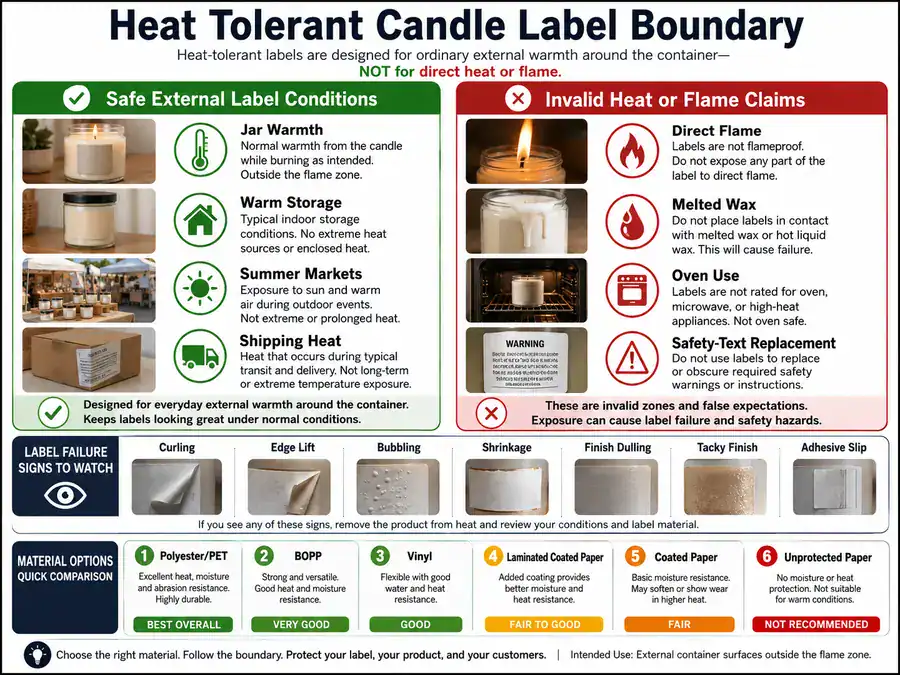
- Confirm the label is for the outside of the candle container only.
- Check whether the adhesive can handle warm storage and jar warmth.
- Watch for curling, edge lift, bubbling, shrinkage, and finish dulling.
- Compare BOPP, vinyl, polyester, coated paper, and laminated paper on the same jar.
- Keep flame exposure, burn testing, and candle warning-label compliance outside the material claim.
- Use jar temperature and candle use only as a boundary for external label conditions.
- Confirm the choice with the same label durability testing checklist used for water, oil, rub, peel, and surface fit.
| Material system | Heat-adjacent strength | Main risk | Best-fit use |
|---|---|---|---|
| Polyester/PET | Stronger stability than most common options | Can be unnecessary for low-exposure lines | Premium durability, warmer storage, rough handling |
| BOPP | Good for many professional candle labels | Adhesive or finish may fail before the film | Retail jars, moisture and oil exposure, clear or white labels |
| Vinyl | Flexible and durable in many jar uses | Some vinyl stocks or adhesives may curl on curves or heat | Curved jars, small batches, durable labels |
| Laminated coated paper | Moderate | Edge lift, curling, or laminate separation | Lower heat exposure with added surface protection |
| Coated paper | Limited to moderate | Curling, ink wear, and adhesive lift | Dry indoor candles with low handling |
| Unprotected paper | Weakest | Curling, staining, and print wear | Temporary or very low-risk labels |
Adhesive often fails before the visible face stock. A film label may look durable, but the label still fails if warmth softens the adhesive, curls the edges, or makes the finish tacky. Polyester may be worth considering for warmer storage or rough handling, but it can be more label than a low-exposure candle line needs.
Method note: Use sample labels on the exact jar, then compare edge lift, curl, smear, and readability after a warm-storage check. Treat the result as a practical screening step, not a formal safety or fire-resistance claim.
Adhesives Matter: Permanent, Removable, and All-Temperature Options for Candle Jars
Adhesive is part of the candle label material system and often decides whether a label peels, curls, bubbles, or stays bonded.
A durable candle label needs the right adhesive for the container surface and exposure condition. Permanent vs removable vs all-temperature adhesive for candle jars is not just a glue choice; it affects glass, tin, frosted, painted, curved, stored, shipped, and handled candles.
| Adhesive type | Best surface fit | Water risk | Oil risk | Heat risk | When to avoid |
|---|---|---|---|---|---|
| Permanent adhesive | Smooth glass, coated tins, many standard jars | Medium if edges are exposed | Medium to high if oil reaches the bond | Medium if not heat-rated | Avoid on dirty, waxy, oily, or textured surfaces without testing |
| Removable adhesive | Temporary labels, samples, short-term batches | Medium to high | High | Medium | Avoid for retail jars, shipping, or high-handling candles |
| Aggressive adhesive | Frosted glass, textured jars, painted jars, hard-to-bond surfaces | Lower with the right stock | Medium | Medium | Avoid when labels may need repositioning |
| Freezer-grade adhesive | Cold storage, chilled transport, condensation-prone stockrooms | Lower in cold moisture | Medium | Not its main strength | Avoid assuming it solves warmth or oil exposure |
| All-temperature adhesive | Storage swings, shipping temperature changes, mixed environments | Medium to low with the right stock | Medium | Lower than standard adhesive | Avoid assuming it is waterproof, oilproof, or heatproof |
| Repositionable adhesive | Hand-applied labels that need adjustment | Medium | Medium to high | Medium | Avoid when the final bond must survive rough retail handling |
Permanent means intended to stay bonded under correct use, not guaranteed on contaminated glass, oily jars, wet surfaces, or warm storage. All-temperature means the adhesive is built for broader temperature swings, but it does not fix poor surface prep, weak face stock, exposed ink, or oil at the label edge. Removable labels are useful for samples and temporary labeling, but they are usually risky for candles that will be handled, shipped, displayed, or sold.
Use candle label adhesive types as a material-selection filter before choosing between paper, BOPP, vinyl, or polyester. Smooth glass usually gives the easiest bond, while frosted glass, painted jars, textured tins, and tight curves need closer adhesive testing. Jar surface compatibility matters because a label that works on clear glass may lift on frosted glass or bubble on a curved tin.
For cleaning and positioning before application, keep the next step with label application surface prep rather than turning adhesive choice into a full labeling tutorial. If a label has already lifted, wrinkled, or peeled after sale, handle the failure pattern under label troubleshooting instead of assuming the adhesive alone was wrong. For small jars, tapered containers, or hand-applied batches, curved jar label application becomes the better place to judge flexibility, tack, and placement tolerance.
A simple adhesive screen is enough before ordering in bulk:
- Apply the label to the exact jar surface.
- Wait long enough for the bond to settle.
- Press the edges gently and check for lift.
- Add a light moisture check if condensation is likely.
- Add a light oil-edge check if fragrance oil handling is likely.
- Warm the labeled jar under realistic storage conditions.
- Compare peel, curl, bubble, and edge lift against another adhesive option.
Vinyl Candle Labels: Best Uses, Limits, and When to Choose Them
Vinyl candle labels are film-based product labels, not decorative decals, and their performance depends on adhesive, finish, and print method.
Vinyl candle labels can be a durable choice when a candle needs water resistance, flexibility, curved-jar tolerance, and a smooth product-label finish. They are not automatically better than BOPP, polyester, or coated paper because the best vinyl label still needs the right adhesive, coating, printer method, and jar surface.
| Material | Durability strength | Weakness | Best use | Avoid when |
|---|---|---|---|---|
| Vinyl | Flexible film, good water resistance, good curve tolerance | Can vary by adhesive, finish, and printable stock | Small batches, curved jars, handled candles, premium-feeling labels | You need a professional roll-label look at scale and BOPP fits better |
| BOPP | Professional film stock, strong moisture and oil handling | Face stock alone does not solve adhesive or surface issues | Retail labels, clear labels, white labels, many roll-label orders | The jar shape needs more flexibility than the chosen BOPP construction gives |
| Polyester | Stronger toughness and stability | Can be more than low-exposure candles need | Higher durability, abrasion risk, warm storage | Budget or low-handling candles do not need premium film |
| Coated paper | Better texture and lower material cost | Weaker against moisture, oil, and rough handling | Dry indoor candles, kraft looks, low-exposure batches | Bathroom, spa, market, or shipped candles need stronger protection |
Best vinyl means product-label vinyl matched to candle-use conditions, not any vinyl sheet sold for crafts. Vinyl candle labels for water exposure, curved jars, and durable product packaging work best when the stock is made for printed product labels and paired with an adhesive that suits the jar. Craft vinyl, transfer tape, weeding, and cutting-machine decals are different workflows, and they should not drive the material choice for a retail candle label.
Vinyl is useful when flexibility matters. Curved glass, small jars, tins, and hand-applied batches can benefit from a film that conforms better than stiffer materials. It is also a strong option when moisture and handling are likely, but that does not make it the safest choice for every candle line.
Choose BOPP candle labels when a professional roll-label supplier recommends BOPP for clear, white, waterproof, or oil-resistant candle packaging. Choose polyester when abrasion, warmer storage, or premium durability justifies the higher material tier. Choose coated paper when the candle is dry, low-handling, and the texture or budget matters more than maximum resistance.
Use this vinyl decision check:
- Choose vinyl when curve tolerance, water resistance, and small-batch flexibility matter.
- Compare BOPP when the label will be professionally printed at scale.
- Compare polyester when heat, abrasion, or rough handling raises the failure risk.
- Compare coated paper when the candle has low exposure and needs texture or lower cost.
- Reject decorative decal vinyl when the goal is a durable product label.
- Test the exact adhesive, finish, print method, and jar surface before ordering a full batch.
BOPP Candle Labels: Why Professional Label Printers Often Recommend Them
Professional printers often recommend BOPP candle labels because the polypropylene film balances moisture resistance, oil resistance, clear or white label options, and roll-label production efficiency.
| BOPP option | Best candle use | Watch-outs | Better alternative when |
|---|---|---|---|
| White BOPP | Opaque product labels, strong color coverage, retail jars | Can feel less textured than paper | Coated paper fits a dry, tactile label better |
| Clear BOPP | Glass jars, no-label look, transparent areas | Adhesive visibility, bubbles, and cloudy edges can show | Clear vinyl or another clear film suits the jar better |
| Matte BOPP | Softer finish, reduced glare, premium shelf look | Fingerprints and oil marks may show more | Gloss BOPP handles wipe visibility better |
| Gloss BOPP | Bright color, smoother wipe behavior, splash-prone candles | Glare can affect readability | Matte BOPP reads better under bright shelf lighting |
| Laminated BOPP | Extra rub, scuff, moisture, and oil-mark protection | Adds cost and may change the finish | Plain BOPP is enough for low-handling jars |
| BOPP with unsuitable adhesive | Looks durable but may peel or lift | Adhesive fails before the face stock | Vinyl, polyester, or another adhesive system fits the surface better |
BOPP is strong because it is a film stock rather than absorbent paper. It usually handles light splashes, condensation, fingerprints, and product handling better than unprotected paper. That makes BOPP labels for clear, white, waterproof, and oil-resistant candle packaging a common choice for makers selling at markets, boutiques, retail shelves, and online.
BOPP still has limits. It is not a complete durability promise, and it does not replace adhesive testing, print compatibility, or surface matching. A BOPP label can still lift on frosted glass, show bubbles under a clear finish, scuff without protection, or fail if fragrance oil reaches the adhesive edge.
Choose BOPP when you want a professional film label with balanced water and oil resistance. Compare it with vinyl when flexibility and curved-jar tolerance matter more. Compare it with polyester when abrasion, warm storage, or premium durability raises the failure risk. Compare it with coated paper when the candle is dry, low-handling, and texture matters more than maximum resistance.
Method note: Treat BOPP comparisons as sample-screening decisions. Test the exact stock, adhesive, finish, print method, and jar surface before ordering a full batch.
Polyester Candle Labels: When PET Is Worth the Higher Durability Cost
Polyester/PET candle labels are durable film label stock used when higher toughness, dimensional stability, or abrasion resistance is needed.
Polyester candle labels can be worth the higher cost for premium candles, warmer storage, rougher handling, abrasive shelf contact, or display conditions where labels must stay smooth and readable. They can be overkill when BOPP, vinyl, or coated paper already matches the candle’s exposure level.
| Material | Durability level | Cost tier | Best use | Overkill scenario |
|---|---|---|---|---|
| Coated paper | Low to moderate | Low | Dry indoor candles, low handling, texture-focused labels | Bathroom, spa, or oil-prone candles |
| Vinyl | Moderate to strong | Medium | Curved jars, flexible labels, small batches, handled candles | Standard roll-label production where BOPP fits better |
| BOPP | Strong | Medium | Retail jars, clear or white film labels, moisture and oil handling | High abrasion or warmer storage needs exceed the label system |
| Polyester/PET | Highest of these common options | High | Premium durability, abrasion risk, warm storage, display handling | Low-exposure candles where BOPP, vinyl, or paper is enough |
| Laminated paper or film | Depends on base material | Medium to high | Added rub, splash, and scuff protection | The base stock or adhesive is still wrong for the jar |
PET means polyethylene terephthalate, a polyester film used for tougher label face stock. PET candle labels for higher durability, abrasion, and warmer storage are most useful when the label must resist wear while staying flat, readable, and bonded. PET can outperform BOPP or vinyl when stability and scuff resistance matter more than flexibility or lower cost.
“Worth it” is exposure-driven and sales-channel-driven. A luxury candle line, boutique shelf product, or warm-storage batch may justify polyester. A dry gift candle, low-handling home candle, or budget test batch may not need it.
Polyester does not mean flameproof, fireproof, oven-safe, or safe for direct flame contact. Heat-tolerant labels are still external product labels, and the adhesive, ink, finish, and jar surface must all fit the use condition. PET may improve stability, but it does not turn a candle label into a safety label or industrial heat shield.
A simple PET decision screen works well:
- Choose PET when abrasion, warm storage, or premium durability is a real risk.
- Choose BOPP when water and oil handling matter, but the jar does not need the highest toughness tier.
- Choose vinyl when flexibility and curved-jar tolerance matter more than stiffness.
- Choose coated paper when exposure is low and texture or budget matters most.
- Reject PET when the only reason is “premium sounds safer.”
- Test samples on the exact jar before buying the higher-cost stock.
Method note: Compare at least three sample labels across rub, peel, warmth, and surface fit. Treat the result as buyer-side screening, not certified lab proof.
Coated Paper Candle Labels: When Paper Still Works for Candles
Coated paper candle labels can fit low-exposure candles, but they are not the same as waterproof film labels.
Coated paper candle labels use paper face stock with a treated surface that helps print quality, finish, and light handling. They work best when the candle stays dry, faces low oil contact, and does not need heavy moisture, rub, or shipping resistance.
| Decision | Choose this when | Main benefit | Main risk | Better next choice |
|---|---|---|---|---|
| Paper is fine | Dry indoor candles, gift candles, low handling, short display time | Lower cost, tactile finish, softer look | Moisture, oil, and abrasion can damage it | Stay with coated paper if exposure stays low |
| Paper needs protection | Moderate handling, light splash risk, matte or kraft-style presentation | Keeps paper texture while adding surface help | Edges and adhesive still remain vulnerable | Add laminate or coating |
| Upgrade to film | Bathroom candles, spa candles, markets, e-commerce handling, fragrance oil risk | Better moisture and handling resistance | Higher cost or less paper texture | Use BOPP, vinyl, or polyester |
| Avoid paper | Wet shelves, humid storage, repeated handling, oily jars, rough transit | Prevents predictable paper failure | Texture and budget goals may change | Compare film stock and adhesive options |
Water-resistant paper is not waterproof film. A coated paper label may handle light touch or mild rub better than uncoated paper, but it remains more vulnerable to humidity, fragrance oil, wax residue, and edge lift. Laminated paper improves the printed surface, yet it still does not become the same material system as BOPP, vinyl, or polyester.
Coated paper can still be the best label material for candles when the candle is dry, low-handling, budget-sensitive, and sold in a setting where texture matters more than maximum durability. Kraft paper, matte paper, and textured paper often support a warmer handmade look, but that is a visual choice after the durability risk is accepted. For visual direction, keep candle label design separate from this material decision.
Method note: Compare paper samples on the exact jar and record material, adhesive, surface, exposure, and failure type. Useful failure categories include edge lift, smear, scuff, wrinkle, stain, and poor adhesion after handling.
Laminate vs Coating: How to Add Protection Without Changing the Base Material
Laminate and coating protect the printed surface of a candle label, but they do not replace the right face stock, adhesive, ink or toner, and jar-surface match.
Laminate adds a clear protective film layer over the printed label. Coating, varnish, or UV coating adds a thinner surface finish. Neither option makes the label automatically waterproof, oilproof, heatproof, chemical-proof, or stable on every jar.
| Factor | Laminate or overlaminate | Coating, varnish, or UV coating | What it does not solve |
|---|---|---|---|
| Water splashes | Usually stronger surface protection | Light to moderate help, depending on finish | Weak adhesive edges or wrong base stock |
| Oil marks | Better protection against surface marks | May reduce fingerprints and light oil marks | Fragrance oil at edges or adhesive layer |
| Scuffing | Stronger rub barrier | Helps with light rub and handling | Rough abrasion if the base material is weak |
| Rub resistance | Better for repeated handling | Better for light handling | Poor ink or toner compatibility |
| Finish | Can be matte, gloss, or soft-touch | Can be matte, gloss, flood, or spot finish | Jar-surface bonding problems |
| Cost | Usually higher | Usually lower | Wrong material choice |
| Best use | Paper, BOPP, vinyl, or polyester that needs extra protection | Printed labels needing surface help without a film layer | Printing setup or production workflow |
Laminate vs coating candle labels is a protection-layer choice, not a replacement for choosing the base material. A laminated coated paper label may resist rubbing better than plain paper, but it is still not the same as a waterproof film label. A coated BOPP label may look and wipe better, but it can still fail if the adhesive does not fit frosted glass, painted jars, or oily surfaces.
Choose an overlaminate or coating for candle labels exposed to water, oil marks, and scuffs when the printed surface is the weak point. Upgrade the base stock when the label needs stronger moisture, oil, or heat-adjacent performance from the material itself. Change adhesive or surface prep when edges lift, bubbles form, or the label peels from the jar.
Method note: Compare protected and unprotected samples on the same jar. Judge water marks, oil marks, scuffing, rub wear, edge lift, and finish change after the same handling period.
UV Coating and Varnish for Scuff, Rub, and Light Splash Resistance
UV coating and varnish are surface finishes applied to printed candle labels, not standalone label materials.
UV coating or varnish can help with scuffing, rub, fingerprints, and light splash resistance, but it does not turn weak stock into a fully waterproof, oilproof, heatproof, or edge-protected label. It helps most when the printed surface needs extra protection and the base material, adhesive, and jar surface are already suitable.
Use this choice pattern:
- Choose coating when the label needs light rub help, a finish change, or mild splash support.
- Choose laminate when the label needs stronger surface protection from handling, scuffs, or moisture.
- Upgrade the base material when paper is still absorbing moisture, oil, or residue.
- Change adhesive when the label lifts, curls, or peels from the jar.
- Review the print method when ink smears, toner cracks, or the finish wears quickly.
Method note: Treat coating tests as surface-behavior checks. Record scuffing, rub wear, fingerprint visibility, light splash marks, and edge condition separately so finish problems are not confused with adhesive failure.
Clear Candle Label Materials for Glass, Frosted Jars, and the “No-Label” Look
Clear candle label materials are transparent label systems that combine clear face stock, adhesive, print method, finish, and surface compatibility.
Clear candle labels usually work best as clear BOPP, clear vinyl, or clear polyester film matched to the jar surface. A clear label can be durable and still look cloudy, bubbled, outlined, or visible if the adhesive, finish, surface texture, or application conditions do not suit the container.
| Clear-label issue | Likely cause | Better material decision | What not to assume |
|---|---|---|---|
| Cloudy label area | Adhesive visibility, frosted surface, or poor film match | Test clear BOPP, clear vinyl, or another transparent film on the exact jar | Clear does not mean invisible |
| Bubbles under the label | Curved jar, rigid stock, dust, or hand application limits | Use a more forgiving film and test the jar curve | Bubbles are not always a design problem |
| Visible label outline | Thick stock, gloss mismatch, or strong edge visibility | Compare finish, thickness, and clear adhesive behavior | No-label look is not guaranteed |
| Edge lift | Surface texture, curve, oil residue, or weak adhesive | Match adhesive to the jar surface and exposure | Waterproof stock does not fix poor bonding |
| Smudged or dull clear area | Exposed print, weak finish, or handling oil | Use protected print or a stronger finish | Clear labels are not automatically oil-resistant |
| Poor bond on frosted glass | Textured surface and adhesive mismatch | Test adhesive on the exact frosted jar | Works on smooth glass does not mean works on frosted glass |
Clear BOPP often gives a clean professional look on smooth glass, while clear vinyl can be useful when flexibility matters. Clear polyester can fit tougher durability needs, but it may be more material than a low-exposure candle line needs. Clear paper-like options are usually higher risk when moisture, oil, or a seamless no-label look matters.
Use clear candle labels for glass jars, frosted jars, bubbles, and no-label appearance only after testing the exact jar. Smooth glass is usually the easiest surface. Frosted glass can make adhesive more visible, painted jars can change bond behavior, and tight curves can make even a good film look wrinkled or lifted.
Method note: Test at least three clear-label samples on the exact jar surface. Record bubbles, cloudy finish, adhesive visibility, edge lift, label outline, and poor bond after the same handling period.
Matte vs Gloss Labels: Oil Marks, Scuffs, Fingerprints, and Readability
Matte and gloss are finish choices that change fingerprints, oil marks, scuff visibility, glare, readability, and perceived durability.
Finish alone does not determine waterproofing, oil resistance, heat tolerance, or adhesive strength. A matte label can still need a stronger film or laminate, and a gloss label can still fail if the adhesive or print method is wrong.
| Finish choice | Handles well | Watch-outs | Best use |
|---|---|---|---|
| Matte finish | Softer shelf look, lower glare, premium feel | Fingerprints, oil marks, and scuffs can show on some materials | Boutique candles, low-glare labels, darker packaging |
| Gloss finish | Bright print, smoother wipe behavior, sharper contrast | Glare and fingerprints can be more visible under strong light | Clear labels, colorful designs, splash-prone candles |
| Protected matte | Matte look with better rub resistance | Costs more than plain matte | Handled retail candles that still need a soft finish |
| Protected gloss | Stronger wipe and scuff behavior | Can look too shiny for some candle styles | Moisture-prone or high-handling candles |
| Soft-touch finish | Premium feel | Can mark from oils or handling | Low-to-moderate handling lines that prioritize feel |
| Unprotected finish | Lower cost | Higher scuff, rub, and stain risk | Dry, low-handling candles only |
Use matte vs gloss candle labels as a handling and readability decision, not just a style choice. Matte or gloss candle labels for fingerprints, oil marks, scuffs, and readability should be compared under the candle’s real shelf, market, storage, and handling conditions. Matte does not automatically mean more oil-resistant, and gloss does not automatically mean more durable.
When surface protection is the weak point, return to laminate/coating before changing the base material. When the issue is color, layout, type, or brand style, keep that under candle label design. When the issue is fragrance oil or handling oil, compare finishes against oil-resistant materials before choosing the final stock.
Method note: Compare matte and gloss samples by rubbing, handling with clean and lightly oily fingers, checking glare under display light, and inspecting readability from normal shelf distance.
Match Label Materials to Glass, Tin, Frosted, Painted, Textured, and Curved Jars
Jar surface compatibility means the label material and adhesive are matched to the container’s surface, texture, curvature, cleanliness, and exposure conditions.
Candle label material should be matched to the jar surface, adhesive, texture, curvature, cleanliness, and exposure condition. Generic material advice fails when “glass” means smooth glass in one case, frosted glass in another, or a curved, painted, oily, textured, or tin surface in another.
Use this surface-fit sequence before buying labels:
- Identify the exact surface: smooth glass, frosted glass, tin, painted jar, textured jar, lid, plastic closure, or curved container.
- Choose the face stock by exposure: coated paper for low exposure, film for moisture, oil, handling, or durability.
- Match the adhesive to the surface, not just to the label material.
- Check whether the jar is clean, dry, wax-free, and oil-free before testing the bond.
- Compare flexibility on curves before judging the label’s final look.
- Inspect edge lift, bubbles, wrinkles, residue, and poor bond after handling.
- Keep cleaning, positioning, and pressure technique under candle label application instead of treating every failure as a material problem.
| Jar surface | Material fit | Adhesive risk | Common failure | Better choice |
|---|---|---|---|---|
| Smooth glass | BOPP, vinyl, polyester, coated paper for dry use | Usually lower if clean | Edge lift from residue or wrong adhesive | Test standard permanent adhesive first |
| Frosted glass | Film or coated stock with stronger adhesive testing | Higher because texture changes contact | Poor bond, cloudy clear labels, edge lift | Test adhesive on the exact frosted jar |
| Tin | Flexible film or coated paper for low exposure | Medium because coatings and curves vary | Wrinkles, bubbles, edge lift | Use flexible stock and suitable adhesive |
| Painted jar | Film or paper only after surface test | Medium to high because paint finish varies | Poor bond or paint interaction | Test bond and removal risk on samples |
| Textured jar | Flexible film with stronger adhesive testing | High because contact points are uneven | Poor bond, bubbles, lifted edges | Use smaller labels or more conformable stock |
| Curved jar | Vinyl, flexible BOPP, or suitable film | Medium to high on tight curves | Wrinkles, tunneling, edge lift | Test flexibility, label size, and adhesive |
| Lid or plastic closure | Stock depends on material and finish | Variable by surface energy and texture | Poor bond or peeling | Use supplier surface guidance and samples |
Use labels for candle jar surfaces as a selection step before comparing price or finish. Label materials for glass, tin, frosted, painted, textured, and curved jars must be tested by surface because one “waterproof” material can behave differently across containers. Strong adhesive durability matters most when the surface is frosted, textured, curved, painted, or exposed to oil, humidity, or warmth.
This is material selection, not a candle container buying guide. Container shape and finish matter only because they change bond, flexibility, edge lift, bubbles, and readability. For failures after application, use label troubleshooting later in the process; for sample comparison, return to the label durability testing checklist before ordering in volume.
Method note: Test at least three labeled jars per surface when possible. Record surface type, material, adhesive, application condition, exposure, and failure type.
Curved Jars and Small-Batch Hand Application Tolerance
Application tolerance depends on material flexibility, adhesive behavior, jar curve, and label size, not on “flexible” or “repositionable” claims alone.
Curved jars, small jars, tins, and hand-applied labels need materials that conform without wrinkling, tunneling, or lifting at the edges. A flexible label may still fail if the adhesive grabs too fast, the label is too large, or the jar curve is too tight.
| Curve or batch condition | Higher-risk choice | Safer material decision | Failure to watch |
|---|---|---|---|
| Tight curved glass | Stiff paper or thick film | More flexible film and smaller label area | Wrinkles, tunnels, edge lift |
| Small jars | Oversized label | Shorter label width and flexible stock | Buckling, crooked placement, lifted sides |
| Tins | Rigid stock on curved metal | Flexible film or tested coated stock | Bubbles and poor edge contact |
| Hand-applied batches | Fast-grab adhesive with little correction room | Stock and adhesive tested for placement tolerance | Trapped bubbles and misalignment |
| Textured curves | Large clear label | Smaller label or stronger surface-specific adhesive | Cloudy areas, poor bond, visible edges |
| Low-volume product testing | Premium stock without sample trial | Compare paper, BOPP, vinyl, and polyester samples | Paying for durability that does not solve the real issue |
Use curved jar tolerance when the material question is flexibility and edge behavior on a real container. Flexible does not mean removable, and repositionable does not mean durable after shipping, handling, warmth, or moisture. For technique, sizing templates, pressure methods, or bubble removal, keep the workflow with candle label application rather than expanding this material section.
Method note: Compare the same label size across two or three materials on the same curved jar. Judge wrinkles, bubbles, tunneling, edge lift, and readability after the bond settles.
Match Label Material to Inkjet, Laser, Thermal Transfer, or Professional Printing
A printable label material is only durable if it works with the print method and remains protected after printing.
Printer compatibility belongs inside candle label material selection because the printed label can fail even when the blank stock is durable. Printable candle label material means the face stock, adhesive, ink or toner, ribbon, finish, and exposure all work together cleanly enough for candle labeling.
| Print method | Material fit | Common failure | Likely cause | Better material decision |
|---|---|---|---|---|
| Inkjet | Inkjet-coated paper, inkjet vinyl, or inkjet-compatible film | Ink smearing | Inkjet ink, material, or finish mismatch | Use stock made for inkjet and add protection when moisture or rub is likely |
| Laser | Laser-safe paper or film | Toner cracking or flaking | Material cannot handle heat, fusing, or bending well | Use laser-rated stock and test on the jar curve |
| Thermal transfer | Ribbon-compatible film or specialty stock | Weak print bond or poor rub resistance | Ribbon and face stock mismatch | Match ribbon, stock, and finish as one label system |
| Professional roll-label printing | BOPP, vinyl, polyester, coated paper, or laminated stock | Wrong finish for exposure | Supplier stock is durable, but not matched to oil, water, heat, or handling | Compare supplier material specs against the candle’s use conditions |
| Home-printed waterproof stock | Film or coated printable sheets | “Waterproof” stock but weak printed face | Blank stock resists water, printed ink does not | Protect the print with laminate, coating, or the right print process |
| Any print method | Any stock | Print rub after handling | Weak surface protection | Upgrade finish before changing the whole material |
The best label material for candles must stay readable after printing, not just look durable before printing. Label materials for inkjet, laser, thermal transfer, and professional roll-label printing should be compared by printed-label behavior: smear, rub, cracking, drying, finish wear, and bond to the jar.
Waterproof stock is not always waterproof after printing. Inkjet ink may smear on a film that was not made for inkjet. Laser toner may crack on a stock that bends around a curved jar. Thermal transfer labels need the right ribbon and face stock. Professionally printed roll labels reduce many home-print risks, but the maker still needs to choose the right material, adhesive, and finish for water, oil, heat, handling, and jar surface.
Use the candle label printing guide when the question becomes exact printer settings, DIY production, printer trays, drying time, ICC profiles, or equipment setup. Use lamination and overlaminate protection when the printed face is the weak point, and use UV coating and varnish when the label needs lighter rub, scuff, fingerprint, or splash help without a full laminate.
Method note: Treat print tests as practical material screening, not proof that every printer, ink, toner, ribbon, or supplier setup will behave the same way. Compare at least three samples when possible and record printer type, material, finish, exposure, and failure.
Candle Label Durability Test Checklist: Water, Oil, Heat, Rub, Peel, and Surface Fit
Test candle label samples on the actual jar before ordering in volume because durability depends on the full material system and real exposure conditions.
A label durability testing checklist turns material claims into practical evidence for a candle maker’s own jars. This is buyer-side screening, not lab certification, legal proof, supplier qualification, or a full standards procedure.
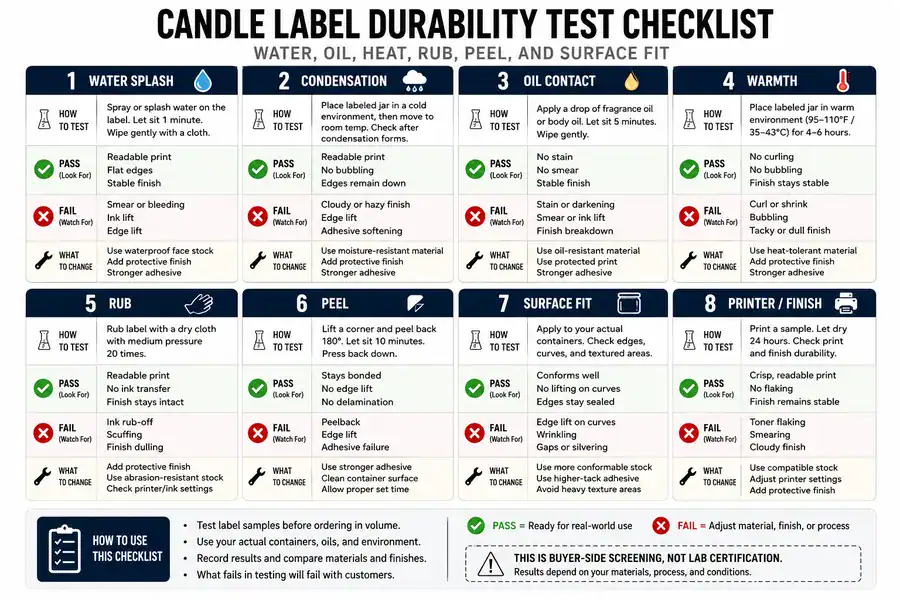
| Test type | How to run the simple check | Pass indicator | Fail indicator | What to change |
|---|---|---|---|---|
| Water splash | Add a light splash or wipe to a labeled sample | Print stays readable; edges stay flat | Smear, wrinkle, edge lift, or cloudy finish | Upgrade to film, laminate, or better print protection |
| Condensation | Chill the empty jar briefly, then let it warm at room conditions | Label stays flat after moisture forms and dries | Edge lift, bubbles, wrinkling, or paper swelling | Use film stock or stronger adhesive |
| Oil contact | Touch a small edge or printed area with realistic handling oil or tiny fragrance-oil exposure | No stain, smear, softening, or edge lift | Greasy mark, dull spot, smear, or adhesive softening | Choose oil-resistant film or stronger finish |
| Warmth | Place the labeled jar in realistic warm storage conditions | Edges, print, and finish stay stable | Curling, tacky finish, lifting, or adhesive slip | Compare heat-tolerant labels and adhesive options |
| Rub | Rub the printed face with clean fingers or cloth | Print and finish stay readable | Scuffing, ink wear, dulling, or toner flaking | Add laminate, coating, or a better print method |
| Peel | Press the edge after the bond settles, then inspect lift risk | Edge stays bonded | Corner lift, weak bond, or peelback | Change adhesive or improve jar-surface match |
| Surface fit | Test smooth glass, frosted glass, tin, painted jars, or curves separately | No bubbles, wrinkles, or poor bond | Surface-specific failure | Recheck jar surface compatibility |
| Printer/finish | Compare printed and unprinted samples | Printed sample performs close to blank stock | Print fails before material fails | Change print method, coating, or supplier stock |
Practical testing should compare real failure signs: smearing, staining, lifting, wrinkling, scuffing, curling, peeling, and cloudy clear labels. The goal is not to prove that one material is universally strongest. The goal is to identify the lowest-risk label system for the candle’s actual surface, exposure, print method, finish, and handling level.
Use waterproof label materials when the water test fails. Use oil-resistant label materials when fragrance oil, wax residue, or fingerprints mark the face or weaken the edge. Use heat-tolerant label materials when warmth causes curl, tack, or adhesive slip. Use jar surface compatibility when the same material works on one container and fails on another.
For ordering, supplier sample ordering should happen before a bulk label run when the candle will be sold, shipped, handled at markets, or placed in humid spaces. If a failed sample points to a pattern such as edge lift, smearing, toner cracking, bubbling, or poor bond, save the result for label troubleshooting instead of guessing at the cause. For exact supplier claims, compare your results with the supplier technical datasheet.
Use this simple decision path:
- Test the label on the actual jar, not a spare surface.
- Run the most likely exposure first: water, oil, heat, rub, peel, surface, or print.
- Compare at least two material systems when the failure risk is high.
- Upgrade the weakest part of the system, not always the whole label.
- Retest after changing stock, adhesive, finish, print method, or jar surface.
- Stop testing once the label survives the realistic use case without overspending.
Method note: These checks are practical buyer-side comparisons based on visible candle-label failures. They do not replace formal laboratory testing, legal certification, supplier audits, or full standards procedures.
Cost vs Durability: How to Choose Enough Label Performance Without Overspending
The best-value candle label is the least expensive material system that still survives the candle’s real exposure, surface, print, and sales-channel conditions.
Best value means fit-for-purpose durability, not the cheapest unit price, highest-spec film, most waterproof stock, or one universal label for every candle line. Candle label materials are the combined face stock, adhesive, ink or toner compatibility, protective finish, and surface fit used on candle containers.
| Candle line or sales condition | Lowest sensible tier | Safer upgrade | Overspend risk | Failure risk if underbuilt |
|---|---|---|---|---|
| Dry indoor gift candles | Coated paper | Laminated coated paper | High if PET is used without real exposure risk | Paper scuffing or wrinkling if handled often |
| Local market candles | BOPP or vinyl | Laminated film | Medium if premium PET solves no visible failure | Fingerprints, rub marks, edge lift, or oil marks |
| Bathroom or spa candles | BOPP or vinyl | Polyester/PET or laminated film | Low to medium if moisture is frequent | Condensation damage, edge lift, smearing, or cloudy labels |
| E-commerce candles | BOPP, vinyl, or laminated paper | Polyester/PET if abrasion or warmth is likely | Medium if packaging is the real weak point | Scuffing, corner lift, or print wear during handling |
| Premium retail line | BOPP, vinyl, or polyester/PET | Laminated polyester/PET | Low if shelf appearance drives the sale | Dull finish, scuffs, label curl, or poor shelf appearance |
| Low-volume test batch | Coated paper or small film sample run | BOPP or vinyl after testing | High if bulk premium labels are ordered too soon | Paying for the wrong material before surface testing |
Use best label material for candles as a fit decision, not a price race. Coated paper is enough when the candle is dry, lightly handled, and budget-sensitive. BOPP or vinyl is safer when moisture, handling, clear labels, curved jars, or fragrance oil risk enter the use case. Polyester/PET or laminate is justified when abrasion, warm storage, retail handling, or premium shelf appearance would make a failed label more expensive than the upgrade.
Candle Label Material Fit Checker
The candle label material fit checker maps exposure, surface, print method, sales channel, and budget risk to the lowest sensible label tier.
| Input | Low-risk answer | Medium-risk answer | High-risk answer | Material direction |
|---|---|---|---|---|
| Moisture exposure | Dry shelf | Light splash or humidity | Bathroom, spa, or condensation | Move from coated paper to BOPP, vinyl, or polyester |
| Oil exposure | Minimal handling | Fingerprints or wax residue | Fragrance oil contact risk | Favor film stock and protected finish |
| Heat-adjacent exposure | Room storage | Warm markets or stockrooms | Repeated warm storage | Compare stronger adhesive and polyester/PET |
| Jar surface | Smooth clean glass | Tin or curved jar | Frosted, textured, painted, or oily surface | Test adhesive before upgrading face stock |
| Print method | Professional supplier | Home laser or inkjet | Smear, rub, or toner cracking risk | Upgrade print-compatible stock or finish |
| Sales channel | Gift or hobby use | Markets | Retail or e-commerce | Increase durability with handling level |
| Appearance requirement | Texture preferred | Clean product label | Premium shelf finish | Balance coated paper, BOPP, vinyl, PET, and laminate |
| Unit-cost pressure | Small batch | Growing line | Repeat retail order | Test samples before locking the tier |
A cost mistake usually comes from buying too little durability or buying premium durability for the wrong reason. Underbuying happens when paper, weak adhesive, or unprotected print is used for wet, oily, warm, or handled candles. Overbuying happens when PET, laminate, or premium finishes are chosen for dry, low-handling candles where coated paper or BOPP would already meet the use case.
Use the label durability testing checklist before a bulk order so the upgrade is tied to visible failure signs. Use coated paper candle labels when dry-use texture and budget matter more than maximum resistance. Use BOPP candle labels or vinyl when the candle needs stronger water, oil, handling, or clear-label performance. Use polyester candle labels when higher toughness, abrasion resistance, or warmer storage makes the extra material cost easier to justify.
For business pricing and margin planning, route to candle pricing or packaging-cost content rather than turning label-material choice into a profit-margin calculator. If the next question is supplier tiers, minimum order quantities, or vendor tradeoffs, keep it to supplier comparison at the material-selection level. If box costs, inserts, damage rates, or shipping supplies drive the budget, separate that from labels and use the candle packaging cost guide.
A practical buying sequence keeps cost under control:
- Pick the lowest material tier that matches the candle’s likely exposure.
- Test that tier on the exact jar, print method, finish, and adhesive.
- Upgrade only the part that fails: stock, adhesive, finish, print method, or surface fit.
- Compare at least one lower-cost and one higher-cost sample before bulk ordering.
- Avoid PET or laminate when coated paper, BOPP, or vinyl already passes the real-use test.
- Avoid unprotected paper when water, oil, handling, warmth, or retail display makes failure likely.
Method note: This checker uses a modeled decision screen based on material tier, exposure type, sales channel, surface fit, finish, and visible failure risk. Treat it as practical pre-order planning, not a profit-margin model, supplier negotiation process, or certified durability test.