
The right candle mold matches your wax, candle type, heat tolerance, release needs, and production goals.
For most makers, silicone is the best starting point for detailed shapes and easy demolding, while metal suits straight pillars and hotter, harder use. Rigid plastic works for simpler shapes when heat is controlled, and latex is usually a niche option for unusual forms. For a broader overview of candle molds and shapes, start with the hub, then use the comparison below to narrow the choice around the candle you actually want to make.
| Mold material | Best for | Watch-outs | Heat / release profile |
|---|---|---|---|
| Silicone | Detailed shapes, sculptural candles, easier demolding | Soft walls can bow on tall or thin designs | Usually handles common candle wax pour ranges well; release is usually easiest |
| Metal | Straight pillars, votives, tapers, repeatable production | Dents and seams can mark candles; release usually needs more attention | Strong heat tolerance; fast cooling; release is less forgiving than silicone |
| Rigid plastic / polycarbonate | Simpler shapes, visible inspection, lower-cost trials | Can warp, craze, or cloud if heat is pushed too far | Use only within stated limits; release varies by shape and finish |
| Latex | Unusual organic shapes and niche small runs | Often needs a support shell and slower handling | More limited heat tolerance; release can be good but setup is slower |
Mold material — compare silicone vs metal vs polycarbonate vs latex
If you only buy one mold family to start, choose platinum-cure silicone and build out from there.
Material is the first filter because it determines heat tolerance, release behavior, durability, and the kind of candle you can make without constant workarounds. If you want a broader overview of different types of candle molds, start there, then narrow the choice based on wax, shape, and production goals.
Silicone molds are the default for many small makers because they flex for easy release, hold detail well, and usually tolerate the pour ranges used for soy, paraffin, and blends. They shine for pillars, sculptural shapes, and textured designs where you want high detail fidelity without wrestling with aggressive release agents. The trade-off is that very soft silicone can bow slightly, so tall or very thin forms may need strapping or support.
Metal molds, usually aluminum or tin-plated steel, are workhorses for straight pillars, votives, and tapers. They handle higher heat than many flexible or rigid alternatives, shed heat quickly, and resist casual damage. You will, however, rely more heavily on release methods and careful wicking, and dents or seam damage can permanently mark your candles.
Polycarbonate and other rigid clear plastics are useful when visual inspection matters or when you want to watch the candle set inside the mold. They are common for simpler shapes and some specialty designs. Clear molds can also help with QA because they make trapped bubbles, embed placement, and wall contact easier to spot, but they last longest when you respect their upper heat rating and avoid rough handling or metal tools inside them.
Latex and other flexible paint-on or slip-style molds are niche tools for unusual textures and organic shapes. They are slower to make, usually need an outer support shell, and generally suit lower-temperature waxes and smaller runs. They earn their place when you need shapes no standard mold family can provide.
As your line grows, keep notes on which materials gave you the best balance of finish, speed, and rejection rate for each product. Over time, that record makes it easier to compare silicone vs metal candle molds for new designs instead of defaulting blindly to one material.
Which candle mold should you choose?
Most makers should start with silicone for detailed work or metal for straight, repeatable forms.
- Choose silicone if you make sculptural candles, want easier release, or care most about fine detail.
- Choose metal if you make straight pillars or tapers, pour hotter wax, or need stronger long-run durability.
- Choose rigid plastic if you want a lower-cost option for simpler shapes and you can control heat carefully.
- Choose latex only when the shape itself rules out the more common mold families.
If you are still unsure, buy one good mold in the material that best matches your main product, then test it with your actual wax and wick setup before expanding your lineup. That approach usually saves more money than buying a pile of speculative molds at once.
Candle type fit — steps to map pillar, votive, taper, container
A mold is right only when it fits a real product in your line.
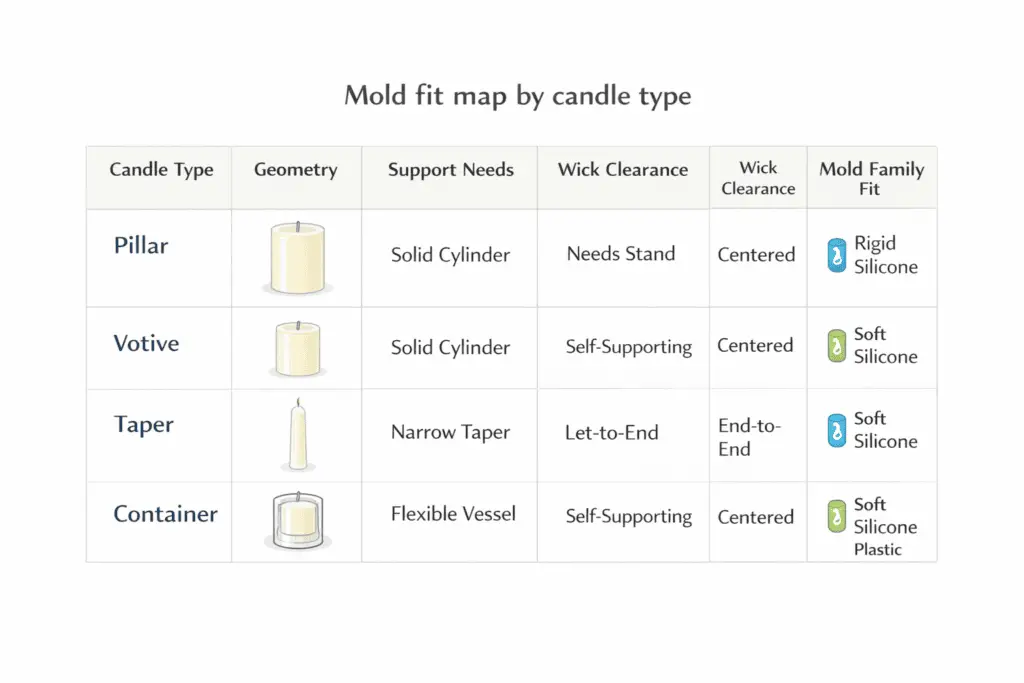
Begin by listing the candle families you actually want to sell: classic straight pillars, tapers, votives, containers, wax melts, or sculptural pieces. Then compare mold families for each category instead of buying random shapes that look good in isolation.
For each candle type:
- Define the functional requirements
For pillars and tapers, safe freestanding stability matters. For containers, glass compatibility and adhesion behavior come first. For wax melts, easy release usually matters most. - Match mold geometry and material
Votives and tealights often pair well with metal or rigid plastic cups; large pillars often prefer silicone or metal tubes; sculptural candles usually gravitate toward silicone. - Review practical fit using your notes or supplier images so you avoid buying beautiful but impractical shapes for your waxes and wick families.
Finally, set a cleaning cadence that matches the candle type. High-soot tests, embedded botanicals, and loaded dyes all add wear to molds, and cleaning schedules that work for unscented test pillars may fail for heavily fragranced container lines. Over time, linking candle type, mold choice, and maintenance schedule will prevent surprise defects partway through a production season.
Wax temperature compatibility — how to set safe pour & pre-warm bands
You will get fewer defects when your wax’s working range and your mold’s heat tolerance are treated as a matched pair.
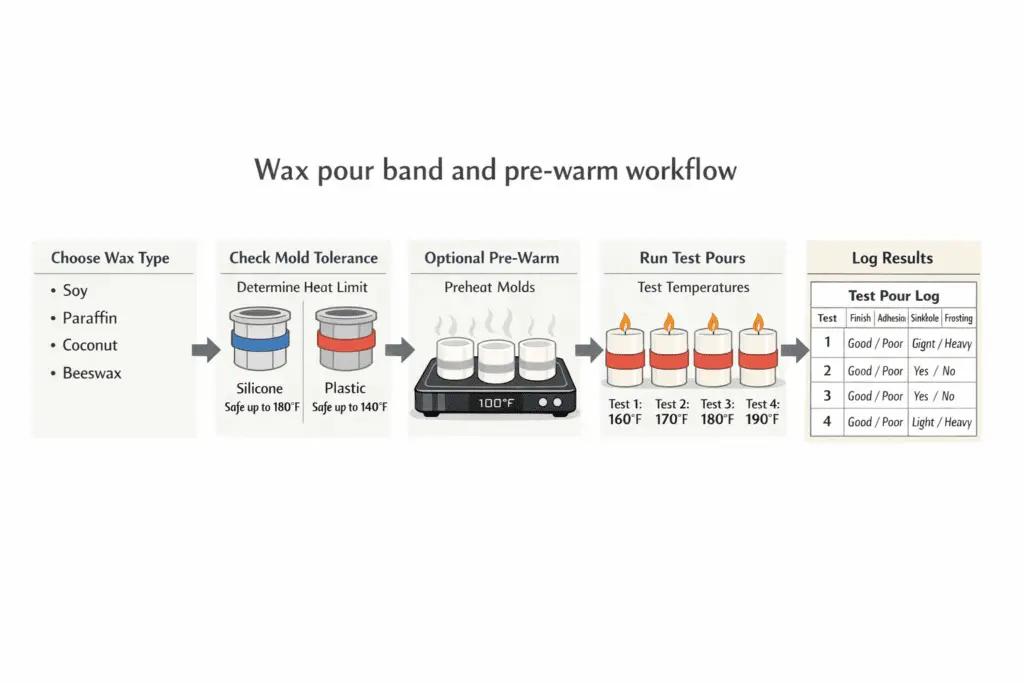
Start by checking supplier information for both wax and mold. Note the recommended melt and pour temperatures for the wax, and any stated maximum service temperature for the mold material. Then map your wax families, paraffin, soy, beeswax, and blends, against the mold materials that can sit safely inside those working bands with some margin.
Match those limits in practice as well as on paper. A hotter paraffin or beeswax pillar poured into thin plastic may move toward warping or clouding long before a metal or sturdier silicone mold has any issue. A cooler soy blend in a thick silicone mold may, by contrast, benefit from slight pre-warming to reduce jump lines and adhesion rings at the wall.
Before a serious production run, run a small test ladder with the same mold and the same candle at a few slightly different pour temperatures inside the safe band. Log surface finish, adhesion, sinkholes, and frosting. The best temperature is rarely the hottest one you can get away with; it is the band that gives clean walls and predictable cooling without creeping toward the mold’s stated limit.
It also helps to compare the upper and lower ends of your safe pour band. Hotter pours can improve detail fill and reduce some wall marks, but they narrow your margin for error in softer silicone or rigid plastics. Cooler pours widen the cushion but may increase bubbles, adhesion issues, or uneven fill in some shapes. Keep those working bands written near your melter, and treat any change of wax supplier or mold material as a reason to re-test rather than a plug-and-play swap.
Release & demolding — steps to prevent sticking and tearing
Consistent, low-stress demolding comes from using the right prep and waiting long enough for the wax to set properly.
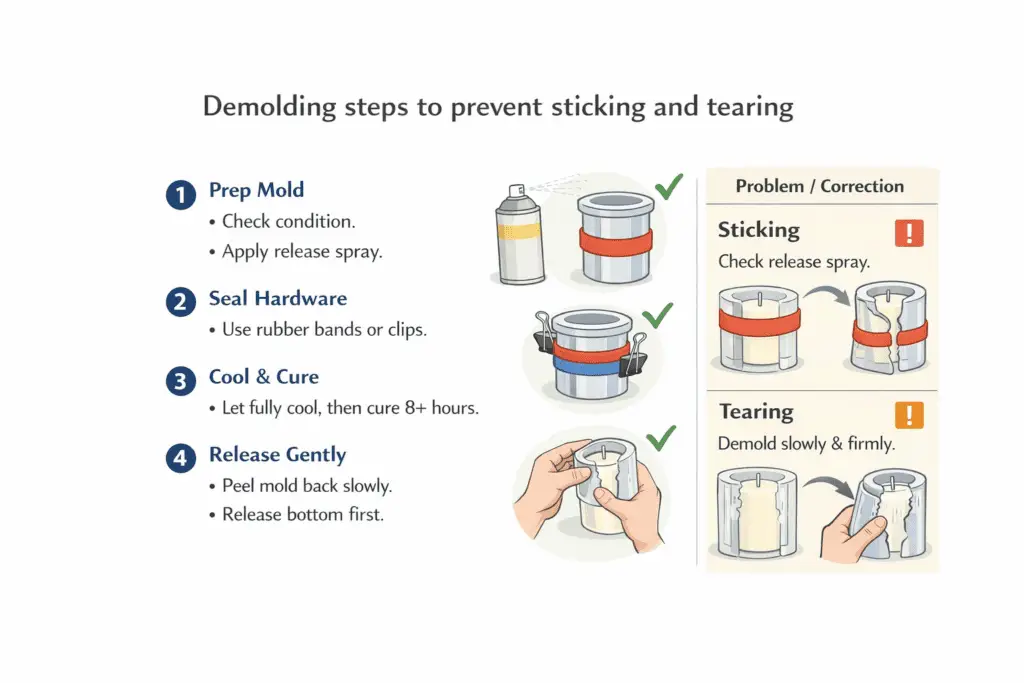
Start by deciding which mold families really need extra help and which can usually release cleanly with good timing and handling alone. Many platinum-cure silicone molds work best when you focus on using silicone candle molds correctly rather than loading them with heavy release agents, because too much spray can build residue and dull detail. Metal, latex, and some rigid plastics usually benefit from light, compatible release applied in a thin, even coat.
To keep release problems under control, break the setup into steps:
- Prep the mold
Check for leftover wax, dust, or old release residue. Clean and dry thoroughly. If you use a spray, apply a fine mist and let the carrier flash off completely. - Seal the hardware
For through-hole molds, make sure wick holes, seams, and plugs are fully sealed to prevent seepage. - Control cooling and cure time
Rushing demold is the fastest way to tear edges or lose surface detail. Thick pillars may need far longer than you expect. - Use a consistent demolding motion
For flexible molds, peel and roll the walls away from the candle rather than pulling the candle out. For rigid molds, gentle tapping, a short chill, or a quick warm water bath on the outside can help break the seal without brute force.
If a particular mold keeps fighting you, note wax type, pour temperature, room conditions, release product, and wait time before changing anything major. If sticking remains a pattern, go deeper with a focused guide on how to prevent candle mold sticking.
Dimensions & volume — calculating capacity and burn implications
Choosing mold dimensions is really about choosing burn profile, not just size.
Start by matching shape and size to the candle family. Cylinders, tapers, containers, and sculptural forms all behave differently as they burn. Taller pillars with narrow diameters tend to tunnel or drown wicks when under-wicked, while wide shallow forms can create aggressive melt pools if over-wicked.
Then calculate capacity. For simple cylinders, use a quick approximation based on the area of the base multiplied by height. For irregular shapes or containers, fill the mold with water, then measure the volume you poured in. Record that full volume in milliliters or ounces for each mold you own so you can connect it later to wax usage, wick choice, and pricing.
Fill slowly along the wall and tap the mold gently so trapped air can escape before you take the reading. If bubbles keep distorting your measurement or your finished candles, review how to prevent air bubbles when using candle molds before assuming the mold size is the main problem. Write the final number next to the mold’s photo or product note so you can reuse it later without re-measuring.
Once you know volume, connect it back to wick class and burn tests. A 200 ml smooth pillar may need a different wick family and burn schedule than a 200 ml three-wick container. Over time, your notes become a small library of volume, wick, wax, burn hours, and customer feedback, and new molds stop feeling like mysteries.
Wicking constraints — how to center, seal, and space single/multi-wicks
Even the best mold fails if it works against your wick setup.
Start by choosing the core burn settings for each product: single wick or multi-wick, expected burn diameter, and the burn environment. That gives you a target melt-pool diameter and a reasonable wick family to test.
Supplier wick charts can give you a starting map, but you still have to adapt them to the mold. Tall narrow molds may need smaller, hotter-burning wicks, while wide shallow molds may require multiple wicks spaced carefully so the melt pools do not crash into each other too aggressively.
Within the mold itself, focus on three constraints:
- Centering and anchoring – Use tabs, pins, or tensioning bars that keep wicks straight without distorting soft molds.
- Sealing – Prevent leaks at wick exits with appropriate plugs or sealants, especially in metal and rigid molds.
- Spacing for multi-wicks – Keep a consistent gap between wicks and between each wick and the mold wall to avoid overlapping melt pools.
As you log test burns, generic wick guidance becomes more useful because you start seeing which wick series behaves well in which mold families, with which wax blends, and at which volumes. The key point for choosing a mold is simple: if the mold makes centering, sealing, or spacing hard, it may be the wrong mold for that candle.
Detail fidelity & surface finish — how to keep edges sharp and surfaces glossy
Sharp detail and glossy surfaces depend mainly on temperature control, mold rigidity, and even cooling.
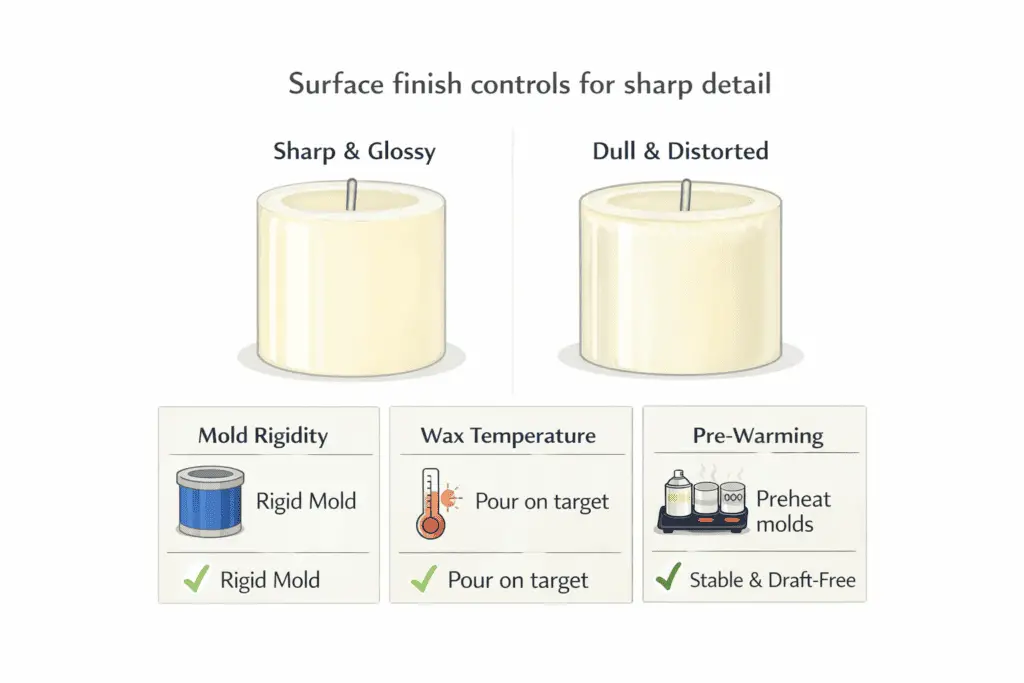
Start by pairing waxes and mold families that naturally support the finish you want. Rigid molds hold crisp edges well, while softer molds make release easier but can round corners if they flex too much under heat or handling. Keep notes on which molds preserve detail best for each wax and design rather than assuming one material always wins.
To keep surfaces glossy rather than hazy, pay attention to:
- Wax temperature – Pouring too cool can trap bubbles and cause ripples; pushing heat too far can increase frosting, micro-cracking, or mold stress in some setups.
- Pre-warming – Slightly warming rigid molds can reduce jump lines and adhesion rings, especially with soy blends.
- Cooling environment – Drafts, cold benches, and fans create uneven cooling that dulls or ripples the surface.
When a candle comes out dull, chalky, or distorted, do not guess. Run a short troubleshooting pass and note whether you changed wax batch, pour temperature, room temperature, or pre-warm habits. Often one stable change, such as slowing cooling or nudging the pour temperature inside the safe band, brings detail and finish back into line.
Production durability & cycle time — compare single vs multi-cavity and cooling methods
Durability and cycle time determine whether a mold belongs in hobby use, side production, or full production.
Single-cavity molds are flexible workhorses: easy to learn on, forgiving, and simple to troubleshoot. Multi-cavity trays, by contrast, excel when you want to pour batches of identical pieces, yet they demand stricter control of durability, cooling, and defect rates.
To compare single-cavity and multi-cavity options, track:
- Cycles to visible wear or failure – How many pours happen before tearing, warping, or obvious surface damage appears?
- Average demold time – How long from pour to safe release without distortion?
- Defect rate – How many pieces per batch need rework or rejection?
In practice, assisted cooling can shorten cycles but may also introduce uneven cooling, ripples, or cracks. Keep a simple log that compares mold material, cavity count, and cooling method against the number of good candles you actually get.
Safety & compliance — what ratings and documents matter
For mold buying, the practical question is simple: can the supplier show what the material is, what heat range it is meant to handle, and what documents support that claim?
Before you buy for regular production, ask for the basic records tied to the exact mold or accessory you plan to use:
- SDS (Safety Data Sheets) for any mold materials, release products, or coatings that may be exposed to repeated heat.
- Material declarations or temperature documentation that show the mold material and any stated service limits.
- Tolerance, warranty, and hazard-label access, including CLP or equivalent hazard labeling where required for related chemicals.
If a supplier cannot support a mold or accessory with basic documentation, treat that as a buying risk rather than something to sort out later.
Budget & total cost of ownership — calculating cost per good candle
Sticker price tells you very little about what a mold will really cost you.
To get a realistic view, estimate total cost of ownership using three inputs:
- Mold cost per cycle – Purchase price divided by the number of pours before the mold fails or becomes too damaged to use.
- Defect cost – Wax, fragrance, color, and packaging lost to rejects, plus time spent remelting or reworking.
- Handling cost – Extra labor for fragile molds, complex cleaning, or finicky release routines.
A tough silicone tray that survives dozens of cycles with low defects might have a higher upfront price but far lower total cost than a cheaper tray that warps or tears after a few busy weekends.
When you calculate cost per good candle, log real numbers. If one mold consistently generates 10% rejects while another stays near 2%, that difference belongs in your buying decision. Over a season, total cost of ownership quietly shows which molds deserve spares and which should never be reordered.
Specialty shapes & structural stability — how to support geometric/bubble/sculptural molds
Specialty shapes can be worth choosing when the finished look is the product, but they also expose weak points in both the mold and the finished wax.
Before buying a complex sculptural mold, check for thin necks, deep undercuts, soft walls, and any need for an outer shell or cradle. If the shape already looks fragile in wax, treat that as a selection issue, not just a production issue.
- Use outer shells or cradles for very soft or thin-walled molds, especially tall sculptures.
- Support undercuts and overhangs during curing so the weight of the wax does not stretch or deform the mold.
- Start with sturdier designs before buying extremely thin or intricate forms for regular production.
Putting it all together — a simple mold-choice workflow
A short, repeatable workflow makes mold selection faster and less expensive.
To turn all of this into a practical decision path, use a short workflow whenever you consider a new mold:
- Clarify the candle’s job
Name the type, pillar, taper, container, sculptural, target burn profile, and any special aesthetic such as fine detail, embeds, or clear walls. - Pick a candidate mold family
Use your notes to choose between silicone, metal, rigid plastic, or specialty materials for that role. - Check heat and volume
Confirm compatibility between wax temperature bands and mold ratings, and calculate volume so you can plan wicking and pricing. - Plan release, climate, and cleaning
Decide how you will prep, demold, and maintain the mold in your actual workspace conditions. - Run a structured test batch
Pour a small ladder of test candles at slightly different pour temperatures or workflow settings, log outcomes, and check safety behavior. - Estimate cost per good candle
Use early defect rates and handling time to judge whether the mold belongs in hobby, small-batch, or full production. - Decide and document
Promote the mold to your core lineup, keep it as a niche art piece, or retire it, and update your notes so future decisions get easier instead of repeating the same mistakes.
Follow this consistently and your mold collection will slowly converge on a set that fits your waxes, climate, and brand instead of becoming a random pile of experiments.