

Yes, you can add coconut oil to candle wax in small weighed test amounts, but it can change softness, scent behavior, wick performance, and burn results.
Coconut oil is an additive oil, while candle wax is the base material that gives a candle its structure, melt behavior, and fuel balance. Coconut wax is a separate candle wax or wax blend, not the same ingredient as the jar of coconut oil used in cooking or skincare. This guide is for candle makers deciding whether to test coconut oil in a wax formula, not for emergency oil candles, food uses, skincare uses, or choosing coconut wax as a base wax. Start by separating coconut oil from coconut wax, because that distinction controls every later decision about amount, burn testing, scent, safety, and repeatability.
On this page, safe and better mean the finished candle sets, cures, and burns predictably after testing; they do not mean food-safe, skincare-safe, toxin-free, medically safer, or legally compliant by ingredient alone.
Coconut Oil Is Not the Same as Coconut Wax
Coconut oil is an additive oil; coconut wax is a candle wax or wax blend used as a base material.
Coconut oil may be measured into a candle wax formula as an additive, while coconut wax is the main wax body used to make the candle. Coconut apricot wax is another base-wax blend, not plain coconut oil.
Candle wax types are base materials that control structure, melt behavior, and fuel flow in a candle. The word “coconut” only describes a source or ingredient family here; it does not mean every coconut-derived candle material behaves the same way.
| Material | What it is | Main candle-making role | When it belongs in the decision |
|---|---|---|---|
| Coconut oil | Separate oil-based additive | Changes a wax formula in small tests | When you want to test softness, texture, or formula behavior |
| Coconut wax | Candle wax or wax blend | Serves as the base wax | When you want to choose a coconut-based wax for the candle |
| Coconut apricot wax | Blended candle wax | Serves as a premium base wax blend | When you are comparing base wax options, not adding oil |
This distinction matters before any percentage advice. A candle maker who adds coconut oil when a recipe meant coconut wax is changing the formula, not following the base-wax choice. That can make the candle softer, oilier, or harder to test against the original recipe.
Use the coconut wax guide when the real decision is choosing a coconut-based base wax. Use the coconut apricot wax guide when the decision is about a blended wax type. Keep reading here when the decision is whether to add coconut oil to an existing candle wax formula.
Method note: This comparison classifies each material by ingredient role, base-wax suitability, and additive suitability. The safety boundary should still be checked against supplier SDS information and candle-use guidance from sources such as the National Candle Association before scaling a formula.
The next decision is whether coconut oil can be tested in candle wax at all, and under which conditions the answer changes.
Can You Add Coconut Oil to Candle Wax?
Yes, you can add coconut oil to candle wax, but only as a measured additive in a small test batch.
“Can” means technically possible, not recommended for every wax, wick, fragrance load, or candle format. Coconut oil changes the wax formula, so the result must be judged by set, surface, scent behavior, melt pool, flame stability, and burn testing.
A measured test batch is the safest decision path because coconut oil can soften the wax body before the candle proves it can burn cleanly and consistently. Container candles usually tolerate softness better than freestanding candles, but the wax still needs a controlled test.
| Situation | Better choice | Why |
|---|---|---|
| You want to soften a container wax slightly | Test coconut oil in a small measured batch | The jar supports the softened wax while you evaluate burn behavior |
| You need a firm pillar or molded candle | Avoid coconut oil or choose a harder wax system | Added oil can reduce structure and make the candle too soft |
| You meant to buy coconut wax | Choose coconut wax instead | Coconut wax is a base material; coconut oil is a formula additive |
| You want a stronger fragrance | Do not treat coconut oil as fragrance oil | Scent throw depends on fragrance oil, wax compatibility, and testing |
| You want to change an entire wax system | Use a wax blending guide | Broad wax blending needs its own formula logic |
| You want an emergency oil-fuel candle | Keep that separate from formulated candle wax | Open-flame oil use is not the same as candle-wax formulation |
Add coconut oil only when you can weigh the ingredient, label the test, keep the rest of the formula stable, and compare the finished candle against a control. A control candle is the same wax, wick, container, and fragrance formula without the coconut oil.
Method note: This decision table uses a condition-based test model rather than a universal percentage. The first safety and performance check should come from the wax supplier’s SDS, the fragrance supplier’s use guidance, and a controlled burn test before any larger batch.
If the goal is not clear, coconut oil becomes a guess instead of a formulation variable.
Why Candle Makers Test Coconut Oil in Wax
Candle makers test coconut oil in wax to change softness, surface feel, pour behavior, or a formula’s handling.
The purpose should be narrow before the ingredient goes into the melting pot. Coconut oil is not a cure-all additive, and it does not automatically make the candle cleaner, safer, more natural, or better scented.
A valid test has one clear goal: soften a wax that feels too firm, compare surface finish, see whether the candle releases from a container more cleanly, or check whether a small formula change improves handling. A weak test starts with vague goals like “make it better” or “make it more natural,” because those goals cannot be judged after the burn test.
| Test goal | What coconut oil may change | What decides success |
|---|---|---|
| Softer wax texture | Wax body and spoonable feel before pouring | The candle still sets without a greasy top |
| Smoother top | Cooling behavior and surface appearance | The top stays stable after cure and burn testing |
| Easier container behavior | Adhesion, wet spots, or sidewall appearance | The jar candle does not slump or separate |
| Formula experiment | Wax blend feel and melt response | The control candle performs worse than the test candle |
| “More natural” positioning | Ingredient story only | Claims stay accurate and not overstated |
A better route may be coconut wax, a soy-coconut blend, beeswax, stearic acid, or a harder container wax if the real goal is a stable base formula. Use the wax additives guide when the decision is about choosing a candle-formulation additive rather than testing coconut oil specifically.
The practical outcome is simple: test coconut oil only when you can name the problem it is supposed to solve. If the finished candle becomes too soft, oily, weak-burning, or inconsistent, the additive failed even if the pour looked good.
Method note: Judge this test against a control candle, not by appearance alone. Keep the same wax, wick, jar, fragrance oil, pour temperature, and cure window so coconut oil is the only changed variable.
That goal-based decision leads into the next question: how much coconut oil belongs in the test.
How Much Coconut Oil Should You Add to Candle Wax?
Start with a very small weighed amount of coconut oil and test it before using the formula in a larger batch.
There is no universal coconut oil percentage that works for every candle wax type. The right amount depends on the base wax, candle format, wick, fragrance load, container, cure time, and whether the finished candle burns consistently.
Do not copy a soy-wax percentage into beeswax, paraffin, coconut wax, coconut apricot wax, pillars, melts, or production batches without a separate control test.
Treat coconut oil as a percentage of total wax weight, not as a spoonful added by eye. For example, a test should record the wax weight, coconut oil weight, fragrance oil weight, wick, container, and pour notes. That record makes the result repeatable if the candle performs well.
| Formula decision | Safer test logic | Risk if skipped |
|---|---|---|
| Measuring coconut oil | Weigh it against total wax weight | The batch cannot be repeated |
| Choosing the first test | Use a very small additive amount | The candle may become too soft or oily |
| Comparing results | Pour a control candle without coconut oil | You cannot tell what changed |
| Scaling the batch | Scale only after set, cure, and burn checks | A larger failed batch wastes wax and fragrance |
| Judging success | Check surface, melt pool, flame, and scent | A good-looking candle may still burn poorly |
A small amount is easier to correct than an over-softened formula. If the candle feels greasy, sinks badly, forms an oversized melt pool, burns weakly, or loses structure, the amount was too high for that wax system or that wick setup.
Use a candle wax calculator only as a weighing aid when you already know the test percentage you want to try. Do not use a calculator to justify skipping the burn test, because coconut oil changes the fuel system rather than acting like a neutral filler.
Method note: Keep test batches small, label each sample, and change only one variable at a time. Check supplier guidance and SDS documents for the wax and fragrance before heating or scaling any formula.
Refined vs Unrefined Coconut Oil for Candle Tests
Refined coconut oil is usually the cleaner test choice because it has less natural coconut odor than unrefined coconut oil.
Refined coconut oil has been processed to reduce odor, color, and non-wax variation. Unrefined coconut oil may carry more coconut scent and natural variation, which can interfere with fragrance testing and make results harder to judge across candle wax types.
This does not mean refined coconut oil is automatically safe, ideal, or performance-neutral in candles. It only means the test variable is usually easier to control when the oil has less scent and fewer visible differences.
| Coconut oil type | Likely candle-making issue | Better use case |
|---|---|---|
| Refined coconut oil | Still softens the wax and may affect burn behavior | Small formula tests where scent interference should be low |
| Unrefined coconut oil | May add coconut odor or more batch variation | Limited experiments where natural coconut odor is part of the goal |
| Any coconut oil | Can make the wax too soft or oily | Only tested formulas with labels, controls, and burn checks |
Do not choose coconut oil by food, skincare, or nutrition standards. A candle test needs the ingredient to behave predictably when melted with wax, fragrance oil, dye if used, and a wick. Supplier guidance matters more than the wording on a grocery label.
If the goal is a coconut-based candle with fewer formula unknowns, coconut wax or a soy-coconut wax blend is usually a better decision than adding unrefined coconut oil to a finished wax formula.
Method note: Label the test by oil type, brand, weight, wax type, wick, jar, fragrance oil, and cure window. If the unrefined sample changes scent or surface more than the refined sample, the oil type is part of the result.
Signs You Added Too Much Coconut Oil
Too much coconut oil can leave the candle greasy, too soft, poorly set, weak-burning, or unstable in the melt pool.
Excess coconut oil means the wax formula shows failure signs, not that it crossed one universal percentage. Different candle wax types tolerate oil differently, so the finished candle decides whether the amount was too high.
The most common warning sign is an oily or slick surface after the candle sets. Other signs include a candle that dents too easily, pulls away from the jar unevenly, develops a large melt pool too fast, burns with a weak flame, or separates in texture.
| Sign after adding coconut oil | Likely meaning | Better next step |
|---|---|---|
| Greasy or slick top | The wax cannot hold the added oil well | Reduce or remove coconut oil in the next test |
| Candle stays too soft | The additive weakened the wax body | Test a smaller amount or use a harder wax |
| Oversized melt pool | Fuel flow changed too much for the wick | Retest with less coconut oil before changing wick size |
| Weak or struggling flame | Wax, oil, fragrance, and wick are mismatched | Compare against a control candle |
| Poor set or texture separation | Formula stability is weak | Discard the test or reformulate from a smaller change |
| Scent seems muted or inconsistent | The wax-fragrance system changed | Test fragrance behavior separately from texture changes |
Do not fix an over-oiled candle by adding random wax after the pour. That hides the formula problem and makes the result hard to repeat. A cleaner correction is to make a new test with less coconut oil and the same wick, jar, wax, and fragrance.
If the candle fails structure or burn testing, treat the coconut oil amount as too high for that formula. The opposite result is a candle that sets cleanly, burns steadily, and performs better than the control without oily residue.
Method note: Record each failure sign before changing the next batch. One correction at a time is the only way to know whether the problem came from coconut oil, wick size, fragrance load, wax type, or cure timing.
How Coconut Oil Changes Wax Hardness and Softness
Coconut oil usually makes candle wax softer because it adds an oil-based ingredient to the wax body.
Wax hardness is the firmness that helps a candle set, hold shape, release heat, and control melt behavior. When coconut oil is added to candle wax types, it can reduce firmness and change how the finished candle feels, cools, and burns.
A softer wax is not always a failure. In a container candle, slight softness may be acceptable if the jar supports the candle and the burn stays stable. In a pillar, molded candle, or tart, softness can become a structure problem because the wax must stand without container support.
| Wax behavior | What coconut oil may do | Why it matters |
|---|---|---|
| Firmness | Makes the wax easier to dent or scoop | The candle may feel unstable after setting |
| Melt response | Speeds up or widens the melt pool | The wick may feed fuel differently |
| Handling | Makes the wax feel smoother or oilier | A nice pour can still fail after curing |
| Structure | Reduces rigidity in unsupported candles | Pillars and molded shapes may slump |
| Formula balance | Changes how wax, fragrance, and wick work together | A stable recipe may need retesting |
The best comparison is not hard versus soft in isolation. The real test is whether the softer candle sets cleanly, handles normally, burns evenly, and keeps a controlled melt pool. A wax that feels pleasant before lighting can still burn too hot, too fast, or too weakly after the wick draws fuel.
For a firmer result, use a harder candle wax, a compatible wax blend, or a candle wax additive made for structure rather than adding more coconut oil. The wax additives guide is the better route when the goal is predictable firmness instead of an oil-based softness test.
Method note: Press, cut, and burn-test the control candle beside the coconut-oil sample. If the sample is softer but burns worse, the texture gain does not justify the formula change.
Watch for Oily Tops, Wet Spots, and Adhesion Changes
Coconut oil can change a candle’s surface finish by causing oily tops, wet spots, adhesion shifts, or uneven cooling marks.
Surface finish is the visible and touchable quality of the candle after it sets. Coconut oil can change how wax cools against the jar, how smooth the top looks, and whether the surface feels dry or slick.
These surface changes matter because they can signal a formula problem, not just a cosmetic flaw. A glossy top may look good at first, but a greasy top means the wax may not be holding the added oil well. Wet spots along glass can come from wax shrinkage, adhesion changes, temperature swings, or formula softness.
| Visible sign | What it may mean | What to check next |
|---|---|---|
| Oily top | Coconut oil may be separating or overloaded | Reduce coconut oil in the next test |
| Wet spots on glass | Adhesion changed during cooling | Compare pour temperature and room temperature |
| Very soft top | The wax body lost firmness | Test less oil or a harder wax |
| Uneven surface | Cooling behavior changed | Compare the control candle after the same cure time |
| Sinkholes or dips | Wax contraction or pour conditions shifted | Check pour temperature and container warming |
| Frosting-like marks | Wax type and cooling conditions are reacting | Judge appearance with burn performance, not alone |
Do not judge the candle immediately after pouring. Let the sample set and cure on the same schedule as the control candle before deciding whether coconut oil improved or weakened the finish.
If the candle looks smoother, burns cleanly, and stays dry to the touch, the surface result may be acceptable. If it looks oily, separates, or gets worse after curing, the formula is not stable enough to scale.
Use the candle surface troubleshooting guide when the main problem is wet spots, sinkholes, frosting, or jar adhesion rather than coconut oil itself.
Method note: Photograph each test candle at pour, after set, after cure, and after the first burn. Surface changes over time are more useful than a single fresh-pour impression.
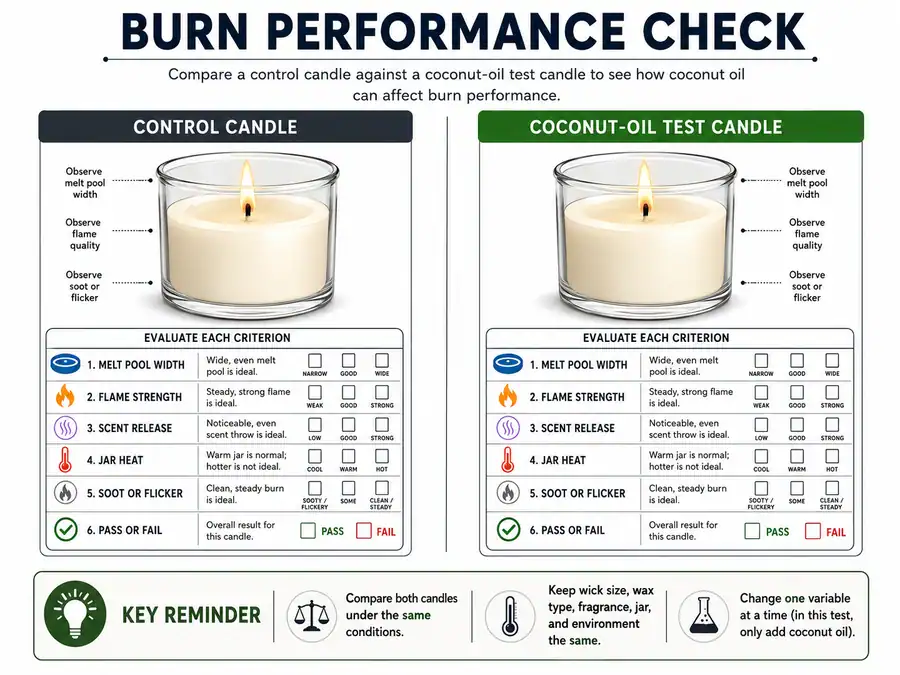
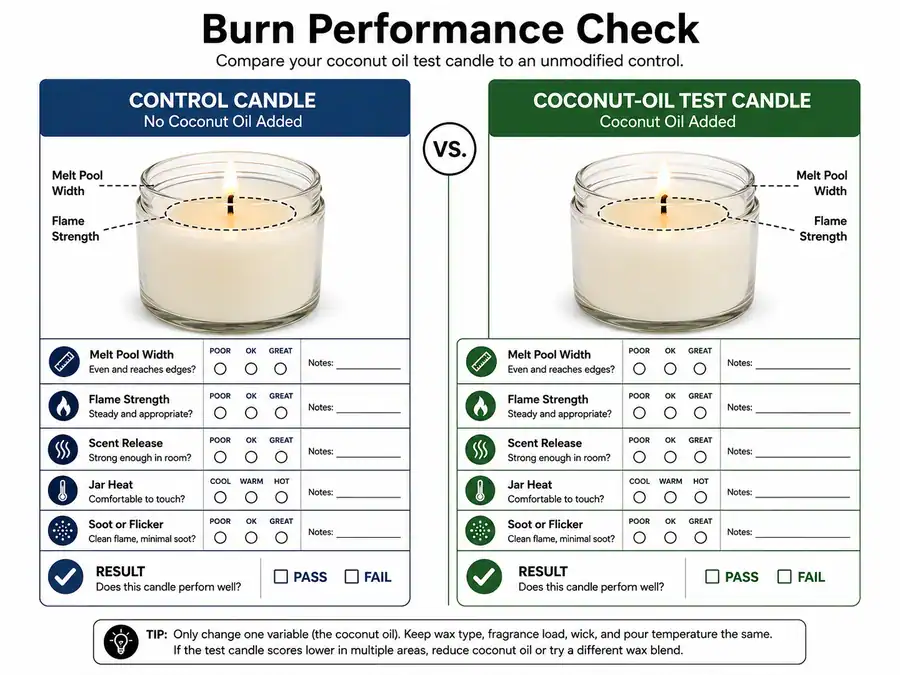
How Coconut Oil Can Affect Burn Performance
Coconut oil can change candle burn performance by altering fuel flow, melt-pool behavior, flame strength, and burn consistency.
Burn performance is how the candle behaves after lighting, including melt pool, flame height, scent release, heat, soot risk, and container temperature. Across candle wax types, coconut oil should be treated as a formula change that requires a fresh burn test.
The main risk is assuming softness means a better burn. A softer wax may melt faster, feed the wick differently, or make the flame less stable. The candle may look smoother before lighting and still burn worse than the control candle.
| Burn result | What coconut oil may have changed | What to do next |
|---|---|---|
| Melt pool gets too wide | The softened wax feeds the wick too quickly | Reduce coconut oil before changing the wick |
| Flame looks weak | The wax, oil, fragrance, and wick may not match | Compare against the control candle |
| Flame grows too large | Fuel flow may be too high | Stop scaling and retest the formula |
| Candle burns unevenly | Melt behavior changed across the jar | Check wax amount, wick centering, and cure time |
| Scent seems weaker | The wax-fragrance system changed | Test scent separately from texture |
| Container gets too hot | The burn may be too aggressive | Treat the batch as a failed test |
A successful test candle burns as steadily as the control or better, without greasy residue, excessive melt pool, unstable flame, or poor scent release. If the burn gets worse, the coconut oil did not improve the candle even if the surface looked better.
Use the candle burn test checklist when the main decision is whether the finished candle burns safely and consistently. Use the wick testing guide when the formula change points to wick mismatch after the coconut oil amount has already been reduced.
Method note: Burn the coconut-oil sample beside a control candle made with the same wax, wick, jar, fragrance, dye if used, and cure time. Judge the full burn behavior, not the first melt pool alone.
Retest Your Wick After Adding Coconut Oil
Retest the wick after adding coconut oil because the wax blend may feed the flame differently.
Wick sizing means matching the wick to the wax, container diameter, fragrance load, dye, and finished burn behavior. Coconut oil can change that match by softening the wax and changing how fuel reaches the flame.
Do not assume the old wick still works because the wax brand stayed the same. Once coconut oil enters the formula, the candle is no longer the same wax system. A wick that worked in the control candle may become too hot, too cool, or inconsistent in the altered blend.
| Wick test sign | Possible meaning | Best next move |
|---|---|---|
| Weak flame | Wick may be too small for the altered blend | Reduce coconut oil first, then test wick size |
| Large flame | Wick may be too large or fuel flow too high | Stop the test and reformulate smaller |
| Deep melt pool | Formula may be too soft for the wick | Test less coconut oil |
| Tunneling | Wick may not be drawing enough fuel | Compare against the control candle |
| Soot or flicker | Wick, fragrance, and wax balance may be off | Retest with one change at a time |
| Hot container | Burn may be too aggressive | Do not scale the batch |
The clean order is formula first, wick second. If the candle is greasy or too soft before burning, changing the wick will not fix the formula. If the candle sets cleanly but burns poorly, wick testing becomes the next controlled step.
Use the best wicks for coconut and coconut apricot candles guide only when the base wax is coconut wax or coconut apricot wax. For plain coconut oil added to another wax, use a general wick testing process tied to the actual container and formula.
Method note: Label each wick test with wax type, coconut oil weight, fragrance load, container, wick series, wick size, cure time, and burn notes. Without that record, a passing wick test cannot be repeated.
Coconut Oil Is Not Fragrance Oil
Coconut oil is not fragrance oil and should not be counted as candle fragrance load.
Fragrance load means the percentage of fragrance oil in the wax blend. Coconut oil is a separate additive oil that may affect scent behavior, but it does not replace a candle fragrance oil, essential oil, or tested scent system.
The word “oil” creates the problem. In this guide, coconut oil means an additive oil used to change the candle wax formula. It does not mean fragrance oil, essential oil, aromatherapy oil, or a scent carrier.
| Ingredient | Candle-making role | How to treat it in the formula | Failure sign to watch |
|---|---|---|---|
| Coconut oil | Additive oil | Weigh separately from fragrance load | Oily surface, oil smell, weak set |
| Fragrance oil | Scent ingredient | Count as the fragrance portion of the wax blend | Weak hot throw, sweating, separation |
| Essential oil | Scent ingredient with separate limits | Treat as a fragrance decision, not a wax-softening additive | Poor scent, wick issues, instability |
| Carrier oil | Non-standard candle ingredient | Do not use as a fragrance oil substitute | Oily residue or poor burn behavior |
Coconut oil may interact with scent throw because it changes the wax system around the fragrance oil. That does not mean it improves scent throw. A candle that smells stronger in the jar may still burn poorly, mute hot throw, or leave an oily smell after curing.
Use the candle fragrance load guide when the decision is how much fragrance oil belongs in the wax. Use the scent throw troubleshooting guide when the main problem is weak hot throw, poor cold throw, or fragrance separation.
Method note: Judge scent changes against a control candle with the same wax, fragrance oil, wick, jar, and cure time. Check supplier SDS and fragrance-use guidance before changing scent materials or heat exposure.
Wax type is the next filter because the same coconut oil test can behave differently in soy, paraffin, beeswax, coconut wax, or blends.
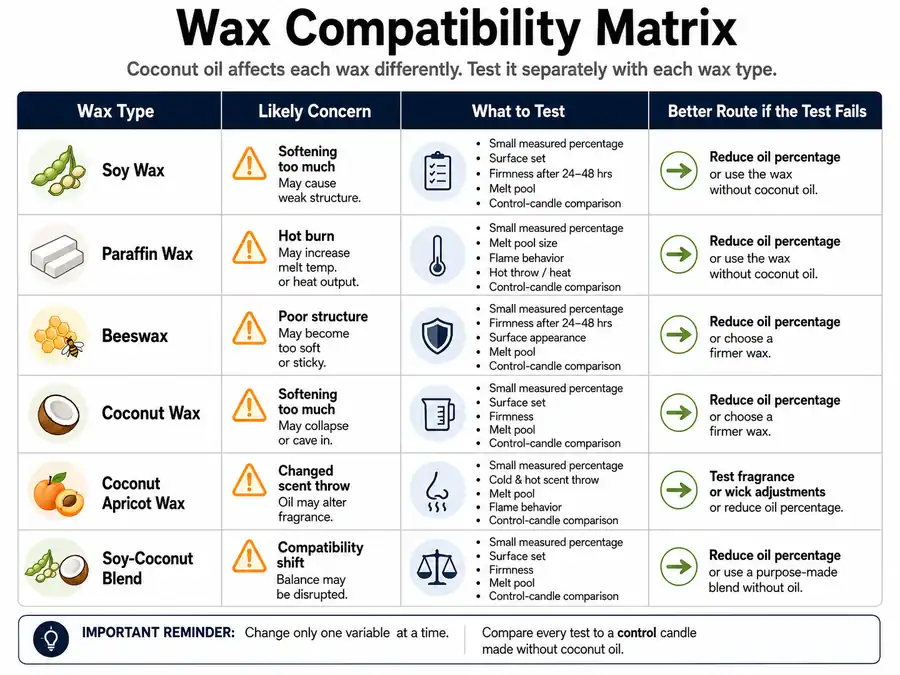
Which Candle Waxes Can You Test with Coconut Oil?
Coconut oil compatibility depends on the candle wax type and must be proven with wax-specific testing.
Candle wax types are base materials such as soy, paraffin, beeswax, coconut wax, and blends. Each base can respond differently when coconut oil changes set, scent behavior, wick fit, and burn performance.
“Compatible” means the tested candle sets cleanly, stays dry to the touch, burns steadily, and performs acceptably after cure. It does not mean coconut oil works the same way in every wax family.
| Candle wax type | Likely concern when adding coconut oil | What to test | Better route if the test fails |
|---|---|---|---|
| Soy wax | Softer set, frosting, weak burn, scent shift | Surface feel, melt pool, flame stability, hot throw | Soy wax guide or wax additive guide |
| Paraffin wax | Formula balance, scent behavior, wick change | Melt pool size, soot risk, jar temperature, scent | Paraffin wax guide |
| Beeswax | Structure change, scent masking, wick mismatch | Firmness, flame strength, burn rate, scent clarity | Beeswax guide or harder blend |
| Coconut wax | Redundant formula change or excess softness | Whether added oil improves anything beyond the base wax | Coconut wax guide |
| Coconut apricot wax | Premium blend balance may be disrupted | Surface, set, wick fit, scent throw | Coconut apricot wax guide |
| Soy-coconut blends | Unknown softness and scent shift | Compare against the unmodified blend | Wax blending guide |
Coconut wax may be the better route when the real goal is a coconut-based candle. Adding coconut oil to another wax changes an existing formula, while coconut wax is a base-wax choice with its own melt and burn behavior.
Do not rank every wax from best to worst here. The better decision rule is narrower: test coconut oil only in the wax you plan to use, then judge set quality, surface stability, scent behavior, and burn-test result before scaling.
Method note: Use a small compatibility set with the same jar, wick family, fragrance oil, cure time, and coconut oil percentage across at least three wax samples when comparing wax families. Treat the matrix as a test plan, not proof that one wax will always work.
Better Alternatives When Coconut Oil Is Not the Right Additive
Use a candle wax, wax blend, or candle additive when coconut oil makes the formula too soft, oily, or hard to repeat.
Coconut oil is only one possible adjustment inside candle wax types. If the goal is structure, smoother finish, stronger scent behavior, or a more stable base wax, another material may solve the problem with less uncertainty.
| Goal | Better alternative | Why it may work better |
|---|---|---|
| Coconut-based candle | Coconut wax | It is a base wax choice, not a loose oil added to another wax |
| Creamy container wax | Soy-coconut blend | The blend is built as a wax system |
| Firmer candle body | Harder wax or beeswax | It supports structure instead of softening it |
| Stronger molded candle | Pillar wax | It is designed for freestanding shape |
| More predictable additive use | Candle wax additive | It is chosen for a defined candle-making purpose |
| Better scent results | Fragrance-load adjustment | Scent problems usually need fragrance testing, not coconut oil |
The main comparison is control versus predictability. Coconut oil may be useful for a narrow test, but a prepared wax blend is usually easier to repeat because the base material has already been designed for candle use.
Use the wax additives guide when the decision is about firmness, opacity, smoothness, or burn adjustment. Use the coconut wax guide when the real goal is a coconut-based candle rather than an oil addition.
A failed coconut-oil test does not mean the whole candle formula is wrong. It may mean the formula needs a different wax family, a harder blend, a lower fragrance load, or a controlled wick test.
Method note: Choose the alternative by the failed attribute. Greasy tops point to less oil; weak structure points to harder wax; poor scent points to fragrance testing; unstable burn points to formula and wick testing.
Container Candles Are More Forgiving Than Pillar Candles
Container candles usually tolerate coconut oil better than pillar candles because the jar supports the softened wax.
Candle format means the physical form of the finished candle, such as jar, tin, pillar, mold, tart, or wax melt. Coconut oil affects each format differently because softness is less risky when a container holds the wax.
A jar candle can survive slight softness if it sets cleanly, stays dry, and burns with a controlled melt pool. A pillar candle has to stand on its own, so extra oil can cause dents, slumping, poor release, or edge collapse.
| Candle format | Coconut oil risk | Safer decision |
|---|---|---|
| Jar candle | Moderate softness risk | Test only in small weighed batches |
| Tin candle | Moderate softness risk | Check heat, surface, and melt pool carefully |
| Pillar candle | High structure risk | Avoid unless the wax is proven firm after testing |
| Molded candle | High release and shape risk | Use pillar wax or a harder blend |
| Wax melt | Texture and handling risk | Test set, release, and storage stability |
| Tart or clam shell | Softness and residue risk | Reduce oil or choose a blend made for melts |
The format changes the pass/fail standard. A container candle can pass if the wax stays stable inside the jar. A freestanding candle can fail even when it burns acceptably, because the body must remain firm before and during use.
Use the container wax selection guide when the main decision is choosing a jar candle base. Use the pillar wax guide when the candle needs structure without glass support.
Method note: Test the same formula in its final format. A coconut-oil blend that works in a small jar should not be assumed safe for a pillar, mold, tart, or wax melt.
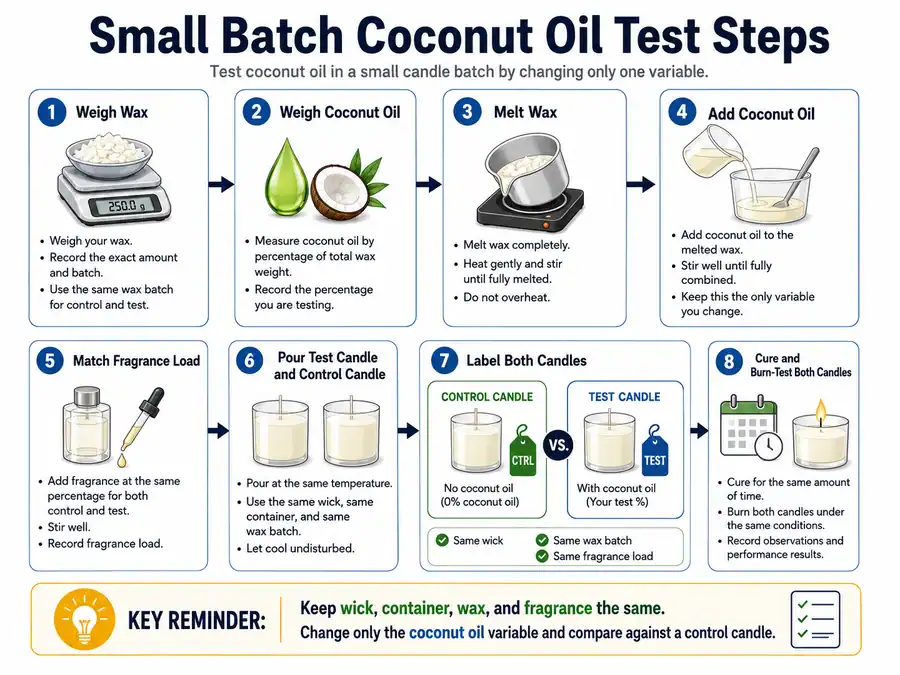
How to Test Coconut Oil in a Small Candle Batch
Test coconut oil in a small candle batch by weighing every ingredient, changing one variable, and comparing it with a control candle.
A small test batch is a controlled sample made before scaling a candle wax formula. Across candle wax types, the goal is to learn whether coconut oil improves the candle without creating softness, oily residue, scent issues, or burn problems.
- Weigh the wax and record the exact amount.
- Weigh a very small amount of coconut oil as a separate additive.
- Melt the wax according to the wax supplier’s handling range.
- Add coconut oil only after the wax is fully melted and ready for the test variable.
- Add fragrance oil only if the control candle uses the same fragrance load.
- Pour one test candle and one control candle in the same container type.
- Label both candles with wax, coconut oil amount, wick, fragrance, pour date, and cure date.
- Burn-test both candles after the same cure window.
| Test control | Why it matters |
|---|---|
| Same wax | Keeps the base material unchanged |
| Same jar | Keeps heat and diameter comparable |
| Same wick | Shows whether coconut oil changed fuel behavior |
| Same fragrance oil | Prevents scent materials from confusing the result |
| Same cure time | Makes set and burn results fair |
| Same burn schedule | Makes melt-pool and flame notes comparable |
Do not test coconut oil by adding it to a full production batch. If the test candle becomes greasy, too soft, weak-burning, or unstable, the small batch limits the loss and gives you a clear next adjustment.
Use the candle burn test checklist when the sample is ready to light. Use the wax blending guide only when the real task is building a larger wax blend rather than testing coconut oil as one additive.
Method note: Keep one change per test. If you change coconut oil amount, wick size, fragrance load, and container at the same time, the result cannot tell you which variable caused the change.
Let the Test Candle Set and Cure Before Judging It
Let a coconut-oil test candle set and cure before judging softness, surface finish, scent, or burn performance.
Set time is the period when melted wax becomes solid. Cure time is the waiting period that lets the wax, fragrance, and additives stabilize before burn testing. Coconut oil can change both because it alters the wax formula.
A candle that looks smooth after pouring may still become oily, soft, sunken, or weak-burning later. A candle that looks slightly uneven at first may settle into an acceptable result after the normal cure window for that wax.
| When you check | What to observe | What it can reveal |
|---|---|---|
| After cooling | Top texture, sinkholes, jar adhesion | Early surface and set behavior |
| After full set | Firmness, oily feel, sidewall changes | Whether the wax body is stable |
| After cure | Cold throw, surface dryness, texture | Whether the formula remains consistent |
| First burn | Flame, melt pool, scent, jar heat | Whether the candle performs under heat |
| Later burns | Residue, tunneling, soot, wick behavior | Whether the formula stays reliable |
Do not judge the formula from the fresh pour alone. Coconut oil may make a candle look smoother before the full set, then show oily tops, weak structure, or an oversized melt pool after curing and burning.
Use the candle cure time guide when the main question is how long a wax should rest before testing. For this coconut-oil test, the important rule is equal timing: the control candle and test candle must be judged after the same set and cure period.
Method note: Record observations at the same time points for every sample. The fairest comparison is control versus coconut-oil test after equal cooling, equal cure time, and equal burn sessions.
Record the Formula Before You Scale the Batch
Record the coconut oil formula before scaling so a passing test can be repeated and a failed test can be corrected.
Formula control means tracking ingredient weights, wax type, wick, container, fragrance, pour conditions, cure time, and burn notes. Coconut oil should be logged as its own additive across candle wax types, not folded into wax weight or fragrance load.
A test candle that performs well is only useful if the formula can be repeated. A failed candle is only useful if the record shows what changed. Without notes, coconut oil becomes a guess instead of a controlled candle-making variable.
| Record field | What to write down | Why it matters |
|---|---|---|
| Wax type and weight | Base wax name and total wax weight | Shows what the coconut oil was added to |
| Coconut oil weight | Exact weighed amount | Makes the additive level repeatable |
| Fragrance oil | Name and weight | Separates scent behavior from oil behavior |
| Wick | Series and size | Tracks burn changes after the formula shift |
| Container | Diameter, material, and fill weight | Affects melt pool and heat |
| Pour notes | Heat, room conditions, and surface result | Explains finish or adhesion changes |
| Cure window | Test date and burn date | Keeps comparisons fair |
| Burn notes | Flame, melt pool, scent, soot, jar heat | Decides whether the formula passes |
Do not scale a coconut-oil test because the first candle looks smooth. Scale only after the candle sets cleanly, cures without oily residue, and burns better than or equal to the control candle.
Use a candle testing log when you plan to compare several versions. Use a wax calculator only to weigh and scale a formula that already passed testing.
Method note: Change one variable per test round. If the next test changes coconut oil amount and wick size, the record should show why the wick change was made.
Safety Notes Before Heating Coconut Oil with Candle Wax
Heat coconut oil with candle wax only in a controlled small test, with supplier guidance, careful temperature tracking, and burn testing.
Use supplier documents and finished-candle burn behavior as the safety basis; ingredient familiarity alone is not a candle-safety test.
Safety Data Sheet (SDS) means a supplier document that lists handling, storage, and hazard information for a material. Candle makers should check SDS details for wax, fragrance oil, dyes if used, and any additive before heating or scaling a formula.
Coconut oil being edible or skin-safe does not prove it is safe or stable in a candle. Candle use adds heat, flame, fragrance materials, a wick, a container, and repeated burn cycles. That system needs candle-specific testing.
| Safety concern | What to do | What to avoid |
|---|---|---|
| Overheating | Track wax temperature with a thermometer | Heating by guesswork |
| Unknown supplier limits | Read wax, fragrance, and additive guidance | Assuming food-use labels apply |
| Flashpoint confusion | Treat fragrance flashpoint separately from wax handling | Using flashpoint as a full candle safety test |
| Formula instability | Test set, cure, and burn before scaling | Selling or gifting untested candles |
| Container heat | Check jar temperature during burn testing | Ignoring hot glass or tins |
| Open flame behavior | Stop testing if flame, soot, or heat looks unsafe | Trying to “fix” a risky burn while lit |
Use a double boiler or wax melter designed for candle making, keep water away from melted wax, and never leave heated wax unattended. If the test candle produces excessive heat, soot, unstable flame, oily residue, or container stress, the formula fails.
Use the candle safety guide when the main question is safe heating, pouring, labeling, or burn-test practice. For coconut oil specifically, the safety decision is narrower: do not scale the formula until the small test passes set, cure, surface, and burn checks.
Method note: Safety judgment comes from supplier guidance plus the finished candle’s behavior. A clean pour is not enough; the candle must remain stable during repeated burns.
Coconut Oil Does Not Automatically Make a Candle Non-Toxic
Adding coconut oil does not automatically make a candle non-toxic, natural, cleaner-burning, or safer.
Non-toxic candle claim means a marketing or safety statement about the finished candle, not just one ingredient. A candle is the full system: wax, coconut oil, fragrance, dye if used, wick, container, and burn behavior.
Coconut oil may sound familiar because it is used in food and skincare. That does not prove it belongs in every candle formula or that the finished candle is healthier to burn. Once the oil is heated with wax and burned through a wick, the decision must be based on candle performance, supplier guidance, and safe wording.
| Claim | Safer wording | Why |
|---|---|---|
| “Non-toxic candle” | “Made with a tested wax formula” | The finished candle needs evidence, not ingredient assumptions |
| “Cleaner because it has coconut oil” | “Contains coconut oil as a tested additive” | Coconut oil does not prove a cleaner burn |
| “Natural candle” | “Made with selected candle ingredients” | Natural can be vague and may overstate the formula |
| “Safe for everyone” | Avoid the claim | Candle safety depends on use, flame, fragrance, and container behavior |
| “Healthier candle” | Avoid the claim | Health claims need evidence outside a candle formula test |
A passing coconut-oil test can show that a candle sets, cures, and burns acceptably. It does not prove broad health, air-quality, or safety claims. If a candle maker wants safer language, the claim should stay tied to verifiable facts: ingredient list, tested formula, wick type, use instructions, and burn results.
Use the natural candle wax guide when the decision is about wax-source language. Use the candle safety guide when the question is safe burning, warnings, or use conditions.
Method note: Treat claim language as a separate check from formula testing. A candle can pass a burn test and still need conservative wording on “natural,” “clean,” or “non-toxic” claims.
Formulated Wax Candle vs Emergency Oil-Fuel Use
A formulated wax candle is different from an emergency oil-fuel candle or open-flame oil setup.
Formulated wax candle means a tested wax, wick, container, and fragrance system made to set and burn as a candle. Emergency oil-fuel use treats oil as the main fuel, which is outside this candle-wax formula decision.
This guide is about adding coconut oil to candle wax as a measured additive. It is not a guide to filling a jar with coconut oil, making survival lamps, or improvising open-flame fuel sources.
| Use case | What coconut oil is doing | This guide’s answer |
|---|---|---|
| Candle wax formula test | Additive inside a wax system | In scope |
| Coconut wax candle | Base wax decision | Use the coconut wax guide |
| Emergency oil candle | Main fuel source | Out of scope |
| Open-flame oil lamp | Liquid or semi-solid fuel source | Out of scope |
| Decorative surface oil | Surface decoration or residue | Avoid in candle-wax testing |
| Scent carrier substitute | Fragrance workaround | Do not treat as fragrance oil |
The distinction matters because a wax candle is judged by set, cure, melt pool, wick behavior, container heat, scent, and repeated burn performance. Emergency oil-fuel use has a different risk profile and should not be blended into wax-formula advice.
If the goal is a stable candle, stay with candle wax types, tested wicks, suitable containers, and supplier guidance. If the goal is emergency lighting, use a separate safety resource instead of adapting a candle-wax formula.
Method note: Keep the fuel role clear in your notes. Coconut oil as a small wax additive and coconut oil as the main burn fuel are different tests with different safety concerns.
Final Decision: Should You Add Coconut Oil to Candle Wax?
Add coconut oil to candle wax only when you can test it as a measured additive and reject the batch if performance gets worse.
The safer answer is conditional: coconut oil can be tested in small amounts, mainly for container candles, but it should not be treated as a universal candle wax upgrade. It can soften the wax, change scent behavior, affect wick fit, and make the candle harder to repeat.
| Your situation | Decision | Why |
|---|---|---|
| You want to test a softer jar candle | Test a very small measured amount | The container supports the wax while you check burn behavior |
| You want a firm pillar candle | Avoid coconut oil | Added oil can weaken structure |
| You meant coconut wax | Buy coconut wax instead | Coconut wax is a base wax, not plain coconut oil |
| You want stronger scent | Work on fragrance load and cure testing | Coconut oil is not fragrance oil |
| Your candle is already oily or too soft | Do not add coconut oil | It can make the problem worse |
| You cannot burn-test the candle | Do not use the additive | The finished candle must prove it works |
| You need a repeatable formula | Record every weight and test result | A passing candle must be repeatable before scaling |
The best use case is a controlled experiment: same wax, same jar, same wick, same fragrance, same cure time, and one small coconut-oil change. The worst use case is adding coconut oil by eye to a full batch and hoping it improves the candle.
If you want a coconut-based candle, start with coconut wax or a tested coconut blend. If you want a formula adjustment, compare coconut oil with harder waxes, candle wax additives, wick changes, and fragrance-load corrections before scaling.
Method note: Treat the control candle as the decision maker. Add coconut oil only if the test candle sets cleanly, stays dry, burns steadily, and performs better than or equal to the unmodified formula.
FAQ
Can you mix coconut oil with soy wax?
Yes, you can test coconut oil with soy wax, but it may soften the set, change frosting, affect scent throw, or require wick retesting.
Soy wax can already be soft, so coconut oil should be added only in a small weighed test. Compare the soy candle with a control before deciding whether the additive helped.
Does coconut oil make candles burn longer?
Coconut oil does not automatically make candles burn longer.
It can change melt speed, fuel flow, and wick behavior. A longer burn only matters if the flame stays stable, the melt pool stays controlled, and the candle performs safely through repeated burns.
Can coconut oil replace fragrance oil in candles?
No, coconut oil should not replace fragrance oil in candles.
Coconut oil is an additive oil, while fragrance oil is the scent ingredient. If the goal is stronger scent, adjust fragrance choice, fragrance load, cure time, and wax compatibility instead.
Will coconut oil make candle wax smoother?
Coconut oil may make some candle wax formulas look or feel smoother, but that result must be checked after cure and burn testing.
A smooth top can still fail if the candle becomes greasy, too soft, weak-burning, or unstable in the melt pool.
Is coconut oil better than coconut wax?
No, coconut oil and coconut wax serve different roles.
Coconut oil is a formula additive. Coconut wax is a base wax or base-wax blend. If the goal is a coconut-based candle, coconut wax is usually the cleaner starting point.
Can you use unrefined coconut oil in candles?
You can test unrefined coconut oil, but it may add natural coconut odor and make scent results harder to judge.
Refined coconut oil is usually easier to test because it brings less odor into the wax-fragrance system. Either type still needs set, cure, and burn checks.
Why did my candle turn oily after adding coconut oil?
An oily candle usually means the wax formula could not hold the added coconut oil well.
Reduce or remove the coconut oil in the next test. Check the wax type, fragrance load, cure time, and wick before changing more than one variable.
Should beginners add coconut oil to candle wax?
Beginners should avoid coconut oil in full batches and test it only after they can make a stable control candle.
A plain wax formula teaches set, scent, wick, and burn behavior first. Coconut oil should come later as one measured test variable.