Most candle wicks used today are safe, and the main risks usually come from soot, overheating, poor sizing, or poor burn care.
Many people still worry about lead, black smoke, or a wick that looks metallic. The better test is not fear but what the candle does while burning, how hot it gets, and whether the flame stays steady. That helps separate an old myth from a real safety problem. It gives you a simple way to judge labels, soot, flame height, and the point where a candle should be put out for good.
Are Candle Wicks Safe Today?
Modern candle wicks are generally safe today, and most real risk comes from soot, overheating, or poor wick fit rather than hidden lead.
In the United States, lead-core wicks are not allowed in candles sold for consumers, so a metallic-looking wick is not the same thing as a lead wick. For the bigger picture on fit and material, start with Wick Types and Sizing, then check the label, the seller, and the way the candle behaves once it is lit.
| Claim | Current reality | What to verify next |
|---|---|---|
| “Any metal in a wick means lead.” | A metal-looking wick can be a modern non-lead core used for stiffness. | Look for clear labeling and a known seller. |
| “Lead wicks are still common in modern candles.” | Current consumer guidance treats lead-core wicks as an old problem, not a normal current feature. | Treat unlabeled or low-trust candles with more caution. |
| “Cotton is always safer than wood or metal-core.” | Cotton, wood, and modern metal-core wicks behave differently. None is automatically best in every candle. | Watch flame steadiness, soot, and heat in actual use. |
| “If the wick looks strange, the candle is toxic.” | Appearance alone does not prove danger. Burn behavior matters more. | Check for smoke, flare-ups, and excessive jar heat. |
People still believe the lead myth because older warnings stayed in search results long after product rules changed. That is why Wick Types and Sizing matters first. It gives you a baseline for what a wick should look like before you jump to the worst conclusion.
A lead-core wick uses lead metal in the core. A metal-core wick uses a non-lead metal core to help the wick stay upright in certain candle designs. Cotton wicks usually give a familiar steady burn when the size matches the jar and wax. Wood wicks can crackle and can be sensitive to wax blend, jar width, and trim. Modern metal-core wicks are not the same thing as old lead-core wicks, so appearance alone is a poor safety test.
A quick look at What Are the Different Types of Candle Wicks? can help you separate material type from burn problem. Then Cotton vs Wooden Wicks: Which Burns Better? helps when the question is behavior, not fear. If the flame is too strong, too smoky, or too weak for the vessel, How to Size Your Candle Wick Correctly is often the better next step than blaming the material.
Before you buy or keep burning an unfamiliar candle, check three things. Look for plain product details instead of vague “lead-free” claims with no other information. Check whether the wick looks centered and the wax surface is clean. Then light the candle and watch for black smoke, repeated flare-ups, or a jar that gets too hot too fast. If a wick looks metallic or unlabeled, do not assume it is toxic. Treat it as a reason to verify the source and then judge the candle by label quality and burn behavior.
What Actually Causes Candle Soot
Candle soot usually comes from incomplete combustion caused by wick length, drafts, carbon buildup, or formula mismatch, not from lead in the wick.
The National Candle Association points people first to basic burn care, and that starts with trimming the wick to about 1/4 inch before lighting. That is why black jar marks often begin with a long wick, a disturbed flame, or a buildup at the tip, then get worse when wax, fragrance, dye, and jar shape all add stress to the burn. If soot shows up with a fast-growing flame or a jar that turns very hot, treat it as a heat warning, not just a cosmetic mark.
| Symptom | Likely cause | First correction | Stop and reassess when |
|---|---|---|---|
| Black marks near the rim | Wick too long | Trim before the next burn | Soot returns right away |
| Visible smoke during a steady burn | Draft exposure | Move the candle away from airflow | Smoke continues in a still room |
| Large black cap on the wick tip | Mushrooming | Cool, trim, and clear debris | The cap returns fast and the flame stays wild |
| Soot appears after long sessions | Overlong burn time or heat buildup | Shorten the next burn session | The jar stays very hot or the flame grows taller |
| Smoke plus strong fragrance and dark dye | Formula stress | Test in shorter sessions and compare with a simpler candle | One change does not calm the burn |
| Soot plus fast melt pool growth | Wick size or full-system mismatch | Check trim, drafts, and jar fit before changing families | The candle still runs hot after basic fixes |
Incomplete combustion means the flame is not burning the wax fuel cleanly. In plain terms, the flame is getting too much fuel, too little stable air, or both. That is why soot is often a burn-condition problem, not proof of a toxic wick.
Mushrooming is a carbon cap that forms on the wick tip during burning. A small cap that does not change the flame is less serious than a large cap that makes the flame taller, smokier, or less steady. Routine care helps here: let the candle cool fully, inspect wick length, remove a heavy carbon cap, clear loose debris from the melt pool, and only then relight. If you keep seeing the same issue, Fixing Wick Issues: Mushrooming, Drowning & More is the better follow-up than guessing from one burn.
Do not diagnose from one symptom alone. A long wick can soot. A draft can soot. Heavy fragrance, dark dye, a wide jar, or a heat-holding vessel can all make the flame look worse than the wick alone would suggest. That is why Wick Types and Sizing still matters in a soot section. It keeps the diagnosis tied to the whole candle, not just the tip of the wick.
A quick routine from How to Pre-Tab, Prime & Trim Candle Wicks can reduce easy soot causes before you change anything larger. If the candle still leaves residue after trim and draft checks, the issue may be size, fuel load, or jar fit rather than basic care. In that case, Wick Size Estimator (Starting-Point Tool) gives you a better starting point for the next test than swapping at random.
The safest order is simple. Trim first. Remove debris. Burn in a still room. Watch whether the flame stays stable. Then ask whether wax, fragrance, dye, or jar shape is pushing the candle harder than the wick can handle cleanly. If the answer is still unclear after one careful pass, move to Burn-Test Log: Check Flame, Heat, and Soot and compare one variable at a time instead of guessing.
High Flame and Overheating: Warning Signs
A wick is acting unsafely when the flame keeps climbing, the jar gets unusually hot, or the candle smokes and flares after basic care.
One strong flame by itself is not the full test. The real warning is a pattern: more heat, more smoke, less control, and a candle that gets harder to calm with a trim or a move away from drafts.
| Warning sign | What it usually points to | What to do next |
|---|---|---|
| The flame stretches taller as the burn continues | Too much fuel is reaching the flame, or the wick is oversized for the system | Extinguish the candle, let it cool, trim the wick, and test again only after the wax surface is clean |
| The jar becomes very hot during a normal session | Heat is building too fast for the vessel, wick, or formula | Stop burning and treat the candle as a heat problem until a controlled retest says otherwise |
| The candle flares up again after a fresh trim | The issue is larger than basic care and may involve wick size, fragrance load, or jar fit | Do not keep pushing longer burns; move to a controlled burn test instead |
| The melt pool spreads fast while the wick leans or throws smoke | The system is running hot and unstable | Extinguish, cool, and review wick size before the next session |
Stop burning now if the flame keeps rising after a trim, the candle gives repeated flare-ups, or the jar feels too hot to handle with comfort. Those signs matter more than whether the wick is cotton, wood, or metal-core, because they show the candle is no longer burning in a stable way.
If those warnings appear more than once, do not keep stretching the same candle session to see what happens. Move to How to Conduct a Candle Burn Test for Fire Risk and compare one change at a time before you burn it again for normal use.
Overwicked vs Underwicked: Diagnose the Mismatch
An overwicked candle burns too hot and too fast, while an underwicked candle struggles to keep a steady melt pool.
Both problems can make a candle feel wrong, but they do not fail in the same way. One pushes excess heat and smoke. The other starves the melt pool, tunnels, or drowns under its own wax.
| Check point | Overwicked signs | Underwicked signs | Better next move |
|---|---|---|---|
| Flame behavior | Tall, active, smoky, or hard to calm | Small, weak, or easy to drown | Record the flame pattern before changing materials |
| Melt pool behavior | Fast spread and strong heat | Narrow pool, tunneling, or wax left behind at the edge | Compare the wick against jar width and wax type |
| Jar temperature | Runs hot early or keeps getting hotter | Stays cooler but fails to melt evenly | Judge heat and melt together, not as separate clues |
| Common outcome | Soot, flare-ups, fast fuel use, mushrooming | Tunneling, weak throw, drowning, uneven wax | Match the correction to the failure, not to the wick label alone |
If the candle runs hot, throws soot, and opens a wide melt pool fast, think overwicked first. If the flame stays weak, the melt pool stays narrow, or the wick keeps sinking under wax, think underwicked first.
That diagnosis should lead to the next right page, not a random swap. Use How to Size Your Candle Wick Correctly when the problem looks like fit, and use Fixing Wick Issues: Mushrooming, Drowning & More when the symptom is already visible in the burn.
Burn-Test Log: Check Flame, Heat, and Soot
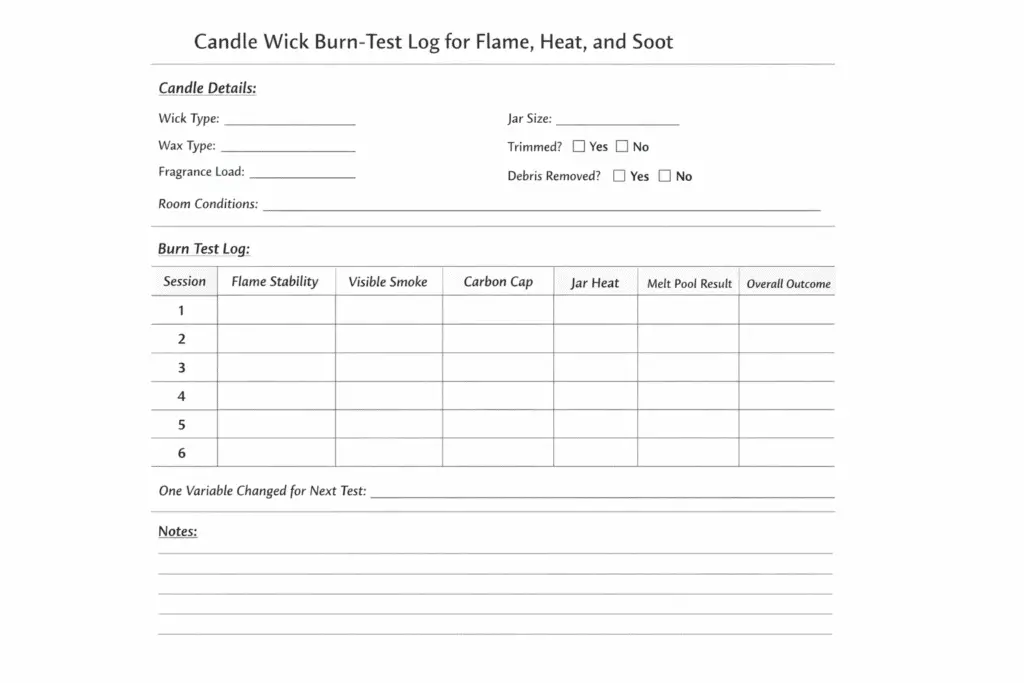
A burn-test log helps you judge wick safety by changing one variable at a time and recording flame, heat, soot, and carbon buildup.
This is the cleanest way to separate a wick problem from a wax, fragrance, dye, jar, or draft problem. It turns guesswork into a repeatable check you can compare across burn sessions.
This process works best when each test keeps the candle setup steady except for one change.
- Start with a trimmed wick, a clean melt pool, and a still room.
- Write down the candle details before lighting: wick type, wax, fragrance load, jar, and any recent trim or debris removal.
- During the burn, note whether the flame stays steady, whether smoke appears, whether a carbon cap forms, and whether the jar feels unusually hot.
- After the session, record what the melt pool looked like and whether the candle acted overwicked, underwicked, or stable.
- Change only one variable for the next test, then compare the new session against the last one.
If you need a full worksheet and a longer safety process, use How to Conduct a Candle Burn Test for Fire Risk. If the log keeps pointing back to size rather than care, return to Wick Size Estimator (Starting-Point Tool) before you start switching wick families again.
Quick FAQ
Can a metal-looking wick still be safe? Yes. A metal-looking wick can be a modern non-lead core, so burn behavior and seller quality matter more than appearance alone.
Does black smoke mean the wick has lead? No. Black smoke points more often to soot from burn conditions such as a long wick, drafts, carbon buildup, or a hot-running candle.
Should you keep burning a candle that gets very hot? No. Extinguish it, let it cool, and treat the heat as a warning until a controlled retest shows the candle can burn in a stable way.
Is trimming always enough to fix soot? No. Trimming is the first check, but soot can still come from draft exposure, formula stress, wick size, or jar fit.
When do you need a burn-test log? Use one when the same candle keeps sooting, running hot, or behaving strangely after trim, debris, and draft checks.