

Supplier guidance varies by wax and recipe, but soy candles usually need 7 to 14 days of cure time before the first burn, though some blends can be tested a bit sooner.
Among common candle wax types , fresh soy candles can look ready long before they give a fair scent or burn read. Most people get the best first burn after waiting about one to two weeks, while some blends are usable sooner. The right window depends on the wax blend, fragrance load, jar size, and storage conditions. A little patience helps you judge throw, melt pool, and wick behavior without false negatives.
How long soy candles should cure before first burn
Most soy candles are best tested after 7 to 14 days of curing, though lighter blends may be usable sooner. For the main guide, see candle making .
A candle that feels hard after 24 to 48 hours may be physically set, but that does not always mean it is ready for a trustworthy scent or burn test.
| First-burn goal | Typical wait | What the result usually tells you |
| Quick check | 2 to 5 days | You can spot obvious flaws, but scent and burn results may still be misleading. |
| Fair test | 7 to 10 days | You get a more useful read on scent strength and initial melt behavior. |
| Best read | 10 to 14+ days | You are more likely to judge pure soy, heavier fragrance loads, and larger jars fairly. |
These are practical planning bands, not lab certainties. The right target depends on the wax, the jar, and what you are trying to learn from the first burn.
If your candle is a soy blend, 7 days can be enough for a reasonable test. If it is pure soy, highly fragranced, or poured into a larger vessel, 10 to 14 days is often the safer call. In other words, “ready to light” and “ready to judge” are not always the same thing.
Why curing matters before you test or burn
Curing matters because soy can look finished before it gives a fair scent or burn result.
Hot throw is how strongly a candle smells while it is burning. With soy, an early burn can make the scent seem weaker than it will be later. It can also make wick or melt behavior look worse than it really is. That is why curing is mainly about test reliability, not just waiting for a stronger smell.
| What you see | What it means |
| Wax is solid | The candle has set enough to handle. |
| Wax is cured | The candle is more ready for a fair scent and burn evaluation. |
A simple way to think about it is this: hardening tells you the candle can exist as a candle, while curing helps tell you whether the candle can be judged as a candle. Burning too soon can create a false negative, especially when the first session is short or the recipe already sits near the edge of its ideal wick and fragrance balance.
What changes soy candle cure time
Wax blend, fragrance load, jar size, and storage consistency are the main factors that make soy candle cure time shorter or longer.
A single cure number does not fit every soy candle. Fragrance load is the percentage of fragrance oil in the wax, and a soy blend is soy mixed with another wax that can change how quickly a candle becomes test-ready.
| Variable | Usually shorter wait | Baseline wait | Usually longer wait | Why it shifts the result |
| Wax type | Soy blend | Balanced soy blend | Pure soy | Pure soy often benefits from more rest before a fair first burn. |
| Fragrance load | Moderate load | Average load | Heavy load near the wax limit | More oil can make the candle slower to judge reliably. |
| Jar size | Small jar | Medium jar | Large or wide jar | Bigger jars take longer to reveal fair melt and scent behavior. |
| Storage | Stable room conditions | Normal indoor setup | Heat swings, light, and dust | Inconsistent conditions can distort the first test. |
| Test goal | Quick usability read | Fair first burn | Best hot-throw read | The stricter your standard, the longer you usually wait. |
The strongest influence is usually the wax itself. Pure soy often wants more patience than a soy blend, and a heavier fragrance load can push you toward the upper end of the range instead of the lower end. Jar size matters too, because a larger container can make it harder to tell whether the candle is truly performing well or just not fully settled yet.
That does not mean every weak candle simply needs more time. Sometimes the formula is fine and only needs a longer rest. Other times the formula is overloaded, and cure time is not the real problem.
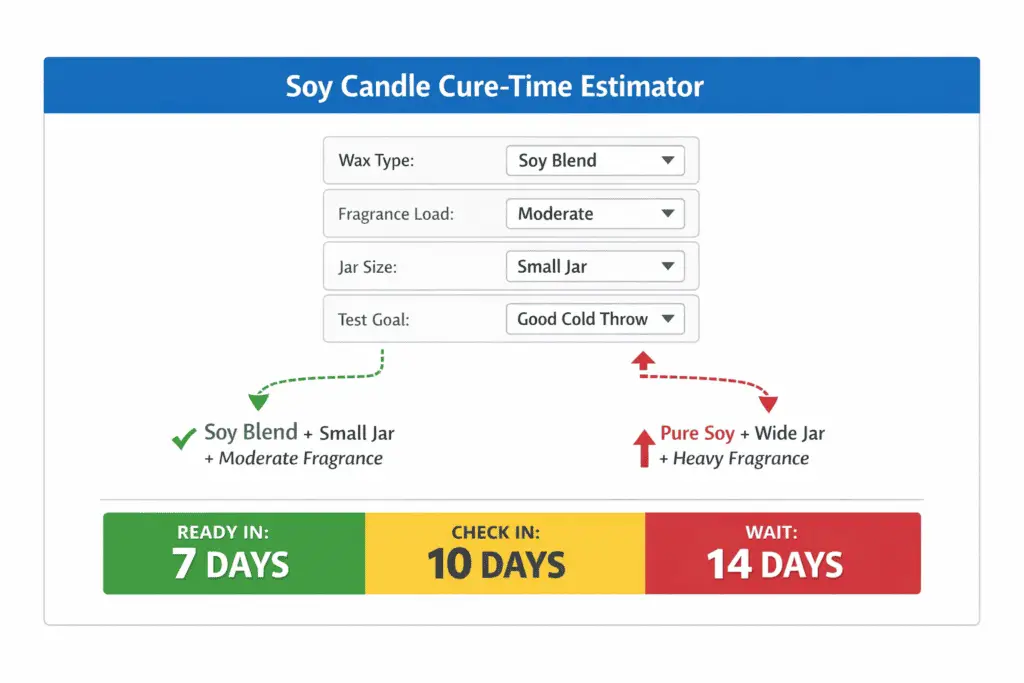
Soy Candle Cure-Time Estimator
Use wax type, fragrance load, jar size, and test goal to estimate whether a soy candle is closer to day 7, day 10, or day 14.
This estimator is meant to help you make a better first-burn decision, not predict performance down to the day.
| Input | Choose this | Adjust your wait |
| Wax type | Soy blend | Start at 7 days |
| Wax type | Pure soy | Start at 10 days |
| Fragrance load | Light to moderate | No change |
| Fragrance load | Heavy | Add 1 to 2 days |
| Jar size | Small jar | No change |
| Jar size | Medium jar | Add 1 day |
| Jar size | Large or wide jar | Add 2 days |
| Test goal | Quick check | You can test at the low end |
| Test goal | Best first-burn read | Stay near the high end |
A simple way to use it is to pick your wax row first, then stack only the adjustments that clearly apply. A pure soy candle in a wide jar with a heavier fragrance load often lands around 12 to 14 days. A soy blend in a smaller jar with a moderate load can be reasonably checked around day 7, though a longer wait may still give a cleaner scent read.
You do not need perfect math to make this useful. The estimator works best as a filter for obvious cases. If several factors lean longer, wait longer. If most factors lean lighter and smaller, a sooner test is more reasonable.
| Example batch | Likely window | Best use of that result |
| Soy blend, small jar, moderate fragrance | 7 to 8 days | Fair early check |
| Pure soy, medium jar, moderate fragrance | 10 to 12 days | Better first-burn read |
| Pure soy, wide jar, heavy fragrance | 12 to 14 days | Stronger chance of a fair scent and burn test |
Treat the output as directional, not absolute. If the candle still gives a flat scent, shallow melt progress, or a confusing burn after the estimated window, wait a bit longer once before assuming the recipe is wrong.
What happens if you burn a soy candle too early
Burning a soy candle too early can make scent feel weak, melt behavior look inconclusive, and wick performance seem worse than it really is.
An early burn often creates bad information more than real damage. The candle may smell faint, look underpowered, or seem like it has a wick problem when the bigger issue is that the wax was judged too soon.
| What you notice | What cure time might be doing | What to do next |
| Weak hot throw | The candle may still be too fresh for a fair scent read | Wait a few more days and retest once |
| Small or hesitant melt pool | Early testing can make performance look slower than it really is | Retest after more cure and use a full session |
| Wick looks too weak | You may be reading the wick before the candle is ready to judge | Give the batch more time before resizing |
| Candle still performs badly after a full wait | Cure time may no longer be the main issue | Move into wick or formula troubleshooting |
A too-short first burn can also leave a memory ring, which makes later sessions harder to judge. That does not always ruin the candle, but it can muddy the test because now you are dealing with two problems at once: an early read and a poor first session.
A good retest decision looks like this:
- Wait longer when the candle is only slightly disappointing and still fresh.
- Retest once with a full, controlled session before changing the formula.
- Escalate only when the candle still underperforms after a fair cure and burn.
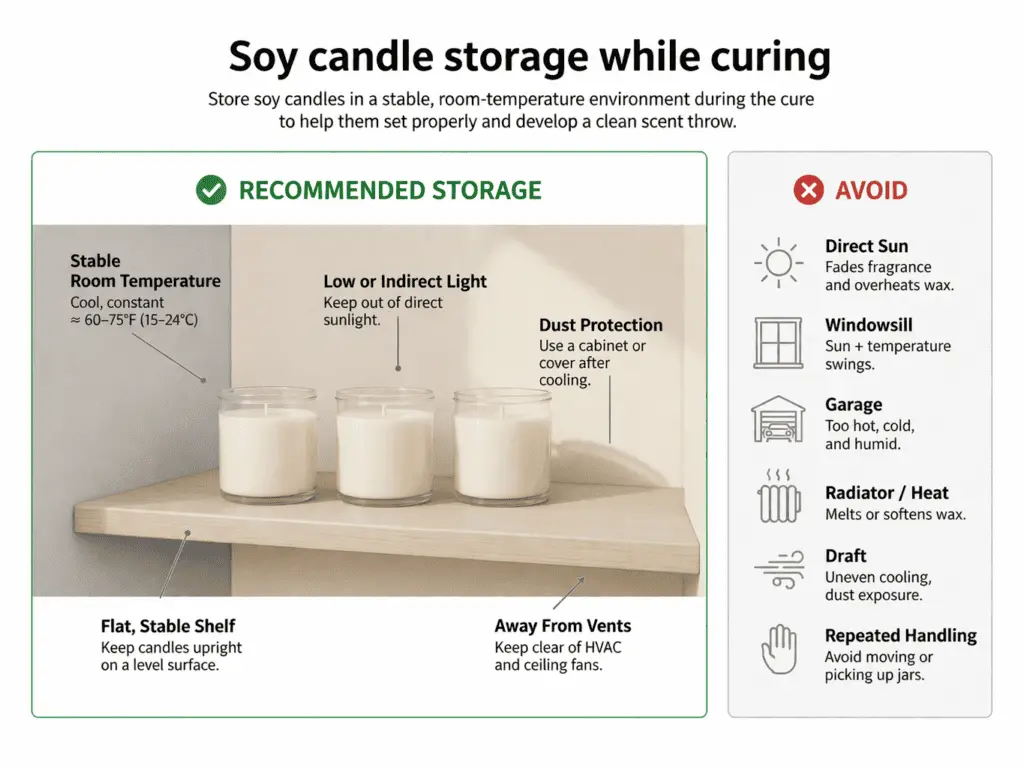
How to store soy candles while they cure
Store soy candles in a clean, stable room-temperature area with minimal light, heat swings, dust, and unnecessary handling.
Curing works best when the setup stays boring and consistent. Storage does not speed curing up, but it does protect the process from being distorted.
| Storage choice | Recommended | Acceptable | Avoid |
| Room conditions | Stable indoor room temperature | Slight normal daily variation | Hot or cold swings, windowsills, garages |
| Light | Low light or indirect light | Normal indoor light | Direct sun or harsh heat exposure |
| Surface exposure | Clean, dust-protected area | Short uncovered rest in a clean room | Open surfaces where dust can settle |
| Lid decision | Consistent lid approach once candle is cool | Brief uncovered setup, then cover | Repeated opening, moving, and rehandling |
| Placement | Flat shelf away from vents | Cupboard or stable workroom shelf | Near radiators, ovens, drafts, or cars |
Once the candle is fully cool, keep it on a flat shelf in a stable room and limit extra handling. A lid or clean cover can help with dust control, but consistency matters more than constantly opening, moving, or storing the candle near heat, drafts, or direct sun.
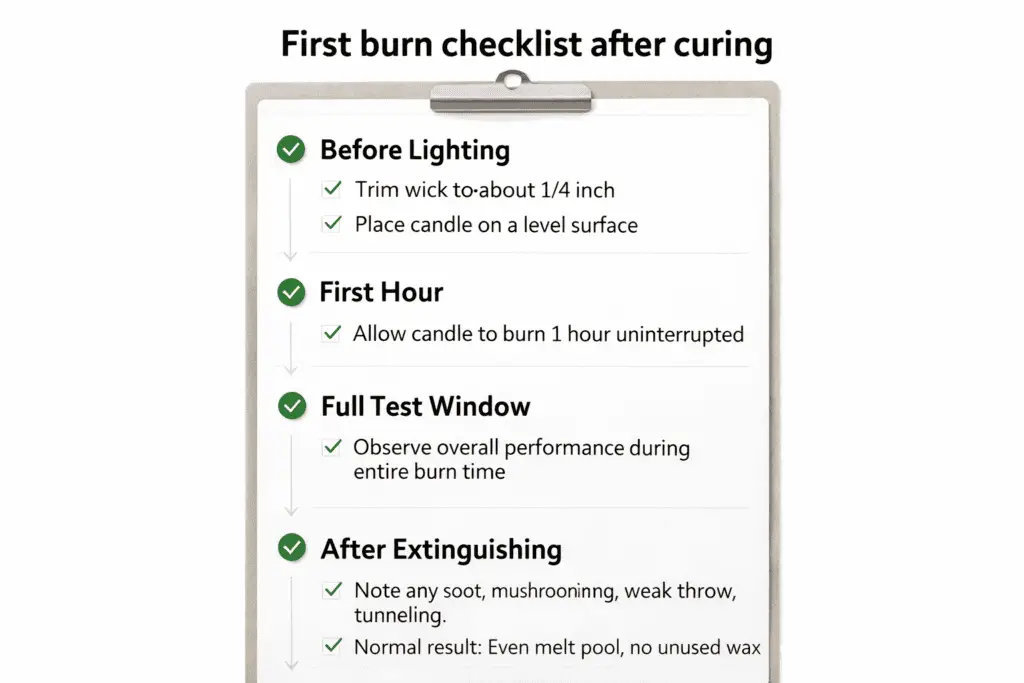
How to do the first burn after curing
After curing, trim the wick, run a controlled first burn, and judge performance only after a full, fair test session.
A trimmed wick gives you the cleanest place to start, especially when you want a readable first test instead of an oversized flame or noisy burn.
| Stage | What to do | What you are looking for |
| Before lighting | Trim wick to about 1/4 inch and place candle on a level surface | A clean start with a manageable flame |
| First hour | Let the candle burn without fussing over it | Steady flame and normal early melt development |
| Full test window | Burn long enough to judge progress fairly, usually a few hours depending on vessel size | Whether the melt pool is developing normally for that jar |
| After extinguishing | Let the wax reset and note what happened | Soot, mushrooming, weak throw, tunneling, or an otherwise normal result |
For a fair first read, start with a trimmed wick, give the candle enough uninterrupted burn time for the vessel size, and judge the result only after it cools. If scent seems flat or melt progress looks slow, retest once after a full session before changing the wick or formula.
FAQ
Can you burn a soy candle after 48 hours?
You can, but 48 hours is usually too soon for a fair read on scent throw and burn performance. Most soy candles are judged more reliably after about 7 to 14 days.
Do soy blends cure faster than pure soy?
Often, yes. Soy blends are commonly testable sooner, while pure soy often benefits from waiting longer before the first serious burn test.
Does curing affect hot throw?
Yes. A candle that is burned too soon can smell weaker than it will after a fuller cure, which is why early testing can create false negatives.
Should you keep the lid on while soy candles cure?
Once the candle is fully cool, a lid or clean cover can help protect it from dust. The bigger priority is steady storage away from heat, direct sun, and constant handling.