For most scented candles, expect 3–14 days of curing: about 7–14 days for soy and coconut blends, 3–5 days for paraffin, 3–7 days for para-soy, and 7–10 days for scented beeswax blends.
Waiting for a candle to cure can feel confusing because different guides quote different day counts. Cure time is the rest period that lets wax and fragrance settle so scent throw and burn results are more consistent. The right window depends on wax family, fragrance load, room conditions, and whether you use essential oils or fragrance oils. With a clear baseline by wax type and a simple testing routine, you can plan pours, test burns, and release dates without guessing or wasting materials.
How long should scented candles cure? (by wax type)
Most scented candles cure best somewhere between 3 and 14 days, with paraffin-based formulas usually ready sooner and soy- or coconut-rich blends often needing at least a week before final scent judgment.
These ranges work best when you read them alongside your wider candle fragrance and scenting plan and your chosen fragrance load.
| Wax type | First meaningful test-burn | Best-performance judgment | Use the longer end when… |
|---|---|---|---|
| Paraffin | 24–48 hours | 3–5 days | the fragrance is heavy or the container runs cool |
| Para-soy / parasoy | 2–3 days | 3–7 days | the soy content is high or the hot throw feels weak early |
| Soy / soy blends | 3–5 days | 7–14 days | the fragrance is complex, the load is high, or the room runs cool |
| Coconut / coconut-soy / apricot blends | 3–5 days | 7–14 days | the blend is soft, highly scented, or still improving after day 7 |
| Scented beeswax / beeswax blends | 3–5 days | 7–10 days | the candle is heavily scented or blended with slower natural waxes |
| Unscented beeswax | 24–48 hours | 1–3 days | full cool-down and hardness are still incomplete |
These day bands are working baselines drawn from common supplier guidance and maker testing practice, not a substitute for your wax maker’s instructions. Use the supplier’s minimum test age first, then keep your own batch notes so you judge each formula at a consistent cure age.
What curing means and why it matters
Curing is the rest period after pouring when wax finishes cooling, settling, and holding fragrance more evenly through the candle. It is different from simple hardening because a candle can look set on top before its scent performance has stabilized.
This matters because an early burn can give false signals. A candle that smells weak at 48 hours may smell normal a week later, especially in soy and coconut-rich blends. Longer rest periods affect scent throw and appearance most in natural-wax systems that keep changing after the surface looks firm.
How to use these cure ranges
- Use the early window to check flame, melt pool, and obvious defects.
- Use the later window to decide whether the fragrance is actually strong enough, balanced enough, and ready to sell or gift.
- Stay with the longer end of the range when the fragrance load is high, the scent is heavy, the room is cool, or the wax is soy- or coconut-rich.
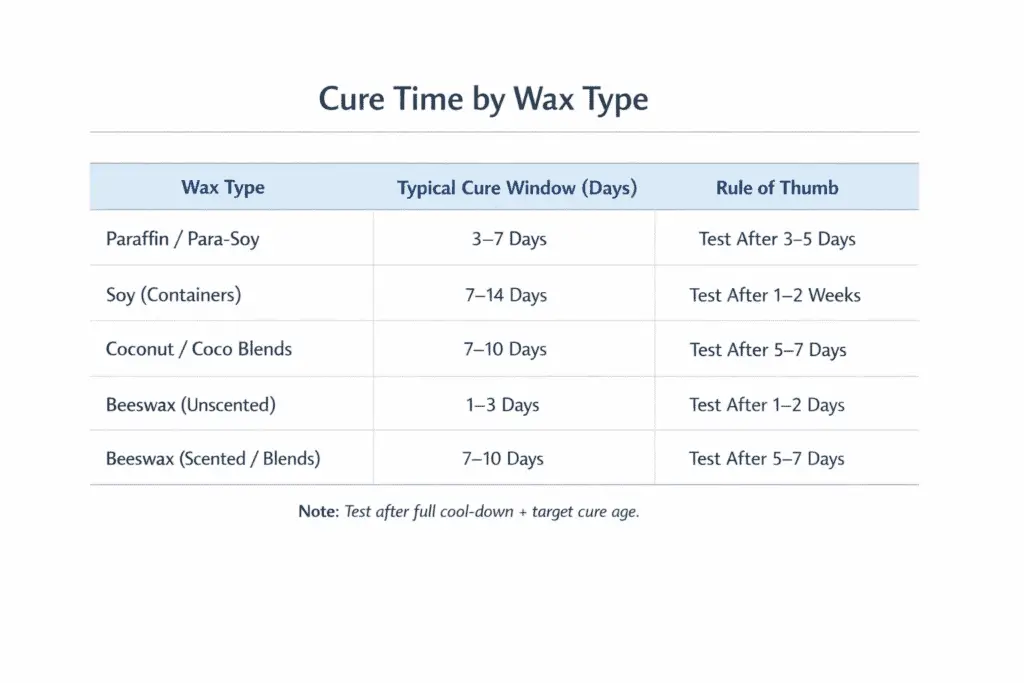
This candle curing times chart is useful as a quick shelf reference, but your production notes matter more than any generic band. A simple schedule keeps this manageable: test paraffin in days, test soy and coconut-rich blends in a week or two, and judge scented beeswax near the middle of that same natural-wax range. Your test burns then tell you whether a specific formula needs the short end or the long end of the band.
How long should soy candles cure? (+ common 464/444 ranges)
Most soy container candles reach their most reliable scent throw after 7–14 days of curing, even though you can often do an early wick check after 3–5 days.
Soy cures more slowly than paraffin because natural waxes keep changing for longer after the surface looks firm. That is why many makers separate soy into two checkpoints: an early burn to confirm behavior and a later burn to judge final throw.
A practical baseline is simple. Do not call a scented soy candle weak before day 7, and expect the fairest performance judgment closer to day 10–14. Manufacturer guidance for Golden Wax 464, for example, often notes that while you can technically burn after 24–48 hours, curing for up to two weeks gives noticeably stronger scent throw.
For Golden Wax 464, treat 24–48 hours as a minimum cool-and-check point and 7–14 days as the real scent window. That same soy-first testing logic often carries over to other soy container waxes, including GB 444: run early safety and wick checks first, then judge final hot throw only after the candle has had enough rest.
Treat cure time as a performance benchmark, not a compliance badge. The practical goal is to standardize when you test, compare, and release a batch so your wick and scent results stay consistent. A simple house rule works well here: wick-test at the supplier’s minimum age, then judge final throw only at your normal cure age for that wax. If the candle still underperforms at that point, use a targeted guide to fix weak scent throw rather than changing multiple variables at once.
How long do paraffin candles need to cure?
Most paraffin container candles are ready for a meaningful test-burn in 24–48 hours and are usually fair to judge for final scent performance in about 3–5 days.
Paraffin stabilizes faster than soy, coconut, and other natural-wax blends. Once the candle has cooled fully and hardened through the jar, the wax–fragrance bond usually settles quickly enough that extra waiting gives only modest gains.
A useful way to plan paraffin cure time is to separate “safe to test” from “ready to judge.” Most paraffin containers can be test-burned once they are completely cool, often after 24–48 hours, but many makers still wait 3–5 days before deciding whether the hot throw is truly finished.
Pure paraffin often performs well within a few days, while parasoy usually lands somewhere between paraffin and soy for final judgment. That keeps the framework consistent: early test-burn first, final scent judgment later.
As with any wax, the supplier’s datasheet still takes priority over a general rule of thumb. Keep notes on cure time, wick, fragrance load, and burn results so you can see whether your particular paraffin system actually needs more than those first few days of rest.
How long to cure coconut and coco-blend candles?
Most coconut and coco-blend container candles are often worth first testing after 3–5 days, but many makers find they give their fairest scent result after about 7–14 days.
Coconut-rich blends can hold a lot of fragrance, but many of them still improve noticeably after the first week. That makes them behave more like soy-heavy natural waxes than like fast-setting paraffin.
A practical workflow is to pour the batch, leave it undisturbed in steady room conditions, run an early burn around day 3–5 if you need a behavior check, then repeat your real evaluation at day 7–14. If the fragrance is still opening up after day 7, stay with the longer end of the range.
This matters most with richer fragrance loads and premium blends because weak early results can lead to unnecessary re-pours. A simple batch log with wax type, fragrance percentage, cure age, and burn notes will tell you whether your own coconut formulas settle by day 7 or need the full two weeks.
Do beeswax candles need to cure when scented?
Scented beeswax candles often benefit from an early test after 3–5 days and a more reliable scent judgment around 7–10 days, while unscented beeswax mostly just needs full cool-down and hardening.
Pure beeswax without added fragrance is mostly a cooling issue. Once it is fully cool and hard, regular burning can begin. Scented beeswax is different because the added fragrance needs time to settle into a wax that is naturally dense and slow to change.
For practical planning, keep the same two-step framework used elsewhere in this article. Use 24–48 hours for unscented beeswax to cool and harden, use 3–5 days for a first meaningful check on scented beeswax, and judge final throw closer to 7–10 days. If the candle is blended with soy or coconut and still improves after the first week, shift toward the longer end of the natural-wax range.
- 100% pure, unscented beeswax: cool fully and rest 24–48 hours before regular burning.
- Scented 100% beeswax with fragrance oils: use 3–5 days for an early test and about 7–10 days for a final scent judgment.
- Beeswax blends with soy, coconut, or other vegetable waxes: treat them like slower natural-wax systems and judge them toward the longer end if the first week still looks unfinished.
If you are selling beeswax candles, build that extra rest into your calendar. A batch that is burned too young can look weak for reasons that disappear once the cure is complete.
Best room conditions for curing candles (°C, %RH, airflow)
Stable normal room conditions matter more than chasing an exact number: cure candles in a steady indoor space away from direct sun, dampness, and strong drafts.
Rapid temperature swings, humid air, and direct airflow can all interfere with how the wax sets and how the finished candle looks. A simple rule works well: keep jars a few centimeters apart, out of sunlight, and on a stable surface in a room that stays consistently comfortable and dry. For deeper storage setup and long-term handling, see sweating wax and storage conditions for finished candles.
Does higher FO% extend cure time? (safe ranges & results)
Using more fragrance oil rarely changes the basic cure window, but heavier or higher-FO% blends often perform better when you judge them at the long end of your usual range.
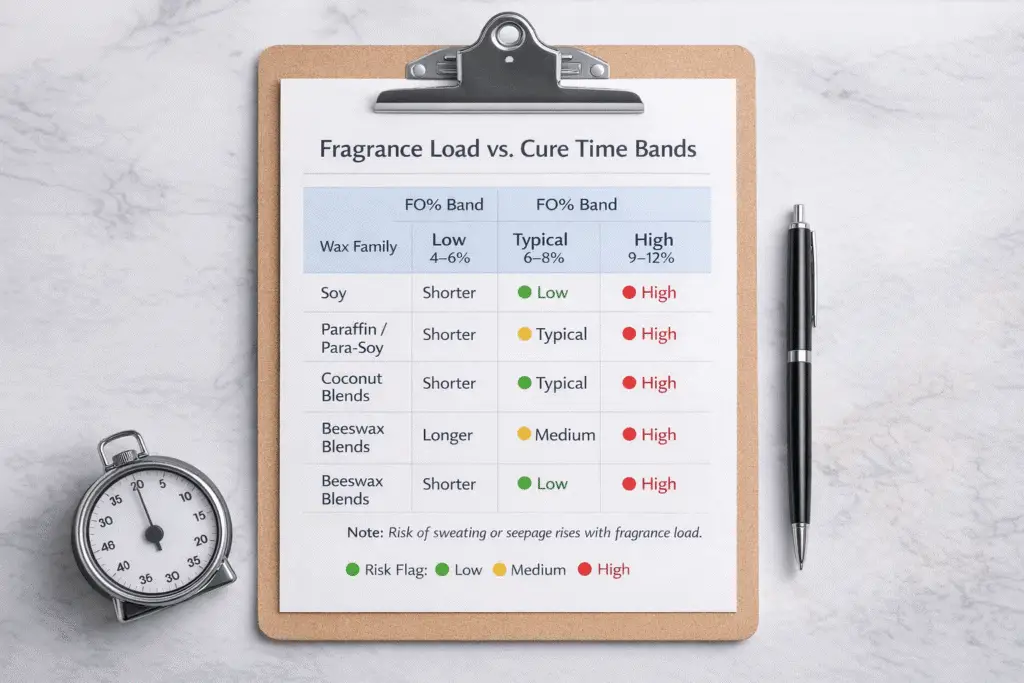
The wax itself still sets on the same broad schedule, but heavier fragrance systems are often easier to judge at the long end of that wax family’s normal range, especially in soy and coconut-rich blends.
Your first limit is still a safe fragrance oil percentage, not cure time. Keep the same wax-based framework, lean toward the longer end when the scent is heavy or complex, and revisit when to add fragrance by wax type before assuming cure time is the only variable.
Curing with the lid on or off? (pros, cons, when to use each)
You can cure candles with the lid on or off, but the safest default is to cool them fully with lids off and add the lid only after the jars reach room temperature.
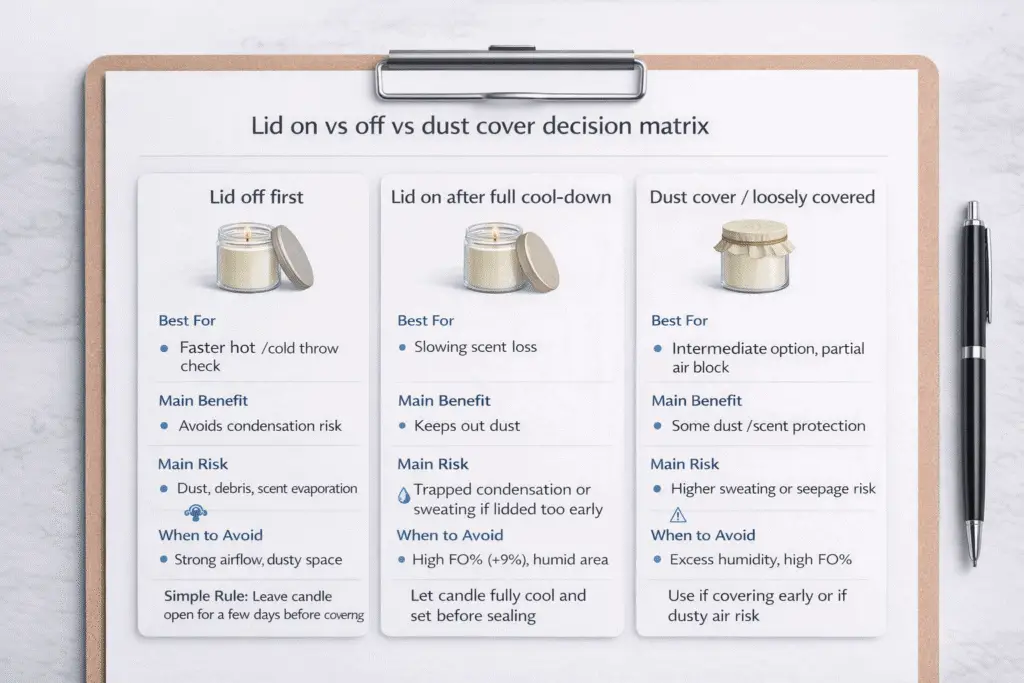
The timing matters more than the lid itself. Leaving lids off during cool-down lets heat escape and makes it easier to spot frosting, craters, or other surface issues before the candle is stored.
Once the candle is fully cool, the lid can help with dust protection and scent retention. If you want to test whether lid use changes results in your wax system, compare an open batch and a lidded batch at the same cure age instead of treating one approach as a fixed rule.
How to tell if a candle is fully cured (quick tests)
You can tell if a candle is fully cured by tracking its age, checking cold throw over time, and running a controlled burn at the point when that wax should be ready for final judgment.
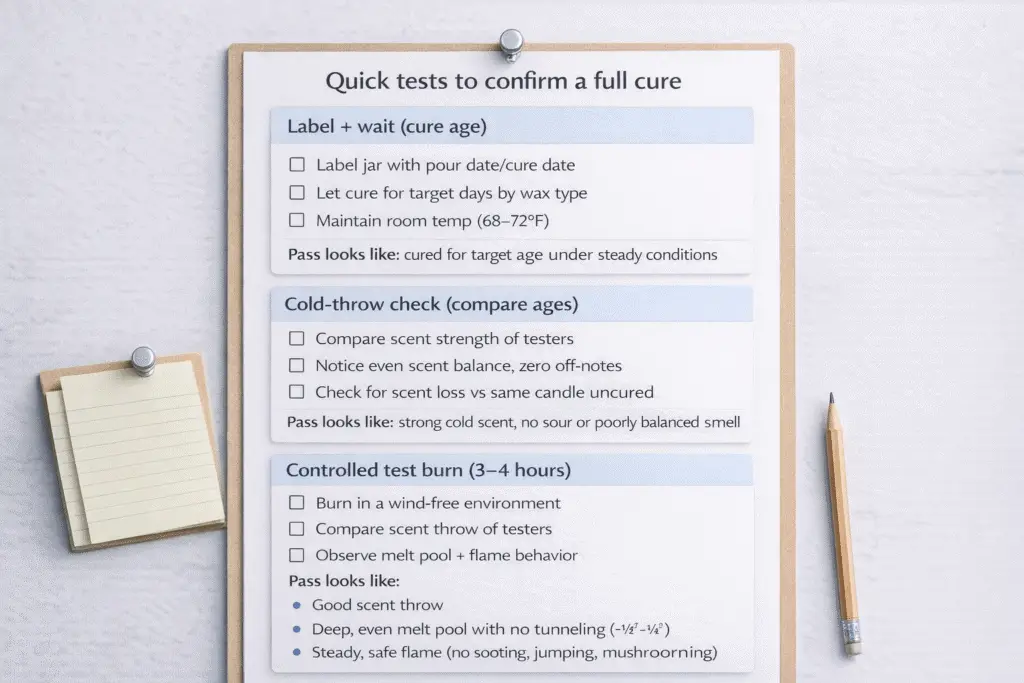
There is no single visual sign that proves a candle is cured. The better test is performance over time: a candle that throws weakly at 48 hours but normally at day 10 was not defective, just too young to judge.
Use this simple routine to avoid false conclusions:
Label and wait
- Mark the pour date and the age when that wax becomes fair to judge for final performance.
- Do early burns only for safety, wick behavior, and obvious defects.
Cold-throw check
- Smell the candle after the first 24–48 hours to establish a baseline.
- Repeat at the final-judgment age; if the scent is fuller or more balanced, the cure was still developing earlier.
Controlled test burn
- Burn in a normal-sized room for one consistent test session—often around 3–4 hours for container candles—watching flame behavior, melt pool, and hot throw.
- A well-cured candle should reach the expected melt pool and throw scent consistently through the session, but judge it against the normal cure age for that wax rather than one early burn alone.
Physical appearance is only a secondary clue. A firm top and no visible oil are helpful signs, but the most reliable answer still comes from tracking cure age and comparing repeatable test burns.
Quick cure-time FAQs
These support questions matter because they can change how you test, store, or interpret a batch, but they do not replace the wax-based cure windows above. Use them to refine your schedule, not to override the main framework.
Do essential oils change cure time?
Essential oils usually do not create a separate cure schedule. Start with the normal cure range for your wax family, then judge EO-heavy candles at the long end of that range because they often smell softer and change more between an early burn and a fully rested burn.
Wax type should set the baseline. Ingredient choice mainly affects how patient you need to be before deciding whether the throw is acceptable. For a full ingredient comparison, see essential oils vs fragrance oils for candles.
Can you speed up candle curing?
You cannot truly compress a normal cure into a fraction of the time. A stable room can improve consistency, but it cannot turn a 10–14 day soy cure into a reliable 2-day cure.
The better shortcut is controlled testing, not force-curing. Pour small test jars, keep them in steady conditions, and compare them at fixed ages such as 48 hours, day 7, and day 14.