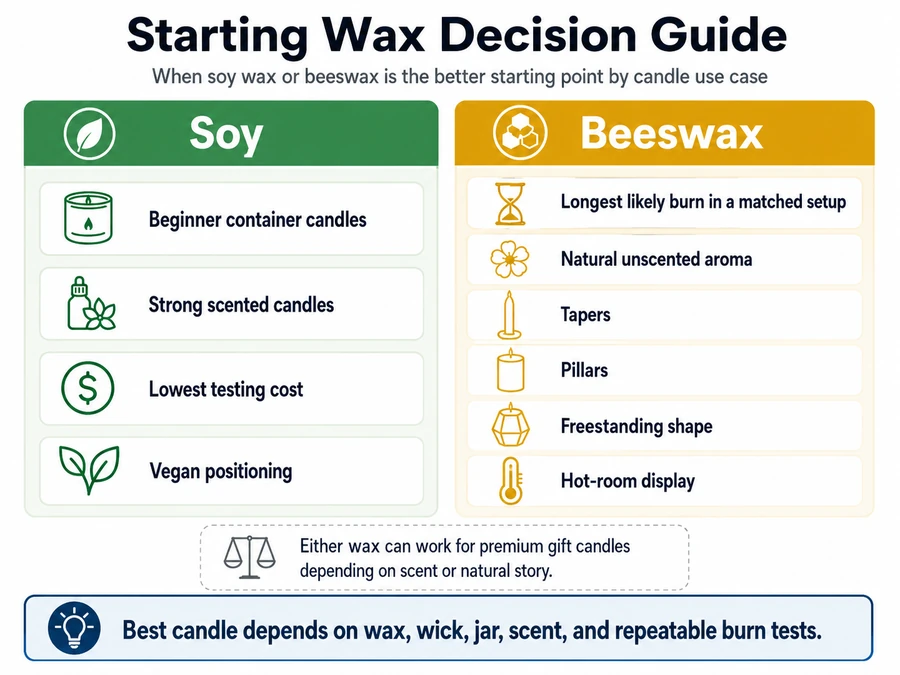
Soy wax and beeswax are candle waxes with different burn-time and quality trade-offs: beeswax often lasts longer, while soy often gives easier scent control, lower testing cost, and beginner-friendly container performance.
Soy wax and beeswax are candle waxes with different burn rates, hardness, natural aroma, and finish behavior.
This comparison is for candle makers choosing between soy and beeswax for burn time, soot, scent throw, melt pool stability, cost, and best use case.
“Better,” “cleaner,” and “longer-lasting” mean observable candle behavior under matched test conditions, not absolute health, safety, or eco claims.
Start with burn rate because wax used per hour explains why the same candle size can produce different burn hours. <!– META-DESCRIPTION: Soy vs beeswax burn time and quality compared by burn rate, clean burn, scent throw, melt pool, wick choice, cost, sustainability, and best candle use. –>
Quality in this comparison means visible candle performance: steady flame, controlled soot, stable melt pool, usable scent throw, acceptable finish, and repeatable burn testing. Best means best for the candle format, scent goal, cost target, and tested burn behavior, not best in every category.
| If the priority is… | Better starting choice | Why |
|---|---|---|
| Longest likely burn time | Beeswax | Harder wax often burns slower when wicked correctly |
| Strong added fragrance | Soy | A more neutral wax base makes fragrance easier to judge |
| Beginner container testing | Soy | Lower testing cost and easier sourcing reduce batch risk |
| Tapers or pillars | Beeswax | Better natural structure and heat tolerance |
| Vegan product line | Soy | Beeswax is an animal byproduct |
| Natural unscented aroma | Beeswax | The honey-like wax scent can be the main feature |
Burn time: soy vs beeswax (what to expect + what changes it)
Beeswax usually burns slower than soy in comparable setups, but wick, jar, fragrance load, and burn conditions can flip the result.
Burn rate means wax consumed per hour, written as grams per hour (g/hr). It is the fairest way to compare soy wax and beeswax because “same jar size” and “same wax weight” do not always mean the same flame heat, melt pool, or oxygen feed. Hours per ounce means burn time divided by wax weight; use it only when jar diameter, wick family, fragrance percentage, cure window, burn session length, and room conditions match.
| Comparison point | Soy wax | Beeswax | What can flip the result |
|---|---|---|---|
| Burn-time direction | Often faster | Often slower | Over-wicking, wide jars, drafts |
| Best fair metric | g/hr | g/hr | Same jar and wick family needed |
| Per-ounce estimate | 28.35 ÷ measured g/hr | 28.35 ÷ measured g/hr | Valid only after burn testing |
| Common fast-burn reason | Wick too large or hot melt pool | Wick too large for a hard wax | Wick fit can matter more than wax label |
Burn-log snippet to create your own g/hr dataset
| Wax type | Jar diameter | Wick | Wax mass | Fragrance load | Burn session | Wax lost | Burn rate |
|---|---|---|---|---|---|---|---|
| Soy | 3 in | Same wick family, size A | 200 g | 6% | 2 hr | record g | wax lost ÷ 2 |
| Beeswax | 3 in | Same wick family, size A | 200 g | 6% | 2 hr | record g | wax lost ÷ 2 |
| Soy | 3 in | Same wick family, size B | 200 g | 6% | 2 hr | record g | wax lost ÷ 2 |
| Beeswax | 3 in | Same wick family, size B | 200 g | 6% | 2 hr | record g | wax lost ÷ 2 |
Methods box: Test soy wax and beeswax in the same jar diameter, wax mass, wick family, fragrance load, room placement, and burn-session length. Weigh each cooled candle before and after every session, then divide wax lost by burn hours. Treat ASTM F2417 as a safety-framing authority for normal candle use, not as permission for unsafe long burns.
What changes burn time most:
- Wick size and wick family: a hotter wick can make either wax burn fast.
- Jar diameter: wider jars need more heat to reach the edge, which can raise wax use.
- Fragrance and dye load: additives can change flame size, soot, and melt behavior.
- Burn session length: short sessions can tunnel; long sessions can overheat the melt pool.
- Room conditions: drafts can disturb the flame and raise soot or uneven burning.
Cure time: when to test for fair soy vs beeswax results
Test soy and beeswax only after both candles have stabilized enough for the wax, wick, and fragrance to behave consistently. Use the same cure rule for the comparison rather than testing one candle fresh and the other later. On pour day, record wax, wick, jar, fragrance percentage, pour notes, and room temperature. On the first test day, burn both candles under the same schedule and log g/hr, flame behavior, soot, and melt pool. On the retest day, repeat the same schedule to see whether scent stability, wick behavior, or melt pool depth changed.
Clean burn quality: soot/smoke, jar residue, mushrooming (and fixes)
Clean burn means low visible soot, steady flame, limited smoke, and light residue, not a blanket health claim about the wax.
For soy wax and beeswax, clean burn depends more on wick fit, airflow, fragrance load, and burn habits than the wax label alone. A good comparison watches visible signs: black rim on glass, smoky relight, high flame, carbon ball at the wick tip, and dark particles in the melt pool. The National Candle Association’s wick-trimming and draft-avoidance guidance supports this type of low-smoke burn routine.
| Symptom | Likely cause | Safer first fix |
|---|---|---|
| Black soot on jar rim | Wick too large, draft, or high fragrance load | Trim wick, move from draft, test one wick size down |
| Smoke while burning | Flame too tall or unstable air flow | Extinguish, cool, trim, retest in still air |
| Mushrooming wick | Wick/fragrance mismatch or long session | Trim before relighting; compare a different wick series |
| Smoky relight | Carbon left on wick tip | Trim charred tip before lighting |
| Fast wax loss plus soot | Over-wicked candle | Wick down in the next test batch |
| Tunneling with little soot | Under-wicked candle or short sessions | Retest with proper session length, then wick up only if needed |
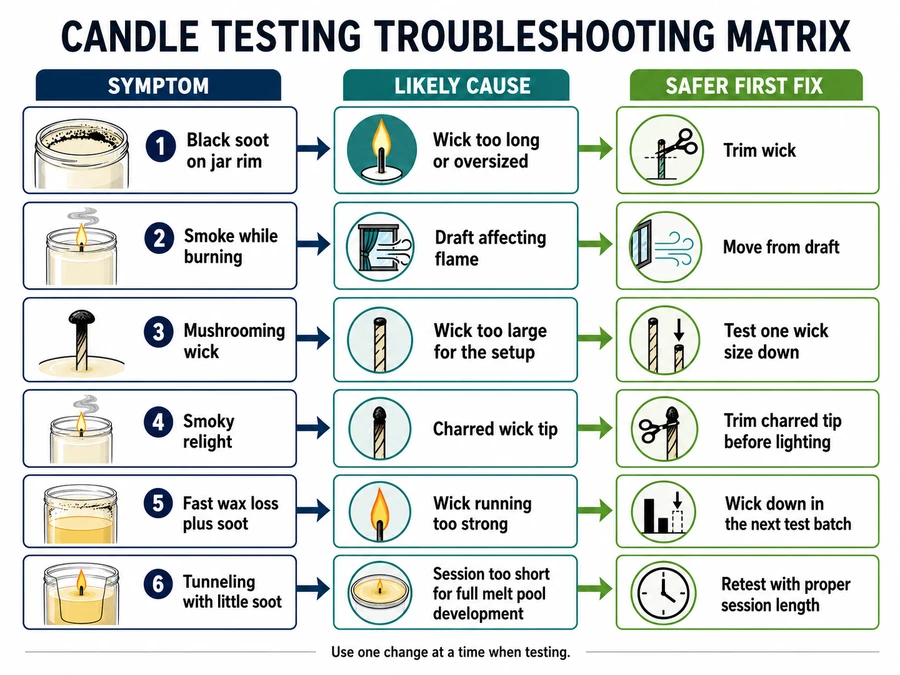
Methods box: Check clean burn after each cooled session, not while the candle is still hot and moving. Record flame height behavior, soot rim, mushrooming, draft exposure, wick trim state, and fragrance load. Use ASTM F2058 as safety-labeling framing, but keep “clean burn” here limited to visible burn behavior rather than health outcomes.
Soy can look clean in one jar and smoky in another if the wick is oversized. Beeswax can burn neatly in a taper but smoke in a container if the wick is too large for the melt pool. The right fix is a controlled retest, not switching wax before checking wick, draft, fragrance, and burn length.
Sensitivities & indoor air: reducing smoke, fragrance irritation
If smoke or scent feels irritating, reduce visible smoke and strong fragrance exposure before treating wax type as the solution.
Soy wax and beeswax can both feel unpleasant in a small room if the flame is too tall, the wick is carbon-heavy, the candle sits in a draft, or the fragrance load feels strong. This comparison can describe visible smoke and fragrance strength only; it should not diagnose health reactions or rank waxes for medical safety. Neither wax should be described as “safe for allergies” or “non-toxic” in this comparison. The safer claim is narrower: a tuned wick, trimmed relight, still-air placement, and lower-scent or unscented formula can reduce common discomfort triggers.
| Step | What to do | Why it helps |
|---|---|---|
| Trim before relighting | Remove the carbon-heavy wick tip | Reduces smoky relight and flame flare |
| Move out of drafts | Keep away from fans, vents, and open windows | Helps the flame stay steady |
| Shorten test sessions | Stop if the flame gets tall, smoky, or unstable | Prevents a bad setup from running hotter |
| Lower scent strength next batch | Reduce fragrance load or change fragrance | Strong scent can feel harsh before the wax is the issue |
| Try unscented | Compare wax behavior without fragrance | Separates wax burn quality from fragrance response |
IFRA Standards apply to fragrance materials and finished consumer-product fragrance mixtures. Use supplier IFRA documentation when changing fragrance type or load.
If discomfort continues, reduce scent load first, switch fragrance second, try unscented third, then retest the wick and jar setup. Stop burning during the test if the flame is repeatedly high, smoky, flickering hard, or heating the container in a way that feels unsafe.
Melt pool & defects: tunneling vs overheating (soy vs beeswax)
A stable melt pool shows balanced wick, wax, and jar behavior; tunneling points to low heat, while overheating points to excess heat.
A melt pool is the liquid wax area around the wick during a burn. In a fair soy vs beeswax comparison, the goal is not melting everything as fast as possible. The goal is a steady flame, controlled wax use, and a melt pool that expands without leaving a deep tunnel or overheating the container. Soy may reach a soft pool more easily in some containers; beeswax may need more careful wick matching because it is harder.
| Check point | What to record | What it means |
|---|---|---|
| Hour 1 | Flame height, melt pool width, soot, jar warmth | Early sign of under-wicking or over-wicking |
| Hour 2 | Edge progress, glass hang-up, mushrooming | Shows whether the pool is expanding evenly |
| Hour 3 | Pool stability, heat feel, wax loss pattern | Confirms whether the setup is controlled or too hot |
Glass hang-up means unmelted wax left on the inside wall of the jar. A little edge wax early in the burn can be normal, but a deep tunnel that persists across sessions usually means the candle is under-wicked, burned too briefly, or built in a jar/wax pairing that needs a different wick series.
Fix sequence without creating soot
- Confirm the candle was burned long enough to test the melt pool, not just briefly lit.
- Trim and relight only after the wax cools and the wick is stable.
- Retest in still air, away from fans and vents.
- If it tunnels again, test the next wick size or a different wick family in a new batch.
- If it reaches the edge too fast, smokes, mushrooms, or heats the container aggressively, wick down in the next batch.
Methods box: Test one variable at a time: wax type, jar diameter, wick, fragrance load, or burn schedule. Keep the same room placement and record the melt pool at hour 1, hour 2, and hour 3. Do not use unsafe long burns to force a full melt pool; if the candle behaves badly, end the test and adjust the next sample.
Melt pool quality connects burn time with scent throw because the same heat pattern that prevents tunneling also controls wax consumption and fragrance release.
Scent throw: when soy wins vs beeswax and why
Soy often gives a more neutral fragrance base, while beeswax adds its own honey-like aroma that can soften or compete with added scent.
Cold throw means how a candle smells before lighting. Hot throw means how it smells while burning. Soy wax can work well for fragrance-forward container candles because it has a milder base odor. Beeswax can smell beautiful unscented, but its natural aroma may change how floral, bakery, citrus, or clean fragrances read in the room.
| Scent factor | Soy wax | Beeswax | Best decision |
|---|---|---|---|
| Natural wax aroma | Mild to neutral | Sweet, honey-like, sometimes earthy | Choose soy for cleaner fragrance expression |
| Unscented appeal | Lower natural scent | Stronger natural scent | Choose beeswax when the wax aroma is the feature |
| Hot throw control | Easier to judge fragrance alone | Harder to separate wax aroma from fragrance | Test beeswax unscented first |
| Fragrance load | Set by wax and fragrance supplier limits | Set by wax and fragrance supplier limits | Follow the lower safe limit |
| Burn behavior effect | Poor wick fit can mute scent | Poor wick fit can mute scent | Fix melt pool and wick before judging scent |
Fragrance load should not be raised just because a test candle smells weak. Use IFRA and supplier documentation when setting fragrance limits, and treat the finished candle’s flame behavior as part of the scent test.
Scent test protocol
- Make one soy and one beeswax candle in the same jar size.
- Use the same wick family, fragrance oil, fragrance percentage, and dye choice.
- Keep one unscented beeswax control so the natural wax aroma is clear.
- Smell cold throw before lighting, then test hot throw after the melt pool is stable.
- Record scent strength, scent character, wick behavior, soot, and wax lost per hour.
- Change one variable per retest: wick, fragrance percentage, fragrance type, or wax blend.
Weak hot throw can come from a poor melt pool, an under-wicked candle, fragrance mismatch, or too much natural beeswax aroma for that scent family. Strong scent with soot or a tall flame is not a win; it is a formulation warning. A good soy or beeswax scent test balances fragrance character, flame behavior, wax use, and clean jar walls.
Appearance & finish: soy frosting vs beeswax bloom/color
Soy tends to show frosting or rougher jar surfaces, while beeswax can show bloom, deeper color, and natural surface variation.
Frosting is a pale, crystal-like pattern often seen on soy wax. Bloom is a whitish film that can appear on beeswax. Neither surface condition automatically means the candle is unsafe or failed. The real question is whether the finish affects selling quality, scent consistency, unmolding, or the maker’s target look.
| Finish issue | More common in | What it looks like | What to adjust |
|---|---|---|---|
| Frosting | Soy | Pale crystal pattern or cloudy patches | Pour temperature, cooling rate, dye load, wax blend |
| Wet spots | Soy container candles | Patchy glass adhesion | Jar temperature, cooling speed, wax blend |
| Bloom | Beeswax | White surface haze | Gentle buffing, storage, wax source |
| Color variation | Beeswax | Yellow to golden to darker tones | Batch selection and supplier consistency |
| Rough tops | Both | Uneven or pitted surface | Pour temperature, cooling, heat correction |
For gift candles or retail candles, soy usually needs more finish control because frosting can stand out in dyed jars. Beeswax often looks natural and premium when the buyer expects golden tones, but its color can vary between batches. White beeswax can reduce color variation, yet it may not give the same natural look as yellow beeswax.
Finish control checklist
- Photograph each batch after cooling and again after storage.
- Log wax batch, pour temperature, jar temperature, dye, fragrance load, and room temperature.
- Compare dyed and undyed samples before blaming the wax.
- Store finished candles away from heat swings and direct sun.
- Decide whether the finish is a defect or part of the product style before reformulating.
Appearance should not overrule burn safety. A smooth top with a smoking wick is a worse candle than a lightly frosted soy candle that burns evenly, holds scent well, and leaves little residue.
Heat tolerance & safety: melt point, hot rooms, summer performance
Beeswax is usually harder and more heat-tolerant than soy, but candle type and wax blend decide the real winner.
Soy wax often softens sooner than beeswax, which is why many soy formulas are used in containers rather than freestanding pillars. Beeswax usually holds shape better in warm rooms, tapers, and pillars, but it still needs matched wick testing. A higher melt point does not make a candle automatically safer because poor wick fit can still overheat the jar, raise soot, or create an unstable flame.
| Heat factor | Soy wax | Beeswax | Practical outcome |
|---|---|---|---|
| Hot-room softness | More likely to soften | Holds shape better | Beeswax has an edge for warmer display areas |
| Summer shipping | Needs more care, especially soft blends | More stable, but not heat-proof | Test packaging before selling |
| Container candles | Strong fit | Works, but needs careful wick matching | Soy is easier for many beginners |
| Pillars and tapers | Needs a harder blend | Strong natural fit | Beeswax usually wins for structure |
| Overheated candle risk | Possible with bad wick fit | Possible with bad wick fit | Melt point does not replace burn testing |
Hot-room test before selling or gifting
- Place a finished soy and beeswax candle in the same warm room.
- Check sweating, slumping, frosting, bloom, lid staining, and scent bleed.
- Move each candle through a short warm/cool cycle.
- Burn-test only after the candle returns to room temperature.
- Reject any setup that sweats badly, deforms, or burns hotter after heat exposure.
Methods box: Use matched storage and burn conditions for both waxes. Record warm-room appearance, jar feel during burning, flame stability, soot, and wax loss. Do not invent a “safe jar temperature” threshold; stop testing any candle that appears unstable, overheated, smoky, or unsafe.
For hot rooms, beeswax is usually the stronger structural choice. For container candles with strong scent goals, soy can still win if the jar, wick, and fragrance load stay stable after heat testing.
Wick selection differences: how to choose a starting wick for each wax
Beeswax often needs a stronger wick than soy, but the right starting wick depends on jar width, wax hardness, and fragrance load.
This section only compares how wick choice changes soy-vs-beeswax testing; it is not a full wick-size chart.
A wick series is a wick family with shared braid, coating, and burn behavior. Do not compare soy and beeswax by dropping the same random wick into both. Start with the same jar diameter, test nearby wick sizes, and judge the result by melt pool, soot, flame height, mushrooming, and wax lost per hour.
| Candle setup | Soy starting point | Beeswax starting point | What to watch |
|---|---|---|---|
| Small container | Medium heat wick from supplier chart | One step hotter or different series | Tunneling vs soot |
| Wide container | Larger size within same series | Hotter series may be needed | Edge reach and jar heat |
| Pillar | Hard-soy or pillar-blend chart | Beeswax taper/pillar chart | Drip, lean, flame height |
| High fragrance load | Retest from baseline | Retest from baseline | Mushrooming and soot |
| Unscented test | Best first control | Best first control | True wax behavior |
The National Candle Association recommends trimming the wick to about 1/4 inch before use and keeping candles away from drafts. Both habits affect high flames and soot.
Starting-wick test plan
- Pick one jar diameter and one wax weight.
- Make an unscented soy control and an unscented beeswax control.
- Test three nearby wick sizes for each wax.
- Record flame height, melt pool width, soot, mushrooming, jar warmth, and g/hr.
- Add fragrance only after the unscented burn pattern is acceptable.
- Retest because fragrance can change flame behavior.
Methods box: Use supplier wick charts only as a starting point. Keep jar, wax mass, burn schedule, room placement, and fragrance load stable while changing one wick variable at a time. Stop a test setup that smokes, mushrooms heavily, overheats the jar, or burns wax too fast.
A wick is too small when the candle tunnels, leaves heavy wall wax, or fails to build a stable melt pool. A wick is too large when the flame gets tall, the jar darkens with soot, the wick mushrooms heavily, or the wax disappears too fast. Good wick selection turns the soy vs beeswax comparison from a guess into a controlled burn result.
Cost & value: price per lb + cost per burn hour (soy vs beeswax)
Soy often looks cheaper by wax weight, while beeswax can narrow the gap if it burns slower in the same candle setup.
Wax price alone does not tell the value story. The better comparison is cost per burn hour, which means the total wax cost in one candle divided by measured burn hours. Beeswax may cost more per lb, but a slower g/hr result can make the usable-hour gap smaller than the shelf price suggests.
| Value factor | Soy wax | Beeswax | What to compare |
|---|---|---|---|
| Wax price | Often lower | Often higher | Your supplier price per lb or kg |
| Burn rate | Often faster | Often slower | Measured g/hr in the same jar |
| Scent cost | Can carry added fragrance well | May need less scent if sold unscented | Fragrance cost per candle |
| Wick cost | Similar starting cost | May need different wick series | Test-pack cost, not single wick price |
| Selling angle | Scented container candles | Natural, premium, tapers, pillars | Buyer expectation and margin |
Use this formula:
Cost per burn hour = total candle input cost ÷ tested burn hours
For wax-only math:
Wax cost per candle = wax weight used × wax cost per gram
Wax cost per burn hour = wax cost per candle ÷ tested burn hours
Example with editable assumptions:
| Input | Soy candle | Beeswax candle |
|---|---|---|
| Wax used | 200 g | 200 g |
| Wax cost | 0.02 per g | 0.06 per g |
| Wax cost per candle | 4.00 | 12.00 |
| Tested burn time | 40 hr | 60 hr |
| Wax cost per burn hour | 0.10 | 0.20 |
In this example, beeswax still costs more per burn hour, but not three times more because it lasts longer. If your beeswax candle burns only slightly longer, the value gap widens. If it burns much longer and supports a higher retail price, the margin may still work.
Methods box: Treat all prices as editable assumptions. Add jar, wick, fragrance, label, packaging, failed test batches, and shipping damage risk before choosing a production wax. Do not use supplier price alone as the value metric because burn quality and tested hours change the real result.
Do not decide value from wax price alone. A cheap candle that tunnels, smokes, or overheats is not a good-value candle, even if the cost-per-hour number looks attractive.
Burn-time + Cost-per-hour Estimators
A burn-time estimator turns soy vs beeswax from a vague comparison into a repeatable cost and performance check.
This tool uses measured burn rate, not seller claims. Enter the wax mass, wax price, and tested g/hr for each sample. The estimate works best after at least three controlled burn sessions per wax and wick setup.
| Input | Unit | How to get it | Typical mistake |
|---|---|---|---|
| Wax type | soy or beeswax | Label each test candle | Comparing a soy blend against pure beeswax without noting it |
| Jar diameter | inches or mm | Measure inside diameter | Changing jar size between waxes |
| Wax mass | g | Weigh wax poured into the candle | Using jar fill weight instead of wax weight |
| Wax price | per g, lb, or kg | Convert supplier price to one unit | Mixing units |
| Fragrance load | % | Fragrance weight ÷ wax weight × 100 | Raising scent before fixing wick fit |
| Burn rate | g/hr | Wax lost ÷ burn hours | Measuring while wax is still hot or spilled |
| Tested burn hours | hr | Wax mass ÷ g/hr | Using label promises instead of test results |
Estimator 1: Burn time
Estimated burn time = wax mass ÷ burn rate
Worked example:
| Wax | Wax mass | Tested burn rate | Estimated burn time |
|---|---|---|---|
| Soy | 200 g | 5 g/hr | 40 hr |
| Beeswax | 200 g | 3.5 g/hr | 57.1 hr |
Estimator 2: Cost per burn hour
Wax cost per candle = wax mass × wax cost per gram
Wax cost per burn hour = wax cost per candle ÷ estimated burn time
Worked example:
| Wax | Wax mass | Wax cost per g | Wax cost per candle | Estimated burn time | Wax cost per burn hour |
|---|---|---|---|---|---|
| Soy | 200 g | 0.02 | 4.00 | 40 hr | 0.10 |
| Beeswax | 200 g | 0.06 | 12.00 | 57.1 hr | 0.21 |
How to read the result
| Result pattern | Meaning | Next decision |
|---|---|---|
| Beeswax costs more and only burns slightly longer | Premium value must come from natural aroma, structure, or brand fit | Use beeswax for candles where those traits matter |
| Beeswax costs more but burns much longer | Higher input cost may be partly offset by longer use | Test retail pricing and buyer fit |
| Soy costs less and burns cleanly | Strong fit for scented container candles | Keep testing scent throw and finish |
| Soy burns too fast | Wick or jar may be wrong before the wax is wrong | Wick down or test a narrower jar |
| Either wax has low cost but poor burn quality | The setup is not production-ready | Fix safety and quality before pricing |
Methods-style disclaimer: These estimates are planning numbers, not guarantees. Validate them with cooled weigh-ins, matched burn sessions, stable room placement, and repeat tests before using the result for labels, product pages, or pricing.
Keep the calculator tied to real burn logs. A low-cost candle that tunnels, smokes, or overheats is not ready for production.
Sustainability & ethics: sourcing trade-offs (vegan fit, local vs imported)
Soy is plant-based and vegan when additives fit, while beeswax is an animal byproduct; the better ethical choice depends on sourcing and buyer values.
Soy wax and beeswax should not be compared with blanket eco claims. Soy can fit vegan candles and repeatable container production, but soybean farming varies by region and supply chain. Beeswax can support beekeepers and use a hive byproduct, but it is not vegan and may cost more because supply is smaller.
| Factor | Soy wax | Beeswax | Best fit |
|---|---|---|---|
| Vegan fit | Yes, when no animal-derived additives are used | No | Soy |
| Natural aroma | Mild | Naturally honey-like | Beeswax |
| Local sourcing | Depends on supplier | Often possible from local beekeepers | Beeswax, if local supply is available |
| Large batch consistency | Often easier | Can vary by beekeeper, season, and filtering | Soy |
| Premium positioning | Works for clean, scented container lines | Works for natural, unscented, taper, and gift candles | Depends on product story |
| Buyer objection risk | Soy sourcing concerns | Animal-product concern | Depends on audience |
A values-based wax choice should state the trade-off clearly. Soy is the better fit when the candle must be vegan, scent-neutral, and repeatable across batches. Beeswax is the better fit when the candle’s natural aroma, hardness, long burn potential, and beekeeper-sourced story matter more than vegan positioning.
Sourcing checklist
- Ask whether the wax is pure or blended.
- Confirm whether additives are plant-based, animal-derived, or synthetic.
- Request supplier batch information when selling repeat products.
- Compare local availability against shipping distance and cost.
- Match the wax story to the buyer’s actual reason for purchasing.
Methods box: Treat sustainability as evidence-based sourcing, not a universal wax ranking. Evidence can include supplier origin notes, batch documentation, additive disclosures, certification claims only when documented, shipping distance, waste rate from failed batches, and buyer fit.
Sustainability is not only the wax. A soy candle with heavy packaging, poor burn quality, and high failure waste may not be the better choice. A beeswax candle shipped far, priced beyond the target buyer, or sold to a vegan audience may not fit either.
Best use cases: container vs pillar/taper, beginners vs pros
Soy is usually better for scented container candles, while beeswax is usually better for tapers, pillars, natural aroma, and heat tolerance.
The best wax depends on candle type, not just burn time. Soy often suits beginners because it is widely available, usually lower cost, and forgiving in jars. Beeswax suits makers who want structure, a naturally sweet scent, long-burn positioning, or freestanding candle forms.
| Use case | Better starting wax | Why |
|---|---|---|
| Beginner container candles | Soy | Easier sourcing, lower test cost, neutral scent base |
| Strong scented candles | Soy | Added fragrance is easier to judge without a strong wax aroma |
| Unscented natural candles | Beeswax | Natural honey-like scent can be the main feature |
| Tapers | Beeswax | Hardness and structure fit the format well |
| Pillars | Beeswax or hard wax blend | Better shape stability than soft container soy |
| Hot-room display | Beeswax | Higher heat tolerance helps structure |
| Vegan product line | Soy | Beeswax does not fit vegan positioning |
| Premium gift candle | Either | Soy can win on scent; beeswax can win on natural story |
Winner-by-scenario
| If you want… | Choose… | Watch for… |
|---|---|---|
| Longest likely burn in a matched setup | Beeswax | Higher wax cost and wick matching |
| Best scent control | Soy | Frosting, cure time, and fragrance load |
| Lowest testing cost | Soy | Cheap wax still needs proper burn tests |
| Natural unscented aroma | Beeswax | Batch color and bloom |
| Vegan positioning | Soy | Additive and fragrance sourcing |
| Freestanding shape | Beeswax | Drip control and wick fit |
Methods box: Tie the wax choice to the candle format, buyer priority, and must-test variable. For containers, test jar diameter, wick, scent, soot, and g/hr. For pillars or tapers, test shape stability, drip behavior, flame height, scent choice, and storage heat.
For most beginners, start with soy container candles because the testing cost is lower and the scent result is easier to read. For makers selling natural tapers, premium unscented candles, or heat-stable gift candles, beeswax is often the stronger starting point.
The fairest final answer is this: beeswax often wins on burn time, hardness, and natural aroma; soy often wins on cost, scent neutrality, and beginner-friendly container testing. The best candle is the wax, wick, jar, scent, and burn schedule that perform together under repeatable tests.